
Betrag (Absolutbetrag)
Der Abstand einer Zahl vom Nullpunkt auf der Zahlengerade wird als Betrag dieser Zahl bezeichnet.
\[ |a| = \begin{cases} a & \text{, wenn } a \geq 0 \\ -a & \text{, wenn } a < 0 \end{cases} \]
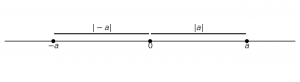
Beispiel:
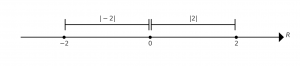
$$ |2| = 2 \quad, \text{ da } 2 > 0 $$
$$|-2| =- (- 2) \quad, \text{ da } -2 < 0 $$
Hinweis:
Der Betrag und Wurzelausdrücke mit geradem Wurzelexponenten können keine negativen Werte annehmen.
$$ \sqrt[2n]{ a^{2n} } = |a | \geq 0 \quad (n \in Z^+)$$
$$ |x | \geq 0, \; \sqrt{ x} \geq 0, \; \sqrt[4]{x} \cdots \text{ usw.} $$
Beispiele:
\( \bullet \quad \text{Wenn } a<b, \text{ dann } a-b<0, \text{ daher } | a-b| = – (a-b) = b-a \)
\( \bullet \quad \text{Wenn } a<b< 0, \text{ dann } a+b<0, \text{ daher } | a+b| = – (a+b) =-a-b \)
\( \bullet \quad \text{Da } |x| + 2 > 0, \text{ gilt } |\;|x|\;+\; 2 | = |x|\;+ \;2 \)
Eigenschaften des Betrags:
\( 1). \; | \;a\;| = | \;-a\; | \quad ( \;| \;a\;-\;b\; | = | \;b\;- \;a\; | \;) \)
\( 2). \; | \;a\; \cdot b\;| = | \;a\; | \cdot | \;b\; | \)
\( 3). \; \large{\left| \frac{a}{b} \right| = \frac{|a|}{|b|} } \quad b\neq0 \)
\( 4). \; \left| \; a^n\; \right| = \left| \; a \; \right|^n\)
\( 5). \; \sqrt[2n]{a^{2n} } = \left| \; a\; \right| \quad n \in Z^+\)
\( 6). \; \left| a \; \pm\; b \;\right| \leq \left| \; a\; \right| + \left| \; b\; \right| \)
Frage 1
\[ \text{Wenn } a < 0 < b, \text{ was ist das Ergebnis von } | a-b | – | a | + | b |? \]
\[
\text{A) } a \quad
\text{B) } 2a \quad
\text{C) } 0 \quad
\text{D) } b \quad
\text{E) } 2b
\]
Lösung:
Da \( a < b \) ist, gilt \( a – b < 0 \). Daher ist \( |a – b | = – ( a – b) = -a + b \).
Da \( a < 0 \) ist, ist \( |a | = -a \). Da \( b > 0 \) ist, ist \( |b | = b \). Daraus folgt:
$$ |a – b | – |a | + |b | = -a + b – (-a) + b = 2b $$
\(\textbf{Antwort: E} \)
Frage 2
\[ \text{Wenn } a = 2\sqrt{2} – 3, \text{ was ist das Ergebnis von } \frac{\sqrt[4]{ a^4} + \sqrt[3]{ (-a)^3} }{\sqrt[3]{ a^3} } – a – 1? \]
\[
\text{A) } 0 \quad
\text{B) } -1 \quad
\text{C) } 1 \quad
\text{D) } -2 \sqrt{2} \quad
\text{E) } 2 \sqrt{2}
\]
Lösung:
$$ \frac{\sqrt[4]{ a^4} + \sqrt[3]{ (-a)^3} }{\sqrt[3]{ a^3} } – a – 1 = \frac{ |a | – a }{a} – a – 1 $$
$$ \text{Da } a = 2\sqrt{2} – 3 < 0 \text{ ist, gilt } |a | = -a $$
$$ = \frac{ -a – a}{a} – a – 1 $$
$$ = -2 – a – 1 $$
$$ = -2 – (2\sqrt{2} – 3) – 1 $$
$$ = -2\sqrt{2} $$
\(\textbf{Antwort: D} \)
Frage 3
\[ \text{Wenn } a < b < 0, \text{ was ist das Ergebnis von } | a + | a + b | | – |a| + b? \]
\[
\text{A) } a \quad
\text{B) } -a \quad
\text{C) } b \quad
\text{D) } -b \quad
\text{E) } 0
\]
Lösung:
Da \( a < 0 \) ist, gilt \( | a | = -a \).
Da \( a < 0 \) und \( b < 0 \) ist, gilt \( a + b < 0 \). Daher:
$$ |a + b | = – (a + b) = -a – b. \text{ Daraus folgt: } $$
$$ |a + |a + b| | – |a| + b = | a – a – b| – (-a) + b $$
$$ = |-b | + a + b $$
Wenn \( b < 0 \) ist, ist \( -b > 0 \), daher gilt \( |-b | = -b \). Somit: \( -b + a + b = a \).
\(\textbf{Antwort: A} \)
Frage 4
\[ \text{Für } x \neq 1, x \leq -\frac{1}{2}, \text{ was ist das Ergebnis von } \frac{\sqrt{ 4x^2 + 4x + 1} + x }{-1 + \sqrt{ x^2} }? \]
\[
\text{A) } -x \quad
\text{B) } x \quad
\text{C) } -1 \quad
\text{D) } 1 \quad
\text{E) } 2
\]
Lösung:
$$ \frac{\sqrt{ 4x^2 + 4x + 1} + x }{-1 + \sqrt{ x^2} } = \frac{ \sqrt{ (2x + 1)^2} + x }{-1 + |x |} $$
$$ = \frac{| 2x + 1 | + x }{-1 + | x|} $$
$$ \text{Da } 2x + 1 < 0 \text{ für } x < -\frac{1}{2} \text{ ist: } $$
$$ = \frac{-(2x + 1) + x }{-1 + (-x)} $$
$$ = \frac{-2x – 1 + x }{ -1 – x } = 1 $$
\(\textbf{Antwort: D} \)
Frage 5
\[ \text{Wenn } a < | a | \text{ und } b < a \text{ ist, was ist das Ergebnis von } \frac{\sqrt[7]{ a^7} }{a} + \frac{\sqrt[4]{ b^4} }{b} – \frac{\sqrt{ a^3 b} }{ab}? \]
\[
\text{A) } 1 \quad
\text{B) } 0 \quad
\text{C) } -1 \quad
\text{D) } -a \quad
\text{E) } a
\]
Lösung:
Da \( a < |a | \), ist \( a < 0 \). Da \( b < a \), ist auch \( b < 0 \).
$$ \frac{\sqrt[7]{ a^7} }{a} + \frac{\sqrt[4]{ b^4} }{b} – \frac{\sqrt{ a^3 b} }{ab} $$
$$ = \frac{a}{a} + \frac{|b|}{b} – \dots = 1 + \frac{-b}{b} – |a| $$
$$ = 1 – 1 – (-a) = a $$
\(\textbf{Antwort: E} \)
Frage 6
\[ \text{Wenn } A = 7 + \frac{ | a| + |b | }{|a-b|} \text{ ist, was ist der kleinste Wert von A?} \]
\[
\text{A) } 7 \quad
\text{B) } 8 \quad
\text{C) } 9 \quad
\text{D) } 10 \quad
\text{E) } 11
\]
Lösung:
$$ | a – b| \leq |a | + |b | \Rightarrow \frac{|a – b|}{|a – b|} \leq \frac{|a | + |b |}{|a – b|} $$
$$ \Rightarrow 1 \leq \frac{|a | + |b |}{| a – b |} $$
Da der kleinste Wert des Bruches 1 ist, ergibt sich für A als kleinster Wert:
$$ 7 + 1 = 8 $$
\(\textbf{Antwort: B} \)
← Vorherige Seite | Nächste Seite →