
Direct Variation
Two quantities are said to be directly proportional (or vary directly) if an increase in one quantity results in a proportional increase in the other, or if a decrease in one results in a proportional decrease in the other. The ratio between two directly proportional quantities is always constant.
If y varies directly with x, then:
\[\frac{y}{x} = k \quad \text{or} \quad y = k \cdot x \]
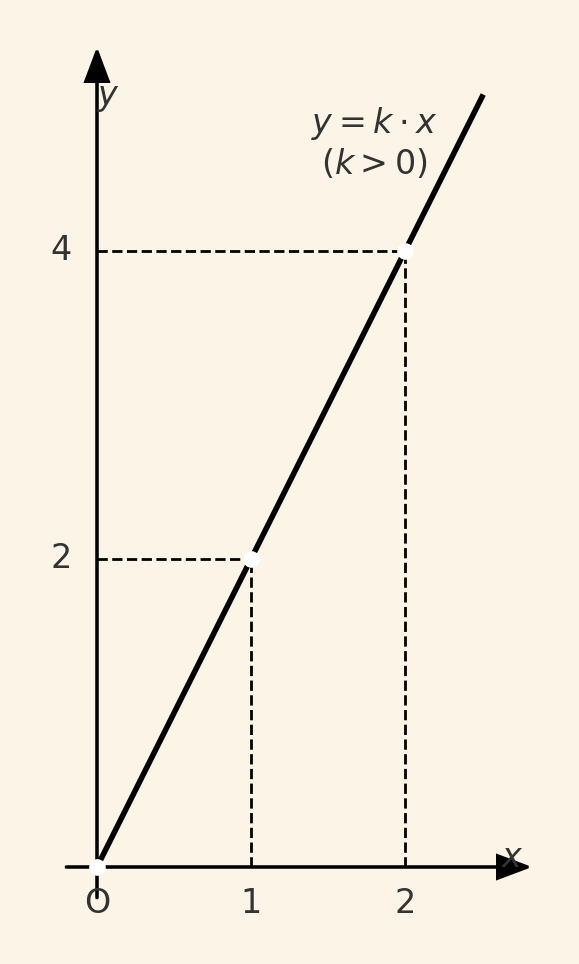
\[ \frac{y}{x} = k \Rightarrow \frac{2}{1} = \frac{4}{2} = k \]
\[ k = 2 \]
Example:
Let \( y = x + 50 \):
For \( x = 15 \), we get \( y = 65 \)
For \( x = 30 \), we get \( y = 80 \)
In this case, when x doubles, y does not double. Therefore, y does not vary directly with x.
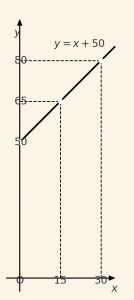
\[ \frac{65}{15} \neq \frac{80}{30} \quad \text{(The ratios are not constant)} \]
← Previous Page | Next Page →