
Inverse Proportion
Two quantities are said to be inversely proportional (or vary inversely) if an increase in one quantity results in a proportional decrease in the other, or if a decrease in one results in a proportional increase in the other.
The product of two inversely proportional quantities is always constant. If \(y\) varies inversely with \(x\), then:
\[ y \cdot x = k \quad \text{or} \quad y= \frac{k}{ x } \]
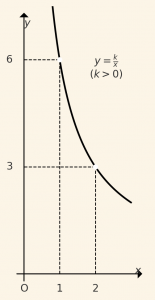
\[ y \cdot x = k \Rightarrow 6 \cdot 1 = 3 \cdot 2\]
\[ k = 6\]
Example:
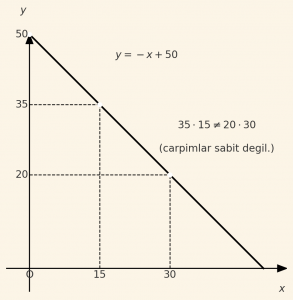
Let \( y = -x + 50 \):
For \( x = 15 \), we get \( y = 35 \)
For \( x = 30 \), we get \( y = 20 \)
In this case, when x doubles, y does not drop by half. Therefore, y does not vary inversely with x.
Note:
If \(y\) is directly proportional to \(x\) and inversely proportional to \(z\), it is written as a joint variation equation:
\[ y = \frac{k \cdot x }{z} \]
Question 1
Ali divided a bag of walnuts among his three siblings in direct proportion to their ages, using the ratios 2, 3, and 4 from youngest to oldest. The middle sibling received 90 fewer walnuts than the combined total of the other two siblings.
What is the total number of walnuts that Ali distributed?
\[
\text{A)} 250 \quad
\text{B) } 260 \quad
\text{C) } 270 \quad
\text{D) } 280 \quad
\text{E) } 290
\]
Solution:
Let the number of walnuts received by the siblings be \( x = 2k \), \( y = 3k \), and \( z = 4k \) respectively. Since the middle sibling’s share is 90 fewer than the sum of the youngest and oldest siblings’ shares:
\[ 3k = (2k + 4k) – 90 \Rightarrow 3k = 6k – 90 \Rightarrow 3k = 90 \Rightarrow k = 30 \]
The total number of walnuts distributed is:
\[ x + y + z = 2k + 3k + 4k = 9k = 9 \cdot 30 = 270 \]
\(\textbf{Answer: C} \)
Question 2
The number 380 is split into three parts such that the first part is inversely proportional to 3, the second part is inversely proportional to 5, and the third part is directly proportional to 2. What is the absolute difference between the largest and the smallest parts?
\[
\text{A)} 230 \quad
\text{B) } 240 \quad
\text{C) } 250 \quad
\text{D) } 260 \quad
\text{E) } 270
\]
Solution:
Let the three parts be \(x\), \(y\), and \(z\).
\[ x = \frac{k}{3}, \quad y = \frac{k}{5}, \quad \text{and} \quad z = 2k \]
Since their sum equals 380:
\[ x + y + z = 380 \Rightarrow \frac{k}{3} + \frac{k}{5} + 2k = 380 \]
Find a common denominator (15) to solve for \(k\):
\[ \frac{5k + 3k + 30k}{15} = 380 \Rightarrow \frac{38k}{15} = 380 \Rightarrow 38k = 5700 \Rightarrow k = 150 \]
Now compute the values of each part:
\[ x = \frac{150}{3} = 50 \]
\[ y = \frac{150}{5} = 30 \quad \text{(Smallest value)} \]
\[ z = 2 \cdot 150 = 300 \quad \text{(Largest value)} \]
The difference between the largest and smallest parts is:
\[ z – y = 300 – 30 = 270 \]
\(\textbf{Answer: E} \)
Question 3
Three interlocking gears have a combined total of 165 teeth. When the first gear completes 2 revolutions, the second gear completes 5 revolutions, and the third gear completes 8 revolutions. How many teeth does the second gear have?
\[
\text{A)} 40 \quad
\text{B) } 45 \quad
\text{C) } 50 \quad
\text{D) } 55 \quad
\text{E) } 60
\]
Solution:
Let the number of teeth on the first, second, and third gears be \( x \), \( y \), and \( z \) respectively. Because the number of teeth on a gear is inversely proportional to its number of revolutions:
\[ x = \frac{k}{2}, \quad y = \frac{k}{5}, \quad z = \frac{k}{8} \]
Summing them together:
\[ x + y + z = 165 \Rightarrow \frac{k}{2} + \frac{k}{5} + \frac{k}{8} = 165 \]
Using a common denominator of 40:
\[ \frac{20k + 8k + 5k}{40} = 165 \Rightarrow \frac{33k}{40} = 165 \Rightarrow 33k = 6600 \Rightarrow k = 200 \]
Now find the number of teeth for the second gear (\(y\)):
\[ y = \frac{200}{5} = 40 \]
\(\textbf{Answer: A} \)
Question 4
A variable \( a \) is directly proportional to \( (a – 1) \) and inversely proportional to \( (b + 1)^2 \). If \( a = 2 \) when \( b = -2 \), what is the value of \( a \) when \( b = 1 \)?
\[
\text{A)} -1 \quad
\text{B) } 1 \quad
\text{C) } 2 \quad
\text{D) } 3 \quad
\text{E) } 4
\]
Solution:
Based on the rules of joint variation, we can set up the formula:
\[ a = \frac{k \cdot (a – 1)}{(b + 1)^2} \]
Substitute the initial conditions (\(a = 2\) and \(b = -2\)) to solve for \(k\):
\[ 2 = \frac{k \cdot (2 – 1)}{(-2 + 1)^2} \Rightarrow 2 = \frac{k \cdot 1}{1} \Rightarrow k = 2 \]
Now substitute \(k = 2\) and \(b = 1\) back into the formula to find the new value of \(a\):
\[ a = \frac{2 \cdot (a – 1)}{(1 + 1)^2} \Rightarrow a = \frac{2a – 2}{4} \]
Cross-multiplying gives:
\[ 4a = 2a – 2 \Rightarrow 2a = -2 \Rightarrow a = -1 \]
\(\textbf{Answer: A} \)
Setting Up Proportions in Word Problems:
To solve word problems involving variation, align quantities of the same units in vertical columns. Next, determine the type of variation. Draw diagonal cross-arrows for direct variation and horizontal parallel arrows for inverse variation. Multiply the values along the arrow paths and set the two products equal to each other to solve for the missing variable.
Question 5
Mustafa read 300 pages of an 800-page book in 12 days. At this constant rate, how many total days will it take Mustafa to finish reading the entire book?
\[
\text{A)} 24 \quad
\text{B) } 26 \quad
\text{C) } 28 \quad
\text{D) } 30 \quad
\text{E) } 32
\]
Solution:
\[
\begin{aligned}
&\text{In 12 days} \quad \quad \quad\quad \text{reads } 300 \ \text{pages} \quad \quad \quad \quad \quad \quad \\[1cm]
&\text{In x days} \quad \quad\quad\quad \text{reads } 800 \ \text{pages} \quad \quad \quad \quad \quad \quad \quad \\[1cm]
\hline \\[0.3cm]
&\textbf{Direct Proportion}
\end{aligned}
\]
As the number of days spent reading increases, the total pages read increases proportionally. Thus, this is a direct proportion problem. We set up cross-multiplication:
\[ 12 \cdot 800 = x \cdot 300 \Rightarrow 9600 = 300x \Rightarrow x = 32 \]
\(\textbf{Answer: E} \)
Question 6
A military outpost has enough rations to feed 300 soldiers for 6 months. If 100 soldiers are discharged and leave the outpost, how many months will the same rations last for the remaining soldiers?
\[
\text{A)} 7 \quad
\text{B) } 8 \quad
\text{C) } 9 \quad
\text{D) } 10 \quad
\text{E) } 11
\]
Solution:
Calculate the remaining troop count: \(300 – 100 = 200\) soldiers.
\[
\begin{aligned}
&\text{For 300 soldiers} \quad \quad \quad\quad \text{rations last } 6 \ \text{months} \quad \quad \quad \quad \quad \quad \\[1cm]
&\text{For 200 soldiers} \quad \quad\quad\quad \text{rations last } x \ \text{months} \quad \quad \quad \quad \quad \quad \quad \\[1cm]
\hline \\[0.3cm]
&\textbf{Inverse Proportion}
\end{aligned}
\]
Fewer soldiers mean the food supply will deplete at a slower rate. Because the number of soldiers and the duration of rations are inversely proportional, we multiply horizontally along parallel lines:
\[ 300 \cdot 6 = 200 \cdot x \Rightarrow 1800 = 200x \Rightarrow x = 9 \]
\(\textbf{Answer: C} \)
Question 7
If 4 weavers working for 3 days can weave \(24\; m^2\) of carpet, how many square meters (\(m^2\)) of carpet can 5 weavers weave in 2 days?
\[
\text{A)} 10 \quad
\text{B) } 12 \quad
\text{C) } 18 \quad
\text{D) } 20 \quad
\text{E) } 24
\]
Solution:
\[
\begin{aligned}
&4 \ \text{weavers} \quad \quad \quad\quad 3 \ \text{days} \quad \quad \quad \text{produce } 24 \; \; m^2 \ \text{carpet} \quad \quad \quad \\[1cm]
&5 \ \text{weavers} \quad \quad \quad\quad 2 \ \text{days} \quad \quad \quad \text{produce } x \; \; m^2 \ \text{carpet} \quad \quad \quad \\[1cm]
\hline \\[0.3cm]
&\textbf{Inverse Proportion} \quad \quad \quad \textbf{Direct Proportion}
\end{aligned}
\]
More weavers reduce the time required to complete a job (inverse relationship). However, working more days increases the quantity of carpet produced (direct relationship). To solve compound proportions, rearrange the parameters using work ratios:
\[ \frac{\text{First piece of work}}{\text{Second piece of work}} = \frac{\text{Product of other variables related to first work}}{\text{Product of other variables related to second work}} \]
\[ \frac{24}{x} = \frac{4 \cdot 3}{5 \cdot 2} \Rightarrow \frac{24}{x} = \frac{12}{10} \]
Cross-multiplying gives:
\[ 12 \cdot x = 24 \cdot 10 \Rightarrow 12x = 240 \Rightarrow x = 20 \; m^2 \]
\(\textbf{Answer: D} \)
← Previous Page | Next Page →