
Linear Equations in Two Variables
For \( a,\; b, \; c \in R\) and \(a \neq 0, \; b \neq 0\), equations of the form \(ax + by + c = 0 \) are called linear equations in two variables.
The set of ordered pairs \( (x, y) \) that satisfies an equation of the form \(ax + by + c = 0 \) represents a line in the analytic plane, and there are infinitely many points on this line. Therefore, the solution set of a linear equation in two variables contains infinitely many elements.
Example:
If the substitution \( x= t \) is made in the equation \( 2x + 3y-7 = 0 \), then
\[2x + 3y -7= 0 \Rightarrow 2t+ 3y -7 = 0 \]
\[\Rightarrow y = \frac{7-2t}{3} \] is obtained. From this, where \( t \in R \), it can be seen that there exist infinitely many ordered pairs like \( t, \frac{7-2t}{3} \) that satisfy the given equation.
System of Linear Equations in Two Variables:
\[ a_1x +b_1y+c_1=0\]
\[ a_2x +b_2y+c_2=0\]
A system consisting of two equations of this form is called a system of linear equations in two variables.
Finding the Solution Set:
\[ d1: \;\; a_1x +b_1y+c_1=0\]
\[d2: \;\; a_2x +b_2y+c_2=0\]
Considering that these equations represent lines d1 and d2 in the analytic plane, there are three possible cases for the solution of a system of linear equations in two variables:
Case 1
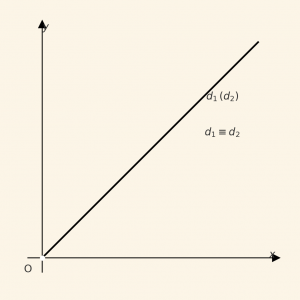
If \[ \;\; \frac{a_1}{a_2} = \frac{b_1}{b_2} = \frac{c_1}{c_2}\], then the solution set of the equation system has infinitely many elements. This is because in this case, the lines are coincident. All points on coincident lines (every ordered pair \((x, y)\) that satisfies the equations) are elements of the solution set.
\[ 1) \;\; \frac{a_1}{a_2} = \frac{b_1}{b_2} = \frac{c_1}{c_2} \Rightarrow d_1 \equiv d_2\] means there are infinitely many solutions.
Question 12
\[ abx-2y -3 =0 \]
\[ 2x+4y-b=0 \]
If the solution set of the system of equations has infinitely many elements, what is the value of a?
\[
\text{A)} \frac{1}{6} \quad
\text{B) } \frac{1}{3} \quad
\text{C) } \frac{1}{2} \quad
\text{D) } 1 \quad
\text{E) } 2
\]
Solution:
For the solution set to have infinitely many elements, we must have
\[ \frac{ab}{2} = \frac{-2}{4} =\frac{-3}{-b} \Rightarrow \frac{-2}{4} = \frac{-3}{-b} \Rightarrow b = -6 \]
and
\[ \frac{ab}{2} = \frac{-2}{4} \Rightarrow a = \frac{1}{6} \]
\(\textbf{Answer: A} \)
Case 2
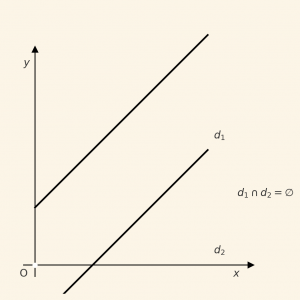
If \[ \;\; \frac{a_1}{a_2} = \frac{b_1}{b_2} \neq \frac{c_1}{c_2}\], then the solution set of the system of equations is the empty set. This is because in this case, the lines are parallel. Since parallel lines do not intersect, they have no points in common.
\[ 1) \;\; \frac{a_1}{a_2} = \frac{b_1}{b_2} \neq \frac{c_1}{c_2} \Rightarrow d_1 // d_2\] means \[S = Ø\]
Question 13
\[ x + ay + 5 =0 \]
\[ (a-2)x-y-4=0 \]
If the solution set of the system of equations is the empty set, what is the value of a?
\[
\text{A)} -2\quad
\text{B) } -1\quad
\text{C) } 0 \quad
\text{D) } 1 \quad
\text{E) } 2
\]
Solution:
For the solution set to be empty, we must have
\[ \frac{1}{a-2} = \frac{a}{-1} \neq \frac{-5}{-4} \]
\[ \Rightarrow -1 = (a-2) \cdot a \]
\[ \Rightarrow a^2 – 2a + 1= 0 \]
\[ \Rightarrow a = 1 \]
\(\textbf{Answer: D} \)
Case 3
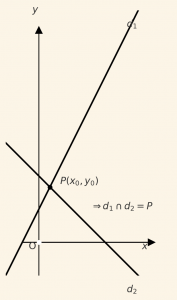
If \[ \;\; \frac{a_1}{a_2} \neq \frac{b_1}{b_2} \], then the solution set of the system of equations contains a unique element. This is because in this case, the lines intersect at exactly one point. The intersection point of the lines is the element of the solution set.
\[ \;\; \frac{a_1}{a_2} \neq \frac{b_1}{b_2} \Rightarrow d_1 \cap d_2 = P(x_0, \; y_0) \]
Methods for Solving Systems of Equations:
a) \[a_1 x+b_1y+c_1=0 \]
\[a_2 x+b_2y+c_2=0 \]
In the system of equations, the coefficients of one of the variables, for instance \(x\), are made equal. Then, these two equations are subtracted from each other. Thus, \(y \) is determined. This value of \(y \) is substituted into either of the equations to find \( x\).
Example:
\[
\begin{aligned}
2x + 3y = 8 \\
x + y = 3
\end{aligned}
\]
Let’s find the solution set of this system of equations. Let’s multiply both sides of the second equation by 2 and subtract it from the first equation.
\[
\begin{aligned}
2x + 3y &= 8\\
– \quad \quad 2x +2 y &= 6\\
\hline
y &=2
\end{aligned}
\]
is obtained. If the value \(y = 2 \) is substituted into the second equation (or the first equation),
\[ x +2 = 3 \Rightarrow x= 1 \] is found. Therefore, \[ S=\{(1,2)\} \] holds.
b)
\[
\begin{aligned}
a_1x + b_1y+ c_1=0
a_2x + b_2y+ c_2=0
\end{aligned}
\]
In this system of equations, one of the variables, for instance \(y\), is expressed in terms of \(x \) from the first (or second) equation. This expression is then substituted into the other equation. Consequently, the resulting equation in one variable is solved. The found value of \(x \) is substituted into either of the equations to determine \(y\).
Example:
\[
\begin{aligned}
y-3x=2 \\
x + 3y = 16\\
\end{aligned}
\]
Let’s find the solution set of this system of equations. Isolating \( y = 3x + 2 \) from the first equation and substituting it into the second equation yields:
\[
\begin{aligned}
x +3 (3x+2) =16 \Rightarrow 10x + 6 = 16\\
\Rightarrow x =1
\end{aligned}
\]
Substituting the value \(x = 1 \) into the second equation,
\[1+ 3y = 16 \Rightarrow y= 5 \] is found. Therefore, \[ S= \{(1,5)\} \] holds.
Question 14
\[
\begin{aligned}
\frac{1}{x} \;- \;\frac{2}{y} &= 3\\
\\
\frac{2}{x} \;+ \; \frac{1}{y} &= 7\\
\end{aligned}
\]
What is the value of x that satisfies the system of equations?
\[
\text{A) } 1 \quad
\text{B) } \frac{5}{3} \quad
\text{C) } \frac{3}{5} \quad
\text{D) } \frac{17}{5} \quad
\text{E) } \frac{5}{17}
\]
Solution:
Let’s multiply both sides of the second equation by 2 and add the equations together.
\[
\begin{aligned}
\frac{1}{x}\; -\; \frac{2}{y} \;=\; &3\\
\\
+ \quad \frac{4}{x}\; +\; \frac{2}{y} = &14\\
\hline
\\
\frac{5}{x} =17
\end{aligned}
\]
\[ \frac{5}{x} = 17 \Rightarrow 5 = 17 x \Rightarrow x = \frac{5}{17}\]
\(\textbf{Answer: E} \)
Question 15
\[
\begin{aligned}
\frac{x+y}{3} -x = 2\\
\\
\frac{x+y}{2} -y = 1\\
\end{aligned}
\]
What is the value of x that satisfies the system of equations?
\[
\text{A) } -10 \quad
\text{B) } -9 \quad
\text{C) } -8 \quad
\text{D) } 7 \quad
\text{E) } 6
\]
Solution:
Let’s add the two equations together.
\[
\begin{aligned}
\frac{x+y}{3}\; -\; x \;=\; &2\\
\\
+ \quad \frac{x+y}{2}\; -\; y = \;&1\\
\hline
\\
\frac{5(x+y)}{6}\; – \;(x+y)\;=\;3
\end{aligned}
\]
\[\Rightarrow x+y= -18 \]
If this value is substituted into the first equation,
\[ -\frac{18}{3} \;- \;x =\; 2 \Rightarrow x \;=\; -8\]
\(\textbf{Answer: C} \)
Question 16
\[
\begin{aligned}
\frac{1}{x}\; -y \; &= -1\\
\\
x\; -\; \frac{1}{y} & = \;2\\
\end{aligned}
\]
then what is the value of the fraction \( \Large \frac{x^2+y^2}{xy} \)?
\[
\text{A) } 2 \quad
\text{B) } \frac{5}{2} \quad
\text{C) } 3 \quad
\text{D) } \frac{7}{2} \quad
\text{E) } 4
\]
Solution:
\[ \frac{1}{x} -y = -1 \Rightarrow \frac{1-xy}{x}= -1 \Rightarrow 1 -xy = -x \]
\[ x \;- \;\frac{1}{y} = 2 \Rightarrow \frac{xy-1}{y}= 2 \Rightarrow 1 -xy = -2y \]
From this, we get
\[ 1- xy = -x = -2y \]
\[ \Rightarrow x= 2y \]
Therefore,
\[\frac{x^2+y^2}{xy} = \frac{(2y)^2 + y^2 }{(2y) \cdot y} = \frac{5}{2} \]
\(\textbf{Answer: B} \)
Question 17
\[
\begin{aligned}
\sqrt{ x}\; -\; \frac{1}{\sqrt{y } } & = \frac{3 \sqrt{ 2} }{2} \\
\\
x\; -\; \frac{1}{y} & = \;\frac{15}{2} \\
\end{aligned}
\]
then what is the value of x?
\[
\text{A) } 4 \quad
\text{B) } 5 \quad
\text{C) } 6 \quad
\text{D) } 7 \quad
\text{E) } 8
\]
Solution:
\[
x \;- \; \frac{1}{y} = \frac{15}{2} \Rightarrow
\left( \sqrt{x} \;-\; \frac{1}{\sqrt{y}} \right) \cdot
\left( \sqrt{x} \;+\; \frac{1}{\sqrt{y}} \right) = \frac{15}{2}
\]
\[ \Rightarrow \frac{3 \sqrt{2 } }{2} \cdot \left( \sqrt{x}\; + \; \frac{1}{\sqrt{y}} \right) = \frac{15}{2} \]
\[\Rightarrow \left( \sqrt{x} + \frac{1}{\sqrt{y}} \right) = \frac{5 \sqrt{ 2} }{2} \]
is found. Based on this,
\[
\begin{aligned}
\sqrt{x} \;- \;\frac{1}{\sqrt{y}}& = \frac{3\sqrt{2}}{2}\\
\\
+\quad \sqrt{x}\; + \;\frac{1}{\sqrt{y}} &= \frac{5\sqrt{2}}{2}\\
\hline
\\
2\sqrt{x}\; &= \;4\sqrt{2}
\end{aligned}
\]
\[\Rightarrow x = 8 \]
\(\textbf{Answer: E} \)
Question 18
\[
\begin{aligned}
2a^2-ab-b^2&=14\\
2a+b&=7\\
\end{aligned}
\]
then what is the value of a?
\[
\text{A) } 1 \quad
\text{B) } 2 \quad
\text{C) } 3 \quad
\text{D) } 4 \quad
\text{E) } 5
\]
Solution:
\[ 2a^2-ab-b^2=14 \Rightarrow (2a+b) \cdot (a-b) = 14\]
\[\Rightarrow 7 \cdot (a-b) = 14 \]
\[\Rightarrow (a-b) = 2 \] is found. Therefore,
\[
\begin{aligned}
2a+ b &=7\\
+ \quad a-b&=2\\
\hline
3a & = 9 \Rightarrow a = 3 \quad \text{is found. }
\end{aligned}
\]
\(\textbf{Answer: C} \)
Question 19
\[
\begin{aligned}
x= \frac{a^2}{2a^2+ 3b^2} \\
y= \frac{b^2}{2a^2+3b^2} \\
\end{aligned}
\]
which of the following expresses y in terms of x?
\[
\text{A) } -x \quad
\text{B) } 2x-1 \quad
\text{C) } \frac{1-2x}{3} \quad
\text{D) } 1-2x \quad
\text{E) } \frac{x}{3}
\]
Solution:
\[ x = \frac{a^2}{2a^2+ 3b^2} \Rightarrow 2x = \frac{2a^2}{2a^2+3b^2} \]
\[ y = \frac{b^2}{2a^2+ 3b^2} \Rightarrow 3y = \frac{3b^2}{2a^2+3b^2} \]
\[
\begin{aligned}
2x= \frac{2a^2}{2a^2+ 3b^2} \\
+ \quad \quad 3y= \frac{3b^2}{2a^2+3b^2} \\\hline \\ \quad
2x+3y= \frac{2a^2+ 3b^2}{2a^2+ 3b^2} = 1\\ \quad
\end{aligned}
\]
\[ y = \frac{1-2x}{3} \]
\(\textbf{Answer: C} \)
Question 20
\[ x^2 \cdot y = a – \frac{1}{b}\]
and
\[ xy^2 = \frac{8b}{1-ab} \]
then what is the value of the product \( x \cdot y \)?
\[
\text{A) } -2 \quad
\text{B) } 2 \quad
\text{C) } -3 \quad
\text{D) } 3 \quad
\text{E) } 1
\]
Solution:
\[ x^2 \cdot y = a – \frac{1}{b} \Rightarrow x^2y= \frac{ab-1}{b} \]
\[ xy^2 = \frac{8b}{1-ab} \Rightarrow xy^2= \frac{-8b}{ab-1} \]
\[
\begin{aligned}
x^2y= \frac{ab-1}{b}\\
\times \quad xy^2 = \frac{-8b}{ab-1} \\\hline \\
x^3 y^3= -8 \Rightarrow xy = -2
\end{aligned}
\]
\(\textbf{Answer: A} \)
← Previous Page | Next Page →