
Motion Problems
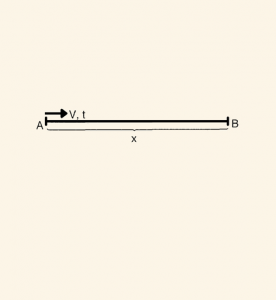
The distance \( |AB| \) traveled by a vehicle with an average speed V in time t is expressed as:
\[ \text{Distance} = \text{Speed} \times \text{Time} \]
\[ |AB| = x = V \times t \]
a) Overtaking (Catch-up) Problem:
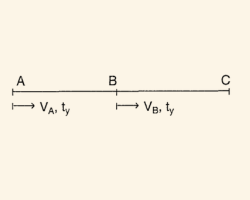
As shown in the figure, when two moving objects from points A and B with average speeds \(V_A \) and \(V_B \) start moving simultaneously in the same direction, provided that \( V_A > V_B \), let the vehicle moving from A catch up with the one moving from B at point C. Since both moving objects reach point C in the same duration \( t_y\), the distances covered by the objects moving from A and B are respectively:
\(|AC| = V_A \cdot t_y \) and \(|BC| = V_B \cdot t_y \). The distance between the two moving objects at the moment they started moving is:
\[|AB| = |AC| – |BC| \] From here,
\[ |AB| =V_A \cdot t_y – V_B \cdot t_y \Rightarrow |AB | = t_y(V_A – V_B) \]
\[t_y= \frac{|AB|}{V_A – V_B} \] is obtained. Therefore:
\[ \text{catch-up time} = \frac{\text{The distance between the initial points of the two moving objects} }{\text{The difference between the speeds of the two moving objects} }\]
Warning:
Here, if \(t_y= 1 \) hour is taken, it becomes \( |AB | = V_A- V_B \). From this, the following conclusion can be drawn: the vehicle behind closes the distance between them by the difference in speeds every 1 hour.
Example:
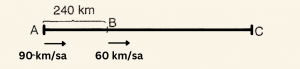
Let’s examine the motion of vehicles A and B, whose speeds are given in the figure, starting simultaneously from points A and B.
1. Vehicle A closes the distance between them in \[ \frac{240}{90-60} = 8 \; \text{hours.} \]
2. Vehicle B travels \(8 \cdot 60 = 480 \; km \) in 8 hours. That is, \(|BC| = 480\; km \).
3. Vehicle A travels \(8 \cdot 90 = 720 \; km \) in 8 hours. That is, \(|AC| = 720\; km \).
b) Meeting Problem:
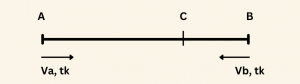
As shown in the figure, when two moving objects from points A and B with average speeds \( V_a\) and \( V_b \) start moving simultaneously towards each other (in opposite directions), let them meet at point C. Since both moving objects reach point C in the same duration \( (t_k) \), the distances covered by the objects moving from A and B are written as:
\[ |AC| = V_a \cdot t_k \]
\[ |BC| = V_b \cdot t_k \]
respectively. The distance between the two moving objects at the moment they started moving is:
\[ |AB| = |AC| + |BC| \; \text{dir} \] From here,
\[ |AB| = V_A \cdot t_k + V_B \cdot t_k \Rightarrow |AB| = t_k(V_A + V_B)\]
\[t_k = \frac{|AB|}{V_A+ V_B} \] is obtained. Therefore:
\[ \text{meeting time} = \frac{\text{The distance between the initial points of the two moving objects} }{\text{The sum of the speeds of the two moving objects} }\]
Warning:
Here, if \(t_k= 1 \) hour is taken, it becomes \( |AB | = V_A + V_B \). From this, the following conclusion can be drawn: two moving objects approach each other by the sum of their speeds every 1 hour.
Example:
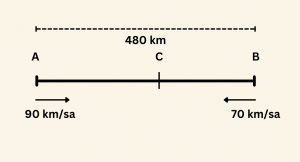
Let’s examine the motion of vehicles A and B, whose speeds are given in the figure, starting simultaneously from points A and B.
1) The distance between the two vehicles is closed after \[\frac{480}{90 + 70 } = 3 \; \text{hours.} \] The two vehicles meet 3 hours later.
2) In 3 hours, vehicle A covers \( 3 \cdot 90 = 270 \) km. That is, |AC| = 270 km.
3) In 3 hours, vehicle B covers \( 3 \cdot 70 = 210 \) km. That is, |BC| = 210 km.
c) Average Speed:
Average speed comes into question when a moving object covers a path at different constant speeds during certain time intervals. However, it should not be thought of as the arithmetic mean of the varying speeds of the vehicle along this path.
The ratio (division) of the total distance covered by a vehicle between two points to the total time spent completing this distance is the average speed of the vehicle between these two points.
Accordingly, it is calculated as:
\[ V_{ort} = \frac{\text{total distance} }{\text{total time} } \]
.
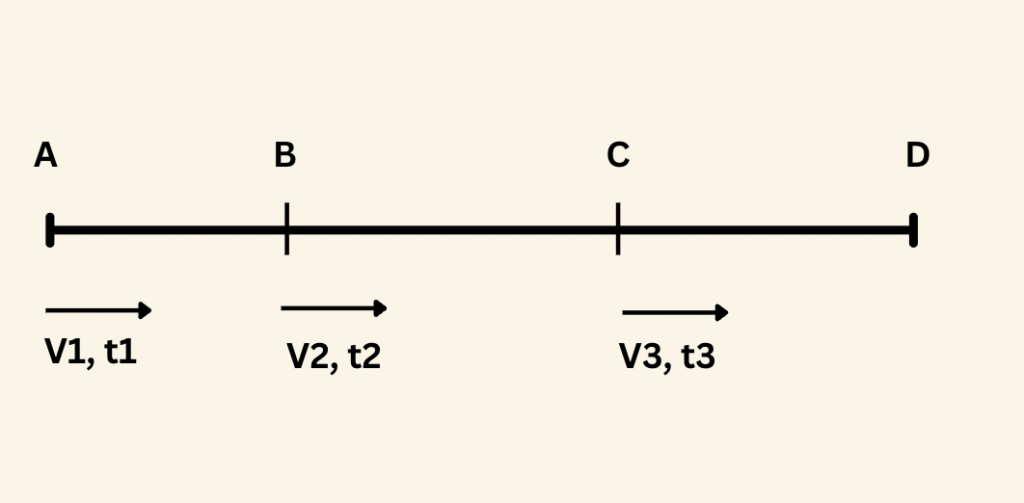
As shown in the figure above, let a vehicle moving from A cover the path AB with a speed of \(V_1 \) in time \(t_1 \), the path BC with a speed of \(V_2 \) in time \(t_2 \), and the path CD with a speed of \(V_3 \) in time \(t_3 \). The average speed of this vehicle along the entire path AD is:
\[ V_{ort} = \frac{|AD|}{t_1 +t_2 + t_3} \] or \[ V_{ort} = \frac{|AD|}{\frac{|AB|}{V_1} + \frac{|BC|}{V_2} + \frac{|CD|}{V_3} } \] .
Example:
If a vehicle covers one-third of its path at a speed of 60 km/h and the remainder at a speed of 80 km/h, let’s find the average speed of this vehicle along this path.
If the diagram showing the motion of this vehicle is drawn as follows:
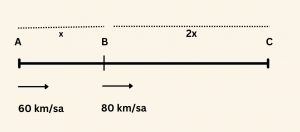
Assuming the total distance covered by the vehicle is \(3x \) km:
\[ V_{ort} = \frac{\text{total distance} }{\text{total time}} = \frac{3x}{\frac{x}{60} + \frac{2x}{80} } = \frac{3x}{ x \cdot \left( \frac{1}{60} + \frac{1}{40} \right)} \]
\[ V_{ort} = 72 \; \text{km/h is found.} \]
Question 16
Two vehicles with speeds of 50 km/h and 90 km/h travel from city A to city B. The vehicle with the higher speed sets off 4 hours after the other and arrives in city B 2 hours before it.
Accordingly, how many kilometers is the distance between cities A and B?
\[
\text{A )} 550 \quad
\text{B) } 600 \quad
\text{C) } 675 \quad
\text{D) } 725 \quad
\text{E) } 750
\]
Solution:
Let the vehicle with a speed of 90 km/h cover the distance |AB| in \( t\) hours. In this case, the vehicle with a speed of 50 km/h covers the distance between the two cities in \( t+ 6\) hours.
Accordingly, if the equation for the given problem is written as:
\[ |AB | = 90 \cdot t = 50 \cdot (t+6 )\] , it simplifies to: \[ 40 \cdot t = 300 \Rightarrow t = \frac{15}{2} \; \text{hours is found.} \]
\[|AB| = 90 \cdot t \Rightarrow |AB | = 90 \cdot \frac{15}{2} = 675 \; \text{km.} \]
\(\textbf{Answer: C} \)
Question 17
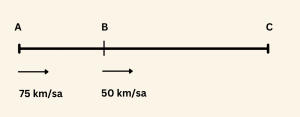
The speeds per hour of two vehicles starting simultaneously and in the same direction from A and B are 75 km and 50 km, respectively. The vehicle starting from A takes a break 2 hours after starting its journey. After a 1-hour break, it continues its journey at the same speed and catches up with the vehicle in front at point C. Given that the distance AB is 75 km, how many km is the distance BC?
Accordingly, how many kilometers is the distance between cities A and B?
\[
\text{A )} 300 \quad
\text{B) } 250 \quad
\text{C) } 200 \quad
\text{D) } 150 \quad
\text{E) } 100
\]
Solution:
Since the distance AB is 75 km, the vehicle starting from A would normally catch up with the vehicle starting from B after:
\[ \frac{75}{75-50} = 3 \] hours.
Since the vehicle starting from A takes a 1-hour break before catching up with the vehicle in front, the vehicle starting from B increased the distance between them by \(50 \cdot 1 = 50 \) km during this 1 hour. Accordingly, the total distance that the vehicle starting from A needs to close with the vehicle in front is \( 75 + 50 = 125\) km. Therefore, it will close this 125 km distance in:
\[\frac{125}{75-50} = 5 \] hours. In addition, during the 1-hour break taken by the vehicle starting from A, the vehicle starting from B traveled \( 50 \cdot 1 = 50\) km. Accordingly, the total distance covered by the vehicle starting from B is:
\[ |BC| = 50 \cdot 5 + 50 = 300 \; \text{km.} \]
\(\textbf{Answer: A} \)
Question 18
The ratio of a runner’s speed to the wind speed is \(\Large \frac{5}{2} \). Since this runner can run a distance of 45 km against the wind in 5 hours, what is the runner’s speed per hour in km?
\[
\text{A )} 3 \quad
\text{B) } 9 \quad
\text{C) } 12 \quad
\text{D) } 15 \quad
\text{E) } 18
\]
Solution:
If the wind speed is called \( 2v \), the runner’s speed becomes \( 5v \). When the runner runs against the wind, their net speed is \[ 5v \; – \; 2v = 3v \]. Since the relationship belonging to the given problem is:
\[ \text{Distance = Speed x Time} \] , we have: \[ 45 = 3v \cdot 5 \Rightarrow v= 3 \; \text{km/h} \]
The runner’s speed is \( 5v = 15 \) km/h.
\(\textbf{Answer: D} \)
Question 19
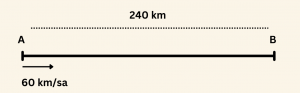
A bus moving from point A at a speed of 60 km/h increases its speed by V hours after starting its journey, and consequently reaches point B 1 hour before its scheduled arrival time. Given that the distance AB is 240 km, how many km/h is V?
\[
\text{A )} 20 \quad
\text{B) } 25 \quad
\text{C) } 30 \quad
\text{D) } 35 \quad
\text{E) } 40
\]
Solution:
The bus has traveled \( 60 \cdot 1 = 60 \) km 1 hour after starting its journey. There are \( 240 \; – \; 60 = 180 \) km remaining to be traveled. If it does not change its speed, it will complete this path after \[ \frac{180}{60} = 3 \; \text{hours.} \] However, when it increases its speed by \(V\), it reaches B 1 hour before its scheduled time, which means it completed the 180 km distance in 2 hours. Accordingly, the equation \[ (60 + V) \cdot 2 = 180 \] is written and solved: \[ 60 + V = \frac{180}{2} = 90 \] \[ V = 90 \; – \; 60 = 30 \; \text{km/h} \] As a result, the speed increase is found to be \(V = 30\) km/h.
\(\textbf{Answer: C} \)
Question 20
A vehicle travels an AB distance at a speed of 80 km/h, and on its return, it covers the path at a speed of 60 km/h. Given that the total round-trip time is 14 hours, how many km is the distance AB?
\[
\text{A) } 480 \quad
\text{B) } 460 \quad
\text{C) } 420 \quad
\text{D) } 300 \quad
\text{E) } 350
\]
Solution:
If the departure time of the vehicle is called t, the return time becomes \(14 – t \). Since the vehicle travels at a speed of 80 km/h on departure and 60 km/h on return, the equation belonging to the given problem is written as:
\[ |AB| = 80 \cdot t = 60 \cdot (14 \; – \; t )\]
\[ 14t = 6 \cdot 14\]
\[\Rightarrow t = 6 \; \text{hours is found.} \]
From here, since \[ |AB| = 80 \cdot t \] :
\[ |AB| = 80 \cdot 6 = 480 \; \text{km.} \]
\(\textbf{Answer: A} \)
Question 21
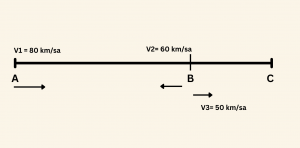
Given that \( V_1 = 80 \) km/h, \( V_2 = 60 \) km/h, and \( V_3 = 50 \) km/h, three vehicles start moving simultaneously from points A and B in the directions shown in the figure. The vehicle moving with a speed of \( V_1 \) meets the vehicle moving with a speed of \( V_2 \) after 3 hours and catches up with the vehicle moving with a speed of \( V_3 \) at point C. Accordingly, how many km is the distance BC?
\[
\text{A) } 420 \quad
\text{B) } 480 \quad
\text{C) } 540 \quad
\text{D) } 680 \quad
\text{E) } 700
\]
Solution:
Since the two vehicles moving towards each other with speeds \( V_1 \) and \( V_2 \) meet after 3 hours, the distance AB is:
\[ |AB| = 3 \cdot (V_1 + V_2) \Rightarrow |AB| = 3 \cdot (80 + 60 ) = 420 \; \text{km.} \] If the vehicle with speed \( V_1 \) catches up with the vehicle with speed \( V_3 \) in t hours:
\[ t = \frac{|AB|}{V_1 \;- \; V_3} \Rightarrow t = \frac{420}{80 \;-\; 50 } = 14 \; \text{hours.} \]
Since the vehicle moving with speed V3 arrives from B to C in 14 hours:
\[ |BC| = 50 \cdot 14 \Rightarrow |BC| = 700 \; \text{km.} \]
\(\textbf{Answer: E} \)
← Previous Page | Next Page →