
Functions
Let \( A \) and \( B \) be two non-empty sets, and let \( f \) be a relation defined from \( A \) to \( B \). If every element in \( A \) is mapped to exactly one element in \( B \) by the relation \( f \), then the relation \( f \) is called a function from \( A \) to \( B \).
It is denoted as:
\[ f: A \longrightarrow B \quad \text{or} \quad A \rightarrow{f} B \]
Here, \( A \) is called the domain and \( B \) is called the codomain of the function. Furthermore, the set consisting of the elements in \( B \) that are actually mapped to by the elements of \( A \) is called the image set (or range) of \( A \), which is denoted by \( f(A) \).
Example:
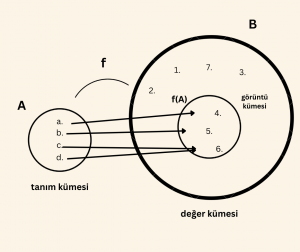
\( A = \{ a, b, c, d \} \) is the domain,
\( B = \{ 1, 2, 3, 4, 5, 6, 7 \} \) is the codomain,
\( f(A) = \{ 4, 5, 6 \} \) is the range, where \( f(A) \subseteq B \).
If \( f: A \to B \) and \( (x,y) \in f \), it is expressed as:
\[ f: x \to y \quad \text{or} \quad y = f(x) \]
where \( y \) is said to be the image of \( x \) under \( f \).
Example:
Consider the sets \( A = \{ -1, 0, 1, 2 \} \) and \( B = \{ -1, 0, 1, 2, 3, 4 \} \). Let a function \( f \) from \( A \) to \( B \) be defined as:
\[
f = \{ (x, y) \mid y = x^2 \}
\]
In this case, the mapping rule is given by:
\[
f(x) = x^2
\]
Evaluating each element:
\[ \text{For } x = -1 \quad \implies \quad f(-1) = (-1)^2 = 1 \]
\[ \text{For } x = 0 \quad \implies \quad f(0) = 0^2 = 0 \]
\[ \text{For } x = 1 \quad \implies \quad f(1) = 1^2 = 1 \]
\[ \text{For } x = 2 \quad \implies \quad f(2) = 2^2 = 4 \]
Thus, the function in roster form is \( f = \{ (-1, 1), (0, 0), (1, 1), (2, 4) \} \), and it can be visualized using an arrow diagram. The range is found to be:
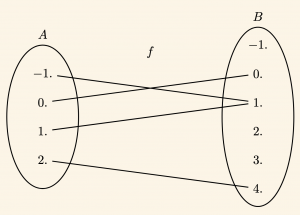
\[ f(A) = \{ 0, 1, 4 \} \]
Note:
For a relation \( f \) defined from \( A \) to \( B \) to qualify as a function, it must satisfy two structural criteria:
\( 1) \) No element in the domain \( A \) can be left unmapped (unpaired); however, there may be elements left over in the codomain \( B \).
\( 2) \) Every element in the domain \( A \) must map to exactly one image in the codomain \( B \).
Examples:
Consider the sets \( A = \{ a, b, c \} \) and \( B = \{ 1, 2, 3 \} \). Let us determine whether the following relations defined from \( A \) to \( B \) represent functions.
\[
\bullet \quad f_1 = \{ (a, 1), (b, 3) \} \quad \text{Let us model this relation with an arrow diagram.}
\]
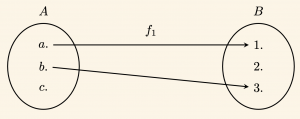
Since the element \( c \in A \) is left unmapped, the relation \( f_1 \) is not a function.
\[
\bullet \quad f_2 = \{ (a, 1), (b,2), (b, 3), (c, 3) \} \quad \text{Let us model this relation with an arrow diagram.}
\]
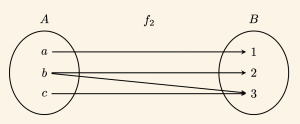
Because the element \( b \in A \) maps to two distinct images, namely 2 and 3 in \( B \), the relation \( f_2 \) is not a function.
\[
\bullet \quad f_3 \quad \text{Let us model this relation with an arrow diagram.}
\]
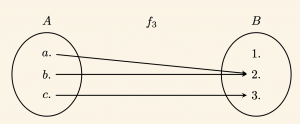
Since the relation \( f_3 \) satisfies all structural criteria, it is a valid function.
\[
\bullet \quad f_4 \quad \text{Let us model this relation with an arrow diagram.}
\]
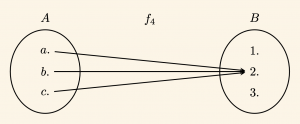
Since the relation \( f_4 \) satisfies all structural criteria, it is a valid function.
Example:
A relation \( f \) is defined on the set \( A = \{ -2, -1, 1, 2 \} \) as shown in the graph below.
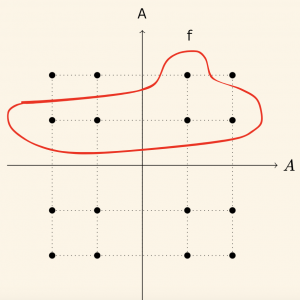
Constructing its corresponding arrow diagram:
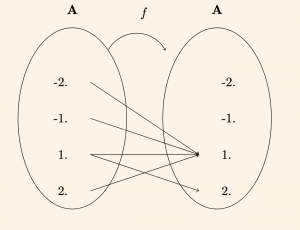
Because the element 1 in the domain is mapped to two distinct images, namely 1 and 2 in the codomain, the relation \( f \) is not a function.
Examples:
Let us investigate whether the following algebraic relations define functions on their specified sets.
1) Defined from \( \mathbb{R} \) to \( \mathbb{R} \):
\[
f_1 = \{(x,y) \mid y = \frac{x}{x^2 – 1} \}
\]
For the rational expression \[ y = \frac{x}{x^2 – 1} \] the denominator becomes zero when \( x = \pm1 \), rendering the expression undefined. Consequently, the elements \( -1 \) and \( 1 \) in the domain are left without a valid mapping, which implies that the relation \( f_1 \) is not a function.
2) Defined from \( \mathbb{R} \) to \( \mathbb{R} \):
\[
f_2 = \{(x,y) \mid |y| = x^2 + 1 \}
\]
Given the absolute value equation \[ |y| = x^2 + 1 \] every input value in the domain yields two distinct outputs. For example, setting \( x = 1 \) results in \( y = \pm 2 \). Since domain elements map to multiple values, the relation \( f_2 \) is not a function.
3) Defined from \( \mathbb{R} \) to \( \mathbb{R} \):
\[
f_3 = \{(x,y) \mid y = \frac{x}{x^2 + 1} \}
\]
Since the quadratic expression in the denominator is positive for all real numbers (\( x^2 + 1 \neq 0 \)), every real input \( x \) maps uniquely to exactly one real output \( y \). Therefore, the relation \( f_3 \) is a valid function.
4) Defined from \( \mathbb{Z} \) to \( \mathbb{Z} \):
\[
f_4 = \{(x,y) \mid y = \frac{x – 1}{3} \}
\]
Certain elements in the domain \( \mathbb{Z} \) cannot be mapped to valid integers in the codomain. For instance, choosing \( x = 2 \) yields \( y = \frac{1}{3} \), which is not an element of \( \mathbb{Z} \). Since elements are left unmapped, the relation \( f_4 \) is not a function.
Strategy (The Vertical Line Test):
To graphically determine if a relation represents a function, draw vertical lines parallel to the y-axis through every point across its specified domain:
1) If there is no vertical line that fails to intersect the curve, and
2) If every vertical line intersects the curve at exactly one single point, then the relation is a function.
Example:
The coordinate graph below illustrates a relation \( f \) defined from \( \mathbb{R} \) to \( \mathbb{R} \), consisting of pairs \( (x, y) \in f \). Let us determine whether this relation defines a function.
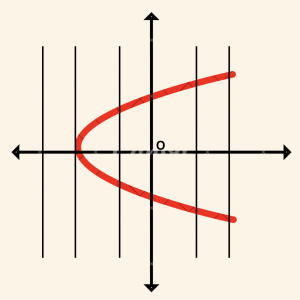
Since the relation is defined over all real numbers, we project vertical lines along the entire x-axis. We observe regions where vertical lines fail to intersect the graph entirely, alongside lines that intersect it at multiple points (twice). Because it fails both essential criteria, the relation \( f \) is not a function.
Conceptually, a vertical line failing to intersect the graph reveals unmapped elements in the domain. Conversely, a vertical line intersecting a graph multiple times indicates that a single input corresponds to more than one output in the codomain.
Examples:
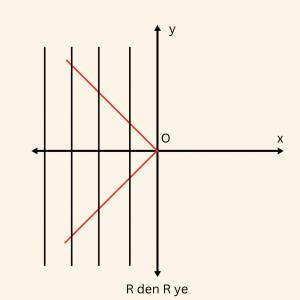
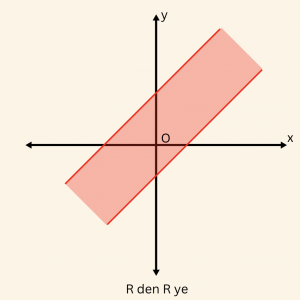
Let us apply the vertical line test to evaluate the following relations:
1)
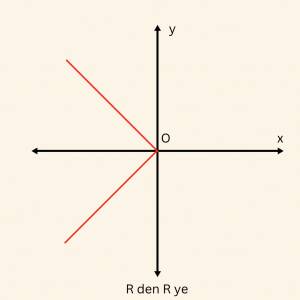
There are vertical lines that do not cross the graph, as well as lines that cut through it at two separate points. Therefore, the relation \( f_1 \) is not a function.
2)
 \(\Rightarrow \)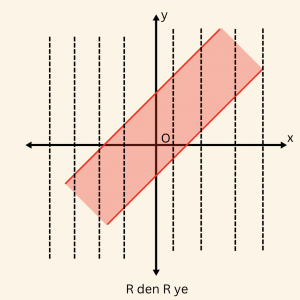
Every vertical line passes through the graph; however, the vertical line along the vertical segment intersects it at infinitely many points. Thus, the relation \( f_2 \) is not a function.
3)
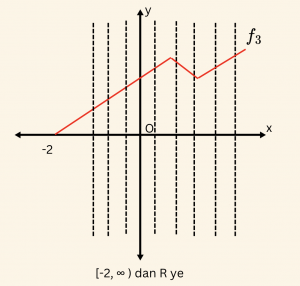
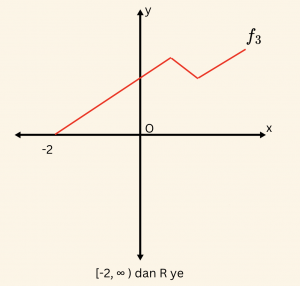 \(\Rightarrow \)
Every vertical line intersects the curve exactly once across the entire domain, with no unmapped areas. Thus, the relation \( f_3 \) is a valid function.
4)
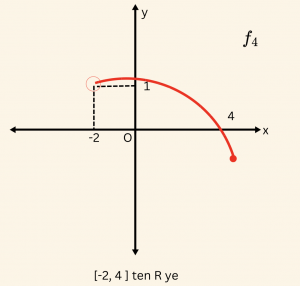 \(\Rightarrow \)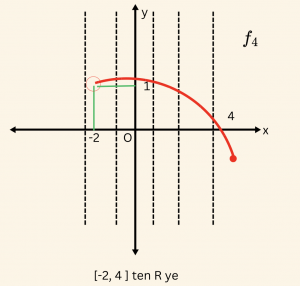
Because the coordinate point \( (-2,1) \) is open (excluded from the graph), the line \( x = -2 \) fails to intersect the curve. This indicates that \( -2 \) is an unmapped element in the domain, which proves that the relation \( f_4 \) is not a function.
5)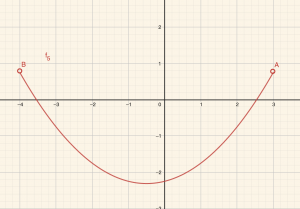
Every valid vertical line crosses the piecewise graph exactly once with no gaps. Thus, the relation \( f_5 \) is a valid function.
Total Number of Functions:
If the cardinalities of sets \( A \) and \( B \) are \( s(A) = m \) and \( s(B) = n \) respectively, the total number of distinct functions that can be defined from \( A \) to \( B \) is given by:
\[ \Large n^m \]
Question 9
Given the sets \[ A = \{ 1,2,3 \} \quad \text{and } \quad B= \{ a, b, c, d \} \] how many relations can be defined from \( A \) to \( B \) that do not constitute a function?
\[
\text{A)} 4026 \quad
\text{B) } 4028 \quad
\text{C) } 4030 \quad
\text{D) } 4032 \quad
\text{E) } 4034
\]
Solution:
The total number of relations from \( A \) to \( B \) is calculated via the power set of the Cartesian product:
\[ 2^{s(A) \cdot s(B)} = 2^{3 \cdot 4} = 2^{12} \]
The number of valid functions that can be constructed from \( A \) to \( B \) is:
\[ s(B)^{s(A)} = 4^3 \]
Subtracting the number of valid functions from the total number of relations yields the total number of non-functional relations:
\[ 2^{12} – 4^3 = 4096 – 64 = 4032 \]
\(\textbf{Correct Answer: D} \)
← Previous Page | Next Page →