
Operations on Sets
1. Intersection of Sets
The set formed by the common elements of set A and set B is called the intersection of A and B. It is denoted as \( A \cap B \).
\[ A \cap B = \{ x \;| \; x \in A \;\; \text{and } \; x \in B \} \;\; \text{is defined as. } \]
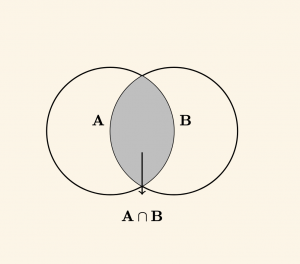
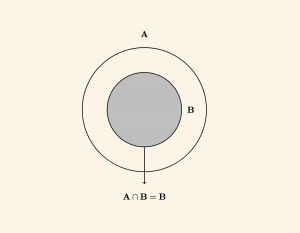
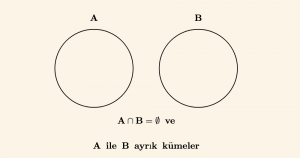
Example:
\[
\text{If } A = \{x : |x| \leq 2, \, x \in \mathbb{R} \} \quad \text{and} \quad
B = \{x : x < 0, \, x \in \mathbb{R} \},
\]
\[
\text{let’s find the set } A \cap B.
\]
\[
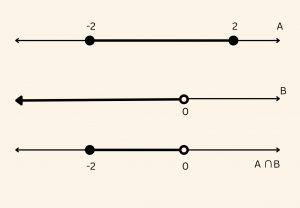
|x| \leq 2 \implies -2 \leq x \leq 2 \quad \text{and} \quad A = [-2, 2]
\]
\[
\text{Since } B = (-\infty, 0),
\]
\[
A \cap B = [-2, 0) \;\; \text{is obtained. }
\]
2. Union of Sets
The set formed by combining all the elements of set A and set B is called the union of A and B. It is denoted as \( A \cup B \).
\[ A \cup B = \{ x\; | \; x \in A \;\; \text{or } x \in B \} \] is defined as.
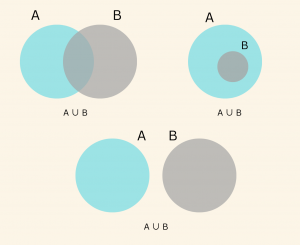
3. Properties of Intersection and Union:
\( 1) \quad \) The intersection and union operations satisfy the commutative property.
\[ \begin{array}{c} A \cap B = B \cap A \\ A \cup B = B \cup A \end{array} \]
\( 2) \quad \) The intersection and union operations satisfy the associative property.
\[ \begin{array}{c}
A \cap B \cap C = ( A \cap B) \cap C = A \cap (B \cap C ) \\
A \cup B \cup C = ( A \cup B) \cup C = A \cup (B \cup C )
\end{array}
\]
\( 3) \quad \) The intersection operation distributes over union, and the union operation distributes over intersection.
\[ \begin{array}{c}
A \cap (B \cup C ) = ( A \cap B) \cup (A \cap C) \\
A \cup (B \cap C ) = ( A \cup B) \cap (A \cup C)
\end{array}
\]
\( 4) \quad \) De Morgan’s Laws
\[ \begin{array}{c}
(A \cap B )’ = A’ \cup B’ \\
(A \cup B )’ = A’ \cap B’ \\
\end{array}
\]
\( 5) \quad \)
\[
\begin{array}{c}
A \cap A’= Ø, \quad A \cap Ø = Ø , \quad A \cap E = A \\
A \cup A’ = E, \quad A \cup Ø = A,, \quad A \cup E = E\\
\end{array}
\]
Question 4
Which of the following is the simplified result of the operation \([A \cap( A \cap B’) ] \cup (A’ \cap B) \)?
\[
\text{A)} A \cup B \quad
\text{B) } A \quad
\text{C) } B\quad
\text{D) } A’ \quad
\text{E) } B’
\]
Solution:
\[ A \cap (A \cap B’)’ \cup (A’ \cup B ) \]
Applying De Morgan’s Law,
\[ = [A \cap (A’ \cup B )] \cup (A’ \cap B) \]
Applying the distributive property,
\[ = [ (A \cap A’ ) \cup (A \cap B ) ] \cup (A’ \cap B ) \]
\[ = [Ø \cup (A \cap B ) \cup (A’ \cap B) ]\]
\[ (A \cap B ) \cup (A’ \cap B)\]
By the distributive property,
\[ B \cap (A \cup A’ ) = B \cap E = B \]
\(\textbf{Answer: C} \)
Question 5
According to the accompanying diagram, what is \( s[(( B \cap C) \cup A’) ]\)?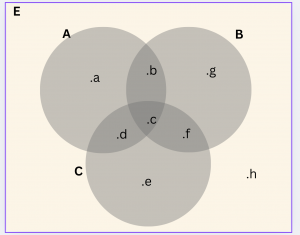
\[
\text{A)} 3 \quad
\text{B) } 4 \quad
\text{C) } 5\quad
\text{D) } 6 \quad
\text{E) } 7
\]
Solution:
\[ B \cap C = \{ c, f \} \;\; \text{and } \;\; A= \{ a,b,c,d \} \]
\[ (B \cap C) \cup A = \{ a, b, c ,d , f \} \]
\[ \text{Since } ( (B \cap C) \cup A’) = \{ e, g, h \}, \text{ then} \]
\[ s[(( B \cap C) \cup A’) ] = 3. \]
\(\textbf{Answer: A} \)
4. Cardinality of the Union of Sets:
\[ s(A \cup B ) = s(A) + s(B)- s(A \cap B) \]
\[ s(A \cup B \cup C ) = s(A) + s(B) + s(C) – \left[ s(A \cap B) + s( A \cap C) + s( B \cap C) \right] + s(A \cap B \cap C) \]
Question 6
If \( s(A) = 2x- 3, \;\; s(B) = 3x+ 4, \;\; s(A \cup B) = 3x+7 \;\; \text{and } \; A \cap B \neq Ø \), what is the minimum possible integer value of x?
\[
\text{A)} 3 \quad
\text{B) } 4 \quad
\text{C) } 5\quad
\text{D) } 6 \quad
\text{E) } 7
\]
Solution:
\[ s(A \cup B ) = s(A) + s(B) – s( A \cap B) \]
\[ 3x+ 7 = 2x-3 + 3x + 4 – s( A \cap B) \]
\[\Rightarrow s( A \cap B) = 2x-6 \]
\[ \text{If } A \cap B \neq Ø \quad \text{then } \quad s( A \cap B)> 0 \]
Therefore, the smallest possible integer value for x is 4.
\(\textbf{Answer: B} \)
Question 7
In a class of 45 students, the number of students who have visited Ankara is 23, those who have visited Istanbul is 18, and those who have visited Bursa is 14. 5 students have visited both Ankara and Istanbul, 10 students have visited both Ankara and Bursa, and 7 students have visited both Istanbul and Bursa. If 9 students have not visited any of these three cities, how many students have visited all three cities?
\[
\text{A)} 1 \quad
\text{B) } 2 \quad
\text{C) } 3 \quad
\text{D) } 4 \quad
\text{E) } 5
\]
Solution:
Since 9 students have not seen any of these three cities, \(45-9 =36 \) students have visited Ankara, Istanbul, or Bursa. Accordingly,
\[ s( A \cup B \cup I ) = s(A) + s(B) + s(İ) – [ s(A \cap İ ) + s( A \cap B) + s(İ \cap B) ] + s(A \cap B \cap İ) \]
\[ 36 = 23 + 18 + 14 \:-\; [5+ 10 + 7 ] + s(A \cap B \cap İ) \]
\[ \Rightarrow s(A \cap B \cap İ) = 3 \]
3 students have visited all three cities: Ankara, Istanbul, and Bursa.
\(\textbf{Answer: C} \)
Question 8
\[ A = \{x \; | \; x < 200, x = 7k , k \in Z^+ \}\]
\[ B = \{x \; | \; x < 351, x = 3k , k \in Z^+ \}\]
Given the sets above, what is \( s(A \cup B) \)?
\[
\text{A)} 133 \quad
\text{B) } 134 \quad
\text{C) } 135 \quad
\text{D) } 136 \quad
\text{E) } 137
\]
Solution:
Since A is the set of positive integers less than 200 that are divisible by 7:
\[ 199 \div 7 = 28 \quad \text{Remainder: } 3 \Rightarrow s(A) = 28 \]
Since B is the set of positive integers less than 351 that are exactly divisible by 3:
\[ 351 \div 3 = 116 \quad \text{Remainder: } 2 \Rightarrow s(B) = 116 \]
\( A \cap B \) is the set of positive integers less than 200 that are divisible by 21 (both 7 and 3). Therefore:
\[ 199 \div 21 = 9 \quad \text{Remainder: } 10 \Rightarrow s(A \cap B) = 9 \]
Based on this:
\[s(A \cup B) = s(A) + s(B) – s(A \cap B) \]
\[ \quad \quad = 28 + 116 \; -\; 9 = 135\]
\(\textbf{Answer: C} \)
Note:
The following figures indicate:
\( 1) \quad \) \( s(A \cap B) = 0 \)
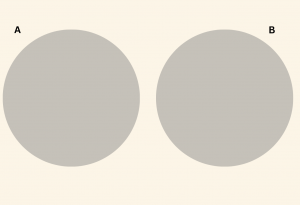
\[ \text{shows the condition where } s(A \cup B ) \text{ reaches its maximum value,} \]
\( 2) \quad \) \( s(A \cap B \neq Ø ) \quad \quad ( s(A \cap B) = 1 ) \)
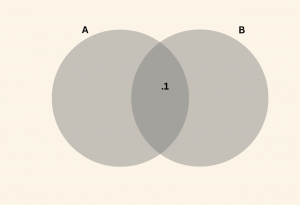
\[ \text{shows the condition where } s(A \cup B ) \text{ reaches its maximum value under constraints,} \]
\( 3) \quad \) \( B \subset A \) \( (s(A \cap B) = s(B) )\)
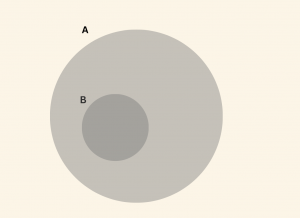
It illustrates the state where \( s(A \cap B ) \) takes its largest possible value while \( s(A \cup B ) \) takes its minimum value.
Question 9
If \( s(A)= 8, \;\; s(B)=6, \;\; \) and \( s (A \cap B) \neq Ø \), what is the sum of the maximum possible value of \( s(A \cap B)\) and the maximum possible value of \( s(A \cup B) \)?
\[
\text{A)} 16 \quad
\text{B) } 17 \quad
\text{C) } 18 \quad
\text{D) } 19 \quad
\text{E) } 20
\]
Solution:
\[ \text{The maximum value of } s(A \cap B ) \quad \text{is } 6\]
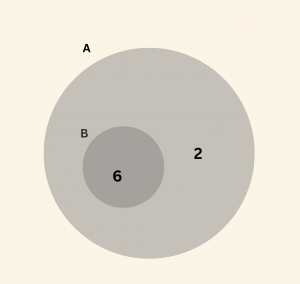
\[ \text{The maximum value of } s(A \cup B ) \quad \text{is } 13 \]
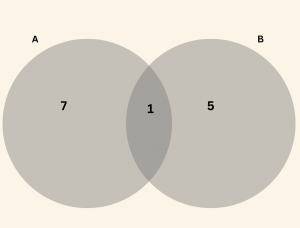
The sum of these two values is \( 6 + 13 = 19\).
\(\textbf{Answer: D} \)
5. Difference of Two Sets
Let A and B be two sets. The set formed by elements that are in A but not in B is called the difference set A minus B.
\[ A – B = A \setminus B = \{ x \mid x \in A \;\; \text{ and }\; x \notin B \} \]
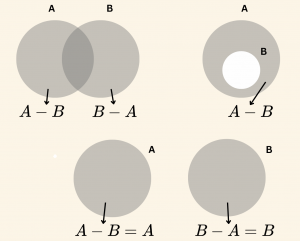
Properties:
\(1) \quad A-B = A \;- \; (A \cap B ) = A \cap B’ \)
\(2) \quad E \;-\; A = A’ \)
\(3) \quad (A\; -\; B) \cup (B \;- \; A ) = A \; \triangle \; B \; \) (Symmetric Difference)
Question 10
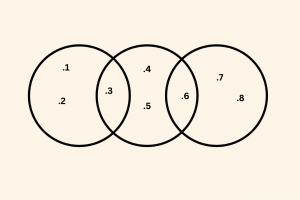
According to the diagram above, what is \(s ((B \setminus A) \cap (B \setminus C))\)?
\[
\text{A)} 1 \quad
\text{B) } 2 \quad
\text{C) } 3 \quad
\text{D) } 4 \quad
\text{E) } 5
\]
Solution:
\[ B \setminus A = \{ 4, 5, 6 \} \]
\[ B \setminus C = \{3, 4, 5 \} \]
\[ (B \setminus A ) \cap (B \setminus C ) = \{ 4, 5 \} \]
\[ \Rightarrow s((B \setminus A) \cap (B \setminus C)) = 2 \]
\(\textbf{Answer: B} \)
Question 11
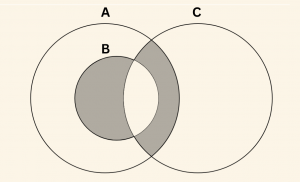
Which of the following expressions represents the shaded region in the figure?
\[
\text{A)}( A \; – \;B ) \cup C \quad
\text{B) } ( A\; – \;B ) \cap C \quad
\text{C) } ( A \cap C ) \cup B \quad
\text{D) } (C\; – \;B ) \cap A \quad
\text{E) } (B \;- \;C) \cup ((A \cap C )\; -\; B)
\]
Solution:
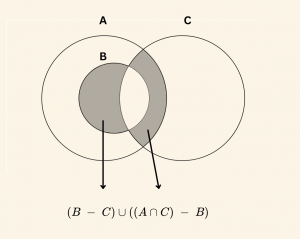
\(\textbf{Answer: E} \)
Question 12
Which of the following is equivalent to the expression \( [(A \cap B ) \cap (A \cup A’ )] \cup ( A \; -\; B) \)?
\[
\text{A)} A \quad
\text{B) } B \quad
\text{C) } A \cap B \quad
\text{D) }A’ \quad
\text{E) } B’
\]
Solution:
\[ [(A \cap B ) \cap (A \cup A’ )] \cup ( A \; -\; B) \]
\[ = [(A \cap B ) \cap E ] \cup ( A \cap B’) \]
\[ = [(A \cap B ) \cup (A \cap B’) ]= A \cap (B \cup B’) \]
\[ = A \cap E = A \]
\(\textbf{Answer: A} \)
Note:
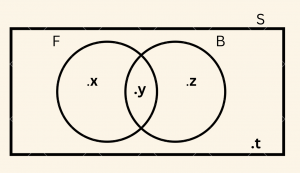
In a class consisting of \(x + y + z + t \) students;
\( \bullet \quad \) Let F be the set of students who play football,
\( \bullet \quad \) Let B be the set of students who play basketball,
Where x, y, z, and t denote the number of elements in their respective regions:
x: number of students who play only football,
y: number of students who play both football and basketball,
z: number of students who play only basketball,
t: number of students who do not play any of the games,
\( x + y+ z \) : number of students who play at least one game,
\( x + z + t \) : number of students who play at most one game.
Question 13
If \( s(A \cap B ) = s(A-B) = s(B-A), \,\; s(A’) = 5 \) and \(s(A’ \cap B’) = 3 \), then what is \( s(A \cup B)\)?
\[
\text{A)} 15 \quad
\text{B) } 12 \quad
\text{C) } 9 \quad
\text{D) } 6 \quad
\text{E) } 3
\]
Solution:
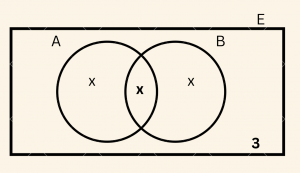 \[ \text{Let } s(A \cap B) = s(A-B) = s(B-A) = x \]
\[s(A’ \cap B’) = s[(A \cup B)’] = 3 \]
\[s(A’)= 5= x+3 \Rightarrow x= 2 \]
\[ s(A \cup B) = 3x = 6 \]
\(\textbf{Answer: D} \)
Question 14
Given that E is the Universal Set:
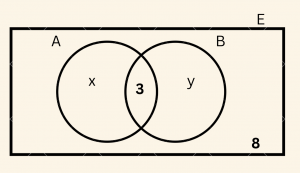
\[ \text{If } [s(A \cup B ) – s(A \cap B) ] = s(A’ \cap B’) = 8 \quad \text{and } \; s(A \cap B )= 3, \] what is \( s(E) \)?
\[
\text{A)} 17 \quad
\text{B) } 18 \quad
\text{C) } 19 \quad
\text{D) } 20 \quad
\text{E) } 21
\]
Solution:
\[ s(A’ \cap B’) = s[(A \cup B)’] = 8 \]
\[ s[(A \cup B) – s(A \cap B)] = 8 \implies x + y = 8 \]
\[ s(E) = x + y + 3 + 8 = 8 + 11 = 19\]
\(\textbf{Answer: C} \)
Question 15
If \[ s(A \; -\; B) = x^2, \quad s(A \cap B) = 16, \quad s(A)= 8x \;\; \text{and } \; s(A’ \cap B) = 4, \]
what is \(s(A \cup B ) \)?
\[
\text{A)} 36 \quad
\text{B) } 35 \quad
\text{C) } 34 \quad
\text{D) } 33 \quad
\text{E) } 32
\]
Solution:
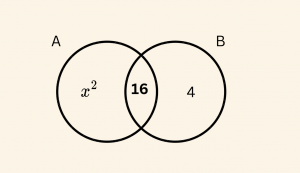
\[ s(A’ \cap B) = s( B-A) = 4 \]
\[s(A)= s(A-B) + s(A \cap B) \]
\[8x= x^2+16 \]
\[ \Rightarrow x^2 – 8x+16=0 \]
\[ (x-4)^2=0 \implies x= 4 \]
\[ s(A \cup B) = x^2 +16+4 = 36\]
\(\textbf{Answer: A} \)
Question 16
Given that E is the universal set:
\[ A \cup B \cup C = E, \quad B \subset A, \quad B \cap C = Ø, \]
\[ \text{and} \]
\[ s(C-A)= 10, \quad s(A)= 16 \quad \text{and } \;\; s(B’)=23, \]
what is \( s(B) \)?
\[
\text{A)} 1 \quad
\text{B) } 2 \quad
\text{C) } 3 \quad
\text{D) } 4 \quad
\text{E) } 5
\]
Solution:
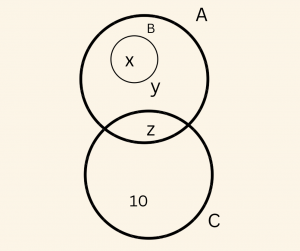
\[ s(B’)= 23 = y + z + 10 \Rightarrow y+z = 13 \]
\[\Rightarrow s(A)= 16 = x+y+z \]
\[\Rightarrow 16= x+13 \]
\[ x = s(B) = 3\]
\(\textbf{Answer: C} \)
Question 17
If \[ ( A \cap C ) \cup (B \cap C ) = Ø, \quad s[(A \cup B’)] = 9 \]
\[ \text{and} \]
\[ s[(A \cup B \cup C)’ ] = 4, \] what is s(C)?
\[
\text{A)} 2 \quad
\text{B) } 3 \quad
\text{C) } 4 \quad
\text{D) } 5 \quad
\text{E) } 6
\]
Solution:
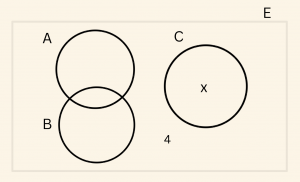
\[ ( A \cap C ) \cup (B \cap C ) = Ø \Rightarrow C \cap ( A \cup B) = Ø \]
\[ s[(A \cup B )’ ] = 9 = x+ 4 \]
\[\quad \Rightarrow x = 5 \quad \text{therefore} \]
\[ s(C) = 5 \]
\(\textbf{Answer: D} \)
Question 18
In a class, there are 14 students who play exactly one of the games basketball or volleyball, 21 students who play at least one of them, and 27 students who play at most one of them. Based on this, what is the total number of students in the class?
\[
\text{A)} 30 \quad
\text{B) } 31 \quad
\text{C) } 32 \quad
\text{D) } 33 \quad
\text{E) } 34
\]
Solution:
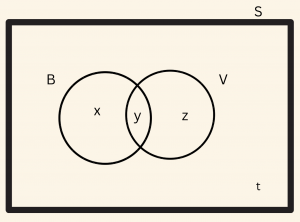
Let B be the set of students who play basketball, and V be the set of students who play volleyball. According to the diagram, the total number of students who play only one game is: \[ x + z = 14 \] The number of students who play at least one game is: \[ x + y + z = 21 \] The number of students who play at most one game is: \[ x + z + t = 27 \] From here, let’s find t: \[ 14 + t = 27 \Rightarrow t = 13 \] Consequently, the total class size is: \[ x + y + z + t = 21 + 13 = 34 \]
\(\textbf{Answer: E} \)
Question 19
In a class of 45 students, 15 students passed the English course. 13 students failed mathematics, and 6 students failed both courses. Accordingly, how many students passed exactly one course in this class?
\[
\text{A)} 30 \quad
\text{B) } 31 \quad
\text{C) } 32 \quad
\text{D) } 33 \quad
\text{E) } 34
\]
Solution:
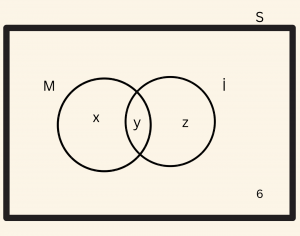
Total class size: \[ x + y + z + 6 = 45 \] \[ x + y + z = 39 \]
Number of students who passed English:
\[ y + z = 15 \] \[ x + 15 = 39 \Rightarrow x = 24 \]
Number of students who failed mathematics:
Since the number of students who failed mathematics is given as:
\[ z + 6 = 13 \quad \text{then } z = 7 \quad \]
Therefore, the number of students who passed exactly one course is:
\[x + z = 24 + 7 = 31 \]
\(\textbf{Answer: B} \)
Question 20
In a group where everyone speaks at least one foreign language, all those who speak French also speak English. If the number of people who speak only German is 3, only English is 5, those who speak German is 6, and those who speak at least two languages is 7, how many people do not speak German?
\[
\text{A)} 6 \quad
\text{B) } 7 \quad
\text{C) } 8 \quad
\text{D) } 9 \quad
\text{E) } 10
\]
Solution:
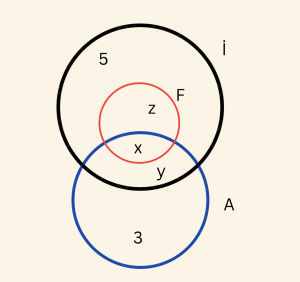
Let F represent the set of French speakers, İ the set of English speakers, and A the set of German speakers. Since there is no one who does not speak a foreign language, the set \( A \cup F \cup İ \) forms the universal set E. Since all French speakers speak English, \( F \subset İ \).
The number of people who speak German: \[ x + y + 3 = 6 \] \[ \Rightarrow x + y = 3 \] The number of people who speak at least two languages: \[ x + y + z = 7 \] \[ \Rightarrow 3 + z = 7 \] \[ \Rightarrow z = 4 \] The number of people who do not speak German: \[ z + 5 = 4 + 5 = 9 \]
\(\textbf{Answer: D} \)
Question 21
In a class where every student plays at least one of the games football, volleyball, or basketball, students who play football cannot play basketball. If the number of students who play only football is 4, only volleyball is 5, both football and volleyball is 3, those who play football or basketball is 14, and those who play volleyball is 11, how many students play only basketball?
\[
\text{A)} 1 \quad
\text{B) } 2 \quad
\text{C) } 3 \quad
\text{D) } 4 \quad
\text{E) } 5
\]
Solution:
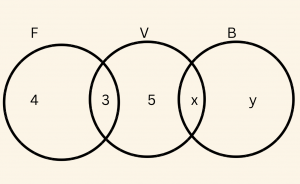
Let F denote the set of football players, V the set of volleyball players, and B the set of basketball players. Since this class consists of students playing at least one of the three games, \[ F \cup B \cup V \] is the universal set. Since football players do not play basketball: \[ F \cap B = Ø \]
The number of students who play football or basketball:
\[ 4 + 3 + x + y = 14 \implies x + y = 7 \]
The number of students who play volleyball:
\[ 3 + 5 + x = 11 \implies x = 3 \]
The number of students who play only basketball:
\[ y = 7 – x \implies 7 – 3 = 4. \]
\(\textbf{Answer: D} \)
← Previous Page | Next Page →