
Cartesian Product
Let \( A\) and \( B \) be two non-empty sets. The set of all ordered pairs whose first component is from \( A\) and whose second component is from \( B \) is called the Cartesian product of \( A\) and \( B \). It is denoted by \( A \times B \) and read as “\( A\) Cartesian product \( B \)”. Accordingly,
\[ A \times B = \{ (x,y ) \;| \; x \in A \quad \text{and } \quad y \in B \} \]
Definition: The Cartesian product of two sets is the set of all ordered pairs formed by taking one element from the first set and one element from the second set.
Example:
Let us consider the following sets: Let \( A = \{1, 2\} \) and \( B = \{a, b\} \).
In this case, \( A \times B \) consists of the following ordered pairs:
\[ A \times B = \{ (1, a ), (1,b ), (2,a ), (2, b )\}\]
These ordered pairs can be represented as points in the Cartesian coordinate system.
2. Meanings of Mathematical Symbols
\( \bullet \) Ordered Pair ( x, y ) : Represents pairs where the first element is \(x \), and the second element is \(y \). This notation is particularly used in Cartesian products and coordinate systems.
\( \bullet \) Curly Braces ( { } ) : Used to specify the elements of a set. For example, the set {1, 2, 3 } contains the elements 1, 2, and 3.
\( \bullet \) Vertical Bar ( | ) : Used in set-builder notation to mean “such that”. For example, the expression \( \{ x \; | \; x > 0 \} \) means “x such that x is positive”.
Note: In the definition of the Cartesian product, since both components of the ordered pairs must be elements of their respective sets, the conjunction “and” or the mathematical logic symbol “\( \land \)” is used.
Example:
If \( A= \{1, 2, 3 \} \) and \( B= \{a, b \} \), then
\[ A \times B = \{ (1, a ), (1, b), (2, a), (2, b), (3, a ), (3, b )\} \]
\[ B \times A = \{ (a, 1 ), (a, 2 ), (a, 3), (b, 1), (b, 2 ), (b, 3) \} \]
Warning:
\[ A \times A = \{ (x,y ) \;| \; x \in A \quad \text{and } \quad y \in A \} \]
If \( A= \{1, 2 \} \), then
\[ A \times A = \{ (1,1 ), (1,2 ), (2,1 ), (2,2 ) \} \]
Warning:
\[ A \times B \times C = \{ (x,y, z ) \;| \; x \in A \quad \text{and } \quad y \in B \quad \text{and } \quad z \in C \} \]
If \( A= \{1, 2 \}, \quad B =\{ a, b \}, \quad C = \{n\} \) then
\[ A \times B \times C = \{ (1,a, n ), (1,b,n ), (2,a,n ), (2,b,n ) \}\]
Properties of the Cartesian Product:
\( 1) \quad \) The Cartesian product does not have the commutative property.
\[ A \times B \neq B \times A \quad (A \neq B)\]
\( 2) \quad \) The Cartesian product has the associative property.
\[A \times B \times C = A \times (B \times C ) = (A \times B) \times C \]
\( 3) \quad \) The Cartesian product distributes over set operations.
\[ A \times (B \cap C) = (A \times B) \cap (A \times C) \]
\[ A \times (B \cup C) = (A \times B) \cup (A \times C) \]
\[ A \times (B \; – \; C) = (A \times B) \; – \; (A \times C) \]
\( 4) \quad \) Cardinality of the Cartesian product:
\[ s(A \times B ) = s(B \times A) = s(A) \cdot s(B) \]
\( 5) \quad \) In the Cartesian product, notations like
\[ A \times A = A^2, \quad A \times A \times A = A^3 \] are used.
Question 3
If \[ A= \{ x \; | \; -3 < x < 5, \;\; x \in \mathbb{Z} \} \] and \[ B = \{ x \; : \; |x | \le 2, \;\; x \in \mathbb{Z} \} \] then what is \( s( A \times B) \)?
Note: The colon ” : ” used in set B and the vertical bar ” | ” used in set A both mean “such that”. In set B, ” : ” was preferred to avoid confusion with the absolute value bars.
\[
\text{A)} 22 \quad
\text{B) } 25 \quad
\text{C) } 28 \quad
\text{D) } 30 \quad
\text{E) } 35
\]
Solution:
Since \[-3 < x < 5 \quad \text{and } \quad x\in \mathbb{Z} \]
\[ A = \{ -2, -1, 0, 1 , 2, 3, 4 \} \quad \text{and } \quad s(A) = 7 \]
Since \[ |x| \le 2 \Rightarrow -2 \le x \le 2 \quad \text{and } x \in \mathbb{Z} \]
\[ B = \{-2, -1, 0, 1, 2 \} \quad \text{and} \quad s(B)= 5 \]
Therefore,
\[ s( A \times B )= s(A) \cdot s(B) = 7 \cdot 5 = 35 \]
\(\textbf{Answer: E} \)
Question 4
If \[ s ( ( A \times B) \cap (A \times C) )= 6 \quad \text{and } \quad s(B \cap C) = 2 \] then what is \( s(A) \)?
\[
\text{A)} 1 \quad
\text{B) } 2 \quad
\text{C) } 3 \quad
\text{D) } 4 \quad
\text{E) } 6
\]
Solution:
\[ s(A \times B ) \cap s(A \times C) = 6 \Rightarrow s(A \times (B \cap C)) = 6 \]
\[ \Rightarrow s(A) \cdot s( B \cap C ) = 6 \]
\[ \Rightarrow s(A) \cdot 2 = 6 \]
\[ \Rightarrow s(A)= 3 \]
\(\textbf{Answer: C} \)
Graph of the Cartesian Product:
Before moving on to the graph of the Cartesian product, let us introduce the rectangular coordinate system. The system formed on a plane by two number axes drawn perpendicular to each other at their origin (zero point) is called a rectangular coordinate system (Cartesian coordinate system).
\(\bullet \quad Ox \) horizontal axis is called the axis of abscissas,
\( \bullet \quad Oy \) vertical axis is called the axis of ordinates.
If a point \( P \) in the plane is represented by the ordered pair \( (a, b )\), it is denoted as \( P(a,b) \). The ordered pair \( (a, b )\) is called the coordinates of \( P \), the number \(a \) is the abscissa of \( P \), and the number \( b\) is the ordinate of \( P \).
The intersection of the perpendicular line drawn to the \( Ox\) axis from the point with abscissa a on the \( Ox\) axis, and the perpendicular line drawn to the \( Oy\) axis from the point with ordinate \( b\) on the \( Oy\) axis gives the point \(P(a,b) \).
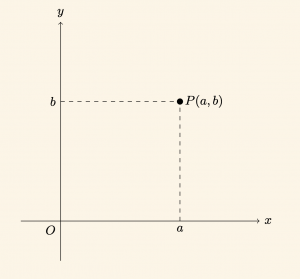
In this way, every ordered pair \( (x,y) \; \in \mathbb{R} \times \mathbb{R} \) corresponds to exactly one point \(P \) in the plane. Thus, the points of the plane form the Cartesian product \( \mathbb{R} \times \mathbb{R}\).
Here, the intersection point of the axes, \( O \), represents the origin corresponding to the ordered pair \( (0, 0) \).
Based on this information, to sketch the graph of \(A \times B \), the elements of \( A\) are taken on the horizontal axis (\(Ox \) axis) and perpendiculars are drawn from these points. The elements of \( B\) are taken on the vertical axis (\( Oy\) axis) and lines are drawn parallel to the horizontal axis. The set of all intersection points of these lines in the plane yields the graph of \( A \times B \).
Example:
If \( A= \{ 1,2,3 \} \) and \( B = ( -1, 2 ] \), let us sketch the graph of \( A \times B \).
On the horizontal axis, perpendicular lines are drawn from the points with abscissas \( 1, 2\) and \( 3\). On the vertical axis, lines are drawn from the points representing real numbers between \(-1 \) (excluded) and \( 2\) (included). The set of intersection points of these lines gives the graph of \( A \times B \).
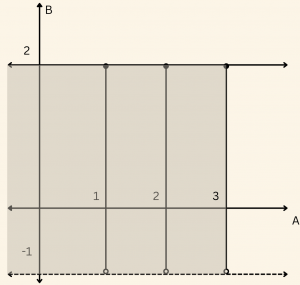
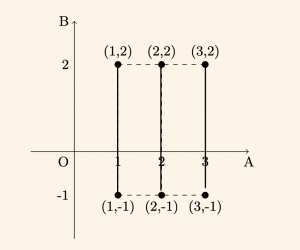
The three vertical line segments in the figure represent the graph of \( A \times B \).
Example:
If \( A= \{1,2,3\} \) and \( B = [-1, 2] \), let us sketch the graph of \(B \times A \).
On the horizontal axis, lines are drawn from the points representing real numbers between -1 (included) and 2 (included). On the vertical axis, perpendicular lines are drawn from the discrete points 1, 2, and 3. The intersection of these lines yields three horizontal line segments which form the graph of \( B \times A \).
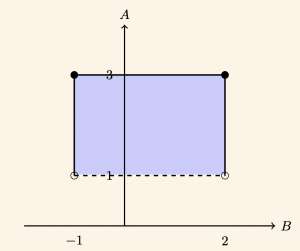
The three line segments in the figure represent the graph of \( B \times A \).
Example:
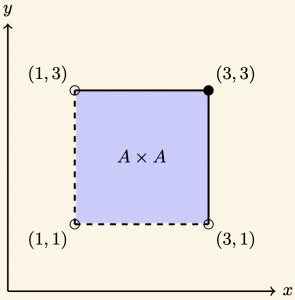
If \( A = (1, 3] \), let us sketch the graph of \( A \times A \).
Example:
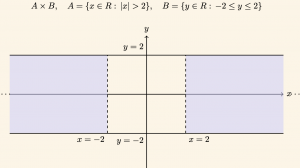
Given \( A= \{ x: |x| > 2, x \in \mathbb{R} \}\) and \( B = \{y | -2 \le y \le 2, y \in \mathbb{R} \} \), let us sketch the graph of \( A \times B \).
\[ |x| >2 \Rightarrow x > 2 \quad \text{or} \quad x < -2 \quad \text{so, } \]
\[ A = (-\infty, -2 ) \cup (2, \infty) \quad \text{and } \quad B= [-2,2 ] \]
← Previous Page | Next Page →