
Trigonometry 1
Directed Angles
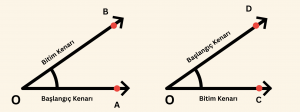
In a plane, the union of two rays sharing a common endpoint is called an angle, and the common endpoint is called the vertex of the angle. One of the two rays forming the angle is called the initial side, and the other is called the terminal side.
\[
\widehat{AOB} = \{ [OA), [OB) \}, \quad
\widehat{DOC} = \{ [OD), [OC) \}
\]
There are two ways to rotate around the vertex from the initial side to the terminal side:
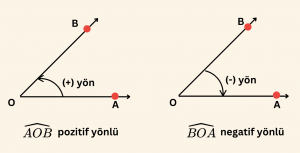
1) Counter-clockwise rotation is defined as the positive direction.
2) Clockwise rotation is defined as the negative direction.
\[
\widehat{AOB} \textbf{ is positively directed} \quad\quad
\widehat{BOA} \textbf{ is negatively directed}
\]
\[
\text{m}(\widehat{AOB}) = – \text{m}(\widehat{BOA})
\]
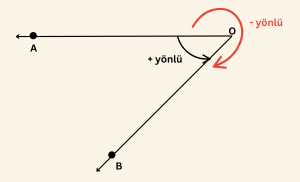
Example:
In the figure below, the angle \( \widehat{AOB} \) has a positive direction, while the angle \( \widehat{BOA} \) has a negative direction.
← Previous Page | Next Page →