
Surjective Function (Onto Function)
Provided that $s(A) \geq s(B)$,
let $f: A \to B$ be a given function. If there are no unmapped elements left in the codomain $B$, then this function is called a surjective function. In other words, the range equals the codomain, denoted as $f(A) = B$.
Examples:
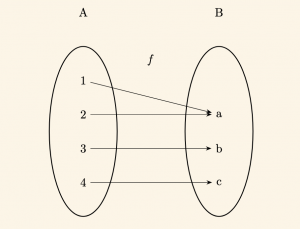
1) The function $f: \;A \to B$ is surjective because every element in the codomain $B$ has a corresponding pre-image in the domain $A$.
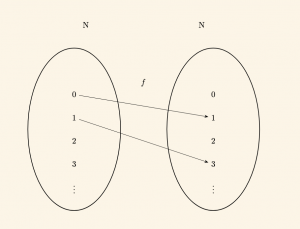
2) The function $f: \;\mathbb{N} \to \mathbb{N}, \quad f(x) = 2x+1$ is not surjective because there are elements left unmapped in the codomain $\mathbb{N}$. Therefore, it is an into function.
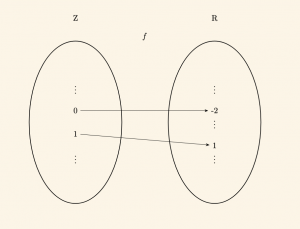
3) The function $f: \;\mathbb{Z} \to \mathbb{R}, \quad f(x) = 3x-2$ is not surjective because elements are left unmapped in the codomain $\mathbb{R}$ (i.e., $f(\mathbb{Z}) \neq \mathbb{R}$). Therefore, it is an into function.
Key Method:
To determine whether a function $f: A \to B, \;\; y= f(x)$ is surjective, express $x$ analytically in terms of $y$. If the resulting value of $x$ belongs to the domain $A$ for every element $y$ chosen from the codomain $B$, then the function is surjective.
Example:
Let us analyze whether the function $f: \mathbb{Z} \to \mathbb{Z}, \quad y = f(x) = 2x + 3$ is surjective.
Rearranging $y = 2x + 3$ yields $x = \frac{y – 3}{2}$. Since $x$ will not be an integer for every integer choice of $y$, this function is not surjective. Therefore, it is an into function.
For instance, if $y = 4$, then $x = \frac{4 – 3}{2} = \frac{1}{2} \notin \mathbb{Z}$.
QUESTION 19
Given $s(A) = n^2 – 4$ and $s(B) = 3n$, what is the minimum value of $n$ for which the function $f: \; A \to B$ can be surjective?
\[
\text{A) } 1 \quad
\text{B) } 2 \quad
\text{C) } 3\quad
\text{D) } 4 \quad
\text{E) } 5
\]
Solution:
For a function $f: A \to B$ to be surjective, the cardinality of the domain must be greater than or equal to the cardinality of the codomain, meaning $s(A) \geq s(B)$. If $s(A) < s(B)$, it is mathematically impossible for the function to map onto the entire codomain. \[ s(A) \geq s(B) \Rightarrow n^2 – 4 \geq 3n \] \[ \Rightarrow n^2 – 3n – 4 \geq 0 \] \[ \Rightarrow (n – 4)(n + 1) \geq 0 \] Since the cardinality requires $n$ to be a positive value, we have $n + 1 > 0$, which implies that $n – 4 \geq 0$ must hold true.
Thus, the minimum valid value for $n$ is 4.
\(\textbf{Correct Answer: D} \)
← Previous Page | Next Page →