
Analyzing the Signs of the Roots of a Quadratic Equation
By utilizing the graph (parabola) of the quadratic function \(f(x) = ax^2 + bx + c\), we can determine both the existence and the signs of the roots of the quadratic equation \(ax^2 + bx + c = 0\).
\( 1. \quad \) \(\Delta = b^2 – 4ac < 0\)
If \(b^2-4ac < 0 \), the equation has no real roots; therefore, analyzing the signs of the roots is not applicable.
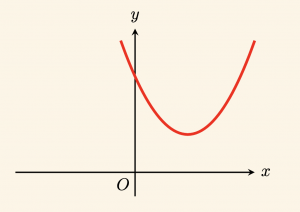
\( 2. \quad \) \(\Delta = b^2 – 4ac = 0\)
In this case, the equation has two equal real roots (a double root). Let the roots of the equation be \(x_1\) and \(x_2\), where \(x_1 = x_2\).
a) \(x_1 + x_2 < 0 \Leftrightarrow x_1 = x_2 < 0\)
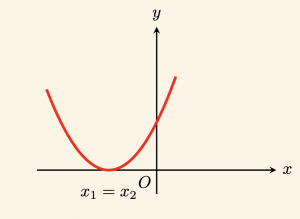
There are two equal negative real roots.
b) \(x_1 + x_2 = 0 \Leftrightarrow x_1 = x_2 = 0\)
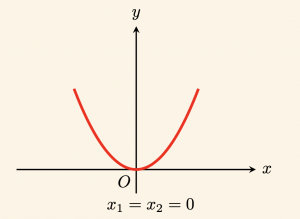
The roots of the equation are located at the origin.
c) \(x_1 + x_2 > 0 \Leftrightarrow x_1 = x_2 > 0\)
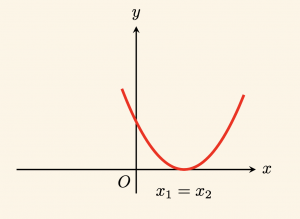
There are two equal positive real roots.
\( 3. \quad \) \(\Delta = b^2 – 4ac > 0\)
In this case, the equation has two distinct real roots. Let the roots of the equation be \(x_1\) and \(x_2\), where \(x_1 < x_2\).
a)
\[
\left.
\begin{aligned}
x_1 \cdot x_2 > 0 \\
x_1 + x_2 > 0
\end{aligned}
\right\} \Leftrightarrow 0 < x_1 < x_2 \\
\]
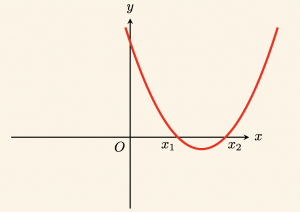
There are two distinct positive roots.
b)
\[
\left.
\begin{aligned}
x_1 \cdot x_2 > 0 \\
x_1 + x_2 < 0
\end{aligned}
\right\} \Leftrightarrow x_1 < x_2 < 0 \\
\]
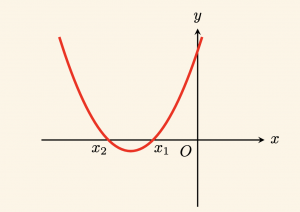
There are two distinct negative roots.
c)
\[
\left.
\begin{aligned}
x_1 \cdot x_2 < 0 \\
x_1 + x_2 > 0
\end{aligned}
\right\} \Leftrightarrow x_1 < 0 < x_2 \text{ and } |x_1| < x_2 \\
\]
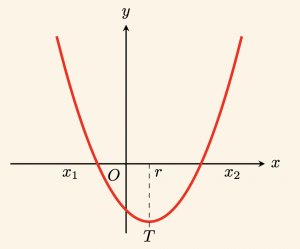
The roots have opposite signs, and the root with the larger absolute value is positive.
d)
\[
\left.
\begin{aligned}
x_1 \cdot x_2 < 0 \\
x_1 + x_2 < 0
\end{aligned}
\right\} \Leftrightarrow x_1 < 0 < x_2 \text{ and } |x_1| > x_2 \\
\]
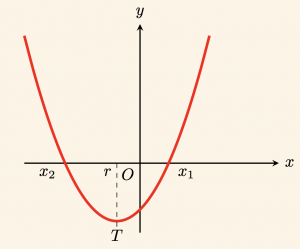
The roots have opposite signs, and the root with the larger absolute value is negative.
e)
\[\left.
\begin{aligned}
x_1 \cdot x_2 < 0 \\
x_1 + x_2 = 0
\end{aligned}
\right\}
\Leftrightarrow x_1 < 0 < x_2 \text{ and } \quad |x_1| = x_2 \]
The roots have opposite signs and equal absolute values.
f)
\[\left.
\begin{aligned}
x_1 \cdot x_2 = 0 \\
x_1 + x_2 > 0
\end{aligned}
\right\}
\Leftrightarrow x_1 = 0 < x_2 \]
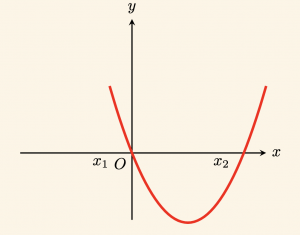
One root is zero and the other root is positive.
g)
\[ \left.
\begin{aligned}
x_1 \cdot x_2 = 0 \\
x_1 + x_2 < 0
\end{aligned}
\right\}
\Leftrightarrow x_1 < 0 = x_2 \]
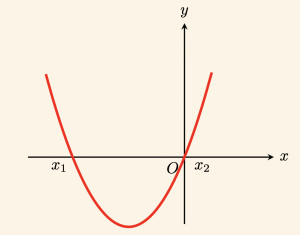
One root is zero and the other root is negative.
Example:
Analyze the existence and signs of the roots for the equation \(x^2 – (m^2 + 1)x\; – m^2 \;- 1 = 0\).
Since \(a = 1 > 0\) and \(c = -m^2\; – 1 < 0\), the discriminant satisfies \(\Delta > 0\). Thus, the equation has two distinct real roots. Let these roots be \(x_1\) and \(x_2\), where \(x_1\; <\; x_2\).
\[
\left.
\begin{aligned}
&x_1 \cdot x_2 = -m^2 – 1 < 0 \\
&x_1 + x_2 = m^2 + 1 > 0
\end{aligned}
\right\}
\text{ therefore, } x_1 < 0 < x_2 \text{ and } |x_1| < x_2.
\]
Example:
Analyze the existence and signs of the roots for the equation \(16x^2 -\; 1000x + 5^6 = 0\).
\[
\Delta = (-1000)^2 – 4 \cdot 16 \cdot 5^6 = 10^6 – 2^6 \cdot 5^6 = 0
\]
Since the discriminant is zero, the equation has a double root. Let the roots be \(x_1\) and \(x_2\).
\[
x_1 + x_2 = -\frac{-1000}{16} = \frac{125}{2} > 0 \Rightarrow x_1 = x_2 > 0.
\]
Question 29
Given that the roots \(x_1\) and \(x_2\) of the equation \(mx^2 -\; 2(1 – \;m)x + m -\; 2 = 0\) satisfy the relations \(x_1 < 0 < x_2\) and \(x_2 < |x_1|\), which of the following statements regarding \(m\) is correct?
\[ \text{A) } m < 0\ \quad
\text{B) } 0 < m < 1\ \quad
\text{C) } 1 < m < 2 \quad
\text{D) }2 < m < 3 \quad
\text{E) } m > 3 \]
Solution:
Consider the given equation:
\[
mx^2 – 2(1 – m)x + m – 2 = 0
\]
From \(x_1 < 0 < x_2\), the product of the roots must be negative: \[x_1 \cdot x_2 = \frac{m – 2}{m} < 0\]
Since \(x_1 < 0\), we have \(|x_1| = -x_1\).
Furthermore, \(x_2 < |x_1| \Rightarrow x_2 < -x_1 \Rightarrow x_1 + x_2 < 0\). Thus, the sum of the roots must be negative:
\[
x_1 + x_2 = \frac{2(1 – m)}{m} < 0
\]
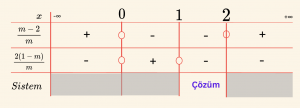
\[
\text{The solution set is } S = \{ m \mid 1 < m < 2,\ m \in \mathbb{R} \}.
\]
\(\textbf{Correct Answer: C} \)
← Previous Page | Next Page →