
The Parabola
\( x = f(y) = Ay^2 + By + C \)
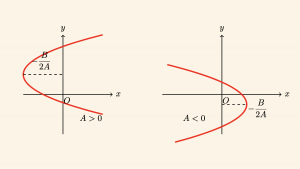
The parabola of the form \( x = Ay^2 + By + C \) is analyzed in a manner entirely analogous to the vertical parabola \( y = ax^2 + bx + c \), but with the roles of the axes reversed.
\[
\text{Y-coordinate (ordinate) of the vertex: } \frac{-B}{2A}
\]
Example:
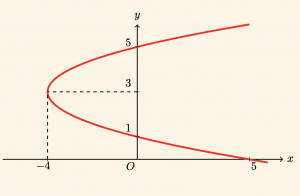
Let us sketch the parabola \( x = f(y) = y^2 – 6y + 5 \).
The y-coordinate of the vertex is:
\[
k = \frac{-(-6)}{2 \cdot 1} = 3
\]
and its x-coordinate is:
\[
h = f(3) = 3^2 – 6 \cdot 3 + 5 = 9 – 18 + 5 = -4
\]
Thus, the vertex is located at \( T(-4, 3) \).
Let us find the intercepts with the coordinate axes:
\[
\text{For } x = 0 \quad \Rightarrow \quad y^2 – 6y + 5 = 0 \quad \Rightarrow \quad y = 1 \quad \text{ or } \quad y = 5
\]
\[
\text{For } y = 0 \quad \Rightarrow \quad x = 0^2 – 6 \cdot 0 + 5 = 5
\]
Furthermore, since the leading coefficient is \( A = 1 > 0 \), the parabola opens to the right (towards the positive direction of the x-axis).
Example:
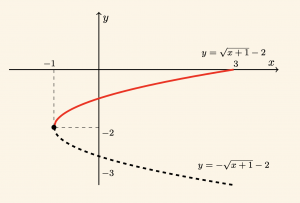
Let us sketch the curve \( y = \sqrt{x + 1} \; – \; 2 \).
Rearranging the equation to reveal its parabolic nature:
\[ y = \sqrt{x + 1} – 2 \Rightarrow (y + 2)^2 = x + 1 \]
\[\Rightarrow x = (y + 2)^2 – 1 \]
This matches a horizontal parabola with its vertex at \( (-1, -2) \).
Let us find the intercepts:
\[
\text{For } x = 0 \quad \Rightarrow \quad (y + 2)^2 – 1 = 0 \quad \Rightarrow \quad y = -1 \quad \text{ or } \quad y = -3
\]
\[
\text{For } y = 0 \quad \Rightarrow \quad 0 = \sqrt{x + 1} – 2 \Rightarrow \sqrt{x + 1} = 2 \Rightarrow x + 1 = 4 \Rightarrow x = 3
\]
Because the original function is defined via a principal square root, we must respect its domain and range constraints:
\[
x + 1 \geq 0 \Rightarrow x \geq -1 \quad \text{and} \quad y \geq -2
\]
This means the graph represents only the upper half of the horizontal parabola.
Example:
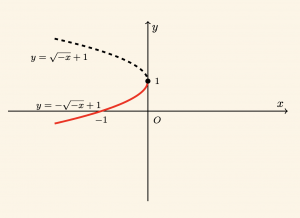
Let us sketch the curve \( y = -\sqrt{-x} + 1 \).
Isolating the radical and squaring both sides:
\[ y – 1 = -\sqrt{-x} \Rightarrow (y – 1)^2 = (- \sqrt{-x})^2 \]
\[ \Rightarrow (y – 1)^2 = -x \Rightarrow x = – (y – 1)^2 \]
The vertex of this horizontal parabola is at \( (0, 1) \). Finding the x-intercept:
\[
\text{For } y = 0 \quad \Rightarrow \quad x = -(0 – 1)^2 = -1 \quad \Rightarrow \quad (-1, 0)
\]
Since the coefficient \( A = -1 < 0 \), the parabola opens to the left (towards the negative side of the x-axis).
Given the restrictions of the original square root function:
\[
-x \geq 0 \Rightarrow x \leq 0 \quad \text{and} \quad y \leq 1
\]
The graph represents only the lower half of this horizontal parabola.
QUESTION 22
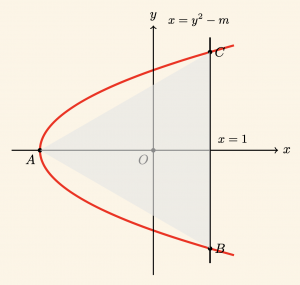
In the figure above, the parabola \( x = y^2 – m \) intersects the vertical line \( x = 1 \) at points B and C. Knowing that \(\triangle ABC\) is an equilateral triangle, find the value of \( m \).
\[
\text{A)} 4 \sqrt{ 3} \quad
\text{B) } 2 \sqrt{ 3} \quad
\text{C) } \sqrt{ 3} \quad
\text{D) } 3 \quad
\text{E) } 2
\]
Solution:
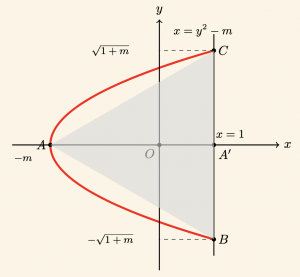
First, find the coordinates of vertex A by setting \( y = 0 \) in the parabola’s equation:
\[ x = 0^2 – m = -m \quad \Rightarrow \quad A(-m, 0) \]
Next, find the coordinates of points B and C by substituting \( x = 1 \) into the equation of the parabola:
\[ 1 = y^2 – m \Rightarrow y^2 = 1 + m \Rightarrow y = \pm\sqrt{1 + m} \]
This gives us the intersection coordinates:
\[ B(1, -\sqrt{1 + m}) \quad \text{and} \quad C(1, \sqrt{1 + m}) \]
From these coordinates, we can deduce the length of the vertical base \( BC \) and the horizontal altitude \( AA’ \) (where \( A’ \) is at \( (1,0) \)):
\[ |BC| = 2\sqrt{1 + m} \]
\[ |AA’| = 1 – (-m) = 1 + m \]
Since \(\triangle ABC\) is an equilateral triangle, its altitude relates to its base side length via the standard geometric formula \( \text{Altitude} = \displaystyle\frac{\text{Base} \cdot \sqrt{3}}{2} \):
\[ |AA’| = \frac{|BC| \cdot \sqrt{3}}{2} \]
\[ \Rightarrow 1 + m = \frac{2\sqrt{1 + m} \cdot \sqrt{3}}{2} \]
\[ \Rightarrow 1 + m = \sqrt{3}\sqrt{1 + m} \]
Squaring both sides of the equation yields:
\[ (1 + m)^2 = 3(1 + m) \]
\[ \Rightarrow (1 + m)^2 – 3(1 + m) = 0 \]
\[ \Rightarrow (1 + m)[(1 + m) – 3] = 0 \]
\[ \Rightarrow (1 + m)(m – 2) = 0 \]
This gives two possible algebraic solutions: \( m = -1 \) or \( m = 2 \). Since the graph indicates that vertex A lies on the negative x-axis, \( -m \) must be negative, meaning \( m > 0 \). Therefore, \( m = 2 \).
\(\textbf{Correct Answer: E} \)
QUESTION 23
The linear function \( y = x + b \) and the horizontal parabola \( x = y^2 + 2y + a \) intersect at two points, A and B. What is the sum of the y-coordinates (ordinates) of these two intersection points?
\[
\text{A)} -3 \quad
\text{B) } -2\quad
\text{C) } -1\quad
\text{D) } 0 \quad
\text{E) } 1
\]
Solution:
To find the coordinates of the intersection points, we solve the system of equations simultaneously. We can substitute \( x = y – b \) from the linear equation directly into the parabola equation:
\[
\left.
\begin{aligned}
x &= y – b \\
x &= y^2 + 2y + a
\end{aligned}
\right \}
\Rightarrow y – b = y^2 + 2y + a
\]
Rearranging all terms to one side gives a standard quadratic equation in terms of \( y \):
\[ y^2 + y + a + b = 0 \]
The roots of this equation, \( y_1 \) and \( y_2 \), correspond precisely to the y-coordinates of the intersection points A and B. Using Vieta’s formulas, the sum of the roots is given by \( -\frac{B}{A} \):
\[ y_1 + y_2 = -\frac{1}{1} = -1 \]
\(\textbf{Correct Answer: C} \)
← Previous Page | Next Page →