
Finding the Equation of a Parabola
1) \( \quad y = ax^2 + bx + c \)
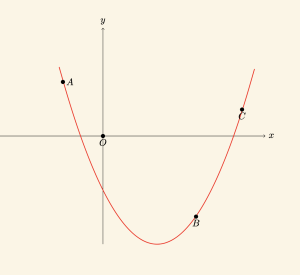
If any three points on the parabola are given, we can substitute these coordinates into the general form of the quadratic equation to determine the coefficients $a, b,$ and $c$, thereby finding the equation of the parabola.
Example:
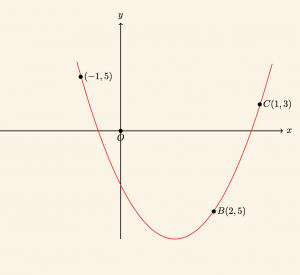
Let us find the equation of the parabola shown in the figure.
By substituting the coordinates of the given points on the parabola into the general form
\[
y = ax^2 + bx + c
\]
we obtain the following system of linear equations:
For \( A(-1 , 5) \): \( a – b + c = 5 \),
For \(B(2 , 5) \): \( 4a + 2b + c = 5 \), and
For \( C(1 , 3) \): \( a + b + c = 3 \).
Solving this system of equations simultaneously yields:
\[ a = 1, \quad b = -1 \quad \text{and } c = 3 \]
Therefore, the equation of the parabola is:
\[ y = ax^2 + bx + c \Rightarrow y = x^2 – x + 3 \]
2) If the x-intercepts of the parabola and any additional point on it are given, its equation can be found using the factored form:
\[ y = a(x – x_1)(x – x_2) \]
Example:
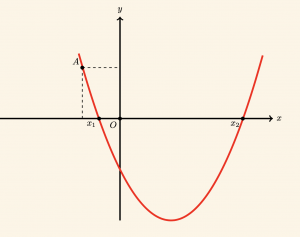
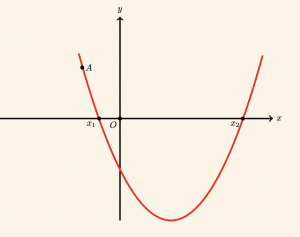
Let us determine the equation of the parabola shown above. Since the x-intercepts are located at
\[ x_1 = -1 \quad \text{and } x_2 = 2, \]
we substitute them into the factored form expression:
\[ y = a(x + 1)(x – 2) \]
To find the value of the leading coefficient \( a \), we substitute the given point \( (-2, \frac{5}{3}) \) into this equation:
For \( x = -2 \): \( y = \frac{5}{3} = a(-2 + 1)(-2 – 2) \)
\[ \Rightarrow a = \frac{5}{12} \quad \text{and the equation is } y = \frac{5}{12} (x + 1)(x – 2). \]
3) If the vertex of the parabola and any other point on it are given, its equation can be found using the vertex form:
\[ y = a(x – r)^2 + k \]

Example:

Let us find the equation of the parabola with vertex T shown in the figure.
Since the coordinates of the vertex are:
\[ r = -1 \quad \text{and } \quad k = 4, \]
substituting these into the vertex form \( y = a(x – r)^2 + k \) yields:
\[ y = a(x + 1)^2 + 4 \]
To find the value of \( a \), we substitute the y-intercept \( (0, 3) \) into this equation:
\[ \text{For } x = 0: \quad y = 3 = a(0 + 1)^2 + 4 \]
\[ \Rightarrow a = -1 \quad \text{and the equation is } y = -(x + 1)^2 + 4. \]
QUESTION 13
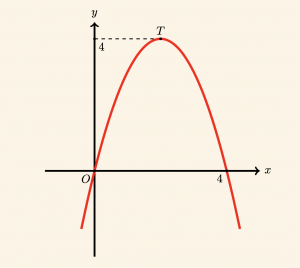
In the figure above, the parabola \( y = f(x) \) with vertex T passes through the origin. What is the value of \( f(5) \)?
\[
\text{A)} -6 \quad
\text{B) } -5 \quad
\text{C) } -4 \quad
\text{D) } -3 \quad
\text{E) } -2
\]
Solution:
Since the parabola intersects the x-axis at
\[ x_1 = 0 \quad \text{and } \quad x_2 = 4, \]
we can express it in factored form as \( y = a(x – x_1)(x – x_2) \Rightarrow y = a x (x – 4) \). The x-coordinate of the vertex is given by the axis of symmetry:
\[
r = \frac{x_1 + x_2}{2} \Rightarrow r = \frac{0 + 4}{2} = 2.
\]
Thus, the vertex is \( T(2, 4) \). Substituting this point into our equation:
\[ \text{For } x = 2: \quad y = 4 = a \cdot 2 \cdot (2 – 4) \]
\[ \Rightarrow a = -1 \quad \text{which gives } f(x) = -x(x – 4). \]
Evaluating the function at \( x = 5 \):
\[ f(5) = -5(5 – 4) = -5 \]
\(\textbf{Correct Answer: B} \)
QUESTION 14

The figure above shows a parabola with vertex \( T(-2, -1) \). What is the area of triangle ATB in square units?
\[
\text{A)} 1 \quad
\text{B) } 2 \quad
\text{C) } 3 \quad
\text{D) } 4 \quad
\text{E) } 5
\]
Solution:
Given the vertex coordinates \( r = -2 \) and \( k = -1 \), the equation in vertex form is:
\[
y = a(x – r)^2 + k \Rightarrow y = a(x + 2)^2 – 1
\]
Substituting the y-intercept \( (0, 3) \) into the equation to solve for \( a \):
\[
\text{For } x = 0: \quad y = 3 = a(0 + 2)^2 – 1
\]
\[
\Rightarrow a = 1 \text{ and } y = (x + 2)^2 – 1
\]
Next, let us find the x-intercepts of the parabola by setting \( y = 0 \):
\[
y = (x + 2)^2 – 1 = 0 \Rightarrow x^2 + 4x + 3 = 0
\]
\[
\Rightarrow x = -3 \text{ or } x = -1
\]
This gives the points \( A(-3, 0) \) and \( B(-1, 0) \). The base of triangle ATB lies along the x-axis, and its length is:
\[
|AB| = |-1 – (-3)| = 2
\]
The height of the triangle is equal to the absolute value of the y-coordinate of the vertex \( T \):
\[
h = |k| = |-1| = 1
\]
Therefore, the area of triangle ATB is:
\[
\text{Area}(ATB) = \frac{ |AB| \cdot |k| }{2} = \frac{2 \cdot |-1|}{2} = 1 \text{ square unit.}
\]
\(\textbf{Correct Answer: A} \)
← Previous Page | Next Page →