
Properties of Binary Operations
1. Closure Property:
Let a binary operation \( \star \) be defined on a set $A$.
If \( \star \) is a function from \( A \times A \) to \( A \), then the set $A$ is said to be closed under the operation \( \star \). In this case,
\[\forall x, y \in A \quad \text{yields} \quad x \star y \in A \]
holds true.
When a Cayley table (operation table) is constructed, if all elements in the table belong to $A$, then the set $A$ is closed under this operation. If there is any element in the table that does not belong to $A$, then the set $A$ is not closed under this operation.
Example:
Let an operation \( \star \) be defined on the set \( A = \{ 1, 2 \} \) as \( x \star y = y^x \). Let us analyze the closure property of this operation.
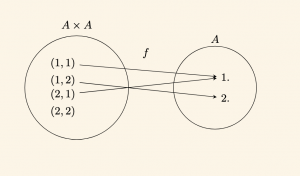 \( f(x, y) = x \star y = y^x \)
\( 1 \star 1 = 1^1 = 1 \in A \)
\( 1 \star 2 = 2^1 = 2 \in A \)
\( 2 \star 1 = 1^2 = 1 \in A \)
\( 2 \star 2 = 2^2 = 4 \notin A \)
Since the relation \( f \) here is not a function from \( A \times A \) to \( A \), the set \( A \) is not closed under the operation \(\star\). Furthermore, because the table contains an element (4) that does not belong to \( A \), it is clear that the set \( A \) is not closed under the operation \(\star\).
\[
\begin{array}{c|cccc}
\star & 1 & 2 &\\
\hline
1 & 1 & 2 \\
2 & 1 & 4 \\
\end{array}
\]
Example:
Let us analyze the closure property of the operation defined on the set of natural numbers \( N \) as \[ x \star y = \frac{x \cdot y + 1}{3} \].
For instance, for \( 1 \) and \( 4 \in N \), we have \( 1 \star 4 = \frac{1 \cdot 4 + 1}{3} = \frac{5}{3} \notin N \). Therefore, the set \( N \) is not closed under the operation \(\star\).
Example:
Let us analyze the closure property of the operation defined on the set of integers \( Z \) as
\[ x \circ y = x^2 + y^2 \]
Since \( x \circ y \in Z \) for all \(\forall x, y \in Z\), the set \( Z \) is closed under the operation \(\circ\).
2. Commutative Property:
Let a binary operation \(\star\) be defined on a set \( A \). If \( x \star y = y \star x \) for all \(\forall x, y \in A\), then the operation \(\star\) is commutative. When a Cayley table is constructed, if the table is symmetric with respect to its main diagonal, then the operation possesses the commutative property.
Example:
Let us analyze the commutative property of the operation \(\star\) defined on the set of real numbers \( \mathbb{R} \) as
\[ a \star b = ab + a + b + 1 \]
Since \[ x \star y = xy + x + y + 1 \] and \[ y \star x = yx + y + x + 1 \] yield \[ x \star y = y \star x \], the operation is commutative.
Example:
Let us analyze the commutative property of the operation \( o \) defined on the set of real numbers \( \mathbb{R} \) as
\[ a \circ b = \frac{ab}{a^2 + b^2} \]
Since \[ x \circ y = \frac{xy}{x^2 + y^2} \] and
\[ y \circ x = \frac{yx}{y^2 + x^2} \]
imply \( x \circ y = y \circ x \), the operation \( o \) is commutative.
Example:
Let us analyze the commutative property of the operation \( o \) defined on the Cartesian plane \( \mathbb{R}^2 \) as
\[ (a, b) \circ (c, d) = (2ac,\, 2b + d) \]
Since \[ (x, y) \circ (z, t) = (2xz,\, 2y + t) \] and
\[ (z, t) \circ (x, y) = (2zx,\, 2t + y) \]
show that \( (x, y) \circ (z, t) \neq (z, t) \circ (x, y) \), the operation \( o \) is not commutative.
Example
\[
\begin{array}{c|cccc}
\star & a & b & c & d\\
\hline
a & c & d & a & b \\
b & d & a & b & c \\
c & a & b & c & d \\
d & b & c & d & a
\end{array}
\]
Since the table for the operation \(\star\) is symmetric with respect to the main diagonal, it is commutative.
\[
\begin{array}{c|cccc}
o & 1 & 2 & 3 & 4\\
\hline
1 & 1 & 2 & 3 & 4 \\
2 & 2 & 3 & 4 & 1 \\
3 & 3 & 4 & 1 & 2 \\
4 & 4 & 1 & 1 & 3
\end{array}
\]
Since the table for the operation \( o \) is not symmetric with respect to the main diagonal, it is not commutative.
3. Associative Property:
Let a binary operation \(\star\) be defined on a set \( A \). If
\[ x \star y \star z = x \star (y \star z) = (x \star y) \star z \] for all \(\forall x, y, z \in A\), then the operation \(\star\) is associative.
Example:
Let us analyze the associative property of the operation \( o \) defined on the set of real numbers \( \mathbb{R} \) as
\[ a \circ b = a + b + 3 \]
Since \[ x \circ (y \circ z) = x + (y + z + 3) + 3 = x + y + z + 6 \]
and \[(x \circ y) \circ z = (x + y + 3) + z + 3 = x + y + z + 6 \]
yield \( x \circ (y \circ z) = (x \circ y) \circ z \), the operation \( o \) is associative.
Example:
Let us analyze the associative property of the operation \(\circ\) defined on the set of real numbers \(\mathbb{R}\) as \(a \circ b = ab + 3\).
\[
x \circ (y \circ z) = x(y \circ z) + 3
= x(yz + 3) + 3
= xyz + 3x + 3
\]
\[
(x \circ y) \circ z = (x \circ y)z + 3
= (xy + 3)z + 3
= xyz + 3z + 3
\]
Since \(x \circ (y \circ z) \neq (x \circ y) \circ z\), the operation \(\circ\) is not associative.
Example:
Let us determine whether the operation \(\star\) defined on the set \(A = \{a, b, c, d\}\) is associative.
\[
\begin{array}{c|cccc}
\star & a & b & c & d\\
\hline
a & b & c & d & a \\
b & c & d & a & b \\
c & d & a & b & c \\
d & a & b & c & d
\end{array}
\]
For instance, let us select \(x = a\), \(y = b\), and \(z = c\).
\[
x \star (y \star z)
= a \star (b \star c)
= a \star a = b
\]
\[
(x \star y) \star z
= (a \star b) \star c
= c \star c = b
\]
Similarly, by choosing different elements for \(x, y, z\), it can be verified that \[x \star (y \star z) = (x \star y) \star z\] always holds. Therefore, the operation is associative.
Note:
To verify the associative property of an operation \(\star\) defined on an $n$-element set $A$ exhaustively, \(n^3\) computations must be checked.
In the example above, since \(s(A) = 4\), a total of \(4^3 = 64\) combinations would need to be evaluated.
4. Identity Element:
Let a binary operation \(\star\) be defined on a set \(A\). If there exists an element \(e \in A\) such that for all \( \forall x \in A \)
\[
x \star e = e \star x = x
\]
then \(e\) is called the identity element of the operation \(\star\).
The identity obtained from the equation \(x \star e = x\) is called the right-identity element, while the identity obtained from \(e \star x = x\) is called the left-identity element.
An operation has a well-defined identity element if and only if its right-identity and left-identity elements exist and are equal. If an identity element exists, it is unique.
Example:
Find the identity element of the operation defined on the set of integers \( \mathbb{Z} \) as
\[
x \circ y = x + y + 2xy
\]
if it exists.
\[
x \circ e = x
\quad \Rightarrow \quad
x + e + 2xe = x
\quad \Rightarrow \quad
(1 + 2x)e = 0
\quad \Rightarrow \quad
e = 0 \in \mathbb{Z}.
\]
Thus, the right-identity element is \( e = 0 \).
\[
e \circ x = x
\quad \Rightarrow \quad
e + x + 2ex = x
\quad \Rightarrow \quad
(1 + 2x)e = 0
\quad \Rightarrow \quad
e = 0 \in \mathbb{Z}.
\]
Thus, the left-identity element is \( e = 0 \).
Consequently, the identity element of the operation \(\circ\) defined on \(\mathbb{Z}\) is \( e = 0 \).
Example:
Find the identity element of the operation defined on the set of natural numbers \( \mathbb{N} \) as
\[
x \Delta y = x + y + 3
\]
if it exists.
\[
x \Delta e = x
\quad \Rightarrow \quad
x + e + 3 = x
\quad \Rightarrow \quad
e = -3 \notin \mathbb{N}
\]
Since \(e = -3\) is not a natural number, there is no right-identity element.
\[
e \Delta x = x
\quad \Rightarrow \quad
e + x + 3 = x
\quad \Rightarrow \quad
e = -3 \notin \mathbb{N}
\]
Similarly, there is no left-identity element.
Therefore, the operation \(\Delta\) defined on \(\mathbb{N}\) does not have an identity element.
Example:
Let an operation be defined on the set of positive real numbers \(\mathbb{R}^+\) as \(x \star y = 2x + xy\). Let us find its identity element if it exists.
\[
x \star e = x \;\;\Rightarrow\;\; 2x + x e = x
\]
\[
\Rightarrow x + x e = 0
\]
\[
\Rightarrow x (1 + e) = 0
\]
Here, \(1 + e = 0 \Rightarrow e = -1 \notin \mathbb{R}^+\). Thus, a valid right-identity element does not exist within the given set.
\[
e \star x = x \;\;\Rightarrow\;\; 2e + e x = x
\]
\[
\Rightarrow (2 + x) e = x
\]
\[
\Rightarrow e = \frac{x}{2 + x}
\]
Since \(e\) is dependent on \(x\) (not constant), a left-identity element does not exist. Consequently, the operation \(\star\) defined on \(\mathbb{R}^+\) has no identity element.
Example:
Find the identity element of the operation defined on the set of negative integers \( \mathbb{Z}^- \) as
\[
x \circ y = x^2 – y^2
\]
if it exists.
\[
x \circ e = x \Rightarrow x^2 – e^2 = x
\]
\[
\Rightarrow e^2 = x^2 – x
\]
\[
\Rightarrow \sqrt{e^2} = \sqrt{x^2 – x}
\]
\[
\Rightarrow |e| = \sqrt{x^2 – x}
\]
Since \(e \in \mathbb{Z}^-\), we have:
\[
\Rightarrow -e = \sqrt{x^2 – x} \Rightarrow e = -\sqrt{x^2 – x}
\]
Because \(e\) is not a constant (it depends on \(x\)), a right-identity element does not exist. Without needing to check the left-identity, we can conclude that the operation \(\circ\) defined on \(\mathbb{Z}^-\) has no identity element.
Note:
If an operation \(\star\) is commutative, then
\[
x \star e = e \star x = x
\]
Therefore, to find the identity element of a commutative operation, checking either the right-identity or the left-identity alone is sufficient.
Example:
Let an operation be defined on \( \mathbb{R} \) as \(x \star y = \frac{xy}{2}\).
\[
x \star y = y \star x \;\;\Rightarrow\;\; \frac{xy}{2} = \frac{yx}{2}
\]
Since the operation \(\star\) is commutative, we only need to evaluate the right-identity:
\[
x \star e = x \;\;\Rightarrow\;\; \frac{x e}{2} = x
\]
\[
\Rightarrow x e = 2x \;\;\Rightarrow\;\; x (e – 2) = 0
\]
\[
\Rightarrow e = 2
\]
Thus, the identity element of the operation \(\star\) defined on \(\mathbb{R}\) is \(e = 2\).
Example:
Find the identity element of the operation defined on \(\mathbb{R}\) as
\[
x \circ y = x^3 + y^3
\]
if it exists.
\[
x \circ y = y \circ x \;\;\Rightarrow\;\; x^3 + y^3 = y^3 + x^3
\]
Since the operation \(\circ\) is commutative, we evaluate only the right-identity:
\[
x \circ e = x \;\;\Rightarrow\;\; x^3 + e^3 = x
\]
\[
\Rightarrow e^3 = x – x^3
\]
\[
\Rightarrow e = \sqrt[3]{x – x^3}.
\]
Because \(e\) depends on \(x\) and is not a constant, the operation \(\circ\) has no identity element.
Note:
In a Cayley table, the element located at the intersection of the row identical to the header row and the column identical to the header column is the identity element of that operation.
If no row matches the header row, or no column matches the header column, the operation lacks an identity element.
Example:
The operation table for \(\star\) defined on \(A = \{a, b, c, d\}\) is given below. Let us determine its identity element:
\[
\begin{array}{c|cccc}
\star & a & b & c & d\\
\hline
a & b & c & d & a \\
b & c & d & a & b \\
c & d & a & b & c \\
d & a & b & c & d
\end{array}
\]
The identity element of the operation \(\star\) is \(d\).
Example:
The operation table for \(\star\) defined on \( A = \{ 0, 1, 2 \} \) is given below.
\[
\begin{array}{c|ccc}
\star & 0 & 1 & 2\\
\hline
0 & 1 & 1 & 1 \\
1 & 1 & 2 & 3 \\
2 & 1 & 3 & 5 \\
\end{array}
\]
Since there is no row matching the header row and no column matching the header column, this operation does not have an identity element.
Examples:
\(\bullet \quad x + e = e + x = x \Rightarrow e = 0 \). Therefore, the identity element for addition over standard number systems is \( e = 0 \).
\( \bullet \quad \) \[ x – e = x \Rightarrow e = 0 \] and \[
e – x = x \Rightarrow e = 2x
\] Since the left and right identities are not consistent, subtraction over number systems does not have an identity element.
\( \bullet \quad x \cdot e = e \cdot x = x \Rightarrow e = 1 \). Therefore, the identity element for multiplication over standard number systems is \( e = 1 \).
$\bullet$
\[
\frac{x}{e} = x \Rightarrow e = 1
\]
\[
\frac{e}{x} = x \Rightarrow e = x^2
\]
Consequently, division over number systems does not have an identity element.
$\bullet$ For any set \( A \):
\[
A \cup \varnothing = \varnothing \cup A = A
\]
\[
A \cap U = U \cap A = A
\]
Therefore, in set theory, the identity element for the union operation (\(\cup\)) is the empty set (\( \varnothing \)), and the identity element for the intersection operation (\(\cap\)) is the universal set (\( U \)).
5. Inverse of an Element:
Let \(e\) be the identity element of an operation \(\star\) defined on a set $A$. For any \(x \in A\), if there exists an element \( x^{-1} \in A \) such that
\[
x \star x^{-1} = x^{-1} \star x = e
\]
then \( x^{-1} \) is called the inverse of \( x \) under the operation \(\star\).
The element \( x^{-1} \) obtained from \( x \star x^{-1} = e \) is the right-inverse of \( x \), and the element obtained from \( x^{-1} \star x = e \) is the left-inverse of \( x \).
An element \( x \) has a well-defined inverse under the operation \(\star\) if and only if its right-inverse and left-inverse exist and are equal.
Example:
Find the inverse of \( 2 \) under the operation defined on \( \mathbb{R} \) as
\[
x \star y = x + y – 3xy
\]
if it exists.
First, let us find the identity element of the operation \(\star\). Since the operation is commutative, checking the right-identity is sufficient:
\[
x \star e = x \;\;\Rightarrow\;\; x + e – 3xe = x
\]
\[
\Rightarrow (1 – 3x) e = 0
\]
\[
\Rightarrow e = 0
\]
Since the operation is commutative, the left and right inverses are equal:
\[
x \star x^{-1} = x^{-1} \star x = e
\]
Thus, we only need to solve for the right-inverse:
\[
x \star x^{-1} = e
\]
\[
2 \star 2^{-1} = 0
\]
\[
\Rightarrow 2 + 2^{-1} – 3 \cdot 2 \cdot 2^{-1} = 0
\]
\[
\Rightarrow -5 \cdot 2^{-1} = -2
\]
\[
\Rightarrow 2^{-1} = \frac{2}{5}
\]
Hence, the inverse of 2 is found to be $\frac{2}{5}$.
Example:
Find the inverse of \( 3 \) and determine the element that has no inverse under the operation defined on \( \mathbb{R} \) as
\[
x \circ y = \frac{x + y – xy + 6}{7}
\]
First, find the identity element of \(\circ\). Since the operation is commutative, we solve for the right-identity:
\[
x \circ e = x \Rightarrow \frac{x + e – xe + 6}{7} = x
\]
\[
\Rightarrow x + e – xe + 6 = 7x
\]
\[
\Rightarrow (1 – x)(e + 6) = 0
\]
\[
\Rightarrow e + 6 = 0 \Rightarrow e = -6
\]
From the factorized form, if \( 1 – x = 0 \Rightarrow x = 1 \), the expression becomes independent of $e$, meaning the element $1$ does not have an inverse. To verify:
\[
x \circ x^{-1} = e \Rightarrow 1 \circ 1^{-1} \overbrace{=}^{?} -6
\]
\[
\Rightarrow \frac{1 + 1^{-1} – 1 \cdot 1^{-1} + 6}{7} \overbrace{=}^{?} -6
\]
\[
\Rightarrow \frac{7}{7} \neq -6 \quad \Rightarrow 1 \neq -6
\]
Now, let us find the inverse of \( 3 \). Since the operation is commutative, we compute:
\[
x \circ x^{-1} = e \Rightarrow 3 \circ 3^{-1} = -6
\]
\[
\Rightarrow \frac{3 + 3^{-1} – 3 \cdot 3^{-1} + 6}{7} = -6
\]
\[
\Rightarrow 9 – 2 \cdot 3^{-1} = -42
\]
\[
\Rightarrow -2 \cdot 3^{-1} = -51 \Rightarrow 3^{-1} = \frac{51}{2}
\]
Example:
Find the inverse of \( 1 \) and determine which element lacks an inverse under the operation defined on \( \mathbb{R} \) as
\[
x \Delta y = 2x + 2y + 2xy + 1
\]
First, let us find the identity element for \( \Delta \). Since it is commutative, we check the right-identity:
\[
x \Delta e = x \Rightarrow 2x + 2e + 2xe + 1 = x
\]
\[
\Rightarrow (1 + x)(2e + 1) = 0
\]
\[
\Rightarrow 2e + 1 = 0 \Rightarrow e = -\frac{1}{2}
\]
Setting the other factor to zero, \( 1 + x = 0 \Rightarrow x = -1 \) reveals the element that has no inverse. Verification:
\[
x \Delta x^{-1} = e \Rightarrow 1 \Delta (-1)^{-1} \overbrace{=}^{?} – \frac{1}{2}
\]
\[
\Rightarrow 2 \cdot (-1) + 2 \cdot (-1)^{-1} + 2 \cdot (-1) \cdot (-1)^{-1} + 1 \overbrace{=}^{?} – \frac{1}{2}
\]
\[
\Rightarrow -1 \neq -\frac{1}{2}
\]
Now, let us find the inverse of \( 1 \):
\[
x \Delta x^{-1} = e \Rightarrow 1 \Delta 1^{-1} = -\frac{1}{2}
\]
\[
\Rightarrow 2 \cdot 1 + 2 \cdot 1^{-1} + 2 \cdot 1 \cdot 1^{-1} + 1 = -\frac{1}{2}
\]
\[
\Rightarrow 4 \cdot 1^{-1} = -\frac{1}{2} – 2 – 1
\]
\[
\Rightarrow 4 \cdot 1^{-1} = -\frac{7}{2} \Rightarrow 1^{-1} = -\frac{7}{8}
\]
Example:
Find the inverse of \( 5 \) under the operation defined on \( \mathbb{Z}^+ \) as
\[
x \circ y = x + y – 2
\]
if it exists.
First, let us find the identity element of \( \circ \). Since the operation is commutative, finding the right-identity is sufficient:
\[
x \circ e = x \Rightarrow x + e – 2 = x
\]
\[
\Rightarrow e = 2
\]
Now, solve for the inverse of \( 5 \):
\[
x \circ x^{-1} = e \Rightarrow 5 \circ 5^{-1} = 2
\]
\[
\Rightarrow 5 + 5^{-1} – 2 = 2
\]
\[
\Rightarrow 5^{-1} = -1 \notin \mathbb{Z}^+
\]
Since \(-1\) is not a positive integer, the element \( 5 \) does not have a valid inverse within the set \( \mathbb{Z}^+ \).
Example:
The operation table for \( \star \) defined on \( A = \{ 1, 2, 3, 4 \} \) is given below. Find the inverse of \( 2 \).
\[
\begin{array}{c|cccc}
\star & 1 & 2 & 3 & 4\\
\hline
1 & 3 & 4 & 1 & 2 \\
2 & 4 & 1 & 2 & 3 \\
3 & 1 & 2 & 3 & 4 \\
4 & 2 & 3 & 4 & 1 \\
\end{array}
\]
The identity element of the operation \( \star \) is \( 3 \).
\[ x \star x^{-1} = e\]
\[\Rightarrow 2 \star 2^{-1} = 3 \]
Looking at the row for 2, it combines with 4 to give the identity 3:
\[ \Rightarrow 2^{-1} = 4 \]
Example:
Find the inverse of \( (1,2) \) under the operation defined on \( \mathbb{R}^2 \) as
\[
(x, y) \circ (a, b) = (xa, y + b + 1)
\]
Since the operation is commutative, we find the right-identity:
\[
(x, y) \circ (e_1, e_2) = (x, y)
\]
\[
\Rightarrow (xe_1, y + e_2 + 1) = (x, y)
\]
\[
\Rightarrow xe_1 = x \quad \text{and} \quad y + e_2 + 1 = y
\]
\[
\Rightarrow e_1 = 1 \quad \text{and} \quad e_2 = -1
\]
Thus, the identity element is \( (e_1, e_2) = (1, -1) \).
Now, let us find the inverse element:
\[
(x, y) \circ (x^{-1}, y^{-1}) = (e_1, e_2)
\]
\[
\Rightarrow (1,2) \circ (1^{-1}, 2^{-1}) = (1, -1)
\]
\[
\Rightarrow (1 \cdot 1^{-1} , 2 + 2^{-1} + 1) = (1 , -1)
\]
\[
\Rightarrow 1 \cdot 1^{-1} = 1 \quad \text{and} \quad 2 + 2^{-1} + 1 = -1
\]
\[
\Rightarrow 1^{-1} = 1 \quad \text{and} \quad 2^{-1} = -4
\]
Therefore, the inverse of \( (1,2) \) under the operation \( \circ \) is \( (1, -4) \).
6. Distributive Property:
Let \( \circ \) and \( \star \) be two binary operations defined on a set A. For all \(\forall x, y, z \in A\):
If \[ x \star (y \circ z) = (x \star y) \circ (x \star z) \]
then the operation \( \star \) is said to be left-distributive over \( \circ \).
If \[ (x \circ y) \star z = (x \star z) \circ (y \star z) \]
then the operation \( \star \) is said to be right-distributive over \( \circ \).
If \( \star \) is both left-distributive and right-distributive over \( \circ \), then \( \star \) is distributive over \( \circ \).
Example:
Consider the operations defined on \( \mathbb{R} \) as
\[ x \star y = 2x + y \] and \[ x \circ y = x + y + 3 \]
Let us determine if \( \star \) is distributive over \( \circ \).
For all \(\forall x, y, z \in \mathbb{R}\):
\[
x \star (y \circ z) = x \star (y + z + 3)
\]
\[
= 2x + y + z + 3
\]
On the other hand:
\[
(x \star y) \circ (x \star z) = (2x + y) \circ (2x + z)
\]
\[
= (2x + y) + (2x + z) + 3
\]
\[
= 4x + y + z + 3
\]
Since \[ x \star (y \circ z) \neq (x \star y) \circ (x \star z) \]
the operation \( \star \) is not left-distributive over \( \circ \). Consequently, \( \star \) is not distributive over \( \circ \).
Example:
Consider the operations defined on \( \mathbb{R} \) as
\[ x \star y = x + y + 1 \] and \[ x \circ y = 2x – y \]
Let us check if \( \star \) is distributive over \( \circ \).
For all \(\forall x, y, z \in \mathbb{R}\):
\[
x \star (y \circ z) = x \star (2y – z)
\]
\[
= x + 2y – z + 1
\]
And:
\[
(x \star y) \circ (x \star z) = (x + y + 1) \circ (x + z + 1)
\]
\[
= 2(x + y + 1) – (x + z + 1)
\]
\[
= x + 2y – z + 1
\]
Since \[ x \star (y \circ z) = (x \star y) \circ (x \star z) \] holds, \( \star \) is left-distributive over \( \circ \).
Now let us check right-distributivity:
\[
(x \circ y) \star z = (2x – y) \star z
\]
\[
= 2x – y + z + 1
\]
And:
\[
(x \star z) \circ (y \star z) = (x + z + 1) \circ (y + z + 1)
\]
\[
= 2(x + z + 1) – (y + z + 1)
\]
\[
= 2x + z – y + 1
\]
Since \[ (x \circ y) \star z = (x \star z) \circ (y \star z) \] holds, \( \star \) is right-distributive over \( \circ \).
Therefore, the operation \( \star \) is fully distributive over \( \circ \).
Example:
The Cayley tables for operations \( \star \) and \( \circ \) on the set \( A = \{ 0, 1, 2, 3 \} \) are shown below. Let us examine if \( \star \) distributes over \( \circ \).
\[
\begin{array}{c|cccc}
\star & 0 & 1 & 2 & 3\\
\hline
0 & 0 & 1 & 2 & 3 \\
1 & 1 & 2 & 3 & 0 \\
2 & 2 & 3 & 0 & 1 \\
3 & 3 & 0 & 1 & 2 \\
\end{array}
\quad \quad \quad
\begin{array}{c|cccc}
\circ & 0 & 1 & 2 & 3\\
\hline
0 & 1 & 2 & 3 & 0 \\
1 & 2 & 3 & 0 & 1 \\
2 & 3 & 0 & 1 & 2 \\
3 & 0 & 1 & 2 & 3 \\
\end{array}
\]
Let us test a counterexample using \( x = 1, y = 2, z = 3 \):
\[
x \star (y \circ z) = 1 \star (2 \circ 3)
\]
\[
= 1 \star 2 = 3
\]
Evaluating the distributed expression:
\[
(x \star y) \circ (x \star z) = (1 \star 2) \circ (1 \star 3)
\]
\[
= 3 \circ 0 = 0
\]
Since \( 3 \neq 0 \), the operation is not left-distributive, meaning \( \star \) is not distributive over \( \circ \).
7. Absorbing (Zero) Element:
Let an operation \( \star \) be defined on a set $A$. If there exists an element \( y \in A \) such that for all \(\forall x \in A\):
\[
x \star y = y \star x = y
\]
then \( y \) is called the absorbing element (or zero element) of the operation \( \star \).
An element satisfying \( x \star y = y \) is a right-absorbing element, and one satisfying \( y \star x = y \) is a left-absorbing element. An operation has an absorbing element if and only if both left and right absorbing elements exist and are equal.
If an absorbing element exists, it is unique. If the operation is commutative, checking one side is sufficient.
Example:
Determine if an absorbing element exists for the operation defined on \( \mathbb{R} \) as
\[
x \star y = \frac{xy}{2} + x + y
\]
Since the operation is commutative, we only check the right-absorbing property:
\[
x \star y = y \Rightarrow \frac{xy}{2} + x + y = y
\]
\[
\Rightarrow x \left( \frac{y}{2} + 1 \right) = 0
\]
For this equation to hold true for all $x$, the term inside the parentheses must be zero:
\[
\Rightarrow \frac{y}{2} + 1 = 0 \Rightarrow y = -2
\]
Thus, the absorbing element is \( y = -2 \).
Example:
Determine if an absorbing element exists for the operation defined on \( \mathbb{Z}^- \) as
\[
x \circ y = \frac{xy}{x + y+1}
\]
Since the operation is commutative, we check the right side:
\[
x \circ y = y \Rightarrow \frac{xy}{x + y + 1} = y
\]
\[
\Rightarrow xy = xy + y^2 + y
\]
\[
\Rightarrow 0 = y^2 + y
\]
\[
\Rightarrow y = 0 \quad \text{or} \quad y = -1
\]
Since the domain is restricted to negative integers (\( y \in \mathbb{Z}^- \)), \( y = 0 \) is excluded. Thus, the absorbing element is \( y = -1 \).
Note:
If an operation has an absorbing element, that absorbing element cannot have an inverse under the operation.
Example:
For all \(\forall x \in \mathbb{R}\):
\[
x \cdot 0 = 0 \cdot x = 0
\]
Thus, \( 0 \) is the absorbing element for standard multiplication. Let us prove that \( 0 \) has no multiplicative inverse:
\[
x \cdot x^{-1} = e \Rightarrow 0 \cdot 0^{-1} = 1
\]
\[
\Rightarrow 0^{-1} = \frac{1}{0} \notin \mathbb{R}
\]
Since division by zero is undefined, \( 0 \) has no inverse under multiplication.
Example:
Determine if an absorbing element exists for the operation defined on \( \mathbb{R} \) as
\[
x \star y = xy + 1
\]
Since the operation is commutative, we check:
\[
x \star y = y \Rightarrow xy + 1 = y
\]
\[
\Rightarrow y(1 – x) = 1 \Rightarrow y = \frac{1}{1 – x}
\]
Since \(y\) is dependent on \(x\) (not a constant), the operation \( \star \) does not have an absorbing element.
Note:
In a Cayley table, if an entire row and its corresponding column consist completely of a single repeating element, then that element is the absorbing element of the operation.
Example:
\[
\begin{array}{c|ccc}
\star & a & b & c\\
\hline
a & b & a & c \\
b & a & a & a \\
c & b & a & c \\
\end{array}
\]
There is no uniform row and column intersection; thus, there is no absorbing element.
\[
\begin{array}{c|cccc}
\star & a & b & c & d\\
\hline
a & a & a & a & a \\
b & a & b & b & b \\
c & a & b & c & c \\
d & a & b & c & d \\
\end{array}
\]
The row and column for \( a \) are filled entirely with \( a \). Therefore, \( a \) is the absorbing element.
← Previous Page | Next Page →