
Properties of Trigonometric Functions
1)

Since the equation of the unit circle is \( x^2 + y^2 = 1 \), \( \quad x = \cos \alpha \quad \) and \( \quad y = \sin \alpha \quad \), it follows that:
\[
\cos^2 \alpha + \sin^2 \alpha = 1
\]
2)
Since \[ \tan \alpha = \frac{\sin \alpha}{\cos \alpha} \quad \] and \[ \cot \alpha = \frac{\cos \alpha}{\sin \alpha} \], it follows that:
\[
\tan \alpha \cdot \cot \alpha = 1
\]
3)
\[
1 + \tan^2 \alpha = 1 + \frac{\sin^2 \alpha}{\cos^2 \alpha} = \frac{\cos^2 \alpha + \sin^2 \alpha}{\cos^2 \alpha}
= \frac{1}{\cos^2 \alpha} = \sec^2 \alpha
\]
\[
\Rightarrow 1 + \tan^2 \alpha = \sec^2 \alpha
\]
\[
1 + \cot^2 \alpha = 1 + \frac{\cos^2 \alpha}{\sin^2 \alpha} = \frac{\cos^2 \alpha + \sin^2 \alpha}{\sin^2 \alpha}
= \frac{1}{\sin^2 \alpha} = \csc^2 \alpha
\]
\[
\Rightarrow 1 + \cot^2 \alpha = \csc^2 \alpha
\]
4)
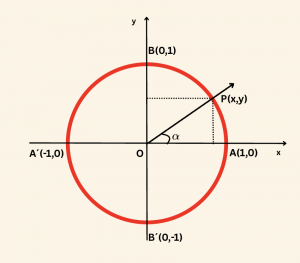
\[
\cos \alpha = x \Rightarrow -1 \leq x \leq 1, \quad \cos : \mathbb{R} \to [-1, 1]
\]
\[
\sin \alpha = y \Rightarrow -1 \leq y \leq 1, \quad \sin : \mathbb{R} \to [-1, 1]
\]
Therefore, the minimum value of both the sine and cosine functions is \(-1\), and the maximum value is \(1\).
\[-1 \leq \cos \alpha \leq 1 \]
\[ -1 \leq \sin \alpha \leq 1\]
5)
Since the x-axis is the cosine axis and the y-axis is the sine axis, the signs of the trigonometric functions for any angle \( \alpha \) are determined by the coordinates of the point where the terminal side of the angle intersects the unit circle. The sign of the x-coordinate (abscissa) determines the sign of \( \cos \alpha \), and the sign of the y-coordinate (ordinate) determines the sign of \( \sin \alpha \).
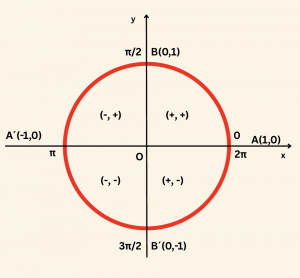
\[
\begin{array}{|c|c|c|c|c|}
\hline
& \textbf{Quadrant I} & \textbf{Quadrant II} & \textbf{Quadrant III} & \textbf{Quadrant IV} \\
& 0 < \alpha < \frac{\pi}{2} & \frac{\pi}{2} < \alpha < \pi & \pi < \alpha < \frac{3\pi}{2} & \frac{3\pi}{2} < \alpha < 2\pi \\
\hline
\cos \alpha & + & – & – & + \\
\hline
\sin \alpha & + & + & – & – \\
\hline
\tan \alpha & + & – & + & – \\
\hline
\cot \alpha & + & – & + & – \\
\hline
\end{array}
\]
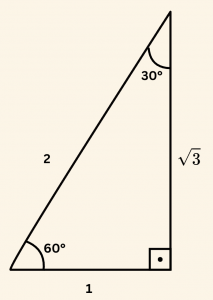
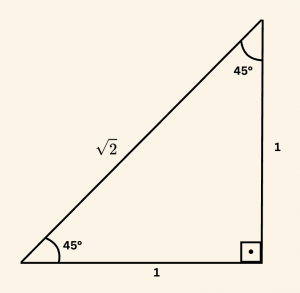
6) Trigonometric ratios for \( 30^\circ, 45^\circ \), and \( 60^\circ \) angles:
\[
\sin 30^\circ = \cos 60^\circ = \frac{1}{2}
\]
\[
\cos 30^\circ = \sin 60^\circ = \frac{\sqrt{3}}{2}
\]
\[
\tan 30^\circ = \cot 60^\circ = \frac{1}{\sqrt{3}}
\]\[
\cot 30^\circ = \tan 60^\circ = \sqrt{3}
\]
\[
\sin 45^\circ = \cos 45^\circ = \frac{1}{\sqrt{2}}
\]
\[
\tan 45^\circ = \cot 45^\circ = 1
\]
7) Trigonometric ratios for \(0^\circ, 90^\circ, 180^\circ\), and \(270^\circ\) quadrantal angles:
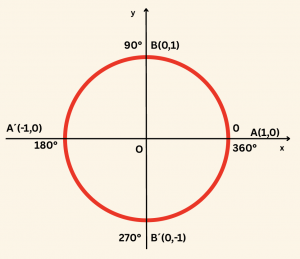
Since the x-coordinate of the point where the terminal side of an angle \( \alpha \) intersects the unit circle is \( \cos \alpha \) and the y-coordinate is \( \sin \alpha \), the trigonometric values derived using points A, B, A’, and B’ on the unit circle above are given by:
\[
\begin{array}{|c|c|c|c|c|}
\hline
\alpha & 0^\circ\ (360^\circ) & 90^\circ & 180^\circ & 270^\circ \\
\hline
\sin \alpha & 0 & 1 & 0 & -1 \\
\hline
\cos \alpha & 1 & 0 & -1 & 0 \\
\hline
\tan \alpha & 0 & \text{undefined} & 0 & \text{undefined} \\
\hline
\cot \alpha & \text{undefined} & 0 & \text{undefined} & 0 \\
\hline
\end{array}
\]
8)
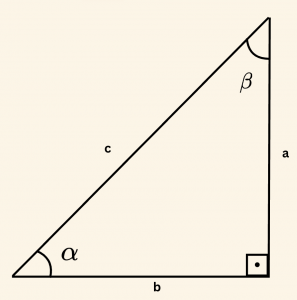
\[
\alpha + \beta = 90^\circ = \frac{\pi}{2} \text{ radians}
\]
\[\sin \alpha = \frac{a}{c} = \cos \beta \]
\[\tan \alpha = \frac{a}{b} = \cot \beta \]
\[\sec \alpha = \frac{c}{b} = \csc \beta \]
Cofunction Identities: For two complementary angles, the sine of one equals the cosine of the other; the tangent of one equals the cotangent of the other; and the secant of one equals the cosecant of the other.
Examples:
\( \bullet \quad \sin(90^\circ – \; \theta) = \cos \theta \)
\( \bullet \quad \tan(30^\circ + x -\; y) = \cot(60^\circ -\; x + y) \)
\( \bullet \quad \sec \frac{2\pi}{5} = \csc \frac{\pi}{10} \quad \to \left( \frac{2\pi}{5} + \frac{\pi}{10} = \frac{\pi}{2} \right) \)
QUESTION 1
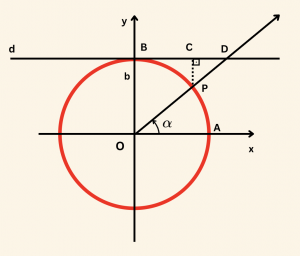
In the figure above, line \( d \) is tangent to the unit circle at point B. If \( m(\widehat{AOP}) = \alpha \), which of the following is equal to \( |CD| \)?
\[
\text{A) } 1\; – \; \tan \alpha \quad
\text{B) } \cot \alpha \;- \;1 \quad
\text{C) } \tan \alpha\; -\; \sin \alpha \quad
\text{D) } \cot \alpha \;-\; \sin \alpha \quad
\text{E) } \cot \alpha \;- \;\cos \alpha
\]
Solution:
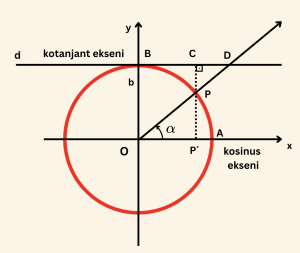
Since the x-coordinate (abscissa) of point P is \( \cos \alpha \), we have:
\[
|OP´| = |BC| = \cos \alpha
\]
Since the x-coordinate of point D is \( \cot \alpha \), we have:
\[
|BD| = \cot \alpha
\]
Therefore,
\[
|CD| = |BD| – |BC| = \cot \alpha \; -\; \cos \alpha
\]
\(\textbf{Correct Answer: E} \)
QUESTION 2
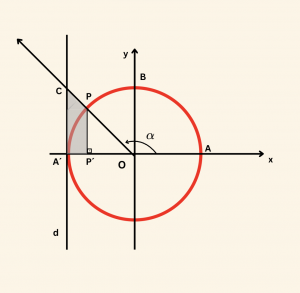
In the figure above, line d is tangent to the unit circle at point A’. If \( m(A\hat{O}P) = \alpha \), which of the following expressions represents the area of trapezoid A’P’PC?
\[
\text{A) } -\frac{\sin^3 \alpha}{2 \cos \alpha }\quad
\text{B) } \frac{1}{2} (1 + \sin^2 \alpha) \quad
\text{C) } \frac{1}{2} \tan \alpha \sin \alpha \quad
\text{D) } -\frac{1}{2} (1 + \cos \alpha) \tan \alpha \quad
\text{E) } \frac{1}{2} \tan \alpha
\]
Solution:
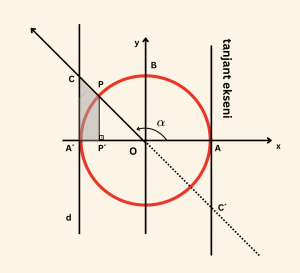 Since the y-coordinate (ordinate) of point C’ is \( \tan \alpha \), we find:
\( |AC’| = |A’C| = -\tan \alpha \)
Since point P has an x-coordinate of \( \cos \alpha \) and a y-coordinate of \( \sin \alpha \), it follows that:
\( |OP’| = -\cos \alpha \) and \( |A’P’| = 1 \; – \; (\;-\cos \alpha) = 1 + \cos \alpha \)
\( |PP’| = \sin \alpha \)
Therefore, using the area formula for a trapezoid:
\[\text{Area}(A’P’PC) = \frac{(|A’C| + |PP’|) \cdot |A’P’|}{2} \]
\[ = \frac{(-\tan \alpha + \sin \alpha)(1 + \cos \alpha)}{2} \]
\[ = -\frac{\sin^3 \alpha}{2 \cos \alpha} \]
\(\textbf{Correct Answer: A} \)
QUESTION 3
Which of the following correctly orders the values \( a = \cos 70^\circ, \quad b = \cos 200^\circ, \quad c = \sin 200^\circ \), and \( d = \cos 285^\circ \) from greatest to least?
\[\begin{aligned}
&\text{A) } a > b > c > d \quad \\
&\text{B) } a > d > c > b \quad \\
&\text{C) } d > a > c > b \quad \\
&\text{D) } d > c > a > b \quad \\
&\text{E) } b > c > a > d
\end{aligned}
\]
Solution:
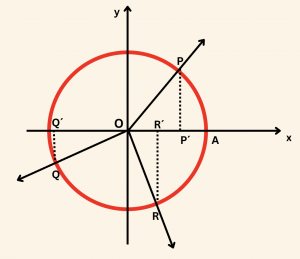 In the figure, \( m( A\hat{O}P ) = 70^\circ \), so the x-coordinate (abscissa) of point P is \( a = \cos 70^\circ = |OP’| \).
Since \( m( A\hat{O}Q) = 200^\circ \), the x-coordinate of point Q is \( b = \cos 200^\circ = -|OQ’| \) and its y-coordinate (ordinate) is \( c = \sin 200^\circ = -|QQ’| \).
Since \( m(A\hat{O}R) = 285^\circ \), the x-coordinate of point R is \( d = \cos 285^\circ = |OR’| \).
In the right triangle \( \Delta OQQ’ \), since \( m(Q\hat{O}Q’) < m(O\hat{Q}Q’) \), it follows that:
\( |QQ’| < |OQ’| \), which implies \( c = -|QQ’| > b = -|OQ’| \).
Comparing the lengths on the unit circle, we have:
\( |OP’| > |OR’| > -|QQ’| > -|OQ’| \), which yields \( a > d > c > b \).
\(\textbf{Correct Answer: B} \)
QUESTION 4
Which of the following correctly orders the values \( a = \tan 40^\circ, \quad b = \cos 55^\circ \), and \(c = \sin 40^\circ \) from greatest to least?
\[\begin{aligned}
&\text{A) } c > a > b \quad \\
&\text{B) } b > a > c \quad \\
&\text{C) } a > c > b \quad \\
&\text{D) } a > b > c \quad \\
&\text{E) } b > c > a
\end{aligned}
\]
Solution:
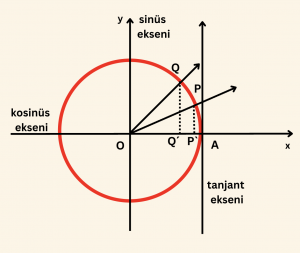
In the figure, since \( m( A\hat{O}T) = 40^\circ \), the y-coordinate of point T on the tangent line \( x=1 \) is:
\[a = \tan 40^\circ = |AT| \]
Using the cofunction identity, we can rewrite \( b = \cos 55^\circ \) as \( \sin 35^\circ \). Since \( m(A\hat{O}P) = 35^\circ \), the y-coordinate of point P is \( b = \cos 55^\circ = \sin 35^\circ = |PP’| \).
Since \( m(A\hat{O}Q) = 40^\circ \), the y-coordinate of point Q is:
\[c = \sin 40^\circ = |QQ’| \]
Comparing the geometric lengths in the first quadrant, we observe:
\[ |AT| > |QQ’| > |PP’| \text{ which means } a > c > b. \]
\(\textbf{Correct Answer: C} \)
QUESTION 5
Simplify the following expression:
\[ \frac{\sin x + \cot x \cdot \cos x}{\cos x + \tan x \cdot \sin x} \]
\[\begin{aligned}
\text{A) } \cos x \quad
\text{B) } \sin x \quad
\text{C) } 1 \quad
\text{D) } \cot x \quad
\text{E) } \tan x \\
\end{aligned}
\]
Solution:
\[ = \frac{\sin x + \cot x \cdot \cos x}{\cos x + \tan x \cdot \sin x } \]
\[ = \frac{\sin x + \frac{\cos x}{\sin x} \cdot \cos x}{\cos x + \frac{\sin x}{\cos x} \cdot \sin x} \]
=\frac{\frac{\sin^2 x + \cos^2 x}{\sin x}}{\frac{\cos^2 x + \sin^2 x}{\cos x}}
\]
By applying the Pythagorean identity \( \sin^2 x + \cos^2 x = 1 \), we can find a common denominator for both the numerator and the denominator:
\[ = \frac{\frac{1}{\sin x}}{\frac{1}{\cos x}} = \frac{1}{\sin x} \cdot \frac{\cos x}{1} = \frac{\cos x}{\sin x} = \cot x \]
\(\textbf{Correct Answer: D} \)
QUESTION 6
If \[ x = \cos \theta \quad \text{and} \quad y = \sin \theta \], which of the following is equal to the expression \[ x^4 – y^4 + 2x^2 – y^2 + 2 \]?
\[\begin{aligned}
\text{A) }5\cos^2 \theta \quad
\text{B) } 4\cos^2 \theta \quad
\text{C) } 3\cos^2 \theta \quad
\text{D) } 2\cos^2 \theta \quad
\text{E) }\cos^2 \theta \\
\end{aligned}
\]
Solution:
First, we factor the difference of squares component in the expression:
\[x^4 – y^4 + 2x^2 – y^2 + 2 = (x^2 + y^2)(x^2 – y^2) + 2x^2 – y^2 + 2 \]
By the Pythagorean identity, we know that \( \cos^2 \theta + \sin^2\theta = 1 \implies x^2 + y^2 = 1 \). Substituting this value yields:
\[ = 1 \cdot (x^2 – y^2) + 2x^2 – y^2 + 2 \]
\[ = 3x^2 – 2y^2 + 2 \]
Group the terms to substitute the identity \( 1 – y^2 = x^2 \):
\[ = 3x^2 + 2(1 – y^2) \]
\[ = 3x^2 + 2x^2 \]
\[ = 5x^2 = 5 \cos^2\theta \]
\(\textbf{Correct Answer: A} \)
QUESTION 7
What is the simplified form of the following rational expression?
\[
\frac{7 + 5 \sin^2 x – \cos^2 x}{3 \sin^2 x + 2 \cos^2 x – 1}
\]
\[
\text{A) } 4 \quad
\text{B) } 5 \quad
\text{C) } 6 \quad
\text{D) } 7 \quad
\text{E) } 8
\]
Solution:
We rewrite the constant terms in both the numerator and the denominator to strategic groupings using the identity \( \sin^2 x + \cos^2 x = 1 \):
\[
\frac{7 + 5 \sin^2 x – \cos^2 x}{3 \sin^2 x + 2 \cos^2 x – 1}
= \frac{6 + 5 \sin^2 x + (1 – \cos^2 x)}{\sin^2 x + 2(\sin^2 x + \cos^2 x) – 1}
\]
Substitute \( 1 – \cos^2 x = \sin^2 x \) into the numerator and \( \sin^2 x + \cos^2 x = 1 \) into the denominator:
\[
= \frac{6 + 5 \sin^2 x + \sin^2 x}{\sin^2 x + 2 \cdot 1 – 1}
= \frac{6 + 6 \sin^2 x}{\sin^2 x + 1}
\]
Factor out the common constant from the numerator and cancel out the common binomial terms:
\[
= \frac{6(\sin^2 x + 1)}{\sin^2 x + 1} = 6
\]
\(\textbf{Correct Answer: C} \)
QUESTION 8
Given that \(\frac{\pi}{2} < \theta < \pi\), \(x = \cos \theta\), and \(y = \sin \theta\), what is the simplified form of the following rational expression?
\[
\frac{\sqrt{1 – 2xy}}{x^3 – x^2 y + xy^2 – y^3}
\]
\[
\text{A) } -2 \quad
\text{B) } -1 \quad
\text{C) } 0 \quad
\text{D) } 1 \quad
\text{E) } 2
\]
Solution:
First, we factor the denominator by grouping:
\[
\frac{\sqrt{1 – 2xy}}{x^3 – x^2 y + xy^2 – y^3}
= \frac{\sqrt{1 – 2xy}}{(x – y)(x^2 + y^2)}
\]
By using the Pythagorean identity, we substitute \(\cos^2 \theta + \sin^2 \theta = 1 \implies x^2 + y^2 = 1\):
\[
= \frac{\sqrt{x^2 + y^2 – 2xy}}{(x – y ) \cdot 1 }
= \frac{\sqrt{(x – y)^2}}{x – y}
= \frac{|\ x – y\ |}{x – y}
\]
Since \(\theta\) lies in Quadrant II (\(\frac{\pi}{2} < \theta < \pi\)), we know that \(\cos \theta < 0\) and \(\sin \theta > 0 \). Therefore, \(x < 0\) and \(y > 0\), which means:
\[ \implies x – y < 0\]
When removing the absolute value bars for a negative expression, we negate the term:
\[
= \frac{-(x – y)}{x – y} = -1
\]
\(\textbf{Correct Answer: B} \)
QUESTION 9
Which of the following expressions is equivalent to:
\[
\frac{\sin^2 x}{\cos x – \sec x} + \frac{\cos^2 x}{\sin x – \csc x}
\]
\[
\text{A) } 1 \quad
\text{B) } \sin x + \cos x \quad
\text{C) } \cos x – \sin x \quad
\text{D) } \sin x – \cos x \quad
\text{E) } -\cos x – \sin x
\]
Solution:
We start by using the reciprocal identities \(\sec x = \frac{1}{\cos x}\) and \(\csc x = \frac{1}{\sin x}\):
\[
\frac{\sin^2 x}{\cos x – \sec x} + \frac{\cos^2 x}{\sin x – \csc x}
\]
\[
= \frac{\sin^2 x}{\cos x – \frac{1}{\cos x}} + \frac{\cos^2 x}{\sin x – \frac{1}{\sin x}}
\]
Next, we find a common denominator for each sub-fraction and simplify the complex rational expression:
\[
= \frac{\sin^2 x \cdot \cos x}{\cos^2 x – 1} + \frac{\cos^2 x \cdot \sin x}{\sin^2 x – 1}
\]
Using the Pythagorean identities \(\cos^2 x – 1 = -\sin^2 x\) and \(\sin^2 x – 1 = -\cos^2 x\), we substitute and cancel the common terms:
\[
= \frac{\sin^2 x \cdot \cos x}{- \sin^2 x} + \frac{\cos^2 x \cdot \sin x}{- \cos^2 x}
\]
\[
= -\cos x – \sin x
\]
\(\textbf{Correct Answer: E} \)
QUESTION 10
Given that \(\frac{3\pi}{2} < x < 2\pi\), simplify the following expression:
\[
\sqrt{\frac{1 – \cos x}{1 + \cos x}} + \sqrt{\frac{1 + \cos x}{1 – \cos x}}
\]
\[
\text{A) } -2 \csc x \quad
\text{B) } 2 \csc x \quad
\text{C) } \sec x\ \quad
\text{D) } -\sec x \quad
\text{E) } 2 \sec x
\]
Solution:
We rationalize the denominators inside the radicals by multiplying the numerator and denominator by their respective conjugates:
\[
\sqrt{\frac{1 – \cos x}{1 + \cos x}} + \sqrt{\frac{1 + \cos x}{1 – \cos x}}
\]
\[
= \sqrt{\frac{(1 – \cos x)^2}{(1 + \cos x)(1 – \cos x)}} + \sqrt{\frac{(1 + \cos x)^2}{(1 – \cos x)(1 + \cos x)}}
\]
Using the identity \((1 – \cos x)(1 + \cos x) = 1 – \cos^2 x = \sin^2 x\), we rewrite the expressions under the radical and apply the property \(\sqrt{a^2} = |a|\):
\[
= \frac{|1 – \cos x|}{|\sin x|} + \frac{|1 + \cos x|}{|\sin x|}
\]
The given domain \(\frac{3\pi}{2} < x < 2\pi\) places \(x\) in Quadrant IV, which means:
\[ \implies 0 < \cos x < 1 \quad \text{and} \quad \sin x < 0 \]
Based on these signs, we evaluate the absolute value expressions:
\[
\implies |1 – \cos x| = 1 – \cos x, \quad |1 + \cos x| = 1 + \cos x, \quad |\sin x| = -\sin x
\]
Substituting these back into our expression yields:
\[
= \frac{1 – \cos x + 1 + \cos x}{-\sin x} = \frac{2}{-\sin x} = -2 \csc x
\]
\(\textbf{Correct Answer: A} \)
QUESTION 11
Given that \(\frac{\pi}{2} < x < \pi\) and
\[
\tan^2 x + \cot^2 x + 2\tan x + 2\cot x – 1 = 0
\]
what is the value of the sum \(\tan^2 x + \cot^2 x\)?
\[
\text{A) } 3 \quad
\text{B) } 4 \quad
\text{C) } 5 \quad
\text{D) } 6 \quad
\text{E) } 7
\]
Solution:
\[
\tan^2 x + \cot^2 x + 2\tan x + 2\cot x – 1 = 0
\]
We rewrite the first two terms by completing the square using the identity \(\tan x \cdot \cot x = 1\):
\[
\Rightarrow (\tan x + \cot x)^2 – 2\; \underbrace{\tan x \cdot \cot x}_{1} + 2(\tan x + \cot x) \;- \;1 = 0
\]
\[
\Rightarrow (\tan x + \cot x)^2 + 2(\tan x + \cot x) – 3 = 0
\]
Let us use u-substitution by setting \(t = \tan x + \cot x\):
\[
t^2 + 2t – 3 = 0 \Rightarrow (t + 3)(t – 1) = 0 \Rightarrow t = -3 \text{ or } t = 1
\]
In the given interval (\(x\) is in Quadrant II), \(\tan x < 0\) and \(\cot x < 0\), which implies their sum must be negative: \(\tan x + \cot x < 0\).
Therefore, we choose \(t = \tan x + \cot x = -3\). Now, square both sides of this equation:
\[
(\tan x + \cot x)^2 = 9
\]
\[
\tan^2 x + \cot^2 x + 2 \cdot \tan x \cdot \cot x = 9
\]
\[
\tan^2 x + \cot^2 x + 2(1) = 9 \Rightarrow \tan^2 x + \cot^2 x = 7
\]
\(\textbf{Correct Answer: E} \)
QUESTION 12
Given that \(x \in (180^\circ,\ 270^\circ)\) and
\[
2 \tan x \; – \; 3 \cot x = 5
\]
what is the value of \(\tan x\)?
\[
\text{A) } 1 \quad
\text{B) } 2 \quad
\text{C) } 3 \quad
\text{D) } 4 \quad
\text{E) } 5
\]
Solution:
Using the reciprocal identity \(\cot x = \frac{1}{\tan x}\), we can substitute it into the equation:
\[
2 \tan x\; -\; 3 \cdot \frac{1}{\tan x} = 5
\]
Multiply the entire equation by \(\tan x\) to clear the fraction and rearrange it into a standard quadratic form:
\[
\Rightarrow 2 \tan^2 x \;- \; 5 \tan x \;-\; 3 = 0
\]
Let \(t = \tan x\). The quadratic equation becomes:
\[
2t^2\; – \;5t \;-\; 3 = 0
\]
By applying the quadratic formula:
\[
t = \frac{5 \pm \sqrt{(-5)^2 – 4 \cdot 2 \cdot (-3)}}{2 \cdot 2}
= \frac{5 \pm \sqrt{25 + 24}}{4}
= \frac{5 \pm \sqrt{49}}{4}
= \frac{5 \pm 7}{4}
\]
\[
t = 3 \quad \text{or} \quad t = -\frac{1}{2}
\]
Since the given domain \(x \in (180^\circ, 270^\circ)\) places \(x\) in Quadrant III, the tangent function must be positive (\(\tan x > 0\)).
\[
\Rightarrow \tan x = 3
\]
\(\textbf{Correct Answer: C} \)
QUESTION 13
If the maximum value of the function
\[
f(x) = \frac{-4 \cos x + 1}{3}
\]
is \(m\), and its minimum value is \(n\), what is the value of \(m + n\)?
\[
\text{A) } 3 \quad
\text{B) } 2 \quad
\text{C) } 1 \quad
\text{D) } \frac{2}{3} \quad
\text{E) } \frac{1}{3}
\]
Solution:
We start with the fundamental range of the cosine function, \( -1 \leq \cos x \leq 1 \), and build the expression step-by-step by applying algebraic operations:
\[
-1 \leq \cos x \leq 1 \implies -4 \cdot (-1) \geq -4 \cos x \geq -4 \cdot 1
\]
\[
\implies 4 \geq -4 \cos x \geq -4 \quad \text{or} \quad -4 \leq -4 \cos x \leq 4
\]
Add 1 to all parts of the inequality:
\[
-4 + 1 \leq -4 \cos x + 1 \leq 4 + 1 \implies -3 \leq -4 \cos x + 1 \leq 5
\]
Divide all parts by 3 to obtain the function \(f(x)\):
\[
\Rightarrow \frac{-3}{3} \leq \frac{-4 \cos x + 1}{3} \leq \frac{5}{3} \implies -1 \leq f(x) \leq \frac{5}{3}
\]
Thus, the maximum value is \(m = \frac{5}{3}\) and the minimum value is \(n = -1\). Calculating their sum gives:
\[
m + n = \frac{5}{3} + (-1) = \frac{5}{3} – \frac{3}{3} = \frac{2}{3}
\]
\(\textbf{Correct Answer: D} \)
QUESTION 14
What is the simplified form of the following rational expression?
\[
\frac{ |1 + \cos x| – |1 – \sin x| }{ | \cos x – 1| – \; \sin x – 1 }
\]
\[
\text{A) } \cot x \quad
\text{B) } \tan x \quad
\text{C) } 1 \quad
\text{D) } 0 \quad
\text{E) } -1
\]
Solution:
To evaluate the absolute values, we determine the sign of each inner expression based on the standard ranges of sine and cosine functions (\(-1 \leq \sin x, \cos x \leq 1\)):
* Since \(-1 \leq \cos x \leq 1\), adding 1 gives \(0 \leq 1 + \cos x \leq 2\). Since it is non-negative:
\[ |1 + \cos x| = 1 + \cos x \]
* Since \(-1 \leq \cos x \leq 1\), subtracting 1 gives \(-2 \leq \cos x – 1 \leq 0\). Since it is non-positive, we reverse the signs:
\[ | \cos x – 1 | = -( \cos x – 1 ) = 1 – \cos x \]
* Since \(-1 \leq \sin x \leq 1\), multiplying by \(-1\) and adding 1 gives \(0 \leq 1 – \sin x \leq 2\). Since it is non-negative:
\[ |1 – \sin x| = 1 – \sin x \]
Substituting these simplified expressions back into the original fraction yields:
\[
\frac{(1 + \cos x) – (1 – \sin x)}{(1 – \cos x) – \sin x – 1} = \frac{1 + \cos x – 1 + \sin x}{1 – \cos x – \sin x – 1}
\]
\[
= \frac{\cos x + \sin x}{- \cos x – \sin x} = \frac{\cos x + \sin x}{-1 \cdot (\cos x + \sin x)} = -1
\]
\(\textbf{Correct Answer: E} \)
QUESTION 15
What are the signs of the following trigonometric values, respectively?
\[
\cos 2252^\circ,\quad \tan \frac{169\pi}{8} ,\quad \csc \left(-\frac{57\pi}{7} \right)
\]
\[
\text{A) } – , – , + \quad
\text{B) } – , – , – \quad
\text{C) } + , – , + \quad
\text{D) } – , + , – \quad
\text{E) } + , – , –
\]
Solution:
First, let’s find the coterminal angle (primary measure) for \(2252^\circ\):
\[
2252^\circ \div 360^\circ = 6 \text{ with a remainder of } 92^\circ \implies 2252^\circ \equiv 92^\circ \pmod{360^\circ}
\]
Since \(90^\circ < 92^\circ < 180^\circ\), the angle lies in Quadrant II, where cosine is negative:
\[
\implies \cos 2252^\circ < 0 \quad (-)
\]
Next, find the coterminal angle for \(\frac{169\pi}{8}\) by dividing out full rotations (\(2\pi\)):
\[
\frac{169\pi}{8} = 20\pi + \frac{9\pi}{8} = 10(2\pi) + \frac{9\pi}{8} \implies \text{coterminal angle is } \frac{9\pi}{8}
\]
Since \(\pi < \frac{9\pi}{8} < \frac{3\pi}{2}\), the angle lies in Quadrant III, where tangent is positive:
\[
\implies \tan \left( \frac{169\pi}{8} \right) > 0 \quad (+)
\]
Finally, find the coterminal angle for \(-\frac{57\pi}{7}\) by adding multiples of \(2\pi\):
\[
-\frac{57\pi}{7} = -8\pi – \frac{1) \cdot 7\pi + 1\pi}{7} = -8\pi – \pi + \frac{6\pi}{7} = -9\pi + \frac{6\pi}{7}
\]
Alternatively, adding the nearest larger even multiple of \(\pi\), which is \(10\pi\):
\[
-\frac{57\pi}{7} + 10\pi = -\frac{57\pi}{7} + \frac{70\pi}{7} = \frac{13\pi}{7}
\]
Since \(\frac{3\pi}{2} < \frac{13\pi}{7} < 2\pi\) (or \(\frac{10.5\pi}{7} < \frac{13\pi}{7} < \frac{14\pi}{7}\)), this angle lies in Quadrant IV, where sine and its reciprocal cosecant (\(\csc\)) are negative:
\[
\implies \sin \left( -\frac{57\pi}{7} \right) < 0 \implies \csc \left( -\frac{57\pi}{7} \right) < 0 \quad (-)
\]
Conclusion:
\[
\cos: – ,\quad \tan: + ,\quad \csc: –
\]
\(\textbf{Correct Answer: D} \)
QUESTION 16
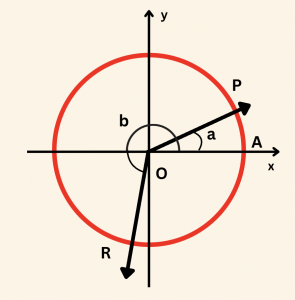
In the unit circle shown above, given that:
\[
m(\hat{AOP}) = a,\quad m(\hat{AOR}) = b
\]
what are the signs of the following trigonometric values, respectively?
\[
\sin(a + b), \quad \tan(\pi + a), \quad \cos\left( \frac{3\pi}{2}\; -\; b \right)
\]
\[
\text{A) } + , + , + \quad
\text{B) } – , – , – \quad
\text{C) } + , – , – \quad
\text{D) } – , + , – \quad
\text{E) } – , + , +
\]
Solution 1 (Analytical Approach):
From the given unit circle graph, we determine the quadrant intervals for angles \(a\) and \(b\):
\[
0 < a < \frac{\pi}{2} \quad (\text{Quadrant I}) \quad \text{and} \quad \pi < b < \frac{3\pi}{2} \quad (\text{Quadrant III})
\]
1. To find the sign of \(\sin(a + b)\), add the two inequalities together:
\[
\begin{aligned}
0 \lt a \lt \frac{\pi}{2} \\
+ \;\; \; \pi \lt b \lt \frac{3\pi}{2} \\
\hline \\
\pi \lt a+b \lt 2 \pi
\end{aligned}
\]
\[
\implies \pi < a + b < 2\pi
\]
Since the sum \(a+b\) lies in Quadrant III or Quadrant IV, its sine value is negative:
\[
\implies \sin(a + b) < 0 \quad (-)
\]
2. For \(\tan(\pi + a)\), add \(\pi\) to the interval of \(a\):
\[
0 < a < \frac{\pi}{2} \implies \pi < \pi + a < \frac{3\pi}{2}
\]
This puts the angle \(\pi + a\) in Quadrant III, where tangent is positive:
\[
\implies \tan(\pi + a) > 0 \quad (+)
\]
3. For \(\cos\left( \frac{3\pi}{2} – b \right)\), manipulate the inequality of \(b\):
\[
\pi < b < \frac{3\pi}{2} \implies -\pi > -b > -\frac{3\pi}{2} \implies -\frac{3\pi}{2} < -b < -\pi
\]
Add \(\frac{3\pi}{2}\) across the entire inequality:
\[
\frac{3\pi}{2} – \frac{3\pi}{2} < \frac{3\pi}{2} – b < \frac{3\pi}{2} – \pi \implies 0 < \frac{3\pi}{2} – b < \frac{\pi}{2}
\]
This shows the modified angle is in Quadrant I, where cosine is positive:
\[
\implies \cos\left( \frac{3\pi}{2} – b \right) > 0 \quad (+)
\]
Combining the results, the sequence of signs is: \((- , + , +)\).
\(\textbf{Correct Answer: E} \)
Solution 2 (Testing Values Approach):
We can pick specific test values for angles \(a\) and \(b\) that conform to the quadrants shown in the figure:
\[
\text{Let } a = 30^\circ = \frac{\pi}{6} \quad \text{and} \quad b = 210^\circ = \frac{7\pi}{6}
\]
1. Evaluate the first expression:
\[
a + b = 30^\circ + 210^\circ = 240^\circ \implies \sin(240^\circ) < 0 \quad (\text{Quadrant III})
\]
2. Evaluate the second expression:
\[
\pi + a = 180^\circ + 30^\circ = 210^\circ \implies \tan(210^\circ) > 0 \quad (\text{Quadrant III})
\]
3. Evaluate the third expression:
\[
\frac{3\pi}{2} – b = 270^\circ – 210^\circ = 60^\circ \implies \cos(60^\circ) > 0 \quad (\text{Quadrant I})
\]
Thus, the signs are verified as \(-, +, +\).
\(\textbf{Correct Answer: E} \)
SORU 17
\[
\tan\left(\frac{13\pi}{38}\right) \cdot \tan\left(\frac{3\pi}{19}\right)
+ \sin^2\left(\frac{\pi}{9}\right) + \sin^2\left(\frac{7\pi}{18}\right)
\]
işleminin sonucu kaçtır?
\[
\text{A) } 1 \quad
\text{B) } 2 \quad
\text{C) } 3 \quad
\text{D) } 4 \quad
\text{E) } 5
\]
Çözüm:
\[
\frac{13\pi}{38} + \frac{3\pi}{19}
= \frac{13\pi}{38} + \frac{6\pi}{38}
= \frac{19\pi}{38} = \frac{\pi}{2}
\]
\(\Rightarrow\) açıları tümledir.
\[
\tan\left(\frac{13\pi}{38}\right) = \cot\left(\frac{3\pi}{19}\right)
\]
\[
\frac{\pi}{9} + \frac{7\pi}{18}
= \frac{2\pi}{18} + \frac{7\pi}{18} = \frac{9\pi}{18} = \frac{\pi}{2}
\]
\(\Rightarrow\) açıları tümledir.
\[
\sin\left(\frac{\pi}{9}\right) = \cos\left(\frac{7\pi}{18}\right)
\]
\[
= \cot\left(\frac{3\pi}{19}\right) \cdot \tan\left(\frac{3\pi}{19}\right)
+ \cos^2\left(\frac{7\pi}{18}\right) + \sin^2\left(\frac{7\pi}{18}\right)
\]
\[
= 1 + 1 = 2
\]
\(\textbf{Cevab: B} \)
SORU 18
\[
\cot 5^\circ \cdot \cot 10^\circ \cdot \cot 15^\circ \cdots \cot 80^\circ \cdot \cot 85^\circ
\]
çarpımının sonucu kaçtır?
\[
\text{A) } 5 \quad
\text{B) } 4 \quad
\text{C) } 3 \quad
\text{D) } 2 \quad
\text{E) } 1
\]
Çözüm:
\[
\cot 5^\circ \cdot \cot 10^\circ \cdot \cot 15^\circ \cdots \cot 40^\circ \cdot \cot 45^\circ \cdot \cot 50^\circ \cdots \cot 85^\circ
\]
Simetrik olarak gruplarsak:
\[
= \cot 5^\circ \cdot \cot 10^\circ \cdots \cot 40^\circ \cdot \cot 45^\circ \cdot \cot 50^\circ \cdots \cot 85^\circ
\]
\[
=\cot 5^\circ \cdots \cot 40^\circ \cdot \cot 45^\circ \cdot \underbrace{ \tan 40^\circ}_{\text{ Birbirini 90° tamamlayan açılar} \cot 50° = \tan 40°} \cdot \tan 5^\circ
\]
\[
= 1 \cdot 1 \cdot \cdots \cdot 1 \cdot 1 = 1
\]
\(\textbf{Cevab: E} \)
SORU 19
A, B ve C bir üçgenin açıları olmak üzere,
\[
\frac{ \cos^2\left( \frac{A + B}{2} \right) + \cos^2\left( \frac{C}{2} \right) }
{ \cot\left( \frac{A + B}{2} \right) \cdot \cot\left( \frac{C}{2} \right) }
\]
ifadesinin değeri kaçtır?
\[
\text{A) } 1 \quad
\text{B) } 2 \quad
\text{C) } 3 \quad
\text{D) } 4 \quad
\text{E) } 5
\]
Çözüm:
Üçgenin iç açıları toplamı:
\[
A + B + C = 180^\circ \Rightarrow \frac{A + B}{2} = \frac{180^\circ – C}{2} = 90^\circ – \frac{C}{2}
\]
İfade şu hale gelir:
\[
\frac{ \cos^2\left(90^\circ – \frac{C}{2} \right) + \cos^2\left( \frac{C}{2} \right) }
{ \cot\left(90^\circ – \frac{C}{2} \right) \cdot \cot\left( \frac{C}{2} \right) }
\]
Trigonometrik dönüşüm:
\[
\cos(90^\circ – x) = \sin x,\quad \cot(90^\circ – x) = \tan x
\]
Uygulayalım:
\[
= \frac{ \sin^2\left( \frac{C}{2} \right) + \cos^2\left( \frac{C}{2} \right) }
{ \tan\left( \frac{C}{2} \right) \cdot \cot\left( \frac{C}{2} \right) }
\]
\[
= \frac{1}{1} = 1
\]
\(\textbf{Cevab: A} \)
QUESTION 20
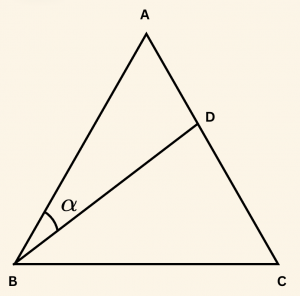
In the figure on the left, \(\triangle ABC\) is an equilateral triangle.
\[
m(\hat{ ABD}) = \alpha,\quad \frac{ |AD| }{ |DC| } = \frac{2}{3}
\]
Based on this information, which of the following is equal to \(\tan \alpha\)?
\[
\text{A) } \frac{\sqrt{3}}{2} \quad
\text{B) } \frac{\sqrt{3}}{3} \quad
\text{C) } \frac{\sqrt{3}}{4} \quad
\text{D) } \frac{\sqrt{3}}{5} \quad
\text{E) } \frac{\sqrt{3}}{6}
\]
Solution:
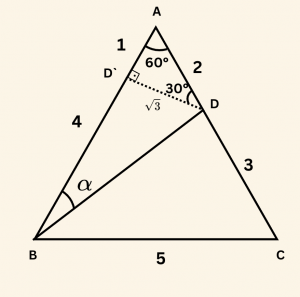
To make our calculations straightforward since we are finding a trigonometric ratio, we can assign specific values based on the given ratio:
\[\frac{AD}{DC} = \frac{2}{3} \implies AD = 2, \quad DC = 3
\]
Because \(\triangle ABC\) is an equilateral triangle, its side length is \(AC = AD + DC = 2 + 3 = 5\). Therefore, \(AB = BC = 5\). Each interior angle is also \(60^\circ\), so \(m(\hat A) = 60^\circ\).
Let us drop an altitude from point \(D\) perpendicular to side \([AB]\) at point \(D’\). This forms a right-angled triangle \(\triangle AD D’\):
\[
m ( \hat {ADD’}) = 30^\circ \quad (\text{since } m(\hat A) = 60^\circ \text{ and } m(\hat{AD’D}) = 90^\circ)
\]
Using the properties of a standard \(30^\circ-60^\circ-90^\circ\) right triangle with a hypotenuse of \(AD = 2\):
\[
|AD’| = \frac{AD}{2} = \frac{2}{2} = 1 \text{ unit}
\]
\[
|DD’| = |AD’| \cdot \sqrt{3} = 1 \cdot \sqrt{3} = \sqrt{3} \text{ units}
\]
Now, we find the remaining segment length on side \([AB]\):
\[
|BD’| = |AB| – |AD’| = 5 – 1 = 4 \text{ units}
\]
Finally, looking at the right-angled triangle \(\triangle BDD’\), we calculate the value of \(\tan \alpha\):
\[
\tan \alpha = \frac{\text{Opposite}}{\text{Adjacent}} = \frac{ |DD’| }{ |BD’| } = \frac{\sqrt{3}}{4}
\]
\(\textbf{Correct Answer: C} \)
QUESTION 21
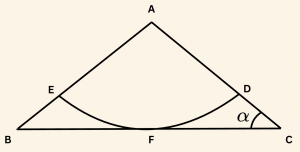
In the figure on the left, point \(A\) is the center of the quadrant (quarter) circle arc.
\[
m(\hat C) = \alpha, \quad \frac{ |AE| }{ |EB| } = 3
\]
If side \([BC]\) is tangent to the arc \(EFD\) at point \(F\), which of the following is equal to \(\cot \alpha\)?
\[
\text{A) } \frac{1}{\sqrt{7}} \quad
\text{B) } \frac{2}{\sqrt{7}} \quad
\text{C) } \frac{3}{\sqrt{7}} \quad
\text{D) } \frac{4}{\sqrt{7}}\quad
\text{E) } \frac{5}{\sqrt{7}}
\]
Solution:
Let the radius of the quarter circle be \(r\). Therefore, the segments representing the radii are equal:
\[
|AE| = |AD| = r
\]
From the given ratio, we have \(\frac{|AE|}{|EB|} = 3 \implies |EB| = \frac{|AE|}{3} = \frac{r}{3}\). Now we can determine the entire length of the hypotenuse side \([AB]\) of the right-angled triangle \(\triangle ABC\):
\[
|AB| = |AE| + |EB| = r + \frac{r}{3} = \frac{4r}{3}
\]
Let’s draw a line from the center \(A\) to the point of tangency \(F\). By geometric properties, a radius drawn to a tangent line is perpendicular to it at the point of tangency:
\[
[AF] \perp [BC] \quad \text{and} \quad |AF| = r \quad (\text{radius of the arc})
\]
This creates a right triangle \(\triangle AFB\) with \(m(\hat{AFB}) = 90^\circ\). We can now apply the Pythagorean theorem to find the length of segment \([BF]\):
\[
|BF|^2 + |AF|^2 = |AB|^2 \implies |BF|^2 + r^2 = \left(\frac{4r}{3}\right)^2
\]
\[
|BF|^2 + r^2 = \frac{16r^2}{9} \implies |BF|^2 = \frac{16r^2}{9} – r^2 = \frac{7r^2}{9}
\]
\[
|BF| = \frac{r\sqrt{7}}{3}
\]
Let’s find \(\cot(\hat B)\) from the right triangle \(\triangle AFB\):
\[
\cot(\hat B) = \frac{\text{Adjacent}}{\text{Opposite}} = \frac{|BF|}{|AF|} = \frac{\frac{r\sqrt{7}}{3}}{r} = \frac{\sqrt{7}}{3}
\]
Now consider the main large right triangle \(\triangle ABC\) where \(m(\hat A) = 90^\circ\). The acute angles add up to \(90^\circ\):
\[
m(\hat B) + m(\hat C) = 90^\circ \implies \hat B = 90^\circ – \alpha
\]
Using the cofunction identity, we substitute \(\hat B\) to find \(\cot \alpha\):
\[
\cot \alpha = \tan(90^\circ – \alpha) = \tan(\hat B)
\]
Since \(\tan(\hat B)\) is the reciprocal of \(\cot(\hat B)\):
\[
\tan(\hat B) = \frac{1}{\cot(\hat B)} = \frac{3}{\sqrt{7}}
\]
\[
\implies \cot \alpha = \frac{3}{\sqrt{7}}
\]
\(\textbf{Correct Answer: C} \)
Solution (Continued):
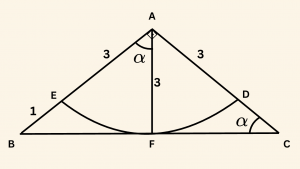
Since point \(A\) is the center of the quadrant circle, we have:
\[
\hat {BAC} = 90^\circ
\]
Since point \(F\) is the point of tangency, the perpendicular radius drawn from the center \(A\) passes through \(F\), giving:
\[
\hat {BAF }= \alpha
\]
Based on the given ratio:
\[
\frac{|AE|}{|EB|} = 3 \implies |AE| = 3,\quad |EB| = 1
\]
Applying the Pythagorean theorem to the right-angled triangle \(\triangle BAF\):
\[
|BA|^2 = |AF|^2 + |BF|^2 \implies 4^2 = 3^2 + |BF|^2 \implies |BF| = \sqrt{7}
\]
As illustrated in the geometric diagram:
\[
|AE| = 3,\quad |EB| = 1 \implies |AF| = 3,\quad |BF| = \sqrt{7}
\]
Therefore, we can calculate the cotangent of \(\alpha\):
\[
\cot \alpha = \frac{\text{Adjacent}}{\text{Opposite}} = \frac{|AF|}{|BF|} = \frac{3}{\sqrt{7}}
\]
\(\textbf{Correct Answer: C} \)
QUESTION 22
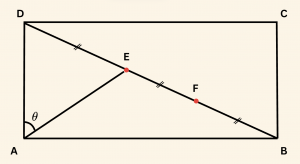
In the rectangle \(ABCD\) shown above:
\[
|DE| = |EF| = |FB|,\quad m\hat {DAE} = \theta,\quad |AB| = 3 |AD|
\]
which of the following is equal to \(\sin \theta\)?
\[
\text{A) } \frac{1}{\sqrt{10}} \quad
\text{B) } \frac{2}{\sqrt{10}} \quad
\text{C) } \frac{2}{\sqrt{13}} \quad
\text{D) } \frac{3}{\sqrt{13}}\quad
\text{E) } \frac{4}{\sqrt{13}}
\]
Solution:
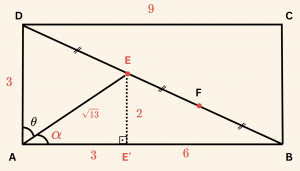
To establish clean numerical proportions, let us choose a base value for the side length:
\[
\text{Let } |AD| = 3 \text{ units} \implies |AB| = 9 \text{ units}
\]
The diagonal segment is divided into three equal parts: \(|DE| = |EF| = |FB|\), which means point \(E\) lies exactly \(\frac{2}{3}\) of the way along the diagonal from vertex \(B\) toward \(D\) (\(|EB| = \frac{2}{3}|DB|\)).
Let us drop a perpendicular line from point \(E\) down to side \([AB]\) intersecting at point \(E’\). This sets up a similarity relationship between the right-angled triangles \(\triangle DAB \sim \triangle EE’B\):
\[ \frac{|AB|}{|E’B|} = \frac{ |DA| }{ |EE’| } = \frac{|DB|}{|EB|} \implies \frac{9}{|E’B|} = \frac{ 3 }{ |EE’| } = \frac{3}{2} \]
Solving these ratios yields the side lengths of the smaller triangle:
\[|E’B| = 6 \text{ units}, \quad |EE’| = 2 \text{ units} \]
Now, compute the remaining segment length along the base line \([AB]\):
\[ |AE’| = |AB| – |E’B| \implies |AE’| = 9 – 6 = 3 \text{ units} \]
Applying the Pythagorean theorem within the right-angled triangle \(\triangle AE’E\):
\[
|AE| = \sqrt{3^2 + 2^2} = \sqrt{13}
\]
Let \(m(\hat {EAE’}) = \alpha\). Since \(\angle DAB\) is a right angle (\(90^\circ\)), the complementary angles must satisfy:
\[
\theta + \alpha = 90^\circ \implies \sin \theta = \cos \alpha
\]
Using the dimensions of the right triangle \(\triangle AE’E\), we find the value of \(\cos \alpha\):
\[
\cos \alpha = \frac{ |AE’| }{ |AE| } = \frac{3}{\sqrt{13}} \implies \sin \theta = \frac{3}{\sqrt{13}}
\]
\(\textbf{Correct Answer: D} \)
QUESTION 23
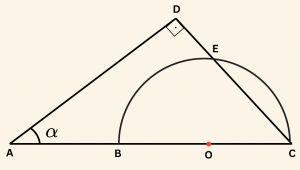
In the figure on the left, \(O\) is the center of the semicircle with diameter \([BC]\).
\[
m(\hat A) = \alpha,\quad m(\hat D) = 90^\circ,\quad \frac{ |OB| }{ |EC| } = \frac{3}{4}
\]
Based on this, which of the following is equal to \(\tan \alpha\)?
\[
\text{A) } \frac{2}{\sqrt{5}} \quad
\text{B) } \frac{3}{\sqrt{5}} \quad
\text{C) } \frac{2}{\sqrt{3}} \quad
\text{D) } \frac{1}{3}\quad
\text{E) } \frac{1}{2}
\]
Solution:
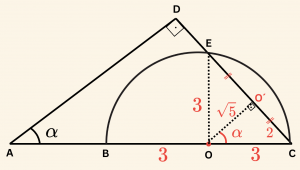
Let’s use the given ratio to assign specific segment values:
\[
|OB| = 3 \implies |EC| = 4
\]
Since \(O\) is the center of the semicircle, the segments representing the radii are all equal:
\[
|OB| = |OC| = |OE| = 3 \text{ units}
\]
Therefore, the entire length of the segment \([OC]\) is \(3\), and since \(|EC| = 4\), the point \(E\) splits the line segment such that the entire length from center \(O\) to point \(C\) is a radius of \(3\). Let’s connect the center \(O\) to point \(E\) on the circle, making \(|OE| = 3\) (radius). This gives the total length of the base line from the center to vertex \(C\):
\[
|OC| = 3 \implies |EC| = 4
\]
Let’s use the property of inscribed angles that subtend a diameter. Connect point \(B\) to point \(E\). An angle inscribed in a semicircle is a right angle:
\[
m(\hat{BEC}) = 90^\circ
\]
Now consider the right-angled triangle \(\triangle BEC\). We can find the length of side \([BE]\) using the Pythagorean theorem with hypotenuse \(|BC| = 2 \cdot r = 6\):
\[
|BE|^2 + |EC|^2 = |BC|^2 \implies |BE|^2 + 4^2 = 6^2
\]
\[
|BE|^2 + 16 = 36 \implies |BE|^2 = 20 \implies |BE| = \sqrt{20} = 2\sqrt{5}
\]
Notice that \(\triangle ADC\) and \(\triangle BEC\) are both right-angled triangles sharing the acute angle \(\hat C\). Therefore, by Angle-Angle similarity, \(\triangle ADC \sim \triangle BEC\). This tells us that the corresponding angles are equal:
\[
m(\hat{DAC}) = m(\hat{EBC}) = \alpha
\]
Now, looking directly at the right triangle \(\triangle BEC\), we can easily compute \(\tan \alpha\) using the angle at vertex \(B\):
\[
\tan \alpha = \frac{\text{Opposite}}{\text{Adjacent}} = \frac{|EC|}{|BE|} = \frac{4}{2\sqrt{5}} = \frac{2}{\sqrt{5}}
\]
\(\textbf{Correct Answer: A} \)
Solution 2 (Alternative Method):
When you drop a perpendicular line from the center $O$ onto the chord $[EC]$, it bisects the chord into two equal lengths at point $O’$:
\[
|O’C| = \frac{|EC|}{2} = \frac{4}{2} = 2 \text{ units}
\]
Because the right triangles share a common structure, the triangles are similar ($\triangle ADC \sim \triangle O’OC$). This corresponding angle relationship yields:
\[
m(\hat A) = m(\hat {O’OC}) = \alpha
\]
Applying the Pythagorean theorem in the smaller right triangle $\triangle O’OC$ to find the length of leg $[OO’]$:
\[
|OO’| = \sqrt{|OC|^2 – |O’C|^2} = \sqrt{3^2 – 2^2} = \sqrt{9 – 4} = \sqrt{5} \text{ units}
\]
Now, using the lengths $|O’C| = 2$ and $|OO’| = \sqrt{5}$ inside this right triangle, we can calculate $\tan \alpha$ directly:
\[
\tan \alpha = \frac{\text{Opposite}}{\text{Adjacent}} = \frac{ |O’C| }{ |OO’| } = \frac{2}{\sqrt{5}}
\]
\(\textbf{Correct Answer: A} \)
QUESTION 24

In the figure on the left:
\[\frac{|AD|}{|DB|} = \frac{\sqrt{3}}{4},\quad |BC| = 4,\quad \cos \theta = \frac{4}{5}\]
Given that $m(\hat D) = 90^\circ$, find the length of $|DC|$ in units.
\[
\text{A) } 1 \quad
\text{B) } 2 \quad
\text{C) } \frac{5}{2} \quad
\text{D) } 3\quad
\text{E) } \frac{7}{2}
\]
Solution:

In the right-angled triangle $\triangle CDA$:
\[
\cos \theta = \frac{\text{Adjacent}}{\text{Hypotenuse}} = \frac{|DC|}{|AC|} = \frac{4}{5}
\]
This allows us to scale the sides relative to a variable $x$, such that $|DC| = 4x$ and $|AC| = 5x$. By the Pythagorean theorem, this maps perfectly to a classic $3:4:5$ right triangle pattern:
\[
|AD| = 3x
\]
Now let’s use the given ratio to set up an expression for side length $|DB|$:
\[
\frac{|AD|}{|DB|} = \frac{\sqrt{3}}{4} \implies \frac{3x}{|DB|} = \frac{\sqrt{3}}{4} \implies |DB| = \frac{12x}{\sqrt{3}} = 4\sqrt{3}x
\]
Next, we apply the Pythagorean theorem within the large right-angled triangle $\triangle BDC$ to solve for $x$:
\[
|BC|^2 = |DB|^2 + |DC|^2 \implies 4^2 = (4\sqrt{3}x)^2 + (4x)^2
\]
\[
16 = 48x^2 + 16x^2 \implies 16 = 64x^2 \implies x^2 = \frac{1}{4} \implies x = \frac{1}{2}
\]
Finally, substitute the value of $x$ back to evaluate the total length of $|DC|$:
\[
|DC| = 4x = 4 \cdot \frac{1}{2} = 2 \text{ units}
\]
\(\textbf{Correct Answer: B} \)
Key Concept:
In a right-angled triangle, if you know the trigonometric ratio of one of the acute angles along with the length of any single side, you can find the exact lengths of all remaining sides.
Example:
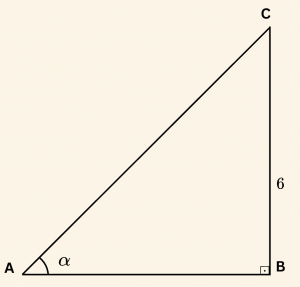
In the right-angled triangle shown on the left:
\[
\tan \alpha = \frac{3}{4} \quad \text{and} \quad |BC| = 6 \text{ units}
\]
Let’s find the absolute lengths of sides $[AB]$ and $[AC]$.
Solution:
Using the definition of the tangent function:
\[
\tan \alpha = \frac{\text{Opposite}}{\text{Adjacent}} = \frac{|BC|}{|AB|} \implies \frac{3}{4} = \frac{6}{|AB|} \implies |AB| = 8 \text{ units}
\]
Now we calculate the hypotenuse $[AC]$ using the Pythagorean theorem:
\[
|AC|^2 = |AB|^2 + |BC|^2 = 8^2 + 6^2 = 64 + 36 = 100 \implies |AC| = 10 \text{ units}
\]
Lösung 2 (Alternative Methode):
Wenn man vom Mittelpunkt $O$ ein Lot auf die Sehne $[EC]$ fällt, wird diese Sehne im Fußpunkt $O’$ halbiert:
\[
|O’C| = \frac{|EC|}{2} = \frac{4}{2} = 2 \text{ Längeneinheiten}
\]
Aufgrund des gemeinsamen Winkels am Kreisbogen sind die rechtwinkligen Dreiecke zueinander ähnlich ($\triangle ADC \sim \triangle O’OC$). Daraus folgt für die entsprechenden Winkel:
\[
m(\hat A) = m(\hat {O’OC}) = \alpha
\]
Wir wenden den Satz des Pythagoras im rechtwinkligen Teildreieck $\triangle O’OC$ an, um die Kathete $[OO’]$ zu berechnen:
\[
|OO’| = \sqrt{|OC|^2 – |O’C|^2} = \sqrt{3^2 – 2^2} = \sqrt{9 – 4} = \sqrt{5} \text{ Längeneinheiten}
\]
Mit den Längenwerten $|O’C| = 2$ und $|OO’| = \sqrt{5}$ können wir nun $\tan \alpha$ direkt bestimmen:
\[
\tan \alpha = \frac{\text{Gegenkathete}}{\text{Ankathete}} = \frac{ |O’C| }{ |OO’| } = \frac{2}{\sqrt{5}}
\]
\(\textbf{Antwort: A} \)
AUFGABE 24
In der linken Abbildung gilt:
\[\frac{|AD|}{|DB|} = \frac{\sqrt{3}}{4},\quad |BC| = 4,\quad \cos \theta = \frac{4}{5}\]
Wie viele Längeneinheiten beträgt die Strecke $|DC|$, wenn $m(\hat D) = 90^\circ$ ist?
\[
\text{A) } 1 \quad
\text{B) } 2 \quad
\text{C) } \frac{5}{2} \quad
\text{D) } 3\quad
\text{E) } \frac{7}{2}
\]
Lösung:
Im rechtwinkligen Dreieck $\triangle CDA$ gilt:
\[
\cos \theta = \frac{\text{Ankathete}}{\text{Hypotenuse}} = \frac{|DC|}{|AC|} = \frac{4}{5}
\]
Daraus wählen wir die proportionalen Längenwerte $|DC| = 4x$ und $|AC| = 5x$. Nach dem Satz des Pythagoras entspricht dies dem klassischen rechtwinkligen $3:4:5$-Dreieck:
\[
|AD| = 3x
\]
Nun setzen wir das gegebene Streckenverhältnis ein, um einen Ausdruck für $|DB|$ zu erhalten:
\[
\frac{|AD|}{|DB|} = \frac{\sqrt{3}}{4} \implies \frac{3x}{|DB|} = \frac{\sqrt{3}}{4} \implies |DB| = \frac{12x}{\sqrt{3}} = 4\sqrt{3}x
\]
Wir wenden den Satz des Pythagoras im großen rechtwinkligen Dreieck $\triangle BDC$ an, um den Skalierungsfaktor $x$ zu berechnen:
\[
|BC|^2 = |DB|^2 + |DC|^2 \implies 4^2 = (4\sqrt{3}x)^2 + (4x)^2
\]
\[
16 = 48x^2 + 16x^2 \implies 16 = 64x^2 \implies x^2 = \frac{1}{4} \implies x = \frac{1}{2}
\]
Damit bestimmen wir schließlich die exakte Länge der Strecke $|DC|$:
\[
|DC| = 4x = 4 \cdot \frac{1}{2} = 2 \text{ Längeneinheiten}
\]
\(\textbf{Antwort: B} \)
Wichtiger Hinweis:
Wenn in einem rechtwinkligen Dreieck das trigonometrische Verhältnis eines der spitzen Winkel und die Länge einer beliebigen Seite bekannt sind, lassen sich die Längen aller anderen Seiten eindeutig berechnen.
Beispiel:
In dem links abgebildeten rechtwinkligen Dreieck gilt:
\[
\tan \alpha = \frac{3}{4} \quad \text{und} \quad |BC| = 6 \text{ Längeneinheiten}
\]
Berechnen wir die Seitenlängen von $[AB]$ und $[AC]$.
Lösung:
Mithilfe der Definition des Tangens gilt:
\[
\tan \alpha = \frac{\text{Gegenkathete}}{\text{Ankathete}} = \frac{|BC|}{|AB|} \implies \frac{3}{4} = \frac{6}{|AB|} \implies |AB| = 8 \text{ Längeneinheiten}
\]
Über den Satz des Pythagoras ermitteln wir nun die Hypotenuse $[AC]$:
\[
|AC|^2 = |AB|^2 + |BC|^2 = 8^2 + 6^2 = 64 + 36 = 100 \implies |AC| = 10 \text{ Längeneinheiten}
\]
Solution:
\[
\tan \alpha = \frac{\text{Opposite}}{\text{Adjacent}} = \frac{|BC|}{|AB|} \implies \frac{3}{4} = \frac{6}{|AB|} \implies |AB| = 8 \text{ units}
\]
Applying the Pythagorean theorem to find the hypotenuse $[AC]$:
\[
|AC|^2 = |AB|^2 + |BC|^2 = 8^2 + 6^2 = 64 + 36 = 100 \implies |AC| = 10 \text{ units}
\]
Example:
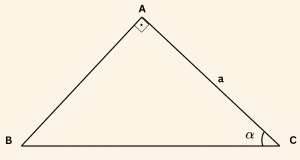
Let’s find the length of side $[AB]$ in the right-angled triangle shown on the left based on the given variables:
\[
\tan \alpha = \frac{\text{Opposite}}{\text{Adjacent}} = \frac{|AB|}{|AC|} = \frac{|AB|}{a}
\]
\[
\implies |AB| = a \cdot \tan \alpha
\]
QUESTION 25
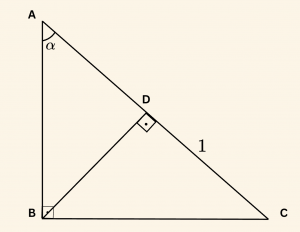
In the figure on the left:
\[\begin{aligned} &m(\hat{ BDC}) = 90^\circ,\quad \\
&m(\hat {ABC}) = 90^\circ,\quad\\
&m(\hat{ BAD}) = \alpha,\quad\text{and } \\ &|DC| = 1 \end{aligned} \]
Based on this, which of the following expressions is equal to $|AB|$?
\[
\text{A) } \frac{\cot \alpha}{\sin \alpha} \quad
\text{B) } \frac{\tan \alpha}{\cos \alpha} \quad
\text{C) } \tan \alpha \quad
\text{D) } \cot \alpha\quad
\text{E) } \sin \alpha \cdot \cos \alpha
\]
Solution:
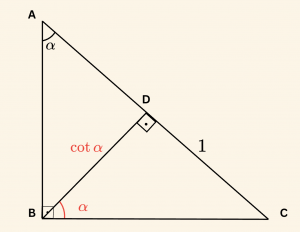
First, let’s trace the angles. In the large right-angled triangle, since $m(\hat{ABC}) = 90^\circ$, the acute angles satisfy $m(\hat{C}) = 90^\circ – m(\hat{DBC})$. Looking at the right-angled triangle $\triangle BDC$, the angle at vertex $B$ satisfies $m(\hat{BDC}) = 90^\circ$, which means $m(\hat{BCD}) = 90^\circ – m(\hat{DBC})$. By angle-angle consistency across the shared boundary line, we find:
\[
m(\hat{BCD}) = m(\hat{BAD}) = \alpha
\]
Now, analyzing the right-angled triangle $\triangle BDC$ using cotangent:
\[
\cot \alpha = \frac{\text{Adjacent}}{\text{Opposite}} = \frac{|BD|}{|DC|} = \frac{|BD|}{1} \implies |BD| = \cot \alpha
\]
Next, tracking inside the adjacent right-angled triangle $\triangle ADB$ using sine:
\[
\sin \alpha = \frac{\text{Opposite}}{\text{Hypotenuse}} = \frac{|BD|}{|AB|} = \frac{\cot \alpha}{|AB|} \implies |AB| = \frac{\cot \alpha}{\sin \alpha}
\]
\(\textbf{Correct Answer: A} \)
QUESTION 26
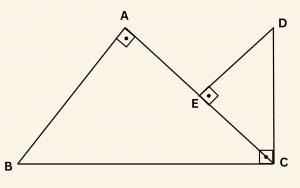
In the figure on the left:
– $[AB] \perp [BC]$
– $[DE] \perp [EC]$
– $[AC] \perp [CD]$
Given $m(\hat{ CDE}) = \alpha$ and $|AC| = |CD| = 1 \text{ unit}$, which of the following is equal to the length of $|BE|$?
\[
\text{A) } \tan \alpha \; – \; \sin \alpha \quad
\text{B) } 1 \; – \; \tan \alpha \quad
\text{C) } \sin \alpha \;- \;\cos \alpha\quad
\text{D) } 1 \;- \;\cot \alpha\quad
\text{E) } \cos \alpha \;- \; \sin \alpha
\]
Solution (Continued):
From the right-angled triangle $\triangle DEC$:
\[
\sin \alpha = \frac{\text{Opposite}}{\text{Hypotenuse}} = \frac{|EC|}{|DC|} = \frac{|EC|}{1} \implies |EC| = \sin \alpha
\]
From the right-angled triangle $\triangle ABC$:
\[
\cos \alpha = \frac{\text{Adjacent}}{\text{Hypotenuse}} = \frac{|BC|}{|AC|} = \frac{|BC|}{1} \implies |BC| = \cos \alpha
\]
Therefore, we calculate the target segment length $|BE|$ by subtraction:
\[
|BE| = |BC| – |EC| = \cos \alpha – \sin \alpha
\]
\(\textbf{Correct Answer: E} \)
Key Concept:
If you know any single trigonometric ratio of an angle, you can find all other trigonometric ratios for that same angle by sketching a reference right triangle.
QUESTION 27
Given $0^\circ < x < 90^\circ$, if: \[ \frac{\sin^2 x - \cos^2 x}{(\sin x + \cos x)^2} = \frac{1}{2} \] what is the value of $\sin x$? \[ \text{A) } \frac{3}{\sqrt{5}} \quad \text{B) } \frac{2}{\sqrt{5}} \quad \text{C) } \frac{1}{\sqrt{5}} \quad \text{D) } \frac{3}{\sqrt{10}}\quad \text{E) } \frac{1}{\sqrt{10}} \]
Solution:
Factor the numerator using the difference of squares identity:
\[
\frac{(\sin x – \cos x)(\sin x + \cos x)}{(\sin x + \cos x)^2} = \frac{1}{2}
\]
\[
\implies \frac{\sin x – \cos x}{\sin x + \cos x} = \frac{1}{2}
\]
Cross-multiply to group the terms:
\[\begin{aligned} &2(\sin x – \cos x) = \sin x + \cos x \\ \\
\implies &2\sin x – 2\cos x = \sin x + \cos x \\ \\
\implies &\sin x = 3\cos x \\\\
\implies & \frac{\sin x}{\cos x } = 3 \implies \tan x = 3 \end{aligned}\]
Let’s construct a reference right triangle to find the corresponding sine value:
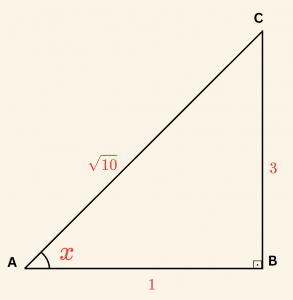
In this right triangle, we assign the sides relative to angle $x$ based on $\tan x = \frac{3}{1}$:
* $\text{Opposite side } |BC| = 3 \text{ units}$
* $\text{Adjacent side } |AB| = 1 \text{ unit}$
Applying the Pythagorean theorem, the hypotenuse $|AC|$ is calculated as:
\[
|AC| = \sqrt{3^2 + 1^2} = \sqrt{9 + 1} = \sqrt{10} \text{ units}
\]
From this reference triangle, we extract the value of $\sin x$:
\[
\sin x = \frac{\text{Opposite}}{\text{Hypotenuse}} = \frac{|BC|}{|AC|} = \frac{3}{\sqrt{10}}
\]
\(\textbf{Correct Answer: D} \)
QUESTION 28
Given that $B$ is an acute angle, if:
\[
A + B = 30^\circ \quad \text{and} \quad \cos(3A + 2B) = \frac{3}{5}
\]
what is the value of $\tan B$?
\[
\text{A) } 2\quad
\text{B) } \frac{3}{2} \quad
\text{C) } \frac{2}{3} \quad
\text{D) } \frac{4}{3} \quad
\text{E) } \frac{3}{4}
\]
Solution:
Isolate $A$ from the first equation: $A = 30^\circ – B$. Substitute this into the cosine expression:
\[
\cos(3A + 2B) = \frac{3}{5} \implies \cos\left[3(30^\circ – B) + 2B\right] = \frac{3}{5}
\]
\[
\implies \cos(90^\circ – B) = \frac{3}{5}
\]
Using the co-function identity $\cos(90^\circ – B) = \sin B$, we get:
\[
\sin B = \frac{3}{5}
\]
Now let’s sketch a $3-4-5$ reference right triangle to find the tangent ratio for angle $B$:

\[
\tan B = \frac{\text{Opposite}}{\text{Adjacent}} = \frac{3}{4}
\]
\(\textbf{Correct Answer: E} \)
QUESTION 29
Given $0 < x < \frac{\pi}{2}$, if: \[ 2 \sin x - \cos x = 1 \] what is the value of $\sin x$? \[ \text{A) } \frac{4}{5}\quad \text{B) } \frac{3}{5} \quad \text{C) } \frac{2}{5} \quad \text{D) } \frac{1}{5} \quad \text{E) } \frac{1}{6} \]
Solution 1 (Algebraic Substitution Method):
Square both sides of the given equation:
\[
(2 \sin x – \cos x)^2 = 1^2 \implies 4 \sin^2 x + \cos^2 x – 4 \sin x \cos x = 1
\]
Replace $1$ with the basic Pythagorean trigonometric identity $\sin^2 x + \cos^2 x = 1$:
\[ 4 \sin^2 x + \cos^2 x – 4 \sin x \cos x = \sin^2 x + \cos^2 x \]
\[ \implies 3 \sin^2 x – 4 \sin x \cos x = 0 \]
Factor out $\sin x$ from the equation:
\[ \sin x (3 \sin x – 4 \cos x) = 0 \]
Since we are given that $0 < x < \frac{\pi}{2}$, we know that $\sin x \neq 0$. Therefore, we can safely divide out $\sin x$:
\[
3 \sin x – 4 \cos x = 0 \implies 3 \sin x = 4 \cos x \implies \tan x = \frac{4}{3}
\]
Sketching a reference right triangle where the opposite side is $4$ and the adjacent side is $3$ gives a hypotenuse of $5$:
\[
\sin x = \frac{\text{Opposite}}{\text{Hypotenuse}} = \frac{4}{5}
\]
Solution 2 (Radical Elimination Method):
Isolate the cosine term and express it in terms of sine using $\cos x = \sqrt{1 – \sin^2 x}$:
\[
2 \sin x – 1 = \cos x \implies 2 \sin x – 1 = \sqrt{1 – \sin^2 x}
\]
Square both sides to eliminate the radical sign:
\[
(2 \sin x – 1)^2 = (\sqrt{1 – \sin^2 x})^2 \implies 4 \sin^2 x – 4 \sin x + 1 = 1 – \sin^2 x
\]
\[
\implies 5 \sin^2 x – 4 \sin x = 0 \implies \sin x (5 \sin x – 4) = 0
\]
Since $\sin x \neq 0$ within the specified interval, we solve the remaining linear factor:
\[
5 \sin^2 x = 4 \sin x \implies \sin x = \frac{4}{5}
\]
\(\textbf{Correct Answer: A} \)
← Previous Page | Next Page →