
Trigonometric Sum and Difference Formulas
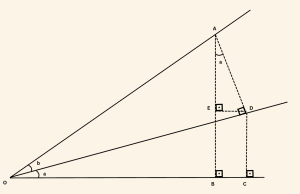
In the figure above, let
\[m( \hat {COD} )= a \;\; \text{and} \;\; m(\hat{ DOA}) = b \] Then, the sum of these angles is
\[m(\hat{ COA}) = a + b \]
From right triangle ABO,
\[
\sin (a + b) = \frac{|AB|}{|OA|} = \frac{|EB|}{|OA|} + \frac{|AE|}{|OA|} = \frac{|DC| + |AE|}{|OA|}
\]
From right triangle DCO,
\[
\sin a = \frac{|DC|}{|OD|} \Rightarrow |DC| = |OD| \cdot \sin a
\]
From right triangle ADO,
\[
\cos b = \frac{|OD|}{|OA|} \Rightarrow |OD| = |OA| \cdot \cos b
\]
Substituting this expression yields:
\[
|DC| = |OA| \cdot \sin a \cdot \cos b
\]
From right triangle AED,
\[
\cos a = \frac{|AE|}{|AD|} \Rightarrow |AE| = |AD| \cdot \cos a
\]
From right triangle ADO,
\[
\sin b = \frac{|AD|}{|OA|} \Rightarrow |AD| = |OA| \cdot \sin b
\]
Substituting this expression yields:
\[
|AE| = |OA| \cdot \sin b \cdot \cos a
\]
Therefore,
\[
\sin (a + b) = \frac{|DC| + |AE|}{|OA|} = \frac{|OA| \cdot \sin a \cdot \cos b + |OA| \cdot \sin b \cdot \cos a}{|OA|}
\]
\[
\sin (a + b) = \sin a \cdot \cos b + \sin b \cdot \cos a
\]
\[ 1. \quad \sin (a + b) = \sin a \cos b + \sin b \cos a \]
Substituting \(-b\) for \(b\) in Formula 1 gives:
\[ 2. \quad \sin (a – b) = \sin a \cos b \; – \; \sin b \cos a \]
For Cosine:
Substituting \( \frac{\pi}{2} – a \) for \(a\) in Formula 2 gives:
\[ 3. \quad \cos (a + b) = \cos a \cos b \; – \; \sin a \sin b \]
Substituting \(-b\) for \(b\) in Formula 3 gives:
\[ 4. \quad \cos (a \; – \; b) = \cos a \cos b + \sin a \sin b \]
For Tangent:
\[
\tan (a + b) = \frac{\sin (a + b)}{\cos (a + b)} = \frac{\sin a \cos b + \sin b \cos a}{\cos a \cos b \; – \; \sin a \sin b}
\]
Dividing both the numerator and the denominator by \( \cos a \cdot \cos b \), we get:
\[ 5. \quad \tan (a + b) = \frac{\tan a + \tan b}{1 – \tan a \cdot \tan b} \]
Substituting \(-b\) for \(b\) in Formula 5 gives:
\[ 6. \quad \tan (a – b) = \frac{\tan a \; – \;\tan b}{1 + \tan a \cdot \tan b} \]
For Cotangent:
\[
\cot (a + b) = \frac{\cos (a + b)}{\sin (a + b)} = \frac{\cos a \cdot \cos b \;- \; \sin a \cdot \sin b}{\sin a \cdot \cos b + \sin b \cdot \cos a}
\]
Dividing both the numerator and the denominator by \( \sin a \cdot \sin b \), we get:
\[ 7. \quad \cot (a + b) = \frac{\cot a \cdot \cot b \;- \;1}{\cot a + \cot b} \]
Substituting \(-b\) for \(b\) in Formula 7 gives:
\[ 8. \quad \cot (a – b) = \frac{\cot a \cdot \cot b + 1}{\cot b \;- \; \cot a} \]
Summary Reference Table:
\[
\begin{array}{| l | }
\hline \\
1. \quad \sin (a + b) = \sin a \cos b + \sin b \cos a \\ \\
\hline \\
2. \quad \sin (a \; – \; b) = \sin a \cos b \;- \; \sin b \cos a \\ \\
\hline \\
3. \quad \cos (a + b) = \cos a \cos b \; – \; \sin a \sin b \\ \\
\hline \\
4. \quad \cos (a \; – \; b) = \cos a \cos b + \sin a \sin b \\ \\
\hline \\
5. \quad \tan (a + b) = \Large \frac{\tan a + \tan b}{1 – \tan a \cdot \tan b} \\ \\
\hline \\
6. \quad \tan (a \;- \; b) = \Large \frac{\tan a \; – \;\tan b}{1 + \tan a \cdot \tan b} \\ \\
\hline \\
7. \quad \cot (a + b) = \Large \frac{\cot a \cdot \cot b \;- \;1}{\cot a + \cot b} \\ \\
\hline \\
8. \quad \cot (a\; – \; b) = \Large \frac{\cot a \cdot \cot b + 1}{\cot b \;- \; \cot a} \\ \\
\hline
\end{array}
\]
Note:
To evaluate \( \cot (a \pm b) \), it is often easier to compute \( \tan (a \pm b) \) first and then take its reciprocal:
\[
\cot (a \pm b) = \frac{1}{\tan (a \pm b)}
\]
Example:
Evaluate \( \sin 75^\circ \) and \( \cot 15^\circ \).
\[
\sin 75^\circ = \sin (45^\circ + 30^\circ) = \sin 45^\circ \cdot \cos 30^\circ + \sin 30^\circ \cdot \cos 45^\circ
\]
\[
= \frac{\sqrt{2}}{2} \cdot \frac{\sqrt{3}}{2} + \frac{1}{2} \cdot \frac{\sqrt{2}}{2} = \frac{\sqrt{6} + \sqrt{2}}{4}
\]
To find \( \cot 15^\circ \), we first determine \( \tan 15^\circ \):
\[
\tan 15^\circ = \tan (60^\circ – 45^\circ) = \frac{\tan 60^\circ – \tan 45^\circ}{1 + \tan 60^\circ \cdot \tan 45^\circ} = \frac{\sqrt{3} – 1}{1 + \sqrt{3} \cdot 1}
\]
\[
\cot 15^\circ = \frac{1}{\tan 15^\circ} = \frac{1 + \sqrt{3}}{\sqrt{3} – 1} = 2 + \sqrt{3}
\]
QUESTION 1
If \( \tan 65^\circ = a \), express \( \tan 40^\circ \) in terms of \( a \).
\[
\text{A) } \frac{1 – a^2}{a} \quad \text{B) } \frac{1 – a^2}{2a} \quad \text{C) } \frac{a^2 – 1}{2a} \quad \text{D) } \frac{a^2 + 1}{a} \quad \text{E) } \frac{a^2 + 1}{2a}
\]
Solution:
Given \( \tan 65^\circ = a \), by cofunction identities we have \( \cot 25^\circ = a \), which implies \( \tan 25^\circ = \frac{1}{a} \).
Using the difference identity for tangent:
\[
\tan 40^\circ = \tan (65^\circ – 25^\circ) = \frac{\tan 65^\circ – \tan 25^\circ}{1 + \tan 65^\circ \cdot \tan 25^\circ} = \frac{a – \frac{1}{a}}{1 + a \cdot \frac{1}{a}} = \frac{a^2 – 1}{2a}
\]
\(\textbf{Correct Answer: C} \)
QUESTION 2
If \( \cot x = 3 \) and \( \tan y = -2 \), find the value of \( x + y \).
\[
\text{A) } 135^\circ \quad \text{B) } 150^\circ \quad \text{C) } 225^\circ \quad \text{D) } 240^\circ \quad \text{E) } 300^\circ
\]
Solution:
\[\begin{aligned} &\tan y = -2 \\ \\
& \cot x = 3 \Rightarrow \tan x = \frac{1}{3} \end{aligned}\]
Applying the sum identity for tangent:
\[
\tan (x + y) = \frac{\tan x + \tan y}{1 – \tan x \cdot \tan y} = \frac{\frac{1}{3} + (-2)} {1 – \frac{1}{3} \cdot (-2)} = \frac{-\frac{5}{3}}{1 + \frac{2}{3}} = \frac{-\frac{5}{3}}{\frac{5}{3}} = -1
\]
Since \(\tan (x + y) = -1\), it follows that \(x + y = 135^\circ\).
\(\textbf{Correct Answer: A} \)
QUESTION 3
In triangle ABC, if
\( (\sin A + \cos B)^2 + (\cos A + \sin B)^2 = 3 \), find the measure of angle C.
\[
\text{A) } 60^\circ \quad \text{B) } 90^\circ \quad \text{C) } 120^\circ \quad \text{D) } 135^\circ \quad \text{E) } 150^\circ
\]
Solution:
Expanding both binomial expressions:
\[\begin{aligned}
(\sin A + \cos B)^2 & = \sin^2 A + \cos^2 B + 2 \sin A \cos B \\ \\
(\cos A + \sin B)^2 &= \cos^2 A + \sin^2 B + 2 \cos A \sin B \\ \\
\hline
\text{Summing them up: } \quad \quad 3 & = 1 + 1 + 2 (\sin A \cos B + \cos A \sin B) \\
\end{aligned}\]
Using the sine sum identity:
\[
\Rightarrow \frac{1}{2} = \sin (A + B)
\]
This yields two possibilities for the interior angles of a triangle:
\[
\Rightarrow A + B = 30^\circ \quad \text{or} \quad A + B = 150^\circ
\]
Since the sum of angles in a triangle is \( A + B + C = 180^\circ \):
\[
C = 150^\circ \quad \text{or} \quad C = 30^\circ
\]
Given the options, \(150^\circ\) satisfies the conditions perfectly.
\(\textbf{Correct Answer: E} \)
QUESTION 4
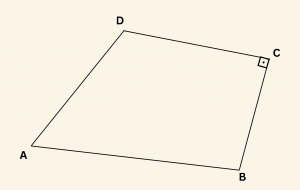 In the accompanying diagram, \( m \hat{C} = 90^\circ \).
If \( \tan A = 3 \) and \( \tan B = -\frac{1}{3} \), find \( \sin D \).
\[
\text{A) } \frac{1}{6} \quad \text{B) } \frac{1}{5} \quad \text{C) } \frac{2}{5} \quad \text{D) } \frac{3}{5} \quad \text{E) } \frac{4}{5}
\]
Solution:
The interior angles satisfy \( A + B + D = 270^\circ \Rightarrow D = 270^\circ – (A + B) \).
Taking the cotangent of both sides:
\[ \Rightarrow \cot D = \cot [270^\circ – (A + B)] = \tan (A + B) \]
Using the tangent addition formula:
\[
\tan (A + B) = \frac{\tan A + \tan B}{1 – \tan A \cdot \tan B} = \frac{3 + \left(-\frac{1}{3}\right)}{1 – 3 \cdot \left(-\frac{1}{3}\right)} = \frac{\frac{8}{3}}{1 + 1} = \frac{4}{3}
\]
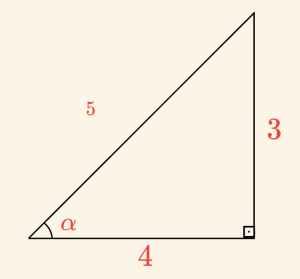
Thus, \( \cot D = \frac{4}{3} \). Constructing a right triangle with adjacent side 4 and opposite side 3:
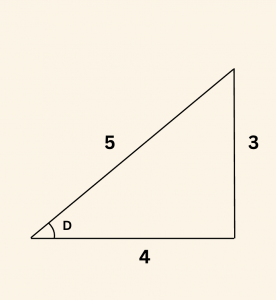
By the Pythagorean theorem, the hypotenuse is 5, so:
\[
\sin D = \frac{3}{5}
\]
\(\textbf{Correct Answer: D} \)
QUESTION 5
Solve the following equation for \( \tan x \):
\[
\frac{\sin \left( x + \frac{\pi}{4} \right)}{\cos \left( x – \frac{\pi}{4} \right)} + \tan \left( x + \frac{\pi}{4} \right) = \frac{1}{2}
\]
\[
\text{A) } 2 \quad \text{B) } 1 \quad \text{C) } -2 \quad \text{D) } -3 \quad \text{E) } -4
\]
Solution:
Using cofunction identity properties, notice that:
\[
\sin \left( x + \frac{\pi}{4} \right) = \cos \left[ \frac{\pi}{2} – \left(x + \frac{\pi}{4}\right) \right] = \cos \left( \frac{\pi}{4} – x \right)
\]
Since \( \cos(-\theta) = \cos(\theta) \), the denominator is also \( \cos \left( \frac{\pi}{4} – x \right) \). Therefore, the rational expression simplifies directly to 1:
\[
\frac{\sin \left( x + \frac{\pi}{4} \right)}{\cos \left( x – \frac{\pi}{4} \right)} = 1
\]
Next, expand the tangent term:
\[
\tan \left( x + \frac{\pi}{4} \right) = \frac{\tan x + \tan \frac{\pi}{4}}{1 – \tan x \cdot \tan \frac{\pi}{4}} = \frac{\tan x + 1}{1 – \tan x}
\]
Substituting these back into the original equation:
\[
1 + \frac{\tan x + 1}{1 – \tan x} = \frac{1}{2}
\]
Finding a common denominator:
\[
\Rightarrow \frac{(1 – \tan x) + (\tan x + 1)}{1 – \tan x} = \frac{1}{2}
\]
\[
\Rightarrow \frac{2}{1 – \tan x} = \frac{1}{2} \Rightarrow 1 – \tan x = 4 \Rightarrow \tan x = -3
\]
\(\textbf{Correct Answer: D} \)
QUESTION 6
Simplify the following expression:
\[
\frac{\sin 10^\circ + \sqrt{3} \cos 10^\circ}{\cos 20^\circ}
\]
\[
\text{A) } 1 \quad \text{B) } 2 \quad \text{C) } 3 \quad \text{D) } 4 \quad \text{E) } 5
\]
Solution:
Substitute \( \sqrt{3} = \tan 60^\circ = \frac{\sin 60^\circ}{\cos 60^\circ} \):
\[
\frac{\sin 10^\circ + \frac{\sin 60^\circ}{\cos 60^\circ} \cdot \cos 10^\circ}{\cos 20^\circ} = \frac{\frac{\sin 10^\circ \cdot \cos 60^\circ + \sin 60^\circ \cdot \cos 10^\circ}{\cos 60^\circ}}{\cos 20^\circ}
\]
Applying the sine sum identity to the numerator:
\[
= \frac{\sin (10^\circ + 60^\circ)}{\cos 60^\circ \cdot \cos 20^\circ} = \frac{\sin 70^\circ}{\frac{1}{2} \cdot \cos 20^\circ}
\]
Since \(\sin 70^\circ = \cos 20^\circ\) by complementary angles, they cancel out:
\[
= \frac{2 \cdot \cos 20^\circ}{\cos 20^\circ} = 2
\]
\(\textbf{Correct Answer: B} \)
QUESTION 7
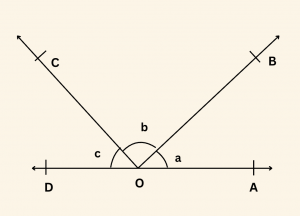 In the given figure,
\[\begin{aligned}&m(A\hat{O}B) = a \\ \\
&m( B\hat{O}C) = b \\ \\
&m( C\hat{O}D) = c \end{aligned}\]
Find an equivalent expression for the sum \( \tan a + \tan b + \tan c \).
\[
\text{A) } \tan a \cdot \tan b \cdot \tan c \quad
\text{B) } -\tan a \cdot \tan b \cdot \tan c \quad
\text{C) } 0 \quad
\text{D) } -1 \quad
\text{E) } 1
\]
Solution:
From the straight line, the angles satisfy \( a + b + c = 180^\circ \Rightarrow a + b = 180^\circ – c \).
Taking the tangent of both sides:
\[
\Rightarrow \tan (a + b) = \tan (180^\circ – c) = -\tan c
\]
Expanding using the tangent addition formula:
\[
\Rightarrow \frac{\tan a + \tan b}{1 – \tan a \cdot \tan b} = -\tan c
\]
Cross-multiplying yields:
\[
\Rightarrow \tan a + \tan b = -\tan c + \tan a \cdot \tan b \cdot \tan c
\]
Rearranging the terms gives the identity:
\[
\Rightarrow \tan a + \tan b + \tan c = \tan a \cdot \tan b \cdot \tan c
\]
\(\textbf{Correct Answer: A} \)
Note:
To find the maximum and minimum values of an expression of the form \( f(x) = a \sin x + b \cos x \):
\[
f(x) = a \left( \sin x + \frac{b}{a} \cos x \right)
\]
Letting \( \frac{b}{a} = \tan y = \frac{\sin y}{\cos y} \), we can substitute it into the expression:
\[
f(x) = a \left( \sin x + \frac{\sin y}{\cos y} \cdot \cos x \right) = a \left( \frac{\sin x \cdot \cos y + \sin y \cdot \cos x}{\cos y} \right) = \frac{a \sin (x + y)}{\cos y}
\]
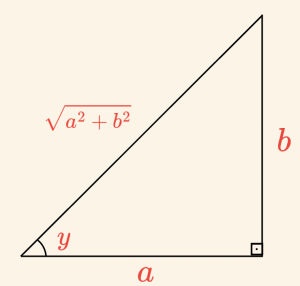 From the reference right triangle, we have \( \cos y = \frac{a}{\sqrt{a^2 + b^2}} \). Substituting this back:
\[
f(x) = \frac{a \sin (x + y)}{a / \sqrt{a^2 + b^2}} = \sqrt{a^2 + b^2} \cdot \sin (x + y)
\]
Since \( -1 \leq \sin (x + y) \leq 1 \), it follows that:
\[\begin{aligned}
&f_{\text{max}} = \sqrt{ a^2+b^2} \quad (\text{when } \sin(x+y) = 1) \\ \\
&f_{\text{min}} = -\sqrt{ a^2+b^2} \quad (\text{when } \sin(x+y) = -1) \\ \\
\end{aligned}\]
QUESTION 8
Let \( m \) be the maximum value and \( n \) be the minimum value of the function \( f(x) = 3 \sin x \;- \; 4 \cos x \). Identify the ordered pair \( (m, n) \).
\[
\text{A) } (-1, 1) \quad \text{B) } (5, -5) \quad \text{C) } (-4, 3) \quad \text{D) } (-3, 4) \quad \text{E) } (-\sqrt{5}, \sqrt{5})
\]
Solution:
\[
m = f_{\text{max}} = \sqrt{3^2 + (-4)^2} = \sqrt{9 + 16} = 5
\]
\[
n = f_{\text{min}} = -\sqrt{3^2 + (-4)^2} = -5
\]
Thus, the ordered pair is \( (5, -5) \).
\(\textbf{Correct Answer: B} \)
QUESTION 9
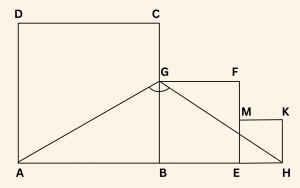
In the figure, ABCD, BEFG, and EHKM are squares.
Given that \( |AB| = 2|BE| = 4|EH| \), evaluate \( \tan (\hat{ AGH}) \).
\[ \text{A) } -\frac{1}{2} \quad \text{B) } -\frac{2}{3} \quad \text{C) } -1 \quad \text{D) } -\frac{3}{2} \quad \text{E) } -\frac{7}{4} \]
Solution:
Let \( m(\hat {AGB} ) = a \) and \( m(\hat{ BGH} ) = b \).
Setting \( |EH| = 1 \) unit as a base scale:
Then \( |BE| = |BG| = 2 \) units, and \( |AB| = 4 \) units.
From right triangle ABG:
\[
\tan a = \frac{|AB|}{|BG|} = \frac{4}{2} = 2
\]
From right triangle GBH, where \(|BH| = |BE| + |EH| = 2 + 1 = 3\):
\[
\tan b = \frac{|BH|}{|BG|} = \frac{3}{2}
\]
Thus, applying the tangent sum formula for \( \hat{AGH} = a + b \):
\[
\tan (\hat{ AGH} ) = \tan (a + b) = \frac{\tan a + \tan b}{1 – \tan a \cdot \tan b} = \frac{2 + \frac{3}{2}}{1 – 2 \cdot \frac{3}{2}} = \frac{\frac{7}{2}}{-2} = -\frac{7}{4}
\]
\(\textbf{Correct Answer: E} \)
QUESTION 10
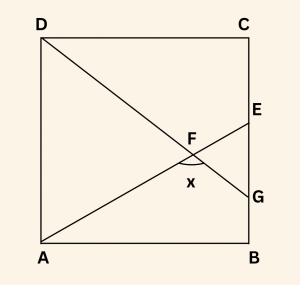
In the figure, ABCD is a square.
If \( |EC| = |EG| = 2|GB| \) and \( m(\hat{ AFG}) = x \), find the value of \( \tan x \).
\[
\text{A) } -\frac{35}{13} \quad
\text{B) } \frac{35}{13} \quad
\text{C) } \frac{34}{15} \quad
\text{D) } -\frac{13}{15} \quad
\text{E) } -\frac{7}{13}
\]
Solution:
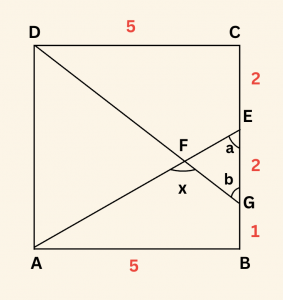 Let \( m(\hat{ AEG}) = a \) and \( m(\hat{ DGE}) = b \). By exterior angle properties, \( x = a + b \).
Choosing a scale where \( |GB| = 1 \) unit:
Then \( |EG| = |CE| = 2 \) units, meaning side length of the square is \( |BC| = |CE| + |EG| + |GB| = 2 + 2 + 1 = 5 \) units. Thus, \( |AB| = |DC| = 5 \).
From right triangle ABE (where \(|EB| = |EG| + |GB| = 3\)):
\[
\tan a = \frac{|AB|}{|EB|} = \frac{5}{3}
\]
From right triangle GCD (where \(|CG| = |CE| + |EG| = 4\)):
\[
\tan b = \frac{|DC|}{|CG|} = \frac{5}{4}
\]
Using the tangent sum identity:
\[
\tan x = \tan (a + b) = \frac{\tan a + \tan b}{1 – \tan a \cdot \tan b} = \frac{\frac{5}{3} + \frac{5}{4}}{1 – \frac{5}{3} \cdot \frac{5}{4}} = \frac{\frac{35}{12}}{1 – \frac{25}{12}} = \frac{\frac{35}{12}}{-\frac{13}{12}} = -\frac{35}{13}
\]
\(\textbf{Correct Answer: A} \)
QUESTION 11
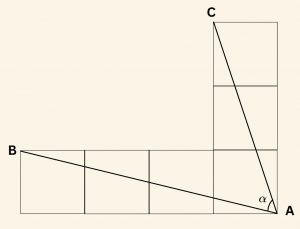
The figure consists of six identical unit squares.
If \( m(\hat{ BAC}) = \alpha \), find the value of \( \cot \alpha \).
\[
\text{A) } \frac{1}{3} \quad
\text{B) } 3 \quad
\text{C) } \frac{11}{7} \quad
\text{D) } \frac{7}{11} \quad
\text{E) } 4
\]
Solution:
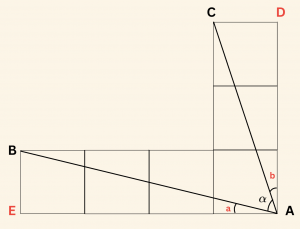
Let \( m(\hat {CAD}) = b \) and \( m ( \hat { EAB } ) = a \). Looking at the right angle at vertex A, we see that \( \alpha = 90^\circ \;-\; (a + b) \).
Assume each square has a side length of 1 unit.
From right triangle CDA (with opposite side 1 and adjacent side 3):
\[ \tan b = \frac{|CD|}{|DA|} = \frac{1}{3} \]
From right triangle BEA (with opposite side 1 and adjacent side 4):
\[ \tan a = \frac{|BE|}{|EA|} = \frac{1}{4} \]
By complementary angle identities:
\[
\cot \alpha = \cot [90^\circ – (a + b)] = \tan (a + b)
\]
Applying the tangent addition formula:
\[
\tan (a + b) = \frac{\tan a + \tan b}{1 – \tan a \cdot \tan b} = \frac{\frac{1}{4} + \frac{1}{3}}{1 – \frac{1}{4} \cdot \frac{1}{3}} = \frac{\frac{7}{12}}{\frac{11}{12}} = \frac{7}{11}
\]
\(\textbf{Correct Answer: D} \)
QUESTION 12
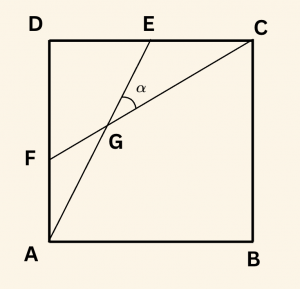
In the diagram, ABCD is a square.
If \( m( \hat{ EGC}) = \alpha \) and \( |DE| = |DF| = |FA| \), find \( \sin \alpha \).
\[
\text{A) } \frac{3}{4} \quad
\text{B) } \frac{3}{5} \quad
\text{C) } \frac{2}{3} \quad
\text{D) } \frac{2}{\sqrt{5}} \quad
\text{E) } \frac{3}{\sqrt{5}}
\]
Solution:
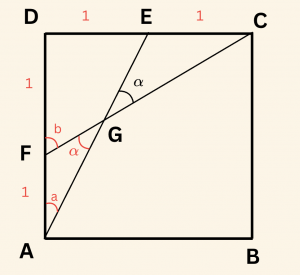 Let \( m (\hat {DAE} ) = a \) and \( m(\hat { DFC} ) = b \).
By exterior angle properties in triangles, \( b = a + \alpha \Rightarrow \alpha = b – a \).
Let \( |DE| = |DF| = |FA| = 1 \) unit.
Thus, the square side length is \( |DC| = |DA| = 2 \) units.
First, determine \( \tan \alpha \).
From right triangle ADE:
\[
\tan a = \frac{|DE|}{|DA|} = \frac{1}{2}
\]
From right triangle CDF:
\[
\tan b = \frac{|DC|}{|DF|} = \frac{2}{1} = 2
\]
Using the difference identity for tangent:
\[
\tan \alpha = \tan (b – a) = \frac{\tan b – \tan a}{1 + \tan b \cdot \tan a} = \frac{2 – \frac{1}{2}}{1 + 2 \cdot \frac{1}{2}} = \frac{\frac{3}{2}}{2} = \frac{3}{4}
\]
Constructing a 3-4-5 right triangle corresponding to \(\tan \alpha = \frac{3}{4}\):
\[
\sin \alpha = \frac{3}{5}
\]
\(\textbf{Correct Answer: B} \)
QUESTION 13
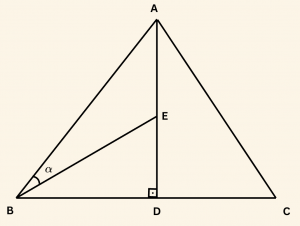
In the equilateral triangle ABC shown,
\( m(\hat{ ABE} ) = \alpha\), \( |AE| = |ED| \), and \( [BC] \perp [AD] \). Find \( \tan \alpha \).
\[
\text{A) } \frac{\sqrt{3}}{2} \quad
\text{B) } \frac{\sqrt{3}}{3} \quad
\text{C) } \frac{\sqrt{3}}{4} \quad
\text{D) } \frac{\sqrt{3}}{5} \quad
\text{E) } \frac{\sqrt{3}}{6}
\]
Solution:
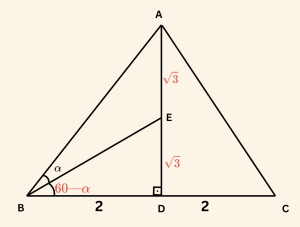
Let the side length of the equilateral triangle be \( |BC| = 4 \) units.
Since altitude \( [AD] \) is also a median:
\[
|BD| = |DC| = 2 \text{ units}
\]
The altitude is \( |AD| = 2\sqrt{3} \) units. Since E is the midpoint:
\[
|AE| = |ED| = \sqrt{3} \text{ units}
\]
Since \( m(\hat{ ABC}) = 60^\circ \), the remaining angle is \( m(\hat{ EBD}) = 60^\circ – \alpha \).
From right triangle BDE:
\[
\tan (60^\circ – \alpha) = \frac{|ED|}{|BD|} = \frac{\sqrt{3}}{2}
\]
Expanding using the tangent difference identity:
\[
\frac{\tan 60^\circ – \tan \alpha}{1 + \tan 60^\circ \tan \alpha} = \frac{\sqrt{3}}{2} \Rightarrow \frac{\sqrt{3} – \tan \alpha}{1 + \sqrt{3} \tan \alpha} = \frac{\sqrt{3}}{2}
\]
Cross-multiplying to solve for \(\tan \alpha\):
\[
2 (\sqrt{3} – \tan \alpha) = \sqrt{3} (1 + \sqrt{3} \tan \alpha)
\]
\[
2 \sqrt{3} – 2 \tan \alpha = \sqrt{3} + 3 \tan \alpha \Rightarrow \sqrt{3} = 5 \tan \alpha \Rightarrow \tan \alpha = \frac{\sqrt{3}}{5}
\]
\(\textbf{Correct Answer: D} \)
QUESTION 14
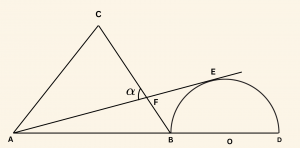
In the figure, a semicircle centered at O is inscribed along with equilateral triangle ABC.
Given \( m(\hat{ CFA}) = \alpha \), \( |AB| = |BD| \), and AE is tangent to the semicircle at point E, calculate \( \tan \alpha \).
\[
\text{A) } \frac{1 + \sqrt{3}}{3} \quad
\text{B) } \frac{2 + \sqrt{3}}{3} \quad
\text{C) } \frac{2 – \sqrt{3}}{3} \quad
\text{D) } \frac{\sqrt{3}}{4} \quad
\text{E) } \frac{\sqrt{2} + 4 \sqrt{3}}{4 – \sqrt{6}}
\]
Solution:
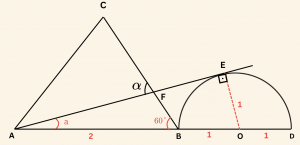 The radius \( [OE] \) is perpendicular to tangent line AE at point E.
Let \( |AB| = |BD| = 2 \) units.
Then \( |OB| = |OE| = 1 \) unit. In right triangle AEO, using the Pythagorean theorem with hypotenuse \(|AO| = |AB| + |OB| = 3\):
\[
|AE| = \sqrt{3^2 – 1^2} = 2 \sqrt{2} \text{ units}
\]
Let \( m(\hat{ FAB}) = a \). Since triangle ABC is equilateral, \( m(\hat{ CBA}) = 60^\circ \). By exterior angle theorem, \( \alpha = a + 60^\circ \).
From right triangle AEO:
\[
\tan a = \frac{|OE|}{|AE|} = \frac{1}{2 \sqrt{2}} = \frac{\sqrt{2}}{4}
\]
Applying the sum identity for tangent:
\[
\tan \alpha = \tan (a + 60^\circ) = \frac{\tan a + \tan 60^\circ}{1 – \tan a \cdot \tan 60^\circ} = \frac{\frac{\sqrt{2}}{4} + \sqrt{3}}{1 – \frac{\sqrt{2}}{4} \cdot \sqrt{3}} = \frac{\sqrt{2} + 4 \sqrt{3}}{4 – \sqrt{6}}
\]
\(\textbf{Correct Answer: E} \)
QUESTION 15
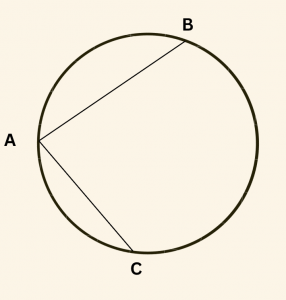
A circle with radius R is shown.
If \( |AB| = \frac{2\sqrt{5} R}{5} \) and \( |AC| = \frac{6R}{5} \), find the value of \( \tan (\hat{ BAC}) \).
\[
\text{A) } -2 \quad \text{B) } -1 \quad \text{C) } 2 \quad \text{D) } 3 \quad \text{E) } 4
\]
Solution:
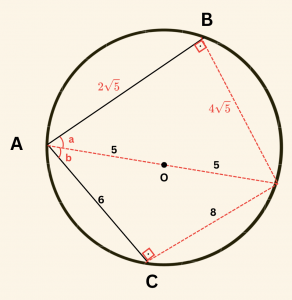 Let \( R = 5 \) units to simplify the parameters. Then the diameter is \( |AA’| = 10 \) units, \( |AB| = 2\sqrt{5} \), and \( |AC| = 6 \).
Drawing chords \( [BA’] \) and \( [CA’] \), since they subtend the diameter, the inscribed angles are right angles:
\[
m(\hat{ B}) = m(\hat{ C}) = 90^\circ
\]
By the Pythagorean theorem in right triangle ABA’:
\[
|BA’| = \sqrt{10^2 – (2\sqrt{5})^2} = 4 \sqrt{5} \text{ units}
\]
By the Pythagorean theorem in right triangle ACA’:
\[
|CA’| = \sqrt{10^2 – 6^2} = 8 \text{ units}
\]
Let \( m(\hat{ BAA’}) = a \) and \( m(\hat { A’AC} ) = b \), so \( \hat{BAC} = a + b \).
From right triangle ABA’:
\[
\tan a = \frac{|BA’|}{|AB|} = \frac{4 \sqrt{5}}{2 \sqrt{5}} = 2
\]
From right triangle ACA’:
\[
\tan b = \frac{|CA’|}{|AC|} = \frac{8}{6} = \frac{4}{3}
\]
Applying the tangent sum identity:
\[
\tan (\hat{ BAC}) = \tan (a + b) = \frac{\tan a + \tan b}{1 – \tan a \cdot \tan b} = \frac{2 + \frac{4}{3}}{1 – 2 \cdot \frac{4}{3}} = \frac{\frac{10}{3}}{-\frac{5}{3}} = -2
\]
\(\textbf{Correct Answer: A} \)
QUESTION 16
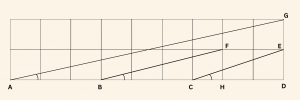
In the grid above consisting of 18 identical squares, find the sum of the angles \( a + b + c \) where
\( m(\hat{ DAG}) = a \), \( m(\hat{ DBF} ) = b \), and \( m(\hat { DCE}) = c \).
\[
\text{A) } 30^\circ \quad \text{B) } 45^\circ \quad \text{C) } 60^\circ \quad \text{D) } 75^\circ \quad \text{E) } 90^\circ
\]
Solution:
From right triangle GDA:
\[
\tan a = \frac{|GD|}{|AD|} = \frac{2}{9}
\]
From right triangle FHB:
\[
\tan b = \frac{|FH|}{|BH|} = \frac{1}{4}
\]
From right triangle EDC:
\[
\tan c = \frac{|ED|}{|CD|} = \frac{1}{3}
\]
First, find \( \tan(a + b) \):
\[
\tan (a + b) = \frac{\tan a + \tan b}{1 – \tan a \cdot \tan b} = \frac{\frac{2}{9} + \frac{1}{4}}{1 – \frac{2}{9} \cdot \frac{1}{4}} = \frac{\frac{17}{36}}{\frac{34}{36}} = \frac{1}{2}
\]
Next, find \( \tan[(a + b) + c] \):
\[
\tan [(a + b) + c] = \frac{\tan (a + b) + \tan c}{1 – \tan (a + b) \cdot \tan c} = \frac{\frac{1}{2} + \frac{1}{3}}{1 – \frac{1}{2} \cdot \frac{1}{3}} = \frac{\frac{5}{6}}{\frac{5}{6}} = 1
\]
Since the tangent of the total angle equals 1, the angle measure is:
\[
a + b + c = 45^\circ
\]
\(\textbf{Correct Answer: B } \)
← Previous Page | Next Page →