
Inequalities
Linear Inequalities in One Variable:
Let \( a, b \in \mathbb{R} \) and \( a \ne 0 \). An inequality written in the form of
\[ ax + b > 0 \] \[ax + b \ge 0 \]\[ax + b < 0 \] or \[ ax + b \le 0 \]
is called a linear inequality in one variable. The set of all real numbers \( x \) that satisfy the given expression is called the solution set of the inequality.
Solving a linear inequality in one variable means determining the sign of the binomial \( f(x) = ax + b \) across different intervals to find which values satisfy the inequality.
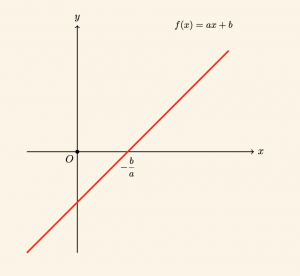
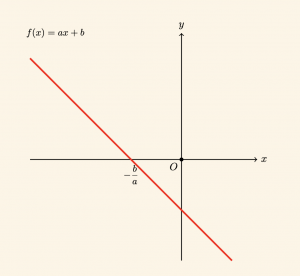
Let us analyze the behavior of the sign by looking at the graph of \( f(x) = ax + b \).
1) When \( \quad a > 0 \):
\[\text{For } x > -\frac{b}{a} \quad \Rightarrow \quad f(x) > 0, \]
\[\text{For } x < -\frac{b}{a} \quad \Rightarrow \quad f(x) < 0. \]
2) When \( \quad a < 0 \):
\[\text{For } x > -\frac{b}{a} \quad \Rightarrow \quad f(x) < 0, \quad \]
\[\text{For } x < -\frac{b}{a} \quad \Rightarrow \quad f(x) > 0. \]
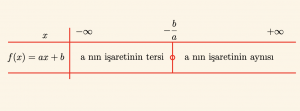
Consequently, we observe a general rule:
\[
\text{For } x > -\frac{b}{a}, \quad \text{the sign of } ax + b \text{ is } \textbf{the same as} \text{ the sign of } a.
\]
\[
\text{For } x < -\frac{b}{a}, \quad \text{the sign of } ax + b \text{ is } \textbf{opposite to} \text{ the sign of } a.
\]
We can systematically represent this rule in a sign chart (interval table):
Example:
Let us analyze the sign of the linear expression \[ f(x) = 2x – 16. \]
First, find the root:
\[2x – 16 = 0 \Rightarrow x = 8. \]
Since the leading coefficient is \( a = 2 > 0 \) (positive), the sign chart is constructed as follows:
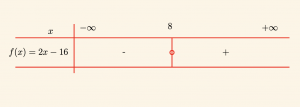
Thus, we conclude:
\[
\begin{aligned}
\text{If } x > 8 &\Rightarrow 2x – 16 > 0 \\
\text{If } x < 8 &\Rightarrow 2x – 16 < 0
\end{aligned}
\]
Example:
Let us analyze the sign of the linear expression \[ f(x) = 4 – 2x. \]
First, find the root:
\[4 – 2x = 0 \Rightarrow x = 2. \]
Since the leading coefficient is \( a = -2 < 0 \) (negative), the sign chart is constructed as follows:
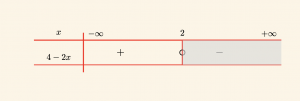
If we want to find the solution set for the inequality \( 4 – 2x \ge 0 \), looking at the positive region gives:
\[ S = \{ x \in \mathbb{R} \mid -\infty < x \le 2 \} = (-\infty, 2] \]
← Previous Page | Next Page →