
Permutation Function
Let $A$ be a finite (countable) set. Every bijective function $f: A \to A$ is called a permutation of $A$.
Since the domain and the codomain of the bijective function $f: A \to A$ are identical, this function is always surjective (and thus bijective).
Example:
Let a permutation of the set $A = \{ 1, 2, 3, 4 \}$ be given as:
\[
f =
\begin{pmatrix}
1 & 2 & 3 & 4 \\
3 & 1 & 2 & 4
\end{pmatrix}
\]
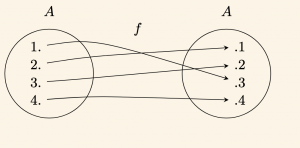
The function $f: A \to A$ is bijective.
Here:
\[
\begin{array}{c@{\quad}l}
f =
\begin{pmatrix}
1 & 2 & 3 & 4 \\
3 & 1 & 2 & 4
\end{pmatrix}
&
\begin{aligned}
&\rightarrow \text{domain}\\
&\rightarrow \text{codomain (range)}
\end{aligned}
\end{array}
\]
Therefore, $f(1) = 3,\quad f(2) = 1,\quad f(3) = 2,\quad f(4) = 4$.
Since $f$ is given as:
\[
f =
\begin{pmatrix}
1 & 2 & 3 & 4 \\
3 & 1 & 2 & 4
\end{pmatrix}
\]
the inverse function is defined as:
\[
f^{-1} =
\begin{pmatrix}
1 & 2 & 3 & 4 \\
2 & 3 & 1 & 4
\end{pmatrix}
\]
Example:
Consider the following permutations on the set $A = \{ 1, 2, 3, 4 \}$:
\[
f =
\begin{pmatrix}
1 & 2 & 3 & 4 \\
2 & 4 & 3 & 1
\end{pmatrix}
\quad\text{and}\quad
g =
\begin{pmatrix}
1 & 2 & 3 & 4 \\
4 & 3 & 1 & 2
\end{pmatrix}
\]
Let us find the composite permutation $f \circ g^{-1}$.
First, we determine the inverse function $g^{-1}$:
\[
g^{-1} =
\begin{pmatrix}
1 & 2 & 3 & 4 \\
3 & 4 & 2 & 1
\end{pmatrix}
\]
Now, we evaluate the individual values for the composition:
\[
\text{For } (f \circ g^{-1})(1) = f\bigl(g^{-1}(1)\bigr), \quad g^{-1}(1) = 3 \quad\Rightarrow\quad f(3) = 3
\]
\[
\text{For } (f \circ g^{-1})(2) = f\bigl(g^{-1}(2)\bigr), \quad g^{-1}(2) = 4 \quad\Rightarrow\quad f(4) = 1
\]
\[
\text{For } (f \circ g^{-1})(3) = f\bigl(g^{-1}(3)\bigr), \quad g^{-1}(3) = 2 \quad\Rightarrow\quad f(2) = 4
\]
\[
\text{For } (f \circ g^{-1})(4) = f\bigl(g^{-1}(4)\bigr), \quad g^{-1}(4) = 1 \quad\Rightarrow\quad f(1) = 2
\]
Thus, the result is:
\[
f \circ g^{-1} =
\begin{pmatrix}
1 & 2 & 3 & 4 \\
3 & 1 & 4 & 2
\end{pmatrix}
\]
Example:
On the set $A = \{ a, b, c \}$, we are given:
\[
f =
\begin{pmatrix}
a & b & c \\
c & a & b
\end{pmatrix},
\quad
g \circ f =
\begin{pmatrix}
a & b & c \\
b & a & c
\end{pmatrix}
\]
Let us find the permutation $g$.
From the mappings, we have step-by-step:
\[
f(a) = c \quad\text{and}\quad g\bigl(f(a)\bigr) = b \quad\Rightarrow\quad g(c) = b
\]
\[
f(b) = a \quad\text{and}\quad g\bigl(f(b)\bigr) = a \quad\Rightarrow\quad g(a) = a
\]
\[
f(c) = b \quad\text{and}\quad g\bigl(f(c)\bigr) = c \quad\Rightarrow\quad g(b) = c
\]
Therefore, the function $g$ is found as:
\[
g =
\begin{pmatrix}
a & b & c \\
a & c & b
\end{pmatrix}
\]
Number of Permutation Functions:
Let $s(A) = n$. The total number of possible permutation functions (bijective functions) $f : A \to A$ is calculated by:
\[ P(n, n) = \frac{n!}{(n-n)!} = n! \]
QUESTION 33
How many of the functions defined on the set $A = \{1, 2, 3, 4\}$ do not have an inverse function?
\[
\text{A) } 200 \quad
\text{B) } 232 \quad
\text{C) } 256 \quad
\text{D) } 276 \quad
\text{E) } 278
\]
Solution:
The total number of all possible functions $f : A \to A$ is: $4^4 = 256$.
The number of functions that have an inverse—meaning all bijective permutation functions—is: $4! = 24$.
Therefore, the number of functions that do not have an inverse function is: $256 – 24 = 232$.
\(\textbf{Answer: B} \)