
Rotation of a Complex Number
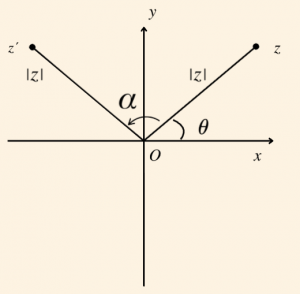
Let \( z = |z|(\cos \theta + i \sin \theta) \) be a complex number represented in the complex plane. If this vector is rotated counterclockwise (positive direction) through an angle of \( \alpha \), the resulting complex number \( z’ \) is given by:
\( z’ = |z|[\cos(\theta + \alpha) + i \sin(\theta + \alpha)] \)
\( = |z|(\cos \theta + i \sin \theta)(\cos \alpha + i \sin \alpha) \).
Therefore,
\[ z’ = z(\cos \alpha + i \sin \alpha) \]
If the complex number \( z = |z|(\cos \theta + i \sin \theta) \) is rotated clockwise (negative direction) through an angle of \( \alpha \), the resulting complex number \( z” \) is given by:
\( z” = z[\cos(\ – \ \alpha) + i \sin(\ – \ \alpha)] \).
Example:
Find the complex number \( z’ \) obtained by rotating \( z = 2 + 4i \) counterclockwise through an angle of \( 60^\circ \) in the complex plane.
\( z’ = (2 + 4i)(\cos 60^\circ + i \sin 60^\circ) \)
\( = (2 + 4i)(\displaystyle\frac{1}{2} + \displaystyle\frac{\sqrt{3}}{2}\,i) \)
\( = 1 \ – \ 2\sqrt{3} + (2 + \sqrt{3})\,i \).