
Double-Angle and Half-Angle Formulas
By substituting $b = a$ into the sum identity $\sin(a + b) = \sin a \cos b + \sin b \cos a$, we obtain:
\[
1) \quad \sin 2a = 2 \sin a \cos a
\]
By substituting $b = a$ into the sum identity $\cos(a + b) = \cos a \cos b – \sin a \sin b$, we obtain:
\[
2) \quad \cos 2a = \cos^2 a – \sin^2 a
\]
Using the Pythagorean identities $\cos^2 a = 1 – \sin^2 a$ and $\sin^2 a = 1 – \cos^2 a$, we can rewrite the expression as:
\[
\cos 2a = 1 – 2 \sin^2 a
\]
or
\[\cos 2a = 2 \cos^2 a – 1 \]
From these equations, we can derive the half-angle power-reducing formulas:
\[
\sin^2 a = \frac{1 – \cos 2a}{2}
\]
\[ \cos^2 a = \frac{1 + \cos 2a}{2} \]
Similarly, substituting $b = a$ into the tangent sum formula
\[
\tan (a + b) = \frac{\tan a + \tan b}{1 – \tan a \tan b}
\]
yields:
\[
3) \quad \tan 2a = \frac{2 \tan a}{1 – \tan^2 a}
\]
For the cotangent function, substituting $b = a$ into the identity
\[
\cot (a + b) = \frac{\cot a \cot b – 1}{\cot a + \cot b}
\]
yields:
\[
4) \quad \cot 2a = \frac{\cot^2 a \; – \; 1}{2 \cot a}
\]
We can express $\tan x$ in terms of its half-angle as follows:
\[
\tan x = \frac{2 \tan(x/2)}{1 – \tan^2(x/2)}
\]
By applying the substitution $\tan \frac{x}{2} = u$, we can represent this relationship geometrically using a right triangle:
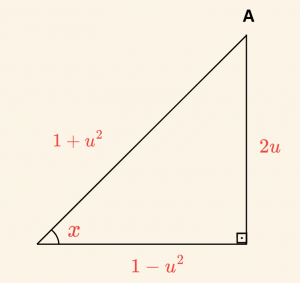
\[ \tan x = \frac{2u}{1- u^2} \]
\[\sin x = \frac{2u}{1+ u^2} \]
Consequently, we establish the following parametric identities:
\[ \sin x = \frac{2 \tan(x/2)}{1 + \tan^2(x/2)} \quad \text{and} \quad \cos x = \frac{1- \tan^2(x/2)}{1 + \tan^2(x/2)} \]
To summarize these fundamental double-angle identities:
\[
\begin{array}{| l | }
\hline \\
1) \quad \sin 2a = 2 \sin a \cos a \\ \\
\hline \\
2) \quad \cos 2a = \cos^2 a – \sin^2 a \\ \\
\hline \\
3) \quad \tan 2a = \Large \frac{2 \tan a}{1 – \tan^2 a} \\ \\
\hline \\
4) \quad \cot 2a = \Large \frac{\cot^2 a \; – \; 1}{2 \cot a} \\ \\
\hline
\end{array}
\]
Examples:
- $\sin x = 2 \sin \frac{x}{2} \cos \frac{x}{2}$
- $\cos 24^\circ = \cos^2 12^\circ – \sin^2 12^\circ = 1 – 2 \sin^2 12^\circ$
- $\tan 4x = \frac{2 \tan 2x}{1 – \tan^2 2x}$
- $\sin \frac{\pi}{4} = 2 \sin \frac{\pi}{8} \cdot \cos \frac{\pi}{8}$
Example:
Evaluate the exact values of $\sin 15^\circ$ and $\tan 22.5^\circ$.
Using the half-angle formula $\sin^2 a = \frac{1 – \cos 2a}{2}$:
\[ \Rightarrow \sin^2 15^\circ = \frac{1 – \cos 30^\circ}{2} \]
\[ \Rightarrow \sin^2 15^\circ = \frac{1 – \frac{\sqrt{3}}{2}}{2} = \frac{2 – \sqrt{3}}{4} \]
\[ \Rightarrow \sin 15^\circ = \frac{\sqrt{6} – \sqrt{2}}{4} \]
Using the double-angle formula $\tan 2a = \frac{2 \tan a}{1 – \tan^2 a}$:
\[ \Rightarrow \tan 45^\circ = \frac{2 \tan 22.5^\circ}{1 – \tan^2 22.5^\circ} = 1 \]
\[ 1 – \tan^2 22.5^\circ = 2 \tan 22.5^\circ \]
\[ \Rightarrow \tan^2 22.5^\circ + 2 \tan 22.5^\circ – 1 = 0 \]
Let $t = \tan 22.5^\circ$:
\[ t^2 + 2t – 1 = 0 \]
Applying the quadratic formula yields:
\[ \Rightarrow t = \tan 22.5^\circ = \sqrt{2} – 1 \]
Example:
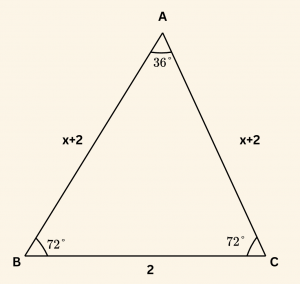
Find the exact value of $\sin 18^\circ$.
Let us construct an isosceles triangle $ABC$ such that $m(\angle A) = 36^\circ$ and $|BC| = 2$ units.
Since the base angles must be equal, $m(\angle B) = m(\angle C) = 72^\circ$. This implies $|AB| = |AC| > |BC|$. Let $|AB| = |AC| = x + 2$ units.
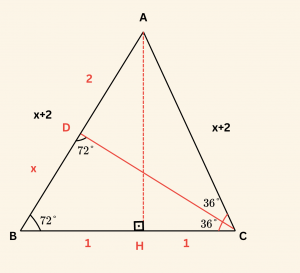
Construct the angle bisector $[DC]$ of angle $C$.
This division gives $m(\angle CDB) = 72^\circ$. Consequently, $\triangle BCD$ and $\triangle ADC$ are also isosceles, yielding $|BC| = |DC| = 2$ units, $|AD| = |CD| = 2$ units, and leaving $|BD| = x$ units.
Since $\triangle CAB \sim \triangle BCD$ by Angle-Angle similarity, we can set up the ratio:
\[ \frac{|CB|}{|BD|} = \frac{|CA|}{|BC|} \]
\[ \frac{2}{x} = \frac{x+2}{2} \]
\[ \Rightarrow x^2 + 2x – 4 = 0 \Rightarrow x = \sqrt{5} – 1 \]
From the right triangle $AHC$ formed by dropping an altitude:
\[ \cos(\angle ACB) = \frac{|HC|}{|AC|} \Rightarrow \cos 72^\circ = \frac{1}{\sqrt{5} – 1 + 2} \]
Applying the cofunction identity, we find:
\[ \cos 72^\circ = \sin 18^\circ = \frac{\sqrt{5} – 1}{4} \]
QUESTION 17
Evaluate the following expression:
\[ \frac{\sin 33^\circ}{\sin 11^\circ} \; – \; \frac{\cos 33^\circ}{\cos 11^\circ} \]
\[ \text{A) } 3 \quad \text{B) } 2 \quad \text{C) } 1 \quad \text{D) } -1 \quad \text{E) } -2 \]
Solution:
First, find a common denominator to combine the rational expressions:
\[ \frac{\sin 33^\circ}{\sin 11^\circ}\; -\; \frac{\cos 33^\circ}{\cos 11^\circ} = \frac{\sin 33^\circ \cdot \cos 11^\circ\; -\; \sin 11^\circ \cdot \cos 33^\circ}{\sin 11^\circ \cdot \cos 11^\circ} \]
Apply the sine difference identity $\sin(a – b) = \sin a \cos b – \cos a \sin b$ to the numerator:
\[ = \frac{\sin(33^\circ \;- \;11^\circ)}{\sin 11^\circ \cdot \cos 11^\circ} = \frac{\sin 22^\circ}{\sin 11^\circ \cdot \cos 11^\circ} \]
Rewrite the numerator using the double-angle identity $\sin 2\theta = 2\sin\theta\cos\theta$:
\[ = \frac{2 \sin 11^\circ \cdot \cos 11^\circ}{\sin 11^\circ \cdot \cos 11^\circ} = 2 \]
\( \textbf{Correct Answer: B} \)
QUESTION 18
Evaluate the following expression:
\[ \cos^2 \frac{13\pi}{12} + \sin^2 \frac{5\pi}{12} \]
\[ \text{A) } 1 \quad \text{B) } 2 \;- \;\sqrt{3} \quad \text{C) } 2 + \sqrt{3} \quad \text{D) } \frac{2 – \sqrt{3}}{2} \quad \text{E) } \frac{2 + \sqrt{3}}{2} \]
Solution:
Using reference angles and cofunction identities, rewrite each term:
\[ \cos^2 \frac{13\pi}{12} + \sin^2 \frac{5\pi}{12} = \cos^2 \left( \pi + \frac{\pi}{12} \right) + \sin^2 \left( \frac{\pi}{2} \; – \; \frac{\pi}{12} \right) \]
\[ = \left(-\cos \frac{\pi}{12}\right)^2 + \cos^2 \frac{\pi}{12} = 2 \cos^2 \frac{\pi}{12} \]
Apply the power-reducing formula $2 \cos^2 a = 1 + \cos 2a$:
\[ = 1 + \cos \frac{2\pi}{12} = 1 + \cos \frac{\pi}{6} \]
\[ = 1 + \frac{\sqrt{3}}{2} = \frac{2 + \sqrt{3}}{2} \]
\( \textbf{Correct Answer: E} \)
QUESTION 19
If $A = 1 + \tan 2x \cdot \tan 4x$, which of the following is equivalent to $\frac{1}{A}$ ?
\[ \text{A) } \cos 4x \quad \text{B) } \sin 4x \quad \text{C) } \sec 4x \quad \text{D) } \cos 2x \quad \text{E) } \sin 2x \]
Solution:
Express the tangent functions in terms of sine and cosine:
\[ A = 1 + \tan 2x \cdot \tan 4x = 1 + \frac{\sin 2x}{\cos 2x} \cdot \frac{\sin 4x}{\cos 4x} \]
Substitute the double-angle formulas for $\sin 4x$ and $\cos 4x$:
\[ = 1 + \frac{\sin 2x}{\cos 2x} \cdot \frac{2 \sin 2x \cdot \cos 2x}{\cos^2 2x\; – \; \sin^2 2x} \]
\[ = 1 + \frac{2 \sin^2 2x}{\cos^2 2x \; – \; \sin^2 2x} = 1 + \frac{2 \sin^2 2x}{\cos 4x} \]
Find a common denominator to simplify the expression:
\[ = \frac{\cos^2 2x – \sin^2 2x + 2 \sin^2 2x}{\cos^2 2x \;- \;\sin^2 2x} = \frac{\cos^2 2x + \sin^2 2x}{\cos 4x} \]
\[ = \frac{1}{\cos 4x} \]
Taking the reciprocal gives:
\[ \frac{1}{A} = \cos 4x \]
\( \textbf{Correct Answer: A} \)
QUESTION 20
Given $\pi < x < 2\pi$ and $A = \frac{1 – \cos x}{1 + \cos x}$, which of the following is equal to $\sqrt{A}$?
\[ \text{A) } -1 \quad \text{B) } \tan \frac{x}{2} \quad \text{C) } – \tan \frac{x}{2} \quad \text{D) } 2 \tan \frac{x}{2} \quad \text{E) } -2 \tan \frac{x}{2} \]
Solution:
Substitute the appropriate double-angle identities to eliminate the constant terms:
\[ A = \frac{1 – \cos x}{1 + \cos x} = \frac{1 – (1 – 2 \sin^2 \frac{x}{2})}{1 + (-1 + 2 \cos^2 \frac{x}{2})} \]
\[ = \frac{2 \sin^2 \frac{x}{2}}{2 \cos^2 \frac{x}{2}} = \tan^2 \frac{x}{2} \]
Taking the principal square root requires evaluating the sign within the given domain:
\[ \Rightarrow \sqrt{A} = \sqrt{\tan^2 \frac{x}{2}} = \left| \tan \frac{x}{2} \right| \]
Since $\pi < x < 2\pi$, dividing by 2 gives $\frac{\pi}{2} < \frac{x}{2} < \pi$, placing the half-angle in Quadrant II where tangent is negative:
\[ \sqrt{A} = – \tan \frac{x}{2} \]
\( \textbf{Correct Answer: C} \)
QUESTION 21
If $\cos 40^\circ = a$, express $\cos 280^\circ$ in terms of $a$.
\[ \text{A) } 1 – a \quad \text{B) } 1 – 2a \quad \text{C) } 1 – a^2 \quad \text{D) } -1 + 2a^2 \quad \text{E) } 1 – 2a^2 \]
Solution:
Use the reduction and cofunction identities to simplify the expression:
\[ \cos 280^\circ = \cos(270^\circ + 10^\circ) = \sin 10^\circ = \cos 80^\circ \]
Apply the cosine double-angle formula $\cos 2\theta = 2\cos^2\theta – 1$:
\[ \cos 80^\circ = 2 \cos^2 40^\circ – 1 = 2a^2 – 1 \]
\( \textbf{Correct Answer: D} \)
QUESTION 22
Simplify the following trigonometric expression:
\[ 1 \;- \; 2 \sin^2 x + \frac{\sin^2 2x \; – \; 2 \cos^2 x}{\cos^4 x \;- \;\sin^4 x} \]
\[ \text{A) } – \tan 2x \quad \text{B) } \tan 2x \quad \text{C) } – \cot 2x \quad \text{D) } 1 \quad \text{E) } -1 \]
Solution:
Recognize $\cos 2x = 1 – 2\sin^2 x$ and factor the denominator as a difference of squares:
\[ = \cos 2x + \frac{\sin^2 2x \;- \; 2 \cos^2 x}{(\cos^2 x + \sin^2 x)(\cos^2 x \; – \; \sin^2 x)} \]
Since $\cos^2 x + \sin^2 x = 1$ and $\cos^2 x – \sin^2 x = \cos 2x$, the expression simplifies to:
\[ = \cos 2x + \frac{\sin^2 2x \; – \; 2 \cos^2 x}{\cos 2x} = \frac{\cos^2 2x + \sin^2 2x \; – \; 2 \cos^2 x}{\cos 2x} \]
Apply the Pythagorean identity to rewrite the numerator:
\[ = \frac{1 \;-\; 2 \cos^2 x}{\cos 2x} = \frac{- (2 \cos^2 x – 1)}{\cos 2x} = \frac{-\cos 2x}{\cos 2x} = -1 \]
\( \textbf{Correct Answer: E} \)
QUESTION 23
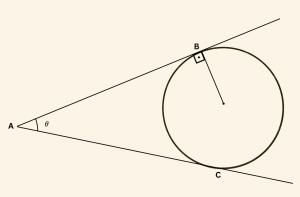
In the accompanying figure, tangent lines from an external point $A$ touch the circle centered at $O$ at points $B$ and $C$.
If $3|OB| = |AB|$ and $m(\angle BAC) = \theta$, determine the value of $\sin \theta$.
\[ \text{A) } \frac{1}{5} \quad \text{B) } \frac{2}{5} \quad \text{C) } \frac{3}{5} \quad \text{D) } \frac{4}{5} \quad \text{E) } \frac{2}{3} \]
Solution:
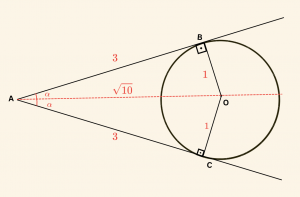
Construct segment $[AO]$. By symmetry, $[AO]$ bisects $\angle BAC$, so $m(\angle BAO) = m(\angle CAO) = \alpha$ and $\theta = 2\alpha$. Let $|OB| = 1$ unit, which means $|AB| = 3$ units.
Applying the Pythagorean theorem to right triangle $ABO$ ($\angle ABO = 90^\circ$):
\[ |AO| = \sqrt{1^2 + 3^2} = \sqrt{10} \text{ units} \]
From $\triangle ABO$, determine the primary trigonometric ratios:
\[ \sin \alpha = \frac{|OB|}{|AO|} = \frac{1}{\sqrt{10}} \quad \text{and} \quad \cos \alpha = \frac{|AB|}{|AO|} = \frac{3}{\sqrt{10}} \]
Using the double-angle identity for sine:
\[ \sin \theta = \sin 2\alpha = 2 \sin \alpha \cos \alpha = 2 \cdot \frac{1}{\sqrt{10}} \cdot \frac{3}{\sqrt{10}} = \frac{6}{10} = \frac{3}{5} \]
\( \textbf{Correct Answer: C} \)
QUESTION 24
Given the domain restriction $\frac{2\pi}{4} < x < \pi$ and the equation:
\[ \frac{\sin^2 x}{1 + \cos^2 x + \cos 2x} = \frac{4}{3} \]
Find the exact value of $\tan 2x$.
\[ \text{A)} -\frac{1}{3} \quad \text{B)} -\frac{1}{2} \quad \text{C)} 2 \quad \text{D)} \frac{4}{3} \quad \text{E)} \frac{3}{4} \]
Solution:
Substitute $\cos 2x = 2\cos^2 x – 1$ into the denominator:
\[ \Rightarrow \frac{\sin^2 x}{1 + \cos^2 x + (2 \cos^2 x – 1)} = \frac{4}{3} \Rightarrow \frac{\sin^2 x}{3 \cos^2 x} = \frac{4}{3} \]
\[ \Rightarrow \tan^2 x = 4 \]
Since $x$ lies in Quadrant II ($\frac{\pi}{2} < x < \pi$), the tangent value must be negative:
\[ \tan x = -2 \]
Now evaluate $\tan 2x$ using its double-angle identity:
\[ \tan 2x = \frac{2 \tan x}{1 – \tan^2 x} = \frac{2 \cdot (-2)}{1 – (-2)^2} = \frac{-4}{-3} = \frac{4}{3} \]
\( \textbf{Correct Answer: D} \)
QUESTION 25
If $\frac{\cos 2x – 3 \sin x + 1}{2 + \sin x} = -\frac{1}{5}$, find the value of $\cot 2x$.
\[ \text{A) } \frac{24}{7} \quad \text{B) } \frac{7}{24} \quad \text{C) } \frac{4}{3} \quad \text{D) } \frac{3}{4} \quad \text{E) } 1 \]
Solution:
Express the numerator solely in terms of sine using $\cos 2x = 1 – 2\sin^2 x$:
\[ \Rightarrow \frac{(1 – 2 \sin^2 x) – 3 \sin x + 1}{2 + \sin x} = -\frac{1}{5} \Rightarrow \frac{-2 \sin^2 x – 3 \sin x + 2}{2 + \sin x} = -\frac{1}{5} \]
Factor the quadratic expression in the numerator by grouping:
\[ \Rightarrow \frac{-(2 \sin x – 1)(\sin x + 2)}{2 + \sin x} = -\frac{1}{5} \]
Cancel out the common factor $(\sin x + 2)$:
\[ \Rightarrow 2 \sin x – 1 = \frac{1}{5} \Rightarrow \sin x = \frac{3}{5} \]
This corresponds to a standard 3-4-5 right triangle, yielding $\tan x = \frac{3}{4}$. Find $\tan 2x$ next:
\[ \tan 2x = \frac{2 \tan x}{1 – \tan^2 x} = \frac{2 \cdot \frac{3}{4}}{1 – \left( \frac{3}{4} \right)^2} = \frac{\frac{3}{2}}{\frac{7}{16}} = \frac{24}{7} \]
Since $\cot 2x$ is the reciprocal of $\tan 2x$:
\[ \cot 2x = \frac{7}{24} \]
\( \textbf{Correct Answer: B} \)
QUESTION 26
Simplify the following expression:
\[ \tan \left( \frac{\pi}{4} \;- \; x \right) – \cot \left( x \; – \; \frac{\pi}{4} \right) \]
\[ \text{A) } 1 \quad \text{B) } -1 \quad \text{C) } 2 \quad \text{D) } -2 \sec 2x \quad \text{E) } 2 \sec 2x \]
Solution:
Use the odd-party property of cotangent, $-\cot\theta = \cot(-\theta)$, to rewrite the second term:
\[ = \tan \left( \frac{\pi}{4} \;- \; x \right) + \cot \left( \frac{\pi}{4}\; – \; x \right) \]
Convert the expressions to sine and cosine formats:
\[ = \frac{\sin \left( \frac{\pi}{4} – x \right)}{\cos \left( \frac{\pi}{4} – x \right)} + \frac{\cos \left( \frac{\pi}{4} – x \right)}{\sin \left( \frac{\pi}{4} – x \right)} = \frac{\sin^2 \left( \frac{\pi}{4} – x \right) + \cos^2 \left( \frac{\pi}{4} – x \right)}{\sin \left( \frac{\pi}{4} – x \right) \cos \left( \frac{\pi}{4} – x \right)} \]
Apply the Pythagorean identity to the numerator and the product identity to the denominator:
\[ = \frac{1}{\frac{1}{2} \sin \left( \frac{\pi}{2} – 2x \right)} \]
Using the cofunction identity $\sin(\frac{\pi}{2} – \theta) = \cos\theta$:
\[ = \frac{2}{\cos 2x} = 2 \sec 2x \]
\( \textbf{Correct Answer: E} \)
QUESTION 27
Given the domain constraint $180^\circ < x < 270^\circ$, if $\tan x = \frac{3}{4}$, compute the value of $\sin \frac{x}{2}$
\[ \text{A)} \frac{3}{\sqrt{10}} \quad \text{B)} -\frac{3}{\sqrt{10}} \quad \text{C)} \frac{1}{\sqrt{10}} \quad \text{D)} -\frac{1}{\sqrt{10}} \quad \text{E)} \frac{3}{4} \]
Solution:
Relate $\tan x$ to its half-angle components:
\[ \tan x = \frac{2 \tan \frac{x}{2}}{1 – \tan^2 \frac{x}{2}} \Rightarrow \frac{3}{4} = \frac{2 \tan \frac{x}{2}}{1 – \tan^2 \frac{x}{2}} \]
\[ \Rightarrow 3 – 3 \tan^2 \frac{x}{2} = 8 \tan \frac{x}{2} \Rightarrow 3 \tan^2 \frac{x}{2} + 8 \tan \frac{x}{2} – 3 = 0 \]
Let $t = \tan \frac{x}{2}$. Factoring the quadratic equation yields:
\[ 3t^2 + 8t – 3 = 0 \Rightarrow (3t – 1)(t + 3) = 0 \Rightarrow t = \frac{1}{3} \quad \text{or} \quad t = -3 \]
Determine the correct sign based on the half-angle interval: $180^\circ < x < 270^\circ \Rightarrow 90^\circ < \frac{x}{2} < 135^\circ$. Since Quadrant II tangent values are negative, select $\tan \frac{x}{2} = -3$.
Construct a reference triangle where the legs are $3$ and $1$, resulting in a hypotenuse of $\sqrt{10}$:
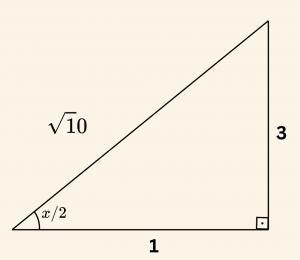
From this geometric model:
\[ \left| \sin \frac{x}{2} \right| = \frac{3}{\sqrt{10}} \]
Because $90^\circ < \frac{x}{2} < 135^\circ$, sine must be positive:
\[ \sin \frac{x}{2} = \frac{3}{\sqrt{10}} \]
\( \textbf{Correct Answer: A} \)
Warning / Useful Geometric Strategy:
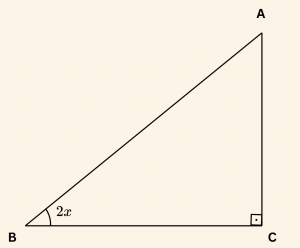
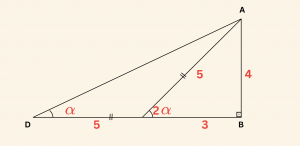
When an acute angle $2x$ has known trigonometric ratios, the ratios for its half-angle $x$ can be found geometrically using a right triangle extension.
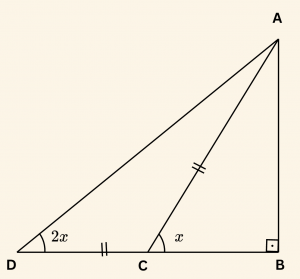
Construct a right triangle $ABC$ matching the given ratios for angle $2x$. Extend the base segment $[BC]$ to a point $D$ such that the extension length $|CD|$ equals the hypotenuse length $|AC|$.
Connecting point $D$ to vertex $A$ creates a new large right triangle $\triangle ABD$. By the Exterior Angle Theorem, the interior base angle $m(\angle D)$ equals exactly $x$.
QUESTION 28
Given $0^\circ < x < 45^\circ$, if $\cos x = \frac{2 \sqrt{2}}{\sqrt{13}} + \sin x$, find the value of $\cot x$.
\[ \text{A) } 2 \quad \text{B) } 3 \quad \text{C) } 4 \quad \text{D) } 5 \quad \text{E) } 6 \]
Solution:
Rearrange the terms and square both sides of the equation:
\[ \cos x – \sin x = \frac{2 \sqrt{2}}{\sqrt{13}} \Rightarrow (\cos x – \sin x)^2 = \left(\frac{2 \sqrt{2}}{\sqrt{13}}\right)^2 \]
\[ \cos^2 x + \sin^2 x – 2 \cos x \sin x = \frac{8}{13} \]
Apply fundamental identities ($1 – \sin 2x = \frac{8}{13}$):
\[ \sin 2x = \frac{5}{13} \]
Using the geometric extension method discussed above, construct a right triangle with an angle $2x$, leg $5$, and hypotenuse $13$. Extending the base by $13$ results in a total base length of $12 + 13 = 25$ for the half-angle triangle:
\[ \cot x = \frac{\text{adjacent}}{\text{opposite}} = \frac{25}{5} = 5 \]
\( \textbf{Correct Answer: D} \)
QUESTION 29
In $\triangle ABC$, if $\tan A = 2$ and $\tan B = \frac{2}{3}$, find the value of $\tan \frac{C}{2}$.
\[ \text{A)} \frac{4}{3} \quad \text{B)} \frac{3}{4} \quad \text{C)} \frac{8}{\sqrt{65}} \quad \text{D)} \frac{\sqrt{65}}{8} \quad \text{E)} \frac{8}{1+\sqrt{65}} \]
Solution:
Since the interior angles sum up to $180^\circ$ ($A + B + C = 180^\circ$):
\[ \tan(A + B) = \tan(180^\circ – C) = – \tan C \]
Apply the tangent addition formula:
\[ \frac{\tan A + \tan B}{1 – \tan A \tan B} = \frac{2 + \frac{2}{3}}{1 – 2 \cdot \frac{2}{3}} = \frac{\frac{8}{3}}{-\frac{1}{3}} = -8 \]
\[ \Rightarrow -\tan C = -8 \Rightarrow \tan C = 8 \]
Using the triangle extension method to transition from angle $C$ to its half-angle $\frac{C}{2}$:
\[ \tan \frac{C}{2} = \frac{\text{opposite}}{\text{adjacent}} = \frac{8}{1 + \sqrt{1^2 + 8^2}} = \frac{8}{1 + \sqrt{65}} \]
\( \textbf{Correct Answer: E} \)
QUESTION 30
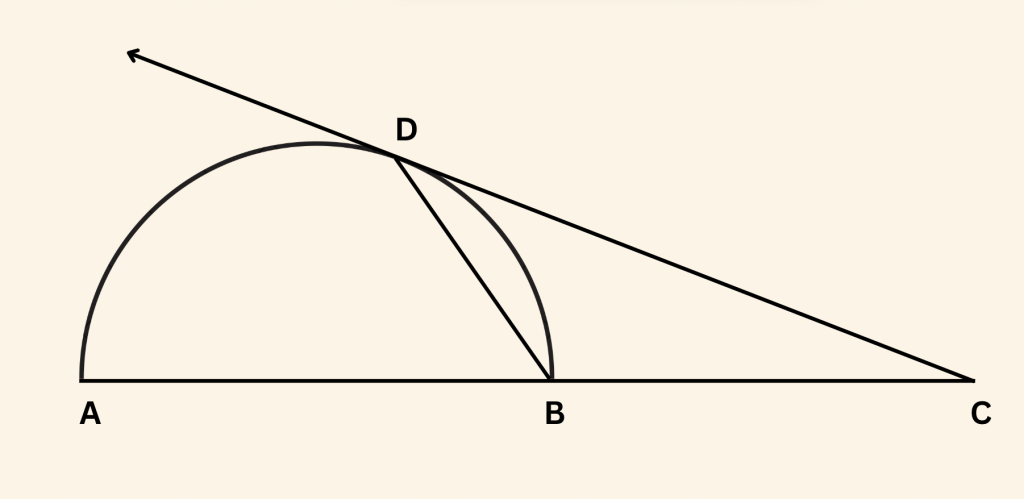
Segment $[CD]$ is tangent to the semicircle with diameter $[AB]$ at point $D$.
Given $|AB| = 12\text{ cm}$, $|BC| = 4\text{ cm}$, and $m(\angle BDC) = \alpha$, calculate the value of $\tan \alpha$.
\[ \text{A)} \; \frac{1}{3} \quad \text{B)}\; \frac{1}{2} \quad \text{C)}\; 2 \quad \text{D)}\; 3 \quad \text{E)}\; 4 \]
Solution:
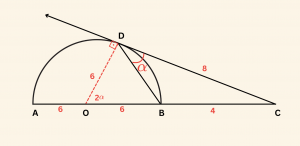
Draw a radius to the tangency point $D$. A radius meeting a tangent line forms a right angle ($[OD] \perp [CD]$).
By the tangent-secant theorem and inscribed angle properties, the central angle satisfies $m(\angle DOB) = 2\alpha$. The radius is $6\text{ cm}$, making $|OC| = 6 + 4 = 10\text{ cm}$. Using the Pythagorean theorem on $\triangle ODC$ gives $|DC| = 8\text{ cm}$.
\[ \tan 2\alpha = \frac{|DC|}{|DO|} = \frac{8}{6} = \frac{4}{3} \]
Alternatively, looking at the inscribed geometric layout directly:
\[ \tan \alpha = \frac{|AB|}{|BD|} = \frac{4}{8} = \frac{1}{2} \]
\[ \textbf{Correct Answer: B} \]
QUESTION 31
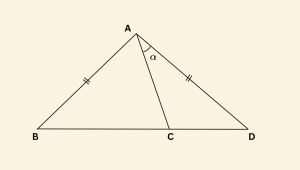
In the figure above, $[AB] \perp [AC]$, $m(\angle CAD) = \alpha$, $|AB| = |AD|$, and $3|BC| = 5|AC|$. Determine the value of $\sin \alpha$.
\[ \text{A)}\ \frac{7}{25} \quad \text{B)}\ \frac{8}{25} \quad \text{C)}\ \frac{9}{25} \quad \text{D)}\ \frac{2}{5} \quad \text{E)}\ \frac{11}{25} \]
Solution:
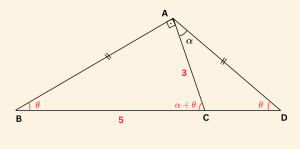
Let $m(\angle B) = \theta$. Since $\triangle ABD$ is isosceles ($|AB| = |AD|$), its base angles match: $m(\angle ADB) = \theta$. Then, the exterior angle satisfies $m(\angle ACD) = \theta + \alpha$.
Within right triangle $\triangle ABC$, the complementary angles yield $\alpha = 90^\circ – 2\theta$. Choose a scale where $|AC| = 3$ units and $|BC| = 5$ units.
Using the cofunction identity and cosine double-angle equation:
\[ \sin \alpha = \sin(90^\circ – 2\theta) = \cos 2\theta \]
From $\triangle ABC$, we know $\sin \theta = \frac{|AC|}{|BC|} = \frac{3}{5}$. Substituting this value gives:
\[ \sin \alpha = 1 – 2\sin^2 \theta = 1 – 2 \cdot \left(\frac{3}{5}\right)^2 = 1 – \frac{18}{25} = \frac{7}{25} \]
\( \textbf{Correct Answer: A} \)
QUESTION 32
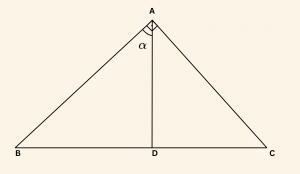
In the figure above, $m(\angle BAC) = 90^\circ$, $m(\angle BAD) = \alpha$, $3|AC| = 4|AB|$, and $|AB| = 3|BD|$. Find the exact value of $\sin \alpha$.
\[ \text{A)} \ \frac{3}{\sqrt{10}} \quad \text{B)} \ \frac{1}{\sqrt{10}} \quad \text{C)} \ \frac{1}{\sqrt{5}} \quad \text{D)} \ \frac{1}{3} \quad \text{E)} \ \frac{1}{4} \]
Solution:
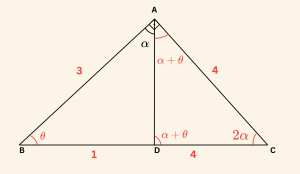
Let $|BD| = 1$ unit. This implies $|AB| = 3$ units and $|AC| = 4$ units. By the Pythagorean theorem, the total hypotenuse length is $|BC| = 5$ units.
Since $|BD| = 1$, the remaining segment is $|DC| = 5 – 1 = 4$ units. This means $\triangle ACD$ is isosceles ($|AC| = |DC| = 4$).
Let $m(\angle B) = \theta$. Tracing angles tells us $m(\angle C) = 2\alpha$. From right triangle $\triangle ABC$:
\[ \tan 2\alpha = \frac{|AB|}{|AC|} = \frac{3}{4} \]
Using a standard reference triangle to track the half-angle components:
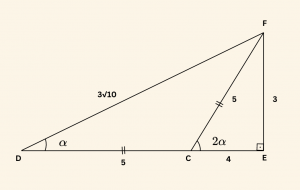
\[ \sin\alpha = \frac{|FE|}{|ED|} = \frac{3}{3 \sqrt{10}} = \frac{1}{\sqrt{10}} \]
\( \textbf{Correct Answer: B} \)
QUESTION 33
Evaluate the continuous product expression: $\cos 20^\circ \cdot \cos 40^\circ \cdot \cos 80^\circ$
\[ \text{A)} \ \frac{1}{2} \quad \text{B)} \ \frac{1}{4} \quad \text{C)} \ \frac{1}{8} \quad \text{D)} \ \frac{1}{16} \quad \text{E)} \ \frac{1}{32} \]
Solution:
Multiply and divide the expression by $2\sin 20^\circ$ to trigger a chain of double-angle identities:
\[ = \frac{\sin 20^\circ \cdot \cos 20^\circ \cdot \cos 40^\circ \cdot \cos 80^\circ}{\sin 20^\circ} \]
\[ = \frac{\frac{1}{2} \cdot \sin 40^\circ \cdot \cos 40^\circ \cdot \cos 80^\circ}{\sin 20^\circ} \]
\[ = \frac{\frac{1}{4} \cdot \sin 80^\circ \cdot \cos 80^\circ}{\sin 20^\circ} = \frac{\frac{1}{8} \sin 160^\circ}{\sin 20^\circ} \]
Apply the supplementary angle identity $\sin(180^\circ – \theta) = \sin\theta$ to simplify the fraction:
\[ = \frac{1}{8} \cdot \frac{\sin 20^\circ}{\sin 20^\circ} = \frac{1}{8} \]
\( \textbf{Correct Answer: C} \)