
Intersection of a Parabola and a Line
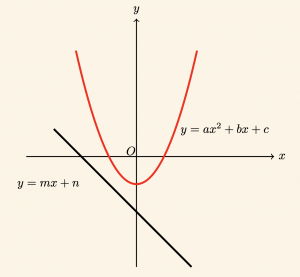
To analyze the relative position of a parabola given by the equation \( y = ax^2 + bx + c \) and a line given by the equation \( y = mx + n \), we solve their equations simultaneously.
\[
\left.
\begin{array}
y = ax^2 + bx + c \\
y = mx + n\\
\end{array}
\right\} \quad \Rightarrow ax^2 + bx + c = mx + n \\
\\
\\
\]
\[\Rightarrow ax^2 + (b – m)x + (c – n) = 0 \]
This substitution yields a quadratic equation. We can determine the relationship between the two graphs by evaluating the discriminant of this resulting equation:
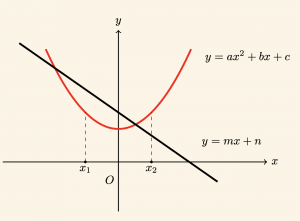
1) If \( \quad \Delta > 0 \),
The parabola and the line intersect at two distinct points.
The real roots \( x_1 \) and \( x_2 \) of the quadratic equation \( ax^2 + (b – m)x + c – n = 0 \) correspond to the x-coordinates (abscissas) of these two points of intersection.
Example:
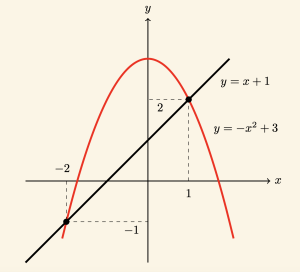
Let us determine the relative position of the parabola \( y = -x^2 + 3 \) and the line \( y = x + 1 \).
\[
\left.
\begin{aligned}
y &= -x^2 + 3 \\
y &= x + 1
\end{aligned}
\right\} \Rightarrow -x^2 + 3 = x + 1\]
\[\Rightarrow x^2 + x \; – 2 = 0\]
\[\Rightarrow x_1 = -2 \quad \text{ or } \quad x_2 = 1 \]
Since the quadratic equation has two distinct real solutions, the parabola and the line intersect at two distinct points. We find the corresponding y-coordinates by substituting these values back into either the linear or the quadratic equation.
Substituting into \( y = x + 1 \):
\[\text{For } x_1 = -2 \quad \Rightarrow \quad y_1 = -1 \]
\[\text{For } x_2 = 1 \quad \Rightarrow \quad y_2 = 2 \quad \]
Thus, the intersection points are \( (-2, -1) \) and \( (1, 2) \).
2) If \( \quad \Delta = 0 \),
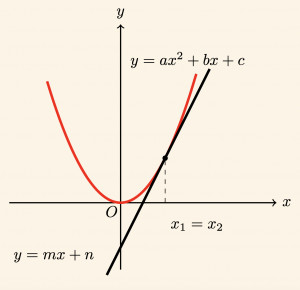
The line is tangent to the parabola. The single real solution (or double root) \( x_1 = x_2 \) of the equation \( ax^2 + (b \;-\; m)x + c\; – \;n = 0 \) gives the x-coordinate of the point of tangency.
Example:
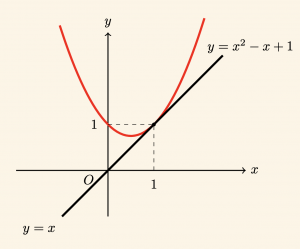
Let us determine the relative position of the parabola \( y = x^2 – x + 1 \) and the line \( y = x \).
\[
\left.
\begin{aligned}
y &= x^2 – x + 1 \\
y &= x
\end{aligned}
\right\}
\Rightarrow x^2 – x + 1 = x\]
\[\Rightarrow x^2 – 2x + 1 = 0
\Rightarrow x_1 = x_2 = 1 \]
Since the equation yields a double root, the line is tangent to the parabola at \( x = 1 \). Let us find the corresponding y-coordinate:
\[ \text{Substituting } x = 1 \text{ into } y = x \text{ yields } y = 1. \]
The point of tangency is \( (1, 1) \).
3) If \( \quad \Delta < 0 \),
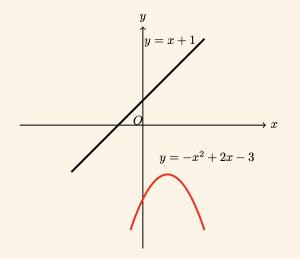
The quadratic equation has no real solutions, meaning the parabola and the line do not intersect and have no common points.
Example:
Let us determine the relative position of the parabola \( y = -x^2 + 2x – 3 \) and the line \( y = x + 1 \).
\[
\left.
\begin{aligned}
y &= -x^2 + 2x – 3 \\
y &= x + 1
\end{aligned}
\right\}
\Rightarrow -x^2 + 2x – 3 = x + 1\\ \]
\[
\Rightarrow x^2 – x + 4 = 0\\
\Rightarrow \Delta = (-1)^2 – 4(1)(4) = -15 < 0
\]
Since the discriminant is negative, there are no real solutions. Therefore, the parabola and the line have no points of intersection.
← Previous Page | Next Page →