
Systems of Inequalities
A set of multiple inequalities that must be satisfied at the same time is called a system of inequalities. The intersection of the individual solution sets of these inequalities is called the solution set of the system.
Therefore, to find the solution set of a system of inequalities, we determine the solution set of each individual inequality and find their intersection.
Example:
Let us find the solution set of the following system of inequalities:
\[f(x) = x^3 + x^2 – x – 1 \geq 0 \]
\[ g(x) = \frac{x + 1}{-x^2 + 3x – 2} > 0 \]
\[ x^3 + x^2 – x – 1 = 0 \Rightarrow (x + 1)^2(x – 1) = 0 \]
\[ \Rightarrow x_1 = x_2 = -1 \quad \text{or} \quad x_3 = 1 \]
\[x + 1 = 0 \Rightarrow x = -1 \]
\[- x^2 + 3x – 2 = 0 \Rightarrow x_1 = 1 \quad \text{or} \quad x_2 = 2 \]
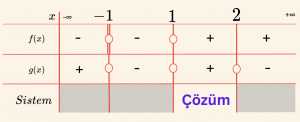
The solution set is found as:
\[ \mathcal{S} = \{ x \mid 1 < x < 2, \, x \in \mathbb{R} \} \]
QUESTION 14
Which of the following options represents one of the intervals that satisfy the system of inequalities below?
\[ f(x) = \frac{x^2 \;- \; x^3}{x^2 + 2} \leq 0 \]
\[ g(x) = \frac{2}{x + 1} > 0 \]
\[ \text{A) } x \geq 1 \quad
\text{B) } x < -1 \quad
\text{C) } x < 0 \quad
\text{D) } -1 < x < 0 \quad
\text{E) } 0 < x < 1 \]
Solution:
\[\begin{aligned} & x^2 \; – \; x^3 = 0 \Rightarrow x^2(1 – x) = 0 \Rightarrow x_1 = x_2 = 0 \text{ (double root) or } x_3 = 1\\ \\
& x^2 + 2 = 0 \Rightarrow x^2 = -2 < 0, \text{ so there are no real roots.} \\ \\
&x + 1 = 0 \Rightarrow x = -1 \end{aligned}\]
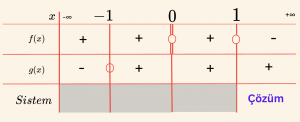
The solution set is:
\[ \mathcal{S} = \{ x \mid 1 \leq x < \infty, \, x \in \mathbb{R} \} \cup \{ 0 \} \]
\(\textbf{Answer: A} \)
QUESTION 15
Which of the following options represents one of the intervals that satisfy the system of inequalities below?
\[ \frac{x^2 – x + 6}{x + 2} < x + 1 \leq \frac{3}{x – 1} \]
\[ \text{A) } -3 < x < 0 \quad
\text{B) } x > 1 \quad
\text{C) } 0 < x \leq 2 \quad
\text{D) } -2 < x < 1 \quad
\text{E) } x < -2 \]
Solution:
We split the compound inequality into two separate parts:
\[ \frac{x^2 – x + 6}{x + 2} < x + 1 \quad \text{and} \quad x + 1 \leq \frac{3}{x – 1} \]
For the first inequality:
\[ \frac{x^2 – x + 6}{x + 2} – (x + 1) < 0 \Rightarrow \frac{x^2 – x + 6 – (x^2 + 3x + 2)}{x + 2} < 0 \]
\[ \Rightarrow f(x) = \frac{-4x + 4}{x + 2} < 0 \]
Roots of $f(x)$:
\[ -4x + 4 = 0 \Rightarrow x = 1 \quad , \quad x + 2 = 0 \Rightarrow x = -2 \]
For the second inequality:
\[ x + 1 – \frac{3}{x – 1} \leq 0 \Rightarrow \frac{(x + 1)(x – 1) – 3}{x – 1} \leq 0 \]
\[ \Rightarrow g(x) = \frac{x^2 – 4}{x – 1} \leq 0 \]
Roots of $g(x)$:
\[ x^2 – 4 = 0 \Rightarrow x = \pm 2 \quad , \quad x – 1 = 0 \Rightarrow x = 1 \]
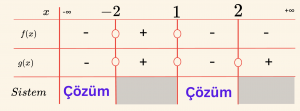
The combined solution set is:
\[ \mathcal{S} = \{ x \mid x < -2 \text{ or } 1 < x \leq 2, \, x \in \mathbb{R} \} \]
Looking at the choices, option E ($x < -2$) represents one of these valid intervals.
Note: The original text marks E as the correct answer. Even though option E perfectly matches a part of our solution set, please notice that $1 < x \leq 2$ is also a valid interval.
\(\textbf{Answer: E} \)
QUESTION 16
Which of the following intervals satisfies the system of inequalities below?
\[ -1 < \frac{x^2 – 5}{x – 1} < 2 \]
\[ \text{A) } x < -3 \quad
\text{B) } -1 < x < 1 \quad
\text{C) } 2 < x < 3 \quad
\text{D) } 1 < x < 2 \quad
\text{E) } x > 3 \]
Solution:
We analyze the system as two separate inequalities:
\[ -1 < \frac{x^2 \; – \; 5}{x- 1 } \quad \text{and} \quad \frac{x^2-5}{x-1} < 2 \]
For the first inequality:
\[ \frac{x^2 – 5}{x – 1} + 1 > 0 \Rightarrow \frac{x^2 + x – 6}{x – 1} > 0 \]
Setting the numerator to zero:
\[ x^2 + x – 6 = 0 \Rightarrow x_1 = -3 \quad \text{or} \quad x_2 = 2 \]
For the second inequality:
\[ \frac{x^2 – 5}{x – 1} – 2 < 0 \Rightarrow \frac{x^2 – 2x – 3}{x – 1} < 0 \]
Setting the numerator to zero:
\[ x^2 – 2x – 3 = 0 \Rightarrow x_1 = -1 \quad \text{or} \quad x_2 = 3 \]
The common root for both denominators is:
\[ x – 1 = 0 \Rightarrow x = 1 \]
Let us define the functions for our sign chart:
\[ f(x) = \frac{x^2 + x – 6}{x – 1} > 0 \]
\[ g(x) = \frac{x^2 – 2x – 3}{x – 1} < 0 \]
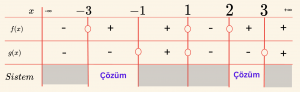
The intersection of both satisfied regions gives the solution set:
\[ \mathcal{S} = \{ x \mid -3 < x < -1 \quad \text{or} \quad 2 < x < 3, \; x \in \mathbb{R} \} \]
Looking at the options, interval C ($2 < x < 3$) satisfies the system.
\(\textbf{Answer: C} \)
QUESTION 17
Which of the following intervals satisfies the system of inequalities below?
\[ \frac{-x^2 + 2x – 3}{x^2 + 1} < x^2 + x + 1 < \frac{7}{x – 1} \]
\[\text{A) } x < 1 \quad
\text{B) } -3 < x < -1 \quad
\text{C) } -1 < x < 1 \quad
\text{D) } 1 < x < 2 \quad
\text{E) } x > 2 \]
Solution:
We split the compound inequality into two parts:
\[ \frac{-x^2 + 2x – 3}{x^2 + 1} < x^2 + x + 1 \quad \text{and} \quad x^2 + x + 1 < \frac{7}{x – 1} \]
Let us evaluate the first inequality. For all $x \in \mathbb{R}$:
– The numerator $-x^2 + 2x – 3$ has a negative leading coefficient and a negative discriminant ($\Delta = 2^2 – 4(-1)(-3) = -8 < 0$), so it is always negative.
– The denominator $x^2 + 1$ is always positive.
– The expression $x^2 + x + 1$ has a positive leading coefficient and a negative discriminant ($\Delta = 1^2 – 4(1)(1) = -3 < 0$), so it is always positive.
Since a negative value divided by a positive value is always negative, it will always be less than a strictly positive value. Therefore, the solution set for the first inequality is all real numbers:
\[ \mathcal{S}_1 = \mathbb{R} \]
Now let us evaluate the second inequality:
\[ x^2 + x + 1 < \frac{7}{x – 1} \Rightarrow x^2 + x + 1 – \frac{7}{x – 1} < 0 \]
\[ \Rightarrow \frac{(x^2 + x + 1)(x – 1) – 7}{x – 1} < 0 \]
Using the difference of cubes identity $(x^3 – 1 = (x – 1)(x^2 + x + 1))$:
\[ \Rightarrow \frac{x^3 – 1 – 7}{x – 1} < 0 \Rightarrow f(x) = \frac{x^3 – 8}{x – 1} < 0 \]
Finding the roots of $f(x)$:
\[ x^3 – 8 = 0 \Rightarrow x = 2 \quad \text{and} \quad x – 1 = 0 \Rightarrow x = 1 \]
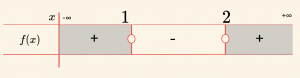
The solution set for the second inequality is:
\[ \mathcal{S}_2 = \{x \mid 1 < x < 2, \, x \in \mathbb{R} \} \]
The final solution set is the intersection of $\mathcal{S}_1$ and $\mathcal{S}_2$:
\[ \mathcal{S} = \mathcal{S}_1 \cap \mathcal{S}_2 = \{x \mid 1 < x < 2, \, x \in \mathbb{R} \} \]
\(\textbf{Answer: D} \)
← Previous Page | Next Page →