
Inverse of a Function
Given a bijective (one-to-one and onto) function:
\[
f: A \to B, \quad f = \{ (x, y) \mid x \in A \text{ and } y \in B \}
\]
the inverse function of $f$, denoted as $f^{-1}$, is defined as:
\[
f^{-1}: B \to A, \quad f^{-1} = \{ (y, x) \mid (x, y) \in f \}
\]
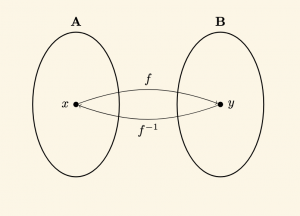
Since $(x, y) \in f \Leftrightarrow (y, x) \in f^{-1}$, we establish the fundamental relation:
\[
y = f(x) \Leftrightarrow x = f^{-1}(y)
\]
If $f: A \to B$ is bijective, its inverse $f^{-1}: B \to A$ is also guaranteed to be a bijective function.
Furthermore, the operation is involutory:
\[
(f^{-1})^{-1} = f
\]
If $f: A \to B$ is not bijective, then $f^{-1}$ fails to be a function from $B$ to $A$, and remains strictly a general relation.
Example:
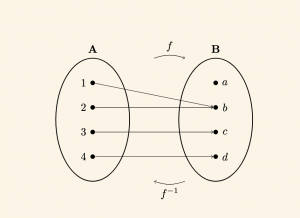
\[ f: A \to B \quad \text{is an into function, thus } \quad f^{-1} \quad \text{is merely a relation from B to A.} \]
Example:
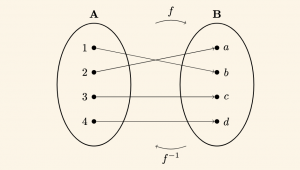
For the function $f: A \to B$ defined explicitly as:
\[ f = \{ (1, b), (2, a), (3, c), (4, d) \} \]
the corresponding inverse function $f^{-1}: B \to A$ is:
\[ f^{-1} = \{ (b, 1), (a, 2), (c, 3), (d, 4) \} \]
Finding the Inverse of an Algebraic Function:
To analytically determine the inverse of a function expressed as $y = f(x)$, apply the relationship $y = f(x) \Leftrightarrow x = f^{-1}(y)$ by solving the equation explicitly for $x$ in terms of $y$, and subsequently swapping the variable positions of $x$ and $y$.
Examples:
$\bullet \quad$ Given $f: \mathbb{R} \to \mathbb{R}, \quad f(x) = \frac{x – 1}{2}$, let us find $f^{-1}(x)$.
\[
y = \frac{x – 1}{2} \Rightarrow 2y = x – 1 \Rightarrow x = 2y + 1
\]
\[
\Rightarrow x = f^{-1}(y) = 2y + 1
\]
\[
\Rightarrow f^{-1}(x) = 2x + 1
\]
$\bullet \quad$ Given $f: \mathbb{R} \to \mathbb{R}, \quad f(x) = x^3 + 1$, let us find $f^{-1}(x)$.
\[
y = x^3 + 1 \Rightarrow y – 1 = x^3 \Rightarrow x = \sqrt[3]{y – 1}
\]
\[
\Rightarrow x = f^{-1}(y) = \sqrt[3]{y – 1}
\]
\[
\Rightarrow f^{-1}(x) = \sqrt[3]{x – 1}
\]
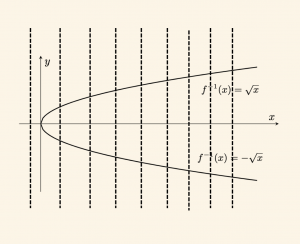
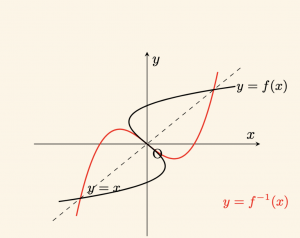
$\bullet \quad$ Given $f: \mathbb{R} \to \mathbb{R}, \quad f(x) = x^2$, let us find $f^{-1}(x)$.
\[
y = x^2 \Rightarrow x = \pm \sqrt{y}
\]
\[
\Rightarrow f^{-1}(x) = \pm \sqrt{x}
\]
Because the original function $f$ over the domain of all real numbers is neither injective nor surjective, the resulting mapping $f^{-1}$ is not a valid function, but a multi-valued relation as shown graphically.
$\bullet \quad$ Given the function $f(x) = \frac{-x}{x – 3}$ with domain $\mathbb{R} – \{3\}$, let us determine its inverse function and its codomain.
\[
y = \frac{-x}{x – 3} \Rightarrow y(x – 3) = -x \Rightarrow xy – 3y = -x
\]
\[
\Rightarrow xy + x = 3y \Rightarrow x(y + 1) = 3y
\]
\[
\Rightarrow x = f^{-1}(y) = \frac{3y}{y + 1}
\]
\[
\Rightarrow f^{-1}(x) = \frac{3x}{x + 1}
\]
For this rule to constitute a valid function, the denominator must satisfy $x + 1 \neq 0 \Rightarrow x \neq -1$. The domain of the inverse function corresponds exactly to the codomain of the original function, which yields $\mathbb{R} – \{-1\}$.
Key Shortcut Formula:
For any bijective homographic (rational linear) function of the form:
\[
f(x) = \frac{ax + b}{cx + d}
\]
the inverse function can be calculated rapidly by swapping the positions and signs of the coefficients $a$ and $d$:
\[
f^{-1}(x) = \frac{-dx + b}{cx – a}
\]
Consequently, the condition for a function to be its own inverse, $f(x) = f^{-1}(x)$, simplifies directly to $a = -d$.
Example:
Consider the function:
\[
f: \mathbb{R} – \{3\} \to \mathbb{R} – \{2\}, \quad f(x) = \frac{2x – 1}{x – 3}
\]
Applying the shortcut rule directly yields:
\[
f^{-1}(x) = \frac{3x – 1}{x – 2}
\]
QUESTION 21
The function defined by
\[
f(x) = \frac{mx + 5}{x – 1}
\]
is bijective. Given that the function is self-inverse, meaning:
\[
f(x) = f^{-1}(x)
\]
what is the value of $m$?
\[
\text{A)} -1 \quad
\text{B) } 0 \quad
\text{C) } 1 \quad
\text{D) } 2 \quad
\text{E) } 3
\]
Solution:
Using the condition $f(x) = f^{-1}(x)$:
\[
\frac{mx + 5}{x – 1} = \frac{x + 5}{x – m}
\]
By invoking our shortcut rule for self-inverse rational functions ($a = -d$), where $a = m$ and $d = -1$, we get $m = -(-1)$, which simplifies to:
\[
\Rightarrow m = 1
\]
\(\textbf{Correct Answer: C} \)
Handling Quadratic Inverses:
To isolate $x$ when evaluating the inverse of a quadratic function of the form $y = f(x) = ax^2 + b x + c$, the polynomial expression must first be converted into vertex form by completing the square.
Example:
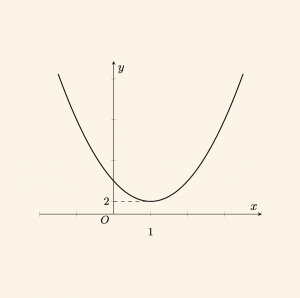
The quadratic function represented above,
\[
f: \mathbb{R} \to \mathbb{R}, \quad f(x) = x^2 – 2x + 3
\]
is not bijective across the entire set of real numbers; hence, its global inverse is not a function. However, restricting the domain and codomain to a monotonic branch, such as $x \geq 1$ and $y \geq 2$, ensures bijectivity. Let us evaluate:
\[
f: [1, \infty) \to [2, \infty), \quad f(x) = x^2 – 2x + 3
\]
\[
y = x^2 – 2x + 1 + 2
\]
\[
\Rightarrow y = (x – 1)^2 + 2
\]
\[
\Rightarrow y – 2 = (x – 1)^2
\]
\[
\Rightarrow \sqrt{y – 2} = |x – 1|
\]
Since the domain constraint specifies $x \geq 1$, the absolute value resolves positively ($|x – 1| = x – 1$):
\[
\Rightarrow \sqrt{y – 2} = x – 1
\]
\[
\Rightarrow x = f^{-1}(y) = \sqrt{y – 2} + 1
\]
\[
\Rightarrow f^{-1}(x) = \sqrt{x – 2} + 1
\]
Practical Note:
When evaluating a single numerical value for an inverse function, it is entirely unnecessary to derive the general algebraic expression for $f^{-1}(x)$. Instead, leverage the equivalent input-output property directly.
Example:
Consider the function:
\[
f(x) = \frac{2x^2 + x + 1}{x^2 + 1}
\]
Let us determine the value of $f^{-1}(2)$ under appropriate domain conditions.
\[
\text{Since } x = f^{-1}(y) \Leftrightarrow y = f(x), \text{ it follows that:}
\]
\[
x = f^{-1}(2) \Leftrightarrow 2 = f(x)
\]
Setting up the algebraic equation:
\[
2 = \frac{2x^2 + x + 1}{x^2 + 1} \Rightarrow 2x^2 + 2 = 2x^2 + x + 1
\]
Canceling the quadratic terms simplifies the expression to:
\[
\Rightarrow x = f^{-1}(2) = 1
\]
QUESTION 22
A function is given as $f(x) = x^3 + ax + a$. If $f^{-1}(5) = 1$ under suitable conditions, what is the value of $a$?
\[
\text{A)} 1 \quad
\text{B) } 2 \quad
\text{C) } 3 \quad
\text{D) } 4 \quad
\text{E) } 5
\]
Solution:
\[
\text{Using the identity } y = f(x) \Leftrightarrow x = f^{-1}(y):
\]
\[
f^{-1}(5) = 1 \Rightarrow 5 = f(1)
\]
Substituting $x = 1$ into the definition of $f(x)$:
\[
5 = 1^3 + a(1) + a
\]
\[
5 = 1 + 2a \Rightarrow 2a = 4 \Rightarrow a = 2
\]
\(\textbf{Correct Answer: B} \)
Geometric Properties of Inverse Graphs:
The graph of any function $y = f(x)$ and the graph of its inverse function $y = f^{-1}(x)$ are perfect reflections of one another across the primary diagonal line, defined by the equation $y = x$.
Example:
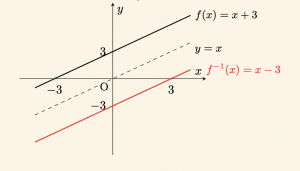
Example:
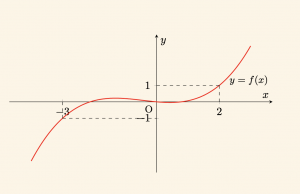
Let us compute the value of the expression $f^{-1}(1) + f^{-1}(-1)$ based on the provided graph.
\[
\text{Using the relation } y = f(x) \Leftrightarrow x = f^{-1}(y):
\]
From the point $(2, 1)$ on the graph, we know $1 = f(2) \Rightarrow 2 = f^{-1}(1)$.
From the point $(-3, -1)$ on the graph, we know $-1 = f(-3) \Rightarrow -3 = f^{-1}(-1)$.
Adding these values together:
\[
f^{-1}(1) + f^{-1}(-1) = 2 + (-3) = -1
\]