
The Law of Cosines
For any triangle \(ABC\) with side lengths \(a\), \(b\), and \(c\):
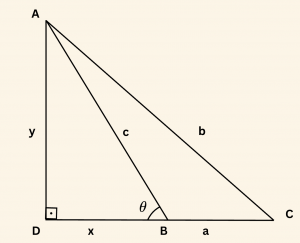
In right triangle ADB,
\[
\cos \theta = -\cos B = \frac{x}{c}
\]
and by the Pythagorean theorem,
\[
x^2 + y^2 = c^2
\]
In right triangle ADC, by the Pythagorean theorem,
\[
(x + a)^2 + y^2 = b^2
\]
\[
\Rightarrow x^2 + a^2 + 2ax + y^2 = b^2
\]
\[
\Rightarrow x^2 + y^2 + 2ax + a^2 = b^2
\]
\[
\Rightarrow c^2 + 2a(-c \cos B) + a^2 = b^2
\]
\[
\Rightarrow b^2 = a^2 + c^2\; -\; 2ac \cos B
\]
Therefore, we obtain the general forms:
\[
\begin{aligned}
a^2 &= b^2 + c^2 \;-\; 2bc \cos A \\ \\
b^2 &= a^2 + c^2 \;- \;2ac \cos B \\ \\
c^2 &= a^2 + b^2 \;-\; 2ab \cos C
\end{aligned}
\]
Key Takeaways:
1. If two sides and the included angle of a triangle are known (SAS), the length of the third side can be found using the Law of Cosines.
2. If all three side lengths of a triangle are known (SSS), the measure of any interior angle can be determined using the Law of Cosines.
Example:
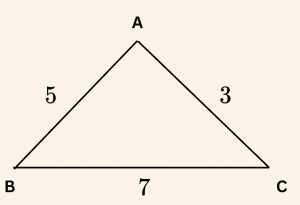 Based on the given figure, let us find the value of \(\cos A\).
Applying the Law of Cosines to triangle ABC:
\[7^2= 5^2 + 3^2- 2 \cdot 5 \cdot 3 \cos A \]
\[ \Rightarrow \cos A= – \frac{1}{2} \]
Example:
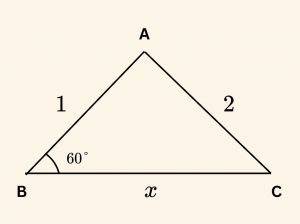 Based on the given figure, let us find the side length \(|BC| = x\).
Applying the Law of Cosines to triangle ABC:
\[
2^2 = 1^2 + x^2 – 2 \cdot 1 \cdot x \cdot \cos 60^\circ
\]
\[
\Rightarrow 4 = 1 + x^2 – 2x \cdot \frac{1}{2}
\Rightarrow x^2 – x – 3 = 0
\]
\[
\Rightarrow x = \frac{1 + \sqrt{13}}{2}
\]
QUESTION 38
In a triangle with side lengths \(a, b, c\), if the following relationship holds:
\[
b + c \;- \;a = \frac{bc}{a + b + c}
\]
what is the measure of angle \(A\) in degrees?
\[
\text{A) } 45^\circ \quad
\text{B) } 60^\circ \quad
\text{C) } 90^\circ \quad
\text{D) } 120^\circ \quad
\text{E) } 150^\circ
\]
Solution:
\[
b + c\; – \;a = \frac{bc}{a + b + c}
\Rightarrow (b + c \;-\; a)(a + b + c) = bc
\]
\[\begin{aligned} \Rightarrow (b + c)^2 \;- a^2 = bc \\ \\
\Rightarrow b^2 + c^2 + 2bc\; – a^2 = bc \\ \\
\Rightarrow a^2 = b^2 + c^2 + bc \end{aligned}\]
Applying the Law of Cosines to triangle ABC:
\[\begin{aligned} a^2 = b^2 + c^2 \;- \;2bc \cos A \\ \\
\Rightarrow b^2 + c^2 + bc = b^2 + c^2 \;- \;2bc \cos A \\ \\
\Rightarrow bc = -2bc \cos A \end{aligned}\]
\[\begin{aligned} \Rightarrow \cos A = -\frac{1}{2} \\ \\
\Rightarrow m(\hat A) = 120^\circ \end{aligned}\]
\(\textbf{Answer: D} \)
QUESTION 39
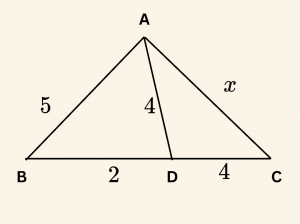
In the given figure,
\(|AB| = 5\) cm,
\(|BD| = 2\) cm,
\(|AD| = |DC| = 4\) cm.
Find the length \(|AC| = x\) in cm.
\[
\text{A) } \sqrt{19} \quad
\text{B) } 2\sqrt{5} \quad
\text{C) } \sqrt{21} \quad
\text{D) } \sqrt{22} \quad
\text{E) } \sqrt{23}
\]
Solution:
Applying the Law of Cosines to triangle ABD:
\[
4^2 = 5^2 + 2^2 – 2 \cdot 5 \cdot 2 \cdot \cos B
\Rightarrow \cos B = \frac{13}{20}
\]
Applying the Law of Cosines to the entire triangle ABC:
\[
x^2 = 5^2 + 6^2 – 2 \cdot 5 \cdot 6 \cdot \frac{13}{20}
\Rightarrow x^2 = 22
\Rightarrow x = \sqrt{22}
\]
\(\textbf{Answer: D} \)
QUESTION 40
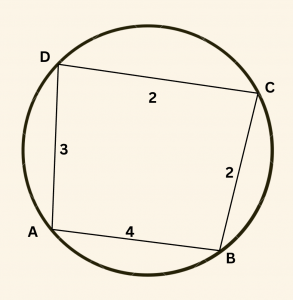
In the given figure, ABCD is a cyclic quadrilateral.
Given \(|AB| = 4\) cm, \(|BC| = |CD| = 2\) cm, and \(|AD| = 3\) cm,
what is the value of \(\cos A\)?
\[
\text{A) } \frac{15}{32} \quad
\text{B) } \frac{1}{2} \quad
\text{C) }\frac{17}{32} \quad
\text{D) }\frac{9}{16} \quad
\text{E) } \frac{19}{32}
\]
Solution:
Since opposite angles in a cyclic quadrilateral are supplementary:
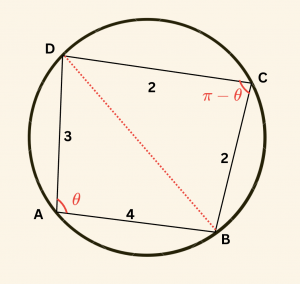
\[m(\hat A) + m(\hat C )= \pi \]
\[\Rightarrow m( \hat C )= \pi \;- \; \theta\]
Applying the Law of Cosines to triangles ADB and CDB:
\[\begin{aligned} |BD|^2 &= 3^2 + 4^2 – 2 \cdot 3 \cdot 4 \cdot \cos \theta \\ \\ |BD|^2 &= 25 -24\cos \theta \end{aligned}\]
\[
|BD|^2 = 3^2 + 4^2 – 2 \cdot 3 \cdot 4 \cdot \cos \theta
\]
\[
|BD|^2 = 2^2 + 2^2 – 2 \cdot 2 \cdot 2 \cdot \cos(\pi – \theta)\]
\[\Rightarrow \cos(\pi – \theta) = -\cos \theta \\
\]
\[\\ |BD|^2 = 8 + 8 \cos \theta \ \]
Equating the two expressions for \(|BD|^2\) and solving for \(\cos \theta\):
\[\begin{aligned} 25 \;- \; 24 \cos \theta = 8 + 8 \cos \theta \\ \\
\Rightarrow 17 = 32 \cos \theta \\ \\
\Rightarrow \cos \theta = \frac{17}{32} \end{aligned}\]
\(\textbf{Answer: C} \)
QUESTION 41
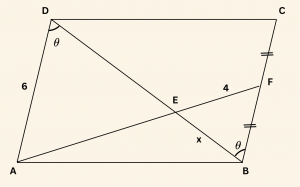 In the given figure,
quadrilateral ABCD is a parallelogram.
If \(|EF| = 4\) cm,
\(|AD| = 6\) cm,
\(|CF| = |FB|\),
\(m(\hat{ ADE}) = \theta\), and \(\cos \theta = \frac{1}{3}\),
find the length \(|EB| = x\) in cm.
\[\text{A) } 1 + 2\sqrt{2} \quad
\text{B) } 2 + \sqrt{2} \quad
\text{C) } \sqrt{2} \quad
\text{D) } 2\sqrt{2} \quad
\text{E) } 3 – \sqrt{2}
\]
Solution:
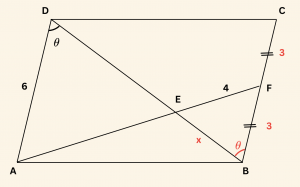 Since opposite sides of a parallelogram are equal:
\[
|AD| = |BC| = 6 \implies |FB| = 3
\]
By alternating interior angles or geometric properties of parallelograms:
\[
m(\hat {ADE}) = m(\hat {EBF}) = \theta
\]
Applying the Law of Cosines to triangle EBF:
\[\begin{aligned} 4^2 &= x^2 + 3^2\; – \; 2 \cdot x \cdot 3 \cdot \cos \theta \\ \\
\Rightarrow 16 &= x^2 + 9 \;- \; 6x \cdot \frac{1}{3} \\ \\ \Rightarrow 16 &= x^2 + 9 \; – \;2x \\ \\ \Rightarrow 0&=x^2\; -\; 2x\; -\; 7 \\ \\ \Rightarrow x& = 1 + 2\sqrt{2} \end{aligned} \]
\(\textbf{Answer: A} \)
QUESTION 42
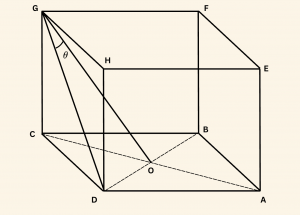
If $ABCDEFGH$ is a cube in the given figure, what is the measure of angle $m(\hat{ DGO}) = \theta$ in degrees?
\[\text{A) } 15^\circ \quad
\text{B) } 30^\circ \quad
\text{C) } 45^\circ \quad
\text{D) } 60^\circ \quad
\text{E) } 75^\circ
\]
Solution:
Let the edge length of the cube be $2$ units.
In square ABCD:
\[
|AC| = |BD| = 2\sqrt{2} \Rightarrow |OD| = |OC| = \sqrt{2}
\]
Applying the Pythagorean theorem to right triangle GCO:
\[
|GC|^2 + |OC|^2 = |OG|^2 \Rightarrow 2^2 + (\sqrt{2})^2 = |OG|^2 \Rightarrow |OG| = \sqrt{6}
\]
Applying the Pythagorean theorem to right triangle GCD:
\[
|GC|^2 + |CD|^2 = |GD|^2 \Rightarrow 2^2 + 2^2 = |GD|^2 \Rightarrow |GD| = 2\sqrt{2}
\]
Applying the Law of Cosines to triangle GDO:
\[
|OD|^2 = |GD|^2 + |OG|^2 – 2|GD| \cdot |OG|\cos\theta
\]
Substituting the calculated lengths:
\[
2 = 8 + 6 – 2 \cdot 2\sqrt{2} \cdot \sqrt{6} \cdot \cos\theta
\Rightarrow 2 = 14 – 4\sqrt{12} \cdot \cos\theta
\]
Since $\sqrt{12} = 2\sqrt{3}$:
\[
2 = 14 – 8\sqrt{3} \cos\theta
\Rightarrow 8\sqrt{3} \cos\theta = 12 \Rightarrow \cos\theta = \frac{3}{2\sqrt{3}} = \frac{\sqrt{3}}{2}
\Rightarrow \theta = 30^\circ
\]
\(\textbf{Answer: B} \)
← Previous Page | Next Page →