
Polar Coordinates
A system formed by two perpendicular number axes intersecting at an origin on a plane is called a Cartesian coordinate system, where any point P in the plane is specified by an ordered pair (x, y).
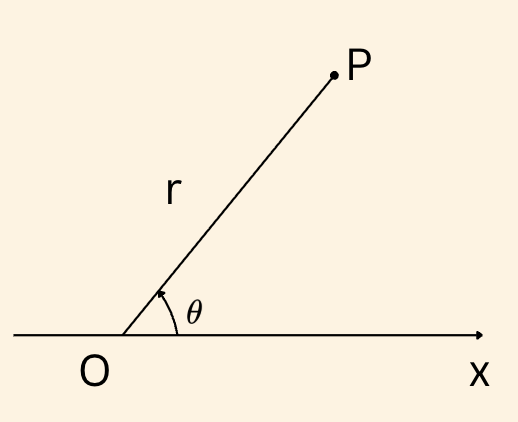
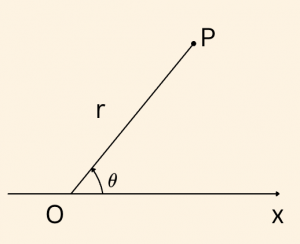
Alternatively, let us consider a fixed point O called the pole (origin) and a directed ray Ox called the polar axis. Let P be any point in the plane and connect O to P. Let \(\theta\) denote the angle formed by the line segment OP and the polar axis Ox.
If \(|OP| = r\), the point P can be uniquely determined by knowing \(r\) and \(\theta\). The values \(r\) and \(\theta\) are called the polar coordinates of the point P, denoted as P(r, \(\theta\)).
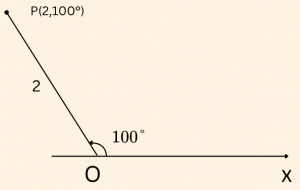
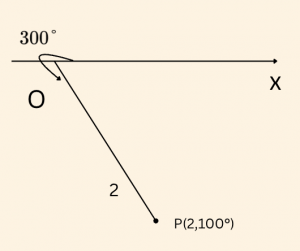
Examples:
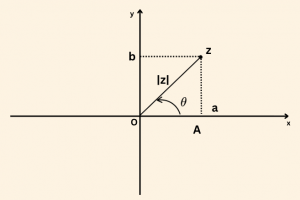
From the right triangle zAO shown in the figure on the side,
\[
|z| = \sqrt{a^{2} + b^{2}}, \qquad \tan \theta = \frac{b}{a}
\]
\[
\cos \theta = \frac{a}{|z|} \Rightarrow a = |z| \cos \theta
\]
\[
\sin \theta = \frac{b}{|z|} \Rightarrow b = |z| \sin \theta
\]
By substituting these expressions for a and b into \( z = a + bi \), we obtain the polar (trigonometric) form of complex numbers.
\[
z = |z|(\cos \theta + i \sin \theta)
\]
This can be written in the shorthand notation \( z = |z| \text{cis} \theta \). A complex number can be easily expressed in polar form once its modulus and argument are known.
Example:
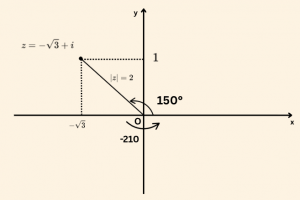
For \( z = -\sqrt{3} + i \):
\[
\arg(z) = 150^\circ + 360^\circ \cdot k \quad (k \in \mathbb{Z})
\]
\[
\arg(z) = -210^\circ \quad (\text{for } k = -1)
\]
\[
\text{Arg}(z) = 150^\circ \quad (\text{the principal argument for } k = 0)
\]
Example:
Express the complex number \( z = \sqrt{2} + \sqrt{2}i \) in polar form.
\[
|z| = \sqrt{ (\sqrt{2})^{2} + (\sqrt{2})^{2} } = 2
\]
Factoring out the modulus \( |z| \) from \( z = \sqrt{2} + \sqrt{2}i \):
\[
z = 2\left( \frac{\sqrt{2}}{2} + i \frac{\sqrt{2}}{2} \right)
\]
Since \( z = |z|(\cos\theta + i\sin\theta) \), we have:
\[
\cos\theta = \frac{\sqrt{2}}{2}, \qquad
\sin\theta = \frac{\sqrt{2}}{2}
\]
\[
\Rightarrow \text{Arg}(z) = \theta = 45^\circ
\]
Therefore,
\[
z = 2(\cos 45^\circ + i\sin 45^\circ) = 2\,\text{cis}\,45^\circ
\]
Example:
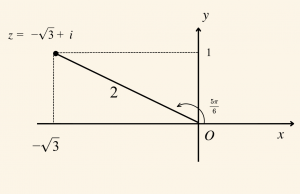
Express the complex number \( z = -\sqrt{3} + i \) in polar form.
\[
|z| = \sqrt{ (-\sqrt{3})^{2} + 1^{2} } = 2
\]
Factoring out the modulus \( |z| = 2 \) from \( z = -\sqrt{3} + i \):
\[
z = 2\left( -\frac{\sqrt{3}}{2} + i\frac{1}{2} \right)
\]
Since \( z = |z|(\cos\theta + i\sin\theta) \), we get:
\[
\cos\theta = -\frac{\sqrt{3}}{2}
\qquad \text{and } \quad
\sin\theta = \frac{1}{2}
\]
\[
\Rightarrow \text{Arg}(z) = \theta = \frac{5\pi}{6}
\]
Therefore,
\[
z = 2\left(\cos \frac{5\pi}{6} + i\sin \frac{5\pi}{6}\right)
= 2\,\text{cis}\,\frac{5\pi}{6}
\]
Example:
Express the complex number \( z = -1 – i \) in polar form.
\[
|z| = \sqrt{ (-1)^{2} + (-1)^{2} } = \sqrt{2}
\]
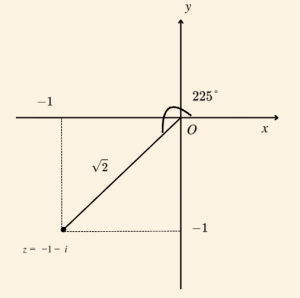
Factoring out the modulus \( |z| = \sqrt{2} \) from \( z = -1 – i \):
\[
z = \sqrt{2}\left( -\frac{1}{\sqrt{2}} + i\left( -\frac{1}{\sqrt{2}} \right) \right)
\]
Since \( z = |z|(\cos\theta + i\sin\theta) \), we have:
\[
\cos\theta = -\frac{1}{\sqrt{2}}, \qquad
\sin\theta = -\frac{1}{\sqrt{2}}
\]
\[
\Rightarrow \text{Arg}(z) = \theta = 225^\circ
\]
Therefore,
\[z = \sqrt{2}(\cos 225^\circ + i\sin 225^\circ ) = \sqrt{2} \,\text{cis}\,225^\circ \]
Example:
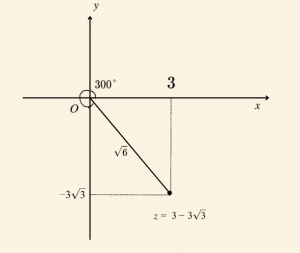
Express the complex number \( z = 3 \ – \ 3\sqrt{3}\, i \) in polar form.
\[
|z| = \sqrt{ 3^{2} + (-3\sqrt{3})^{2} } = 6
\]
Factoring out the modulus \( |z| = 6 \) from \( z = 3 \ – \ 3\sqrt{3}\, i \):
\[
z = 6\left( \frac{3}{6} \ – \ \frac{3\sqrt{3}}{6} i \right)
= 6\left( \frac{1}{2} + i\left( -\frac{\sqrt{3}}{2} \right) \right)
\]
Since \( z = |z|(\cos\theta + i\sin\theta) \), we have:
\[
\cos\theta = \frac{1}{2}, \qquad
\sin\theta = -\frac{\sqrt{3}}{2}
\]
\[
\Rightarrow \text{Arg}(z) = \theta = 300^\circ
\]
Therefore,
\[
z = 6(\cos 300^\circ + i\sin 300^\circ)
= 6\,\text{cis}\,300^\circ
\]
Example:
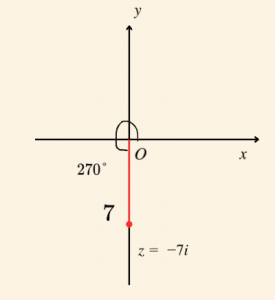
Express the complex number \( z = -7i \) in polar form.
\[
|z| = \sqrt{0^{2} + (-7)^{2}} = 7
\]
 Factoring out the modulus \( |z| \) from \( z = -7i \):
\[
z = 7(0 – i)
\]
Since \( z = |z|(\cos\theta + i\sin\theta) \), we have:
\[
\cos\theta = 0, \qquad \sin\theta = -1
\]
\[
\Rightarrow \text{Arg}(z) = \theta = 270^\circ
\]
Therefore,
\[
z = 7(\cos 270^\circ + i\sin 270^\circ)
= 7\,\text{cis}\,270^\circ
\]
Example:
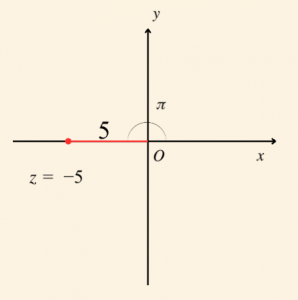
Express the complex number \( z = -5 \) in polar form.
\[
|z| = \sqrt{ (-5)^{2} + 0^{2} } = 5
\]
Factoring out the modulus \( |z| = 5 \) from \( z = -5 \):
\[
z = 5(-1 + 0i)
\]
Since \( z = |z|(\cos\theta + i\sin\theta) \), we have:
\[
\cos\theta = -1, \qquad \sin\theta = 0
\]
 \[
\[
\Rightarrow \text{Arg}(z) = \theta = \pi
\]
Therefore,
\[
z = 5(\cos\pi + i\sin\pi)
= 5\,\text{cis}\,\pi
\]
Example:
Find the complex number given in polar coordinates as \( (\sqrt{2}, 45^\circ) \).
\[
z = \sqrt{2}(\cos 45^\circ + i\sin 45^\circ)
\]
\[
= \sqrt{2}\left( \frac{\sqrt{2}}{2} + i\frac{\sqrt{2}}{2} \right)
= 1 + i
\]
QUESTION 22
What is the principal argument of the complex number \( z = 1 + \cos 36^\circ + i\sin 36^\circ \), in degrees?
\[ A) \ 9^\circ \quad B) \ 18^\circ \quad C) \ 36^\circ \quad D) \ 54^\circ \quad E) \ 72^\circ \]
Solution:
\[
z = 1 + \cos 36^\circ + i\sin 36^\circ
\]
Using half-angle identities:
\[
z = 1 + (-1 + 2\cos^{2}18^\circ) + i\,2\sin18^\circ\cos18^\circ
\]
\[
z = 2\cos18^\circ(\cos18^\circ + i\sin18^\circ)
\]
From this expression, we get:
\[
|z| = 2\cos18^\circ, \qquad \text{Arg}(z) = \theta = 18^\circ
\]
\( \textbf{Answer: B} \)
QUESTION 23
What is the argument of the complex number \( z = 1 + \cos 4\alpha + 2\cos 2\alpha + i\sin 4\alpha \)?
\[ A) \ \alpha \quad B) \ 2\alpha \quad C) \ 3\alpha \quad D) \ 4\alpha \quad E) \ 5\alpha \]
Solution:
Let us convert the complex number \( z = 1 + \cos 4\alpha + 2 \cos 2\alpha + i \sin 4\alpha \) into polar form \( z = |z|(\cos \theta + i \sin \theta) \).
\[
z = 1 + \cos 4\alpha + 2 \cos 2\alpha + i \sin 4\alpha
\]
\[
= 2 \cos^2 2\alpha + 2 \cos 2\alpha + i \, 2 \sin 2\alpha \cos 2\alpha
\]
\[
= 2 \cos 2\alpha (\cos 2\alpha + 1 + i \sin 2\alpha)
\]
\[
= 2 \cos 2\alpha (2 \cos^2 \alpha + i \, 2 \sin \alpha \cos \alpha)
\]
\[
= 2 \cos 2\alpha \cdot 2 \cos \alpha (\cos \alpha + i \sin \alpha)
\]
\[
= 4 \cos 2\alpha \cos \alpha (\cos \alpha + i \sin \alpha)
\]
Therefore,
\[
|z| = 4 \cos 2\alpha \cos \alpha \quad \text{and} \quad \text{arg}(z) = \theta = \alpha
\]
\( \textbf{Answer: A} \)
QUESTION 24
Given that \( \alpha \) is an acute angle, find the principal argument of the complex number \( z = \tan \alpha – i \).
\[ A) \ \alpha \quad B) \ 2\alpha \quad C) \frac{\pi}{2} + \alpha \quad D) \pi + \alpha \quad E) \ \frac{3\pi}{2} + \alpha \]
Solution:
Let us convert the complex number \( z = \tan \alpha \ – \ i \) into polar form \( z = |z|(\cos \theta + i \sin \theta) \).
\[
z = \tan \alpha \ – \ i \Rightarrow z = \displaystyle \frac{\sin \alpha}{\cos \alpha} \ – \ i
\]
\[
= \displaystyle \frac{\sin \alpha \ – \ i \cos \alpha}{\cos \alpha}
\]
\[
= \sec \alpha \left[ \cos\left( \displaystyle \frac{\pi}{2} \ – \ \alpha \right) \ – \ i \sin\left( \displaystyle \frac{\pi}{2} \ – \ \alpha \right) \right]
\]
Since \( \cos(-\theta) = \cos \theta \) and \( -\sin \theta = \sin(-\theta) \), we can rewrite this as:
\[
= \sec \alpha \left[ \cos\left( \alpha \ – \ \displaystyle \frac{\pi}{2} \right) + i \sin\left( \alpha \ – \ \displaystyle \frac{\pi}{2} \right) \right]
\]
Therefore,
\[
|z| = \sec \alpha \quad \text{and} \quad \text{arg}(z) = \theta = \alpha \ – \ \displaystyle \frac{\pi}{2}
\]
Since \( \alpha \) is an acute angle, we have:
\[
\alpha \ – \ \displaystyle \frac{\pi}{2} < 0
\]
which cannot be the principal argument because it is negative.
To find the principal argument in the interval \([0, 2\pi)\), we add \(2\pi\):
\[
\text{Arg}(z) = 2\pi + \alpha \ – \ \displaystyle \frac{\pi}{2} = \displaystyle \frac{3\pi}{2} + \alpha
\]
\( \textbf{Answer: E} \)
Example:
Find the locus of the complex numbers \( z \) in the complex plane satisfying the equation \( \text{Arg}(z \ – \ 1 + i) = \displaystyle \frac{3\pi}{4} \).
Let \( z = x + yi \).
\[
\text{Arg}(z \ – \ 1 + i) = \displaystyle \frac{3\pi}{4} \Rightarrow \text{Arg}(x + yi \ – \ 1 + i) = \displaystyle \frac{3\pi}{4}
\]
\[
\Rightarrow \text{Arg}(x \ – \ 1 + (y + 1)i) = \displaystyle \frac{3\pi}{4}
\]
Since the argument of the complex number \( x \ – \ 1 + (y + 1)i \) is \( \displaystyle \frac{3\pi}{4} \) (which lies in the second quadrant), we must have:
\[
x \ – \ 1 < 0 \quad \text{and} \quad y + 1 > 0 \Rightarrow x < 1 \quad \text{and} \quad y > -1
\]
Furthermore,
\[
\tan \displaystyle \frac{3\pi}{4} = \displaystyle \frac{y + 1}{x \ – \ 1} \Rightarrow -1 = \displaystyle \frac{y + 1}{x \ – \ 1}
\]
\[
\Rightarrow y + 1 = -x + 1 \Rightarrow y = -x \quad (\text{subject to } x < 1 \ \text{and} \ y > -1)
\]
Thus,
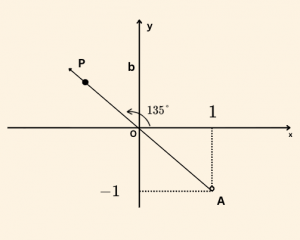
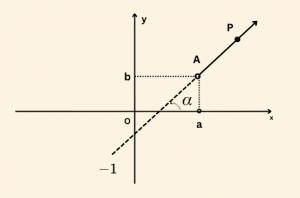
The locus of the complex numbers \( z \) forms the ray AP (excluding the endpoint A).
Rewriting the equation as \( \text{Arg}(z \ – \ (1 – i)) = \displaystyle \frac{3\pi}{4} \), we can see that the vertex A corresponds to the point representing the complex constant \( 1 – i \).
Conclusion:
Let point A represent the complex number \( a + bi \).
The locus of the complex numbers \( z \) satisfying the equation \( \text{Arg}(z – (a + bi)) = \alpha \) is a ray AP originating at point A (excluding point A itself), making an angle of \( \alpha \) with the horizontal direction.
Example:
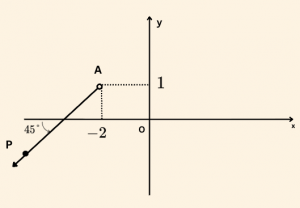
Find the locus of the complex numbers \( z \) in the complex plane satisfying the equation \( \text{Arg}(z + 2 \ – \ i) = \displaystyle \frac{5\pi}{4} \).
Rewriting the equation yields:
\[
\text{Arg}(z + 2 \ – \ i) = \displaystyle \frac{5\pi}{4} \Rightarrow \text{Arg}(z \ – \ (-2 + i)) = \displaystyle \frac{5\pi}{4}
\]
Consequently, if point A represents the complex number \( -2 + i \), the locus of \( z \) is the ray AP starting from point A and making an angle of \( \displaystyle \frac{5\pi}{4} \) radians with the positive real axis.
Example:
Find the locus of the complex numbers \( z \) in the complex plane satisfying the equation \( \text{Arg}(z \ – \ 2) – \text{Arg}(z + i) = \pi \).
Let \( z = x + yi \), \( \text{Arg}(z – 2) = \alpha_1 \), and \( \text{Arg}(z + i) = \alpha_2 \).
\[
\text{Arg}(z \ – \ 2) = \alpha_1 \Rightarrow \text{Arg}(x + yi – 2) = \alpha_1 \Rightarrow \text{Arg}(x \ – \ 2 + yi) = \alpha_1
\]
and
\[
\text{Arg}(z + i) = \alpha_2 \Rightarrow \text{Arg}(x + yi + i) = \alpha_2 \Rightarrow \text{Arg}(x + (y + 1)i) = \alpha_2
\]
Since \( \alpha_1 \ – \ \alpha_2 = \pi \), it implies that the two angles differ by \(180^\circ\). This gives two possible quadrant combinations:
\[
\pi < \alpha_1 < \displaystyle \frac{3\pi}{2} \quad \text{and} \quad 0 < \alpha_2 < \displaystyle \frac{\pi}{2}
\]
or
\[
\displaystyle \frac{3\pi}{2} < \alpha_1 < 2\pi \quad \text{and} \quad \displaystyle \frac{\pi}{2} < \alpha_2 < \pi
\]
Case 1: If \( \alpha_1 \in \left( \pi , \displaystyle \frac{3\pi}{2} \right) \), then the point \( x – 2 + yi \) lies in the third quadrant:
\[
x \ – \ 2 < 0 \quad \text{and} \quad y < 0 \Rightarrow x < 2 \quad \text{and} \quad y < 0
\]
Under this case, \( x + (y + 1)i \) must have an argument \( \alpha_2 \in \left( 0 , \displaystyle \frac{\pi}{2} \right) \), meaning it lies in the first quadrant:
\[
x > 0 \quad \text{and} \quad y + 1 > 0 \Rightarrow x > 0 \quad \text{and} \quad y > -1
\]
Combining these inequalities gives the domain restrictions:
\[
0 < x < 2 \quad \text{and} \quad -1 < y < 0
\]
Now, taking the tangent of both sides of the original angle relation:
\[
\tan(\alpha_1 – \alpha_2) = \tan \pi
\]
\[
\displaystyle \frac{\displaystyle \frac{y}{x \ – \ 2} \ – \ \displaystyle \frac{y + 1}{x}}{1 + \displaystyle \frac{y}{x \ – \ 2} \cdot \displaystyle \frac{y + 1}{x}} = 0 \Rightarrow \displaystyle \frac{y}{x \ – \ 2} \ – \ \displaystyle \frac{y + 1}{x} = 0
\]
\[
\Rightarrow \displaystyle \frac{xy \ – \ xy \ – \ x + 2y + 2}{(x \ – \ 2)x} = 0 \Rightarrow -x + 2y + 2 = 0
\]
\[
\Rightarrow y = \displaystyle \frac{x \ – \ 2}{2} \quad (\text{where } 0 < x < 2 \text{ and } -1 < y < 0)
\]
Thus, the locus of \( z \) is the open line segment (AB) connecting \( B(0, -1) \) and \( A(2, 0) \).
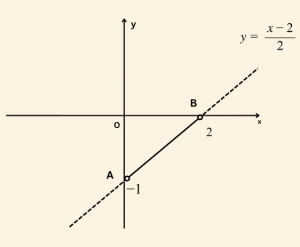
Case 2: For \( \displaystyle \frac{3\pi}{2} < \alpha_1 < 2\pi \) and \( \displaystyle \frac{\pi}{2} < \alpha_2 < \pi \):
The point \( x – 2 + yi \) being in the fourth quadrant implies \( x – 2 > 0 \Rightarrow x > 2 \).
The point \( x + (y + 1)i \) being in the second quadrant implies \( x < 0 \).
Since \( x > 2 \) and \( x < 0 \) cannot simultaneously hold, this case yields no solution (\( \varnothing \)).
Therefore, \( \alpha_1 – \alpha_2 \neq \pi \) for this region.
Example:
Find the locus of the complex numbers \( z \) satisfying the equation \( \text{Arg}(\overline{z}) + \text{Arg}(z + 2i) = \displaystyle \frac{\pi}{2} \).
Let \( z = x + yi \), \( \text{Arg}(\overline{z}) = \alpha_1 \), and \( \text{Arg}(z + 2i) = \alpha_2 \).
\[
\text{Arg}(\overline{z}) = \alpha_1 \Rightarrow \text{Arg}(x \ – \ yi) = \alpha_1
\]
and
\[
\text{Arg}(z + 2i) = \alpha_2 \Rightarrow \text{Arg}(x + yi + 2i) = \alpha_2 \Rightarrow \text{Arg}(x + (y + 2)i) = \alpha_2
\]
Since \( \alpha_1 + \alpha_2 = \displaystyle \frac{\pi}{2} \) and both arguments represent independent angles for parts of the locus, they must lie in the first quadrant:
\[
0 < \alpha_1 < \displaystyle \frac{\pi}{2} \quad \text{and} \quad 0 < \alpha_2 < \displaystyle \frac{\pi}{2}
\]
For \( x – yi \) in the first quadrant (\( \alpha_1 \)):
\[
x > 0 \quad \text{and} \quad -y > 0 \Rightarrow x > 0 \quad \text{and} \quad y < 0
\]
For \( x + (y + 2)i \) in the first quadrant (\( \alpha_2 \)):
\[
x > 0 \quad \text{and} \quad y + 2 > 0 \Rightarrow x > 0 \quad \text{and} \quad y > -2
\]
Combining these gives the valid interval boundaries for the coordinates:
\[
x > 0 \quad \text{and} \quad -2 < y < 0
\]
Using the cotangent addition formula:
\[
\cot(\alpha_1 + \alpha_2) = \cot \displaystyle \frac{\pi}{2}
\]
\[
\Rightarrow \displaystyle \frac{\cot \alpha_1 \cdot \cot \alpha_2 \ – \ 1}{\cot \alpha_1 + \cot \alpha_2} = 0 \Rightarrow \displaystyle \frac{x}{-y} \cdot \displaystyle \frac{x}{y + 2} \ – \ 1 = 0
\]
\[
\Rightarrow \displaystyle \frac{x^2}{-y(y+2)} – 1 = 0 \Rightarrow x^2 = -y^2 – 2y \Rightarrow x^2 + y^2 + 2y = 0
\]
\[
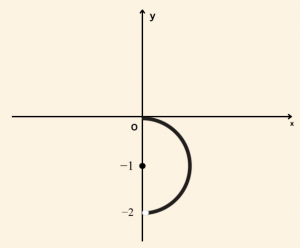
\Rightarrow x^2 + (y + 1)^2 = 1 \quad (\text{where } x > 0 \text{ and } -2 < y < 0)
\]
Thus, the locus of the complex numbers \( z \) forms a semicircle, as shown in the graph below:
QUESTION 25
If the complex number \( z \) satisfies the equation:
\[ \text{Arg} \left( \displaystyle \frac{z + i}{i} \right) = \displaystyle \frac{3\pi}{4} \]
what is the value of \( \text{Re}(z) \ – \ \text{Im}(z) \)?
\[ A) \ -1 \quad B) \ 0 \quad C) \ 1 \quad D) \ 2 \quad E) \ 3 \]
Solution:
Let \( z = x + yi \). Then \( \text{Re}(z) \ – \ \text{Im}(z) = x \ – \ y \).
\[
\text{Arg} \left( \displaystyle \frac{z + i}{i} \right) = \displaystyle \frac{3\pi}{4} \Rightarrow \text{Arg} \left( \displaystyle \frac{x + yi + i}{i} \right) = \displaystyle \frac{3\pi}{4}
\]
\[
\Rightarrow \text{Arg}\left( \frac{x + (y + 1)i}{i} \right) = \text{Arg}\left( \frac{x}{i} + y + 1 \right) = \text{Arg}(y + 1 \ – \ xi) = \displaystyle \frac{3\pi}{4}
\]
The argument of the complex number \( (y + 1) – xi \) is \( \displaystyle \frac{3\pi}{4} \). Let us plot this point in the complex plane:
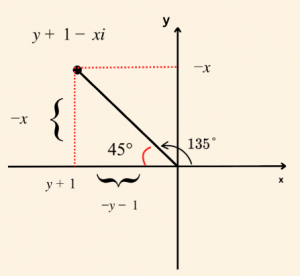 From the geometry of the figure on the side:
\[
\tan 45^\circ = \displaystyle \frac{-x}{-(y \ – \ 1)} \Rightarrow 1 = \frac{-x}{-y – 1} \Rightarrow 1 = \frac{x}{y+1}
\]
\[
\Rightarrow x = y + 1 \Rightarrow x – y = 1
\]
\( \textbf{Answer: C} \)