
Representation of Sets
1. Set-Builder Notation (Common Property Method):
A set is expressed by specifying the common properties shared by all its elements.
Examples:
\(\bullet \quad \) If set A is the set of integers whose absolute value is less than 3, it is represented as:
\[ A= \{x: \; |x| \; < \; 3 , x \in Z \} \] or
\[ A= \{x| \; |x| \; < \; 3 , x \in Z \} \]
- The Colon (:) or Vertical Bar (|) is used here to mean “such that”.
- It serves as a separator to define the properties that the elements of the set must possess.
Meaning:
This expression states the following:
- Set A consists of elements x “such that” x satisfies two conditions:
- |x| < 3 (Its absolute value is less than 3).
- x ∈ Z (x is an integer).
Elements of the Set:
- |x| < 3 means it must be in the interval -3 < x < 3.
- However, x can only be taken from the set of integers.
In this case:
- A = { -2, -1, 0, 1, 2 }
The choice between using a colon or a vertical bar here is merely a writing style preference and does not create any difference in meaning.
\(\bullet \quad \) If set B is the set of consecutive even numbers, it is represented as:
\[ B= \{x| \; x = 2n , n \in Z \} \; \text{dır. } \]
2. Roster (List) Method:
The elements of the set are written inside \( \{\}\) braces, separated from one another by commas.
Example:
If set A is the set of single-digit prime numbers, then \(A = \{ 2, 3, 5, 7 \} \) is obtained.
3. Venn Diagram Method:
The elements of the set are written inside a closed curve, with a dot placed next to each element.
Example:
If set A is the set of vowels in our alphabet, it is shown as:
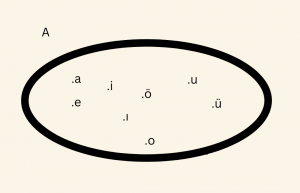
shown as above.
The Concept of Interval:
The set \[ A = \{ x | \; \; a \le x \le b , \;\;\ a,b, x \in R \} \] is denoted as:
\[ A= [a, \; b ] \]
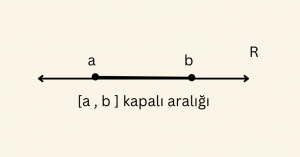
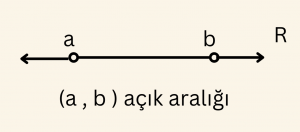
The set \[ A = \{ x | \; \; a < x < b , \text{where } a,b, x \in R \} \] is denoted as \[ A= (a, \; b ) \] and it means that
the number a and the number b are not included in set A.
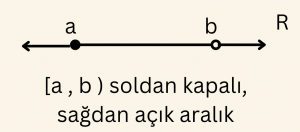
The set \[ A = \{ x | \; \; a \le x < b , \text{where } a,b, x \in R \} \] is denoted as \[ A= [a, \; b ) \]
and it means that the number a is included in set A, but the number b is not included.
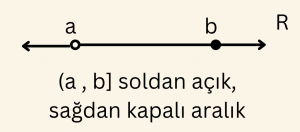
The set \[ A = \{ x | \; \; a < x \le b , \text{where } a,b, x \in R \} \] is denoted as \[ A= (a, \; b ] \]
and it means that the number a is not included in set A, but the number b is included.
Examples:
\( \bullet \quad \) For the set \( A = \{x : \;\;|x | \le 3, \;\; x \in R \}\):
\[ |x | \le 3 \Rightarrow -3 \le x \le 3 \;\; \text{therefore, } A = [-3, 3 ] \]
\( \bullet \quad \) For the set \( B = \{x : \;\;x \le 0, \;\; x \in R \}\):
\[ B = (- \infty, 0 ] \] is shown in this form.
Note: Infinity cannot be closed; therefore, a parenthesis “(” or “)” is used.
← Previous Page | Next Page →