
Types of Sets
Empty Set (Null Set)
A set that has no elements is called an empty set. The empty set is denoted by { } or Ø.
Example:
The set \( A = \{x | \;\; x^2 +1 = 0 \;\; x \in R \}\)
is an empty set because \( \Rightarrow x^2 +1 > 0 \) for all real numbers.
If \( A = \{\} \) or \( A= \) Ø, then \(s(A)=0 \).
Subset:
Given two sets, such as A and B, if every element of set B is also an element of set A, then set B is a subset of set A, or it is said that set A contains (supersets) set B. It is denoted as \( B \subset A \) or \( A \supset B \).
Here:
\(\bullet \quad \) \( \subset \;\; \): Subset symbol
\(\bullet \quad \) \( \supset \;\; \): Contains (superset) symbol.
Examples:
\(\bullet \quad \)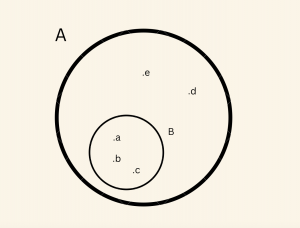
\( A \supset B \)
\(\bullet \quad \) The subsets of set \( F = \{ a, b, c \} \)
are 8 in total, namely: \( F = \{ a, b, c \} , \{ a, b\} ,\{a, c \} ,\{b,c \}, \{a\}, \{b\}, \{c\}, \{ \} \).
Warning:
\(\bullet \quad \) Every set is a subset of itself. \( A \subset \;\; A \)
\(\bullet \quad \) The empty set is a subset of every set. \( Ø \subset \;\; A\)
Number of Subsets:
The number of subsets of a set with n elements is given by:
\[ 2^n \]
Question 1
How many subsets does the set \(A= \{ a, \{ a\} , Ø , b, c, \{b, d \} \} \) have?
\[
\text{A)} 8 \quad
\text{B) } 16 \quad
\text{C) } 32\quad
\text{D) } 64 \quad
\text{E) } 128
\]
Solution:
Since \( s(A) = 6 \), set A has \(2^6= 64 \) subsets.
\(\textbf{Answer: D} \)
Question 2
How many subsets of the set \(A= \{ a, b, c , d, e , f \} \) contain the element a but do not contain the element b?
\[
\text{A)} 32 \quad
\text{B) } 16 \quad
\text{C) } 8\quad
\text{D) } 4 \quad
\text{E) } 2
\]
Solution:
Since the element b will not be present and the element a must be present in these subsets, we can form \(2^4= 16 \) subsets using the remaining elements of the set { c, d, e, f}, and then add the element a into each of these subsets. Therefore, 16 subsets can be written under the given conditions.
\(\textbf{Answer: B} \)
Proper Subset
Subsets of a set other than the set itself are called the proper subsets of that set.
Example:
The proper subsets of set \( A = \{ 1, 2 , 3 \} \)
are 7 in total, namely: \[ A= \{ 1, 2 \} , \{1,3 \} , \{ 2, 3 \} , \{1 \} , \{ 2\} , \{ 3\} , \{ \} \]
The number of proper subsets of a set with n elements is:
\[ 2^n-1 \]
Question 3
What is the number of elements of a set if the sum of its number of subsets and proper subsets is 63?
\[
\text{A)} 3 \quad
\text{B) } 4 \quad
\text{C) } 5\quad
\text{D) } 6 \quad
\text{E) } 7
\]
Solution:
Let the number of elements of this set be n.
\[ 2^n + 2^n-1 = 63 \Rightarrow 2 \cdot 2^n = 64 \]
\[ \Rightarrow 2^n = 32 = 2^5 \Rightarrow n= 5 \]
\(\textbf{Answer: C} \)
Universal Set
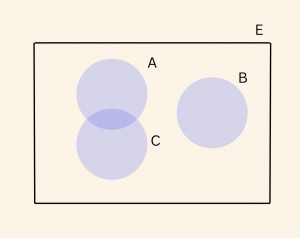
The set that contains all the sets under consideration in a given context is called the universal set. The universal set is denoted by the symbol E (or U).
Example:
Complement of a Set
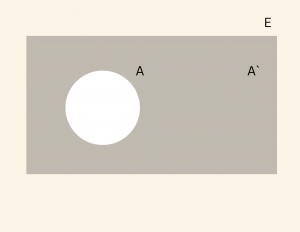
Let set \( A \) be a subset of the universal set \( E \). The set consisting of elements that belong to \( E \) but do not belong to \( A \) is called the complement of set \( A \), and it is denoted by \( A’ \) or \( \overline{A} \).
\[ \overline{A} = A’ = \{ x \, | \, x \in E \text{ and } x \notin A \} \]
Properties:
\(1.)\;\; E’= Ø \quad \quad 2.) \;\; Ø’ = E \quad \quad 3.) \;\; (A’)’ = A \)
\(4.)\;\; B \subset A \;\; \text{implies } B’ \supset A’ \quad \quad 5.) \;\; s(A) + s(A’) = s(E)\)
Example:
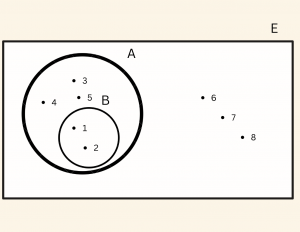
\[\begin{aligned} A’= \{ 6,7,8 \} \\ B’= \{3,4,5,6,7,8 \} \\ B\subset A \;\; \text{and } \;\; B’\; \supset\; A’ \end{aligned}\]
Example:
If \( E= R \) and \( A = \{ x \; | \; x< 0 \;\; \text{or } \; x \ge 3 , \; x \in R \} \), let’s find the complement set \( A’ \).
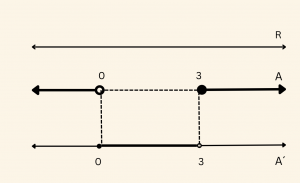
\[ A’ = \{x \;| \; 0 \le x < 3 , x \in R \} \]
← Previous Page | Next Page →