
Arithmetic Operations on Functions
Let \( f: A \to \mathbb{R} \) and \( g: B \to \mathbb{R} \) be two functions. Provided that the intersection of their domains is non-empty (\( A \cap B \neq \emptyset \)), the fundamental arithmetic operations are defined as follows:
1) Sum:
\[ f + g : A \cap B \to \mathbb{R} \quad \text{and} \quad (f+g)(x) = f(x) + g(x) \]
2) Difference:
\[ f – g : A \cap B \to \mathbb{R} \quad \text{and} \quad (f – g)(x) = f(x) – g(x) \]
3) Product:
\[ f \cdot g : A \cap B \to \mathbb{R} \quad \text{and} \quad (f \cdot g)(x) = f(x) \cdot g(x) \]
4) Quotient:
\[ \frac{f}{g} : A \cap B \to \mathbb{R} \quad \text{and} \quad \left( \frac{f}{g} \right)(x) = \frac{f(x)}{g(x)} \quad \text{where } g(x) \neq 0 \]
5) Scalar Multiplication: Let \( c \in \mathbb{R} \), then:
\[ c \cdot f : A \to \mathbb{R} \quad \text{and} \quad (c \cdot f)(x) = c \cdot f(x) \]
Examples:
Consider the real-valued functions \( f: \mathbb{R} \to \mathbb{R} \) given by \( f(x) = x^2 \), and \( g: \mathbb{R} \to \mathbb{R} \) given by \( g(x) = x^2 + 1 \).
\( \bullet \quad (2f + g)(x) = 2 f(x) + g(x) = 2x^2 + x^2 + 1 = 3x^2 + 1 \)
\( \bullet \quad { \left( \frac{2g – f}{2} \right)(x)} = \frac{2 g(x) – f(x)}{2} = \frac{2 (x^2 + 1) – x^2}{2} = \frac{x^2 + 2}{2} \)
\( \bullet \quad 1 + x^4 – (f \cdot g)(x) = 1 + x^4 – f(x) \cdot g(x) = 1 + x^4 – x^2 (x^2 + 1) = 1 – x^2 \)
Question 10
Given the domains \( A = \{-1, 0, 1, 2\} \) and \( B = \{0, 2, 3, 4\} \) along with the functions \( f: A \to \mathbb{R} \), \( f(x) = 2^x \) and \( g: B \to \mathbb{R} \), \( g(x) = x^2 \):
What is the range of the combined function below?
\[
\frac{2f}{f+g}
\]
\[ \text{A)} \{0, \frac{2}{5} \} \quad \text{B) } \{2,1 \} \quad \text{C) } \{0,2 \} \quad \text{D) } \{0,1 \} \quad \text{E)} \{\frac{2}{5} ,2 \} \]
Solution:
The operation is only valid on the shared domain, which is the intersection: \( A \cap B = \{0, 2\} \). Evaluating the individual functions at these inputs gives:
\( f(x) = 2^x \implies f(0) = 2^0 = 1 \quad \) and \( \quad f(2) = 2^2 = 4 \)
\( g(x) = x^2 \implies g(0) = 0^2 = 0 \quad \) and \( \quad g(2) = 2^2 = 4 \)
Now, evaluate the rational expression for each valid input:
\[
\left(\frac{2f}{f+g}\right)(0) = \frac{2 f(0)}{f(0) + g(0)} = \frac{2 \cdot 1}{1 + 0} = 2
\]
\[
\left(\frac{2f}{f+g}\right)(2) = \frac{2 f(2)}{f(2) + g(2)} = \frac{2 \cdot 4}{4 + 4} = 1
\]
Thus, the image set (range) is:
\[
\left(\frac{2f}{f+g}\right)(A \cap B) = \{2, 1\}
\]
\(\textbf{Correct Answer: B} \)
Question 11
Given the polynomial function \( f(x) = x^4 + 4x^3 + 6x^2 + 4x + 1 \), evaluate \( f(\sqrt{2} – 1) \).
\[ \text{A)} 1 \quad \text{B) } 2 \quad \text{C) } 3 \quad \text{D) } 4 \quad \text{E)} 5 \]
Solution:
Recognizing the binomial expansion pattern based on Pascal’s triangle coefficients (1, 4, 6, 4, 1), we can factor the polynomial expression as a perfect fourth power:
\[
f(x) = x^4 + 4x^3 + 6x^2 + 4x + 1 = (x+1)^4
\]
Substituting the given value:
\[
f(\sqrt{2} – 1) = (\sqrt{2} – 1 + 1)^4 = (\sqrt{2})^4 = 4
\]
\(\textbf{Correct Answer: D} \)
Question 12
Consider the function \( f: \mathbb{R} \to \mathbb{R} \) defined by \( f(x) = x^2 + x + 1 \).
If the domain is restricted to the interval \( A = (1,2] \) and its corresponding range is \( f(A) = B \), which of the following sets represents \( B \)?
\[ \text{A)} (4,7] \quad \text{B) } (3,6] \quad \text{C) } (1,5] \quad \text{D) } (3,7] \quad \text{E)} (2,8] \]
Solution:
We are given \( y = f(x) = x^2 + x + 1 \) subject to the domain constraint \( 1 < x \leq 2 \). Since all variables are positive in this interval, we can set up the bounding inequalities for each component:
\[ 1 < x \leq 2 \quad \implies \quad 1^2 < x^2 \leq 2^2 \]
\[ = 1 < x^2 \leq 4 \]
For the linear component, we modify the inequality to match \( x + 1 \):
\[ 1 < x \leq 2 \quad \implies \quad 1 + 1 < x + 1 \leq 2 + 1 \]
\[ = 2 < x + 1 \leq 3 \]
Adding these two inequalities together term-by-term yields the range bounds:
\[
\begin{aligned}
& 1 < x^2 \leq 4 \\
+ \quad & 2 < x + 1 \leq 3\\
\hline \\
&3 < x^2 + x + 1 \leq 7
\end{aligned}
\]
Consequently, the target set is:
\[
B = \{ y \mid 3 < y \leq 7, y \in \mathbb{R} \} \implies B = (3,7]
\]
\(\textbf{Correct Answer: D} \)
Question 13
Let \( f: A \to B \) be a function defined by \( f(x) = \frac{x+1}{2} \). If its range (image set) is given by the open interval \( B = (-2,1) \), what is its domain \( A \)?
\[ \text{A)} (-5,1 ) \quad \text{B) } (-4,2 ) \quad \text{C) } (-3,3) \quad \text{D) } (-2,4 ) \quad \text{E)} (-1,5 ) \]
Solution:
The output values are bounded by the interval \( B \), which means:
\[
B = \{ y \mid -2 < y < 1, y \in \mathbb{R} \}
\]
Substituting the function rule into the inequality to solve for the domain variable \( x \):
\[
-2 < \frac{x+1}{2} < 1
\]
Multiply all parts by 2 to clear the fraction:
\[
\implies -4 < x + 1 < 2
\]
Subtract 1 from all parts to isolate \( x \):
\[
\implies -4 – 1 < x < 2 – 1
\]
\[
\implies -5 < x < 1
\]
Thus, the domain set is:
\[
A = \{ x \mid -5 < x < 1, x \in \mathbb{R} \} \implies A = (-5,1)
\]
\(\textbf{Correct Answer: A} \)
Question 14
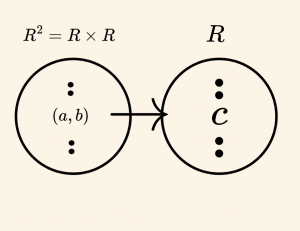
A multivariate function is defined on a two-dimensional real coordinate space as \( f: \mathbb{R}^2 \to \mathbb{R} \), where:
\[ f(x, y) = x^3 – y^3 – 3xy \cdot (x – y) \]
Evaluate the function value at the point \( f(1995, 1996) \).
\[ \text{A)} -1 \quad \text{B) } 0 \quad \text{C) } 1 \quad \text{D) } 2 \quad \text{E )} 3 \]
Solution:
The domain of this function consists of ordered coordinate pairs \( (x,y) \). The mapping can be structurally represented as follows:
Let us algebraically expand and simplify the polynomial rule:
\[
f(x, y) = x^3 – y^3 – 3xy \cdot (x – y)
\]
\[
= x^3 – 3x^2 y + 3xy^2 – y^3
\]
This matches the algebraic identity for the perfect cube of a binomial difference:
\[
\implies f(x, y) = (x – y)^3
\]
Substituting the large coordinate values transforms the problem into a simple arithmetic step:
\[
\implies f(1995, 1996) = (1995 – 1996)^3 = (-1)^3 = -1
\]
\(\textbf{Correct Answer: A} \)
Question 15
A functional equation satisfies the multiplicative property \( f(x + y) = f(x) \cdot f(y) \). If \( f(2) = 3 \), find the value of \( f(8) \).
\[ \text{A)} 3 \quad \text{B) } 9 \quad \text{C) } 27 \quad \text{D) } 81 \quad \text{E )} 243 \]
Solution:
Using the additive property within the input domain, we can break down the integer 8 into a sum of known reference points:
\[
f(x + y) = f(x) \cdot f(y)
\]
\[
\implies f(8) = f(2 + 2 + 2 + 2)
\]
Applying the exponential-like property iteratively transforms the addition into a product of individual values:
\[
= f(2) \cdot f(2) \cdot f(2) \cdot f(2)
\]
\[
= 3 \cdot 3 \cdot 3 \cdot 3 = 81
\]
\(\textbf{Correct Answer: D} \)
← Previous Page | Next Page →