
Into Function (Non-Surjective Function)
Let $f: A \to B$ be a function. If there is at least one element in the codomain $B$ that is not mapped to by any element in the domain $A$, then $f$ is called an into function.
In other words, the range $f(A)$ is a proper subset of the codomain $B$, denoted as $f(A) \neq B$.
Examples:
$\bullet \quad f: A \to B$ is an into function because the element $a$ in the codomain $B$ is left unmapped.
\[
A = \{1,2,3\}, \quad B = \{a, b, c\}
\]
Functional mappings:
\[
f(1) = b, \quad f(2) = b, \quad f(3) = c
\]
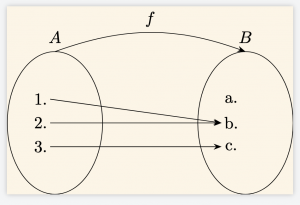
Since the element $a$ has no pre-image in the domain, this is an into function.
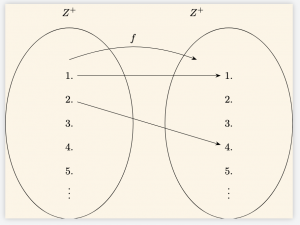
$\bullet \quad f: \mathbb{Z}^+ \to \mathbb{Z}^+$, defined by
\[
f(x) = x^2
\]
is an into function because there are elements left unmapped in the codomain.
For instance,
\[
f(1) = 1, \quad f(2) = 4, \quad f(3) = 9, \quad f(4) = 16, \quad f(5) = 25, \dots
\]
In this function, certain positive integers (such as 2, 3, 5, etc.) are never obtained as an output for any input $x$. Thus, the range does not equal the codomain, making it an into function.
← Previous Page | Next Page →