
Constant Function
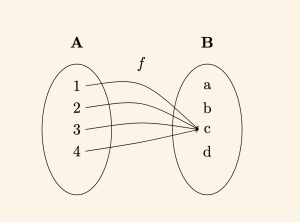
Let $f: A \to B$ be a given function. If every element in the domain $A$ maps to the exact same image in the codomain $B$, then this function is called a constant function.
That is, for all $x \in A$, $f(x) = c$ where $c \in B$.
The total number of unique constant functions that can be defined from $A$ to $B$ is equal to the cardinality of the codomain, $s(B)$.
Example:
The function $f: A \to B$ is defined by the rule $f(x) = c$.
\[
f(1) = c, \quad f(2) = c, \quad f(3) = c, \quad f(4) = c
\]
In this case, exactly $s(B) = 4$ different constant functions can be defined.
QUESTION 20
Given that the function $f: \mathbb{R} \to \mathbb{R}$, defined by
\[
f(x) = \frac{(a – 1)x^2 – 3}{ax^2 – 1}
\]
is a constant function, what is the value of $a$?
\[
\text{A)} -1 \quad
\text{B) } -\frac{1}{2} \quad
\text{C) } 0 \quad
\text{D) } \frac{1}{2} \quad
\text{E) } 1
\]
Solution:
For $f$ to be a constant function, it must satisfy $f(x) = c$ for some constant $c \in \mathbb{R}$.
\[
f(x) = \frac{(a – 1)x^2 – 3}{ax^2 – 1} = c
\]
\[
\Rightarrow (a – 1)x^2 – 3 = acx^2 – c
\]
By equating the coefficients of like terms, we get:
\[
\Rightarrow -3 = -c \quad \text{and} \quad a – 1 = ac
\]
\[ \Rightarrow c = 3 \quad \text{and} \quad a – 1 = 3a \]
\[ \Rightarrow 2a = -1 \Rightarrow a = -\frac{1}{2} \]
\(\textbf{Correct Answer: B} \)
Graph of a Constant Function:
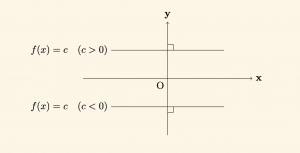
The graph of a constant function $f: \mathbb{R} \to \mathbb{R}, \;\; f(x) = c$ is represented by a horizontal line:
Example:
The constant function
\[
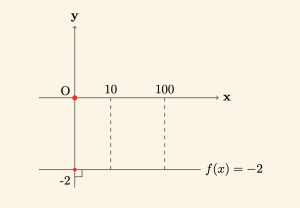
f: \mathbb{R} \to \mathbb{R}, \quad f(x) = -2
\]
is illustrated above. For this function, $f(10) = -2$ and $f(100) = -2$.