
Composite Function
Let $f: A \to B$ and $g: B \to C$ be two given functions. The function that maps elements from set $A$ directly to set $C$ by applying $f$ first and then $g$ is called the composite function of $f$ and $g$.
\[
g \circ f : A \to C, \quad (g \circ f)(x) = g(f(x))
\]
Example:
Consider the functions:
\[
f: \mathbb{R} \to \mathbb{R}, \quad f(x) = x^2 + 1
\]
\[
g: \mathbb{R} \to \mathbb{R}, \quad g(x) = x + 1
\]
The composition $(f \circ g)(x)$ is computed as:
\[
(f \circ g)(x) = f(g(x)) = f(x+1) = (x+1)^2 + 1
\]
\[
= x^2 + 2x + 1 + 1 = x^2 + 2x + 2
\]
The composition $(g \circ f)(x)$ is computed as:
\[
(g \circ f)(x) = g(f(x)) = g(x^2 + 1) = (x^2 + 1) + 1
\]
\[
= x^2 + 2
\]
Properties of Composite Functions:
1. Function composition is generally non-commutative.
\[
f \circ g \neq g \circ f \quad \text{(provided that } f \neq I \text{ and } g \neq I\text{)} \quad (I: \text{ Identity Function})
\]
Note:
For certain specific choices of $f$ and $g$, it is possible that $f \circ g = g \circ f$.
Example:
Let:
\[
f: \mathbb{R} \to \mathbb{R}, \quad f(x) = x + 2
\]
\[
g: \mathbb{R} \to \mathbb{R}, \quad g(x) = x – 7
\]
Calculating both configurations:
\[
(f \circ g)(x) = f(g(x)) = f(x – 7) = x – 7 + 2 = x – 5
\]
\[
(g \circ f)(x) = g(f(x)) = g(x + 2) = x + 2 – 7 = x – 5
\]
In this special instance:
\[ f \circ g = g \circ f \]
2. Function composition is associative:
\[
f \circ (g \circ h) = (f \circ g) \circ h
\]
\[
f \circ g \circ h = f \circ (g \circ h) = (f \circ g) \circ h
\]
Example:
Given $f, g, h: \mathbb{R} \to \mathbb{R}$ with definitions $f(x) = 2x$, $g(x) = x^2$, and $h(x) = x + 1$:
\[
(g \circ h)(x) = g\bigl(h(x)\bigr) = g(x+1) = (x+1)^2
\]
\[
[f \circ (g \circ h)](x) = f\bigl((g \circ h)(x)\bigr) = f\bigl((x+1)^2\bigr) = 2(x+1)^2
\]
\[
(f \circ g)(x) = f\bigl(g(x)\bigr) = f(x^2) = 2x^2
\]
\[
[(f \circ g) \circ h](x) = (f \circ g)\bigl(h(x)\bigr) = (f \circ g)(x+1) = 2(x+1)^2
\]
Since both group methods yield identical outputs, we confirm that $f \circ (g \circ h) = (f \circ g) \circ h$.
Reminder:
\[
(f \circ g \circ h)(x) = [(f \circ g) \circ h](x) = f[g(h(x))]
\]
Examples:
Let $f(x) = x^2 – 1$, $g(x) = 2x$, and $h(x) = x + 2$ be defined on $\mathbb{R} \to \mathbb{R}$.
$\bullet \quad$ To expand $(f \circ g \circ h)(x)$:
\[
(f \circ g \circ h)(x) = f[g(h(x))] = f[g(x+2)] = f[2(x+2)] = [2(x+2)]^2 – 1
\]
\[
= (2x + 4)^2 – 1 = 4x^2 + 16x + 16 – 1 = 4x^2 + 16x + 15
\]
$\bullet \quad$ To evaluate the single value $(f \circ g \circ h)(1)$:
\[
(f \circ g \circ h)(1) = f[g(h(1))] = f[g(1+2)] = f[g(3)]
\]
\[
= f(2 \cdot 3) = f(6) = 6^2 – 1 = 35
\]
3. Composition property with the Identity Function:
\[
f \circ I = I \circ f = f, \quad \text{(where } f: A \to A\text{)}
\]
4. Composition property with an Inverse Function:
\[
f \circ f^{-1} = f^{-1} \circ f = I, \quad \text{(where } f: A \to A\text{)}
\]
Example:
Let $f: \mathbb{R} \to \mathbb{R}, \quad f(x) = \frac{2x – 3}{5}$. Its inverse is $f^{-1}(x) = \frac{5x + 3}{2}$.
\[
\Rightarrow (f \circ f^{-1})(x) = f(f^{-1}(x)) = \frac{2 \cdot \left( \frac{5x + 3}{2} \right) – 3}{5} = \frac{(5x + 3) – 3}{5} = \frac{5x}{5} = x
\]
Conclusion:
\[
f \circ f^{-1} = I
\]
Isolating Functions in Equations:
If you are given a composite relation equation $f \circ g = h$, you can analytically isolate either $f$ or $g$:
1. Composing both sides from the right by $g^{-1}$:
\[
f \circ g = h \Rightarrow f \circ g \circ g^{-1} = h \circ g^{-1}
\]
\[
\Rightarrow f \circ I = h \circ g^{-1} \Rightarrow f = h \circ g^{-1}
\]
2. Composing both sides from the left by $f^{-1}$:
\[
f \circ g = h \Rightarrow f^{-1} \circ f \circ g = f^{-1} \circ h
\]
\[
\Rightarrow I \circ g = f^{-1} \circ h \Rightarrow g = f^{-1} \circ h
\]
Example:
Given $f(x) = \frac{x – 1}{2}$ and $(f \circ g)(x) = 3x + 4$, let us find the expression for $g(x)$.
Let $h(x) = 3x + 4$. Since $g = f^{-1} \circ h$, we find the inverse of $f$ first: $f^{-1}(x) = 2x + 1$.
\[
g(x) = (f^{-1} \circ h)(x) = f^{-1}(h(x)) = f^{-1}(3x + 4)
\]
\[
= 2(3x + 4) + 1 = 6x + 8 + 1 = 6x + 9
\]
Example:
Given $f \left( \frac{2x – 1}{x + 3} \right) = x + 1$, let us determine the rule for $f(x)$.
Let $g(x) = \frac{2x – 1}{x + 3}$ and $h(x) = x + 1$, meaning $(f \circ g)(x) = h(x)$. Therefore, $f(x) = (h \circ g^{-1})(x)$.
First, determine the inverse function $g^{-1}(x) = \frac{-3x – 1}{x – 2}$.
\[
f(x) = h(g^{-1}(x)) = h\left(\frac{-3x – 1}{x – 2}\right) = \frac{-3x – 1}{x – 2} + 1
\]
\[
= \frac{-3x – 1 + (x – 2)}{x – 2} = \frac{-2x – 3}{x – 2}
\]
Note that this method is equivalent to substituting the variable expression $x$ with $g^{-1}(x)$ on both sides of the equation.
Example:
Given $f \left( \sqrt[3]{x} + 1 \right) = x^2$, let us find $f(x)$.
Let $g(x) = \sqrt[3]{x} + 1$. To extract $f(x)$, we swap all occurrences of $x$ with $g^{-1}(x)$.
Finding the inverse equation:
\[
y = \sqrt[3]{x} + 1 \Rightarrow y – 1 = \sqrt[3]{x} \Rightarrow (y – 1)^3 = x \Rightarrow g^{-1}(x) = (x – 1)^3
\]
Substituting $(x – 1)^3$ into the original function equation:
\[
f(x) = \left[ (x – 1)^3 \right]^2 = (x – 1)^6
\]
Domain and Codomain Constraint:
For a bijective mapping $f: A \to B$:
\[
f^{-1} \circ f = I_A \quad (\text{where } I_A : A \to A)
\]
\[
f \circ f^{-1} = I_B \quad (\text{where } I_B : B \to B)
\]
Consequently, if domain $A$ is not identical to codomain $B$, then $f \circ f^{-1} \neq f^{-1} \circ f$ because their underlying domain definitions differ.
Inverse of a Composite Function
If $f, g,$ and $h$ are bijective mappings, evaluating the inverse reverses the application order:
\[
(f \circ g)^{-1} = g^{-1} \circ f^{-1}
\]
\[
(f \circ g \circ h)^{-1} = h^{-1} \circ g^{-1} \circ f^{-1}
\]
Example:
Let $f(x) = x^2 + 1$ (for $x \ge 0$) and $g(x) = \frac{-x + 1}{x + 2}$ be bijective functions. Let us find the value of $(f^{-1} \circ g)^{-1}(2)$.
Solution:
Expanding the composite inverse operation:
\[
(f^{-1} \circ g)^{-1} (2) = (g^{-1} \circ (f^{-1})^{-1} )(2) = (g^{-1} \circ f)(2) = g^{-1}(f(2))
\]
First, find $f(2)$:
\[
f(2) = 2^2 + 1 = 5 \Rightarrow g^{-1}(f(2)) = g^{-1}(5)
\]
Using the fundamental inverse identity $x = g^{-1}(5) \iff 5 = g(x)$:
\[
5 = \frac{-x + 1}{x + 2} \Rightarrow 5(x + 2) = -x + 1 \Rightarrow 5x + 10 = -x + 1
\]
\[
\Rightarrow 6x = -9 \Rightarrow x = -\frac{9}{6} = -\frac{3}{2}
\]
Thus, $(f^{-1} \circ g)^{-1} (2) = -\frac{3}{2}$.
QUESTION 23
Given the expression:
\[
f\left( \frac{2x – 1}{3x + 1} \right) = x – 1
\]
what is the numerical value of $f(3)$?
\[
\text{A)} 1 \quad
\text{B) } – \frac{11}{7} \quad
\text{C) } \frac{11}{7} \quad
\text{D) } -\frac{9}{4} \quad
\text{E) } \frac{9}{4}
\]
Solution:
We set the inner argument equal to 3 to find the matching value of $x$:
\[
\frac{2x – 1}{3x + 1} = 3 \Rightarrow 2x – 1 = 3(3x + 1) \Rightarrow 2x – 1 = 9x + 3
\]
\[
\Rightarrow -4 = 7x \Rightarrow x = -\frac{4}{7}
\]
Now substitute $x = -\frac{4}{7}$ into the right-hand side formula:
\[
f(3) = -\frac{4}{7} – 1 = -\frac{4}{7} – \frac{7}{7} = -\frac{11}{7}
\]
\(\textbf{Correct Answer: B} \)
QUESTION 24
A function satisfies the recurrence formula $f(x) = \frac{2 f(x-2) + x}{3}$. Given that $f(6) = \frac{16}{3}$, what is the value of $f(2)$?
\[
\text{A)} \frac{11}{2} \quad
\text{B) } \frac{11}{3} \quad
\text{C) } \frac{11}{4} \quad
\text{D) } \frac{11}{5} \quad
\text{E) } \frac{11}{6}
\]
Solution:
First, substitute $x = 6$ into the given rule to find $f(4)$:
\[
f(6) = \frac{2f(4) + 6}{3} \Rightarrow \frac{16}{3} = \frac{2f(4) + 6}{3} \Rightarrow 16 = 2f(4) + 6 \Rightarrow 2f(4) = 10 \Rightarrow f(4) = 5
\]
Next, substitute $x = 4$ into the relation to determine $f(2)$:
\[
f(4) = \frac{2f(2) + 4}{3} \Rightarrow 5 = \frac{2f(2) + 4}{3} \Rightarrow 15 = 2f(2) + 4 \Rightarrow 2f(2) = 11 \Rightarrow f(2) = \frac{11}{2}
\]
\(\textbf{Correct Answer: A} \)
QUESTION 25
Given $f(x) = 2^{x-2} + 1$, which of the following expressions represents $f(x+2)$ in terms of $f(x)$?
\[
\text{A)} 3f(x) – 1 \quad
\text{B) } 4f(x) – 1 \quad
\text{C) } 4f(x) \quad
\text{D) } 3f(x) \quad
\text{E) } 4f(x) – 3
\]
Solution:
First, find an explicit representation for $f(x+2)$:
\[
f(x+2) = 2^{(x+2)-2} + 1 = 2^x + 1
\]
Next, isolate the term $2^x$ using the original $f(x)$ equation:
\[
f(x) = 2^{x-2} + 1 \Rightarrow f(x) – 1 = \frac{2^x}{2^2} \Rightarrow f(x) – 1 = \frac{2^x}{4}
\]
\[
\Rightarrow 4(f(x) – 1) = 2^x \Rightarrow 2^x = 4f(x) – 4
\]
Substitute this expression into our equation for $f(x+2)$:
\[
f(x+2) = (4f(x) – 4) + 1 = 4f(x) – 3
\]
\(\textbf{Correct Answer: E} \)
QUESTION 26
Given $f(x^2 + x + 1) = 3x^2 + 3x + 1$, find the general functional expression for $f(x)$.
\[
\text{A)} x+1 \quad
\text{B) } 2x+3 \quad
\text{C) } 2x-3 \quad
\text{D) } 3x-2 \quad
\text{E) } 3x+2
\]
Solution:
Method 1: Pattern Recognition (Algebraic Manipulation)
Observe the structural relationship between the input expression and the output expression:
\[
f(x^2 + x + 1) = 3x^2 + 3x + 1
\]
We can intentionally rewrite the right-hand side expression to replicate the inner pattern $(x^2 + x + 1)$:
\[
3x^2 + 3x + 1 = 3(x^2 + x + 1) – 2
\]
Substituting a generic variable placeholder $u = x^2 + x + 1$ yields:
\[
f(u) = 3u – 2 \Rightarrow f(x) = 3x – 2
\]
Method 2: Testing Linear Assumptions
Alternatively, assuming a linear map $f(x) = ax + b$:
Testing at $x = 0$: $f(1) = 1 \Rightarrow a(1) + b = 1 \Rightarrow a + b = 1$.
Testing at $x = 1$: $f(3) = 3(1)^2 + 3(1) + 1 = 7 \Rightarrow a(3) + b = 7 \Rightarrow 3a + b = 7$.
Subtracting the equations: $(3a + b) – (a + b) = 7 – 1 \Rightarrow 2a = 6 \Rightarrow a = 3$.
Solving for $b$: $3 + b = 1 \Rightarrow b = -2$.
Thus, $f(x) = 3x – 2$.
\(\textbf{Correct Answer: D} \)
QUESTION 27
Given the equation:
\[
f\left( \frac{x}{x^2 + 1} \right) = x – 1
\]
which of the following options defines the inverse function $f^{-1}(x)$?
\[
\text{A) } x \quad
\text{B) } \frac{x+1}{x^2 + 1} \quad
\text{C) } \frac{x}{x^2 + 2} \quad
\text{D) } \frac{x}{x+2} \quad
\text{E) } \frac{x+1}{(x+1)^2 + 1}
\]
Solution:
Apply the property $f(u) = v \iff f^{-1}(v) = u$:
\[
f^{-1}(x – 1) = \frac{x}{x^2 + 1}
\]
To shift the argument from $(x-1)$ to a clean variable $x$, substitute every instance of $x$ with $(x + 1)$:
\[
f^{-1}(x) = \frac{x+1}{(x+1)^2 + 1}
\]
\(\textbf{Correct Answer: E} \)
QUESTION 28
If $f(x+1) = 5x^2 + 1$ and $g(x+8) = x^2 + 1$, what is the numerical value of $(g \circ f)(-1)$?
\[
\text{A) } 169 \quad
\text{B) } 170 \quad
\text{C) } 171 \quad
\text{D) } 172 \quad
\text{E) } 173
\]
Solution:
The composition means $(g \circ f)(-1) = g(f(-1))$.
First, evaluate $f(-1)$ using the formula $f(x+1) = 5x^2 + 1$. We need the input argument to equal $-1$:
\[
x + 1 = -1 \Rightarrow x = -2
\]
\[
f(-1) = 5(-2)^2 + 1 = 5(4) + 1 = 21
\]
Now substitute this output into $g$, meaning we want to evaluate $g(21)$. Using $g(x+8) = x^2 + 1$:
\[
x + 8 = 21 \Rightarrow x = 13
\]
\[
g(21) = (13)^2 + 1 = 169 + 1 = 170
\]
\(\textbf{Correct Answer: B} \)
QUESTION 29
Given the definitions $f(x) = 2^{x+2}$ and $g(x) = x^2 + 15$, compute the value of $(f^{-1} \circ g \circ f)(-2)$.
\[
\text{A) } 2 \quad
\text{B) } 3 \quad
\text{C) } 4 \quad
\text{D) } 5 \quad
\text{E) } 6
\]
Solution:
Deconstruct the chain evaluation from the inside out: $f^{-1}\left(g\left(f(-2)\right)\right)$.
Step 1: Find $f(-2)$:
\[
f(-2) = 2^{-2+2} = 2^0 = 1
\]
Step 2: Substitute this value into $g(x)$, computing $g(1)$:
\[
g(1) = 1^2 + 15 = 16
\]
Step 3: Evaluate $f^{-1}(16)$. Using the relation $f^{-1}(16) = x \iff f(x) = 16$:
\[
2^{x+2} = 16 \Rightarrow 2^{x+2} = 2^4 \Rightarrow x + 2 = 4 \Rightarrow x = 2
\]
Hence, $(f^{-1} \circ g \circ f)(-2) = 2$.
\(\textbf{Correct Answer: A} \)
QUESTION 30
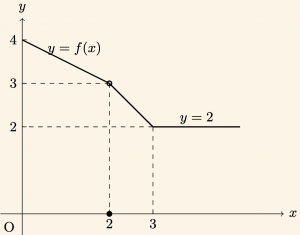
The plot above shows the graph of the function $y = f(x)$. Find the exact output value of $(f \circ f \circ f \circ f)(5)$.
\[
\text{A) } 6 \quad
\text{B) } 5 \quad
\text{C) } 4 \quad
\text{D) } 3 \quad
\text{E) } 2
\]
Solution:
Analyzing the horizontal portion of the graph, we see that for any value $x \geq 3$, the function is constant:
\[
f(5) = 2
\]
Now follow the chain step by step:
\[
(f \circ f \circ f \circ f)(5) = f(f(f(f(5)))) = f(f(f(2)))
\]
From the graph, the point $(2, 0)$ indicates that $f(2) = 0$:
\[
= f(f(0))
\]
The y-intercept is located at $(0, 4)$, indicating that $f(0) = 4$:
\[
= f(4)
\]
Since $4 \geq 3$, it falls back into the constant line region where the output value is 2:
\[
f(4) = 2
\]
\(\textbf{Correct Answer: E} \)
QUESTION 31
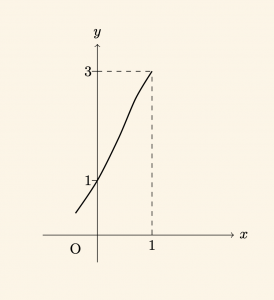
The diagram illustrates the graph of the function $y = f(x)$. If the function values satisfy:
\[
(f \circ f)(2x – 4) = 3
\]
determine the value of $x$.
\[
\text{A) } 0 \quad
\text{B) } 1 \quad
\text{C) } 2 \quad
\text{D) } 3 \quad
\text{E) } 4
\]
Solution:
Write out the nested expression:
\[
f(f(2x – 4)) = 3
\]
Look at the graph to find what input gives a y-value of 3. The coordinate point $(1, 3)$ confirms that $f(1) = 3$. Therefore:
\[
f(2x – 4) = 1
\]
Next, look at the graph to find what input gives a y-value of 1. The coordinate point $(0, 1)$ confirms that $f(0) = 1$. Therefore:
\[
2x – 4 = 0 \Rightarrow 2x = 4 \Rightarrow x = 2
\]
\(\textbf{Correct Answer: C} \)