
Operation
Let $A$ be a non-empty set and $A \subset B$.
Every function
\[
f : A \times A \to B
\]
is called a binary operation, or simply an operation, on $A$.
We generally denote operations with symbols such as $+$, $-$, $\cdot$, $\times$, $\star$, $\Delta$, $\circ$, $\dots$
When an operation
\[
\star : A \times A \to B
\]
is given, each ordered pair $(x, y) \in A \times A$ is mapped to a unique element $z \in B$. We denote this as:
\[
(x, y)\;\to\;x \,\star\,y \;=\;z
\]
Example:

Let us analyze the relation from $A \times A$ to $B$ given by
\[
f(x,y) = x + 2y
\]
where $A = \{1, 2\}$ and $B = \{1, 2, 3, 4\}$.
Evaluating the pairs:
\[
f(1,1) = 1 + 2\cdot1 = 3,\quad
f(1,2) = 1 + 2\cdot2 = 5,\quad
f(2,1) = 2 + 2\cdot1 = 4,\quad
f(2,2) = 2 + 2\cdot2 = 6.
\]
The relation $f$ is not a function from $A \times A$ to $B$ (since the output 5 and 6 are not in the codomain $B$). Therefore, $f$ is not an operation on $A$.
Example:
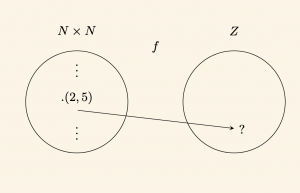
Let us analyze the relation from $\mathbb{N} \times \mathbb{N}$ to $\mathbb{Z}$ defined by:
\[
f(x,y) = \frac{x + y}{3}.
\]
For example,
\[
f(2,5) = \frac{2 + 5}{3} = \frac{7}{3},
\]
which is not an element of $\mathbb{Z}$. Accordingly, the relation $f$ is not a function from $\mathbb{N} \times \mathbb{N}$ to $\mathbb{Z}$. Therefore, $f$ is not an operation on the set of natural numbers.
Example:
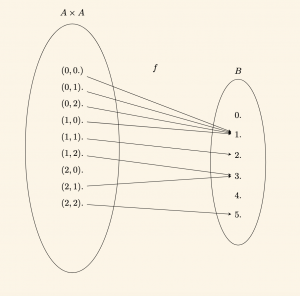
Let $A = \{0, 1, 2\}$ and $B = \{0, 1, 2, 3, 4, 5\}$. Let us analyze the relation from $A \times A$ to $B$ given by:
\[
f(x, y) = x \cdot y + 1
\]
The relation $f$ is a valid function from $A \times A$ to $B$. Therefore, $f$ is an operation on the set $A$.
If we denote this operation with the symbol $\star$, we can write:
\[
x \star y = x \cdot y + 1.
\]
The operation table is as follows:
\[
\begin{array}{c|ccc}
\star & 0 & 1 & 2\\
\hline
0 & 1 & 1 & 1\\
1 & 1 & 2 & 3\\
2 & 1 & 3 & 5
\end{array}
\]
For instance:
\[
2 \star 2 = 2 \cdot 2 + 1 = 5.
\]
Note:
Let the table for the operation \( \star \) defined on set $A$ be as shown below:
\[
\begin{array}{c|cccc}
\star & \dots & b & \dots \to \quad \text{Row Header (Second Component)} \\ \hline
a & & x& \\
\vdots& & & \\
\downarrow \\ \text{Column Header (First Component)}
\end{array}
\]
In the table above, the value $x$ corresponding to the entry $(a, b)$ is read as “$a \star b = x$”.
Example:
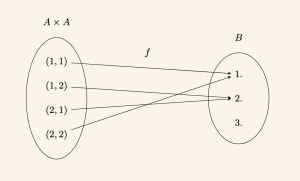 Let $A = \{1, 2\}$ and $B = \{1, 2, 3\}$. Let us analyze the relation defined from $A \times A$ to $B$ by the rule:
\[
f(x,y) = 2^{\,|x – y|}\
\]
Evaluating the combinations:
\[ \Longrightarrow f(1,1) = 2^{|1-1|} = 2^0 = 1, \]
\[f(1,2) = 2^{|1-2|} = 2^1 = 2, \]
\[ f(2,1) = 2^{|2-1|} = 2^1 = 2, \]
\[ f(2,2) = 2^0 = 1. \]
The relation $f$ is a function from $A \times A \to B$. Therefore, it is an operation on $A$.
Let us denote this operation given by the rule $f(x,y) = 2^{\,|x-y|}$ with the symbol $\Delta$. Its operation table is:
\[
x \,\Delta\, y = 2^{\,|x – y|}
\quad\times\quad
\begin{array}{c|cc}
\Delta & 1 & 2 \\
\hline
1 & 1 & 2 \\
2 & 2 & 1
\end{array}
\]
Calculations:
\[
1 \,\Delta\, 1 = 2^{ |1 – 1| } = 2^0 = 1
\]
\[
1 \,\Delta\, 2 = 2^{|1 – 2|} = 2^1 = 2
\]
\[
2 \,\Delta\, 1 = 2^{|2 – 1|} = 2^1 = 2
\]
\[
2 \,\Delta\, 2 = 2^{|2 – 2|} = 2^0 = 1
\]
QUESTION 1
An operation defined on $\mathbb{R}$ is given as $x \star y = x^y + y^x$. What is the result of the expression $(2 \star 3) \star 1$?
\[
\text{A) } 14 \quad
\text{B) } 15 \quad
\text{C) } 16\quad
\text{D) } 17 \quad
\text{E) } 18
\]
Solution:
\[
x \star y = x^y + y^x
\quad\Longrightarrow\quad
2 \star 3 = 2^3 + 3^2 = 8 + 9 = 17
\]
\[
(2 \star 3) \star 1 = 17 \star 1 = 17^1 + 1^{17} = 17 + 1 = 18
\]
\(\textbf{Answer: E} \)
QUESTION 2
An operation defined on $\mathbb{R}$ is given as:
\[
x \,\Delta\, y =
\begin{cases}
x \cdot y, & \text{if } x > y,\\
x + y, & \text{if } x \le y.
\end{cases}
\]
What is the result of the expression $(2 \,\Delta\, 2)\,\Delta\, 5$?
\[
\text{A) } 6 \quad
\text{B) } 7 \quad
\text{C) } 8\quad
\text{D) } 9 \quad
\text{E) } 10
\]
Solution:
Since $x \star y = x + y$ when $x \le y$:
\[
2 \,\Delta\, 2 = 2 + 2 = 4
\]
Applying the rule again since $4 \le 5$:
\[
(2 \,\Delta\, 2)\,\Delta\, 5 = 4 \,\Delta\, 5 = 4 + 5 = 9
\]
\(\textbf{Answer: D} \)
QUESTION 3
The operation $\star$ defined on $\mathbb{R} – \{0\}$ is given by:
\[
\frac{2}{a \star b} \;=\; \frac{2}{a} \;+\; \frac{b}{3}
\]
What is the result of the expression $1 \star 6$?
\[
\text{A) } \frac{1}{2} \quad
\text{B) } 2 \quad
\text{C) } 3\quad
\text{D) } 4 \quad
\text{E) } 5
\]
Solution:
\[
\frac{2}{a \star b}
\;=\;
\frac{2}{a} + \frac{b}{3}
\;\Longrightarrow\;
\frac{2}{\,1 \star 6\,}
=
\frac{2}{1} + \frac{6}{3}
= 2 + 2
= 4
\]
\[ 2 = 4 \cdot ( 1 \star 6 ) \]
\[
\Rightarrow \quad 1 \star 6 = \frac{2}{4} = \frac{1}{2}
\]
\(\textbf{Answer: A} \)
QUESTION 4
The operations $\Delta$ and $\circ$ defined on $\mathbb{R}^+$ are given by:
\[
9^{x \,\Delta\, y} = x^y
\quad\text{and}\quad
x \,\circ\, y = (x \,\Delta\, y) + xy + 1
\]
What is the result of the expression $3 \circ 4$?
\[
\text{A) } 14 \quad
\text{B) } 15 \quad
\text{C) } 16 \quad
\text{D) } 17 \quad
\text{E) } 18
\]
Solution:
\[
x \,\circ\, y = (x \,\Delta\, y) + x\,y + 1
\]
\[3 \circ 4 = (3 \,\Delta\, 4) + 3\cdot4 + 1\]
\[3 \circ 4 = (3 \,\Delta\, 4) + 13
\]
Let us find the value of $3 \,\Delta\, 4$:
\[9^{x \,\Delta\, y }= x^y \quad\Longrightarrow\quad 9^{3 \,\Delta\, 4} = 3^4\]
\[9^{3 \,\Delta\, 4} = 81 = 9^2\]
\[\Rightarrow 3 \,\Delta\, 4 = 2\]
Substituting this value back into the expression:
\[
3 \circ 4 = 2 + 13 = 15
\]
\(\textbf{Answer: B} \)
QUESTION 5
The operation $\star$ defined on $\mathbb{R}$ is given by:
\[
\sqrt[3]{x} \;\star\; \sqrt[3]{y} \;=\; x^2 + y^2
\]
What is the result of the expression $-1 \;\star\; 2$?
\[
\text{A) } 63 \quad
\text{B) } 64 \quad
\text{C) } 65 \quad
\text{D) } 66 \quad
\text{E) } 67
\]
Solution:
We match the terms to the variables:
\[ \sqrt[3]{x} = -1 \;\to\; x = (-1)^3 = -1 \]
\[ \sqrt[3]{y} = 2 \;\to\; y = 2^3 = 8 \]
Now evaluate using the rule:
\[
\sqrt[3]{-1} \;\star\; \sqrt[3]{8}
= (-1) \;\star\; 2
= (-1)^2 + 8^2 = 1 + 64 = 65.
\]
\(\textbf{Answer: C} \)
QUESTION 6
The operation $\star$ defined on $\mathbb{R} – \{0\}$ is given by:
\[
\frac{2}{x} \;\star\; \frac{3}{y} \;=\; x + y
\]
Which of the following represents the operation $x \;\star\; y$?
\[
\text{A) } \frac{2x+ 3y}{xy} \quad
\text{B) } \frac{3x+ y}{xy} \quad
\text{C) } \frac{2x+ y}{xy} \quad
\text{D) } \frac{x+ y}{xy} \quad
\text{E) } \frac{2y+ 3x}{xy}
\]
Solution:
Let us first find the general formula for $a \;\star\; b$:
\[
\frac{2}{x} = a
\;\Rightarrow\;
x = \frac{2}{a},
\quad
\frac{3}{y} = b
\;\Rightarrow\;
y = \frac{3}{b}.
\]
Substitute these into the main expression:
\[
a \;\star\; b = \frac{2}{a} + \frac{3}{b} = \frac{2b + 3a}{ab}
\]
Now, replacing $a$ with $x$ and $b$ with $y$:
\[
x \;\star\; y = \frac{2y + 3x}{\,x\,y}.
\]
\(\textbf{Answer: E} \)
QUESTION 7
The operation $o$ defined on $\mathbb{R}^2$ is given by:
\[
(x, y)\, o\, (z, t) = \bigl(x \cdot z,\; x + y + t + 1\bigr)
\]
If $(m, n) \, o \, (2, 3) = (4, 7)$, what is the value of $m \cdot n$?
\[
\text{A) } 1 \quad
\text{B) } 2 \quad
\text{C) } 3 \quad
\text{D) } 4 \quad
\text{E) } 5
\]
Solution:
Applying the definition:
\[
(m, n)\, o\, (2, 3)
= (\,m \cdot 2,\; m + n + 3 + 1\,)
= (4, 7).
\]
Equating the components:
\[
2m = 4
\quad\Longrightarrow\quad
m = 2,
\]
and
\[
m + n + 4 = 7
\quad\Longrightarrow\quad
2 + n + 4 = 7
\quad\Longrightarrow\quad
n = 1.
\]
Therefore:
\[
m \cdot n = 2 \cdot 1 = 2.
\]
\(\textbf{Answer: B} \)
← Previous Page | Next Page →