
Algebraic Structures
A set together with one or more operations defined on it is called an algebraic structure (or mathematical system).
For instance, the set of integers equipped with addition and multiplication, denoted as
\[
(\mathbb{Z}, +, \cdot)
\]
forms an algebraic structure.
Groups:
Let $A$ be a non-empty set and let $\star$ be a binary operation defined on $A$.
The system $(A, \star)$ is called a group if it satisfies the following four axioms:
1) $A$ is closed under the operation $\star$ (Closure property),
2) The operation $\star$ is associative on $A$ (Associativity property),
3) There exists an identity element in $A$ with respect to $\star$ (Identity element property),
4) Every element in $A$ has an inverse with respect to $\star$ (Inverse element property).
If, additionally, the operation $\star$ satisfies the commutative property for all elements in $A$, then $(A, \star)$ is called an abelian group (or commutative group).
Example:
Let us construct the Cayley table for the addition operation on the cyclic group of residue classes modulo 5, $\mathbb{Z} / 5\mathbb{Z} = \{ 0, \overline{1}, \overline{2}, \overline{3}, \overline{4} \}$.
\[
\begin{array}{c|ccccc}
+ & 0 & \overline{1} & \overline{2} & \overline{3} & \overline{4} \\
\hline
0 & \overline{0} & \overline{1} & \overline{2} & \overline{3} & \overline{4} \\
\overline{1} & \overline{1} & \overline{2} & \overline{3} & \overline{4} & \overline{0} \\
\overline{2} & \overline{2} & \overline{3} & \overline{4} & \overline{0} & \overline{1} \\
\overline{3} & \overline{3} & \overline{4} & \overline{0} & \overline{1} & \overline{2} \\
\overline{4} & \overline{4} & \overline{0} & \overline{1} & \overline{2} & \overline{3} \\
\end{array}
\]
Since the operation $+$ on the set $\mathbb{Z} / 5\mathbb{Z}$ satisfies:
1) Closure,
2) Commutativity,
3) Associativity,
4) Existence of an identity element,
5) Existence of an inverse element for each member,
the algebraic structure $(\mathbb{Z} / 5\mathbb{Z}, +)$ is an abelian group.
Example:
Rotational symmetries of a triangle:
1. The identity transformation (0° rotation)
2. Counterclockwise rotation by 120°
3. Counterclockwise rotation by 240°
Each transformation can be viewed as an element of a symmetry group.
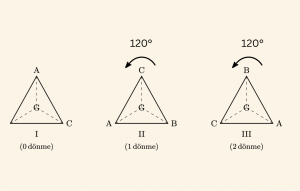
Let $G$ be the centroid of the equilateral triangle $ABC$.
Let $I$ denote the initial state of the triangle $(ABC)$, let $II$ denote its state after a $120^\circ$ rotation about $G$ in the direction of the arrow $(CAB)$, and let $III$ denote the subsequent state after another $120^\circ$ rotation $(BCA)$. Let the binary operation $\star$ represent a $120^\circ$ rotation.
In this context,
\[
II \star III = I
\]
corresponds to the composition of transformations (1 rotation + 2 rotations = 3 rotations $\Rightarrow$ 0 rotations).
Let us construct the operational table on the set $A = \{ I, II, III \}$:
\[
\begin{array}{c|ccc}
\star & I & II & III \\
\hline
I & I & II & III \\
II & II & III & I \\
III & III & I & II \\
\end{array}
\]
Since the operation $\star$ defined on the set $A$ satisfies closure, commutativity, associativity, the identity property, and the inverse property, the system $(A, \star)$ forms an abelian group.
Example:
Let $(A, \circ)$ be a group. Given $a, b, c, x \in A$, let us solve for $x$ in the equation:
\[
a \circ b \circ x = c
\]
Since $(A, \circ)$ is a group, the operation $\circ$ is associative and every element is invertible.
\[
a \circ b \circ x = c \Rightarrow a^{-1} \circ a \circ b \circ x = a^{-1} \circ c
\]
\[
\Rightarrow e \circ b \circ x = a^{-1} \circ c \quad \text{ (where } e \text{ is the identity element)}
\]
\[
\Rightarrow b \circ x = a^{-1} \circ c
\]
\[
\Rightarrow b^{-1} \circ b \circ x = b^{-1} \circ a^{-1} \circ c
\]
\[
\Rightarrow e \circ x = b^{-1} \circ a^{-1} \circ c
\]
\[
\Rightarrow x = b^{-1} \circ a^{-1} \circ c
\]
Thus, the solution is uniquely determined.
Property:
1) If $(A, \star)$ is a group, then for all $x, y \in A$, the socks-and-shoes property holds:
\[
(x \star y)^{-1} = y^{-1} \star x^{-1}
\]
2) In the Latin square property of a group’s Cayley table, every element appears exactly once in each row and exactly once in each column.
Example:
Let
\[
A = \{ 1, 2, 3, 4 \}
\]
and suppose that
\[
(A, \star) \text{ is an abelian group.}
\]
Let us determine the values corresponding to the placeholders $a$, $b$, and $c$.
\[
\begin{array}{c|cccc}
\star & 1 & 2 & 3 & 4 \\
\hline
1 & 2 & 3 & 4 & 1 \\
2 & 3 & a & b & 2 \\
3 & 4 & 1 & 2 & 3 \\
4 & 1 & 2 & 3 & c \\
\end{array}
\]
Since $(A, \star)$ is an abelian group, each element must appear exactly once in each row and column. Analyzing the second and third columns yields:
\[
a = 4, \quad b = 1
\]
Furthermore, the element 4 is missing from the fourth row (and fourth column). Thus, we conclude:
\[
c = 4
\]
Rings:
Let $A$ be a non-empty set equipped with two binary operations, denoted by $\Delta$ and $\star$.
The structure $(A, \Delta, \star)$ is called a ring if it satisfies the following conditions:
1) $(A, \Delta)$ is an abelian group,
2) $A$ is closed under the operation $\star$,
3) The operation $\star$ is associative on $A$,
4) The operation $\star$ distributes over $\Delta$ (both left and right distributivity).
If the operation $\star$ possesses a multiplicative identity element, then $(A, \Delta, \star)$ is referred to as a ring with unity (or a unitary ring).
Fields:
Let $A$ be a non-empty set equipped with two binary operations, $\Delta$ and $\star$.
The algebraic structure $(A, \Delta, \star)$ is called a field if:
1) $(A, \Delta, \star)$ is a commutative ring with unity,
2) The algebraic structure $(A – \{0\}, \star)$ forms an abelian group, where $0$ is the identity element of the operation $\Delta$.
Example:
Let us construct the operational matrices for addition ” + ” and multiplication ” $\cdot$ ” on the field of residue classes modulo 5, $\mathbb{Z} / 5\mathbb{Z} = \{ \overline{0}, \overline{1}, \overline{2}, \overline{3}, \overline{4} \}$.
\[
\begin{array}{c|ccccc}
+ & \overline{0} & \overline{1} & \overline{2} & \overline{3} & \overline{4} \\
\hline
\overline{0} & \overline{0} & \overline{1} & \overline{2} & \overline{3} & \overline{4} \\
\overline{1} & \overline{1} & \overline{2} & \overline{3} & \overline{4} & \overline{0} \\
\overline{2} & \overline{2} & \overline{3} & \overline{4} & \overline{0} & \overline{1} \\
\overline{3} & \overline{3} & \overline{4} & \overline{0} & \overline{1} & \overline{2} \\
\overline{4} & \overline{4} & \overline{0} & \overline{1} & \overline{2} & \overline{3} \\
\end{array}
\]
\[
\begin{array}{c|ccccc}
\cdot & \overline{0} & \overline{1} & \overline{2} & \overline{3} & \overline{4} \\
\hline
\overline{0} & \overline{0} & \overline{0} & \overline{0} & \overline{0} & \overline{0} \\
\overline{1} & \overline{0} & \overline{1} & \overline{2} & \overline{3} & \overline{4} \\
\overline{2} & \overline{0} & \overline{2} & \overline{4} & \overline{1} & \overline{3} \\
\overline{3} & \overline{0} & \overline{3} & \overline{1} & \overline{4} & \overline{2} \\
\overline{4} & \overline{0} & \overline{4} & \overline{3} & \overline{2} & \overline{1} \\
\end{array}
\]
The structure $(\mathbb{Z} / 5\mathbb{Z}, +)$ is an abelian group,
the set $A$ is closed under the multiplication operation ” $\cdot$ “,
the multiplication operation ” $\cdot$ ” is associative on $A$,
the multiplication operation ” $\cdot$ ” distributes over addition ” + “,
there exists a multiplicative identity element in $A$.
Hence, the structure $(A, +, \cdot)$ is a ring with unity.
Moreover, because \( (\mathbb{Z} / 5\mathbb{Z} – \{\overline{0}\}, \cdot) \) constitutes an abelian group under multiplication, the structure $(A, +, \cdot)$ forms a field.
← Previous Page | Next Page →