
Intersection and Relative Positions of Two Parabolas
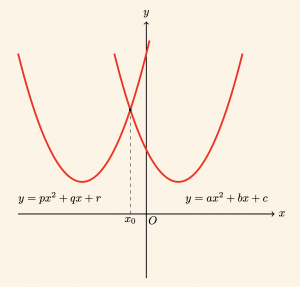
To analyze the relative position of two parabolas given by the equations \( y = ax^2 + bx + c \) and \( y = px^2 + qx + r \), we solve their equations simultaneously.
1) If \( a = p \) and \( b \ne q \),
The two parabolas intersect at exactly one point.
\[
\left.
\begin{aligned}
y &= ax^2 + bx + c \\
y &= px^2 + qx + r
\end{aligned}
\right\}\]
\[\Rightarrow ax^2 + bx + c = px^2 + qx + r \]
\[\Rightarrow bx + c = qx + r\]
The solution to this resulting linear equation gives the x-coordinate (abscissa) of the single point of intersection.
Example:
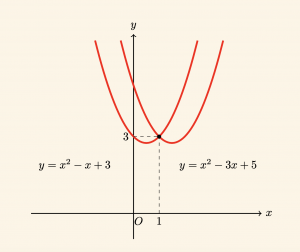
Let us analyze the relative position of the parabolas \( y = x^2 – x + 3 \) and \( y = x^2 – 3x + 5 \).
\[
\left.
\begin{aligned}
y &= x^2 – x + 3 \\
y &= x^2 – 3x + 5
\end{aligned}
\right\}
\Rightarrow x^2 – x + 3 = x^2 – 3x + 5 \]
\[\Rightarrow x = 1 \]
Since the leading coefficients are identical but the linear coefficients differ, the parabolas intersect at exactly one point. Let us find the y-coordinate of this intersection point by evaluating either function at \( x = 1 \):
\[ \text{For } x = 1 \text{ in } y = x^2 – x + 3 \Rightarrow y = 1^2 – 1 + 3 = 3. \]
Thus, the intersection point is \( (1, 3) \).
2) If \( \quad a \ne p \),
There are three possible geometric relationships between the two parabolas. The analytical approach to determine these cases is identical to the method used for analyzing the intersection of a parabola and a line.
Example:
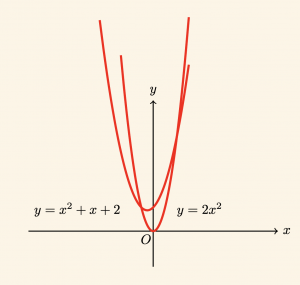
Let us analyze the relative position of the parabolas \( y = 2x^2 \) and \( y = x^2 + x + 2 \).
\[
\left.
\begin{aligned}
y &= 2x^2 \\
y &= x^2 + x + 2
\end{aligned}
\right\}
\Rightarrow 2x^2 = x^2 + x + 2 \]
\[\Rightarrow x^2 – x – 2 = 0 \]
\[ \Rightarrow x_1 = -1 \quad \text{ or } \quad x_2 = 2 \]
Since the quadratic equation yields two distinct real solutions, the parabolas intersect at two distinct points. Let us find the corresponding y-coordinates:
\[ \text{Substituting into } y = 2x^2: \]
\[\text{For } x_1 = -1 \quad \Rightarrow \quad y_1 = 2 \]
\[ \text{For } x_2 = 2 \quad \Rightarrow \quad y_2 = 8 \]
The intersection points are \( (-1, 2) \) and \( (2, 8) \).
Example:
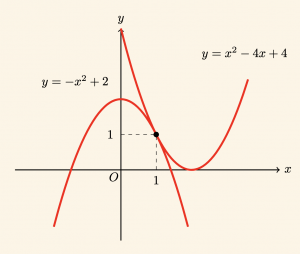
Let us analyze the relative position of the parabolas \( y = x^2 – 4x + 4 \) and \( y = -x^2 + 2 \).
\[
\left.
\begin{aligned}
y &= x^2 – 4x + 4 \\
y &= -x^2 + 2
\end{aligned}
\right \}
\Rightarrow x^2 – 4x + 4 = -x^2 + 2 \]
\[ \Rightarrow 2x^2 – 4x + 2 = 0 \]
\[ \Rightarrow x_1 = x_2 = 1 \]
Since the system yields a double root, the two parabolas are tangent to each other. Let us determine the y-coordinate of the point of tangency:
\[ \text{For } x = 1 \text{ in } y = -x^2 + 2 \Rightarrow y = -(1)^2 + 2 = 1. \]
The point of tangency is \( (1, 1) \).
Example:
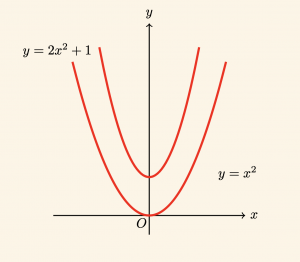
Let us analyze the relative position of the parabolas \( y = 2x^2 + 1 \) and \( y = x^2 \).
\[
\left.
\begin{aligned}
y &= 2x^2 + 1 \\
y &= x^2
\end{aligned}
\right\}
\Rightarrow 2x^2 + 1 = x^2 \]
\[\Rightarrow x^2 + 1 = 0\]
\[\Rightarrow \Delta < 0 \]
Since the resulting equation has a negative discriminant, it has no real roots. Therefore, the parabolas have no points of intersection.
QUESTION 15
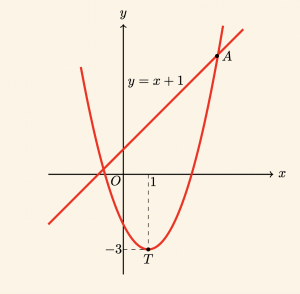
In the figure above, \( T \) represents the vertex of the parabola. What is the x-coordinate (abscissa) of point A?
\[
\text{A)} 7 \quad
\text{B) } 6 \quad
\text{C) } 5 \quad
\text{D) } 4 \quad
\text{E) } 3
\]
Solution:
First, find the x-intercept of the line \( y = x + 1 \) by setting \( y = 0 \):
\[
y = 0 = x + 1 \Rightarrow x_1 = -1
\]
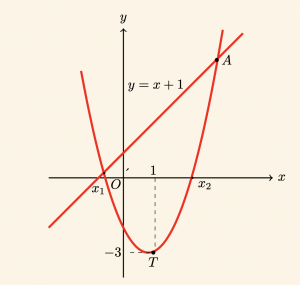
Since the line and the parabola share this x-intercept, \( x_1 = -1 \) is also an x-intercept of the parabola. Using the axis of symmetry formula for the vertex \( r = 1 \):
\[
r = \frac{x_1 + x_2}{2} \Rightarrow 1 = \frac{-1 + x_2}{2} \Rightarrow x_2 = 3
\]
Now, we can write the equation of the parabola in factored form:
\[ y = a(x – x_1)(x – x_2) \]
\[ y = a(x + 1)(x – 3) \]
To find the leading coefficient \( a \), substitute the y-intercept \( (0, -3) \):
\[
\text{For } x = 0: \quad y = -3 = a(0 + 1)(0 – 3) \Rightarrow a = 1
\]
Thus, the equation of the parabola is:
\[ y = (x + 1)(x – 3) = x^2 – 2x – 3 \]
Next, solve the system containing the line and the parabola to find their intersection points:
\[
\left.
\begin{aligned}
y &= x^2 – 2x – 3 \\
y &= x + 1
\end{aligned}
\right\}
\Rightarrow x^2 \;-\; 2x\; -\; 3 = x + 1 \]
\[\Rightarrow x^2 – 3x – 4 = 0 \Rightarrow x = -1 \text{ or } x = 4
\]
Point A is the intersection point with the positive x-coordinate, so the x-coordinate of point A is 4.
\(\textbf{Correct Answer: D} \)
QUESTION 16
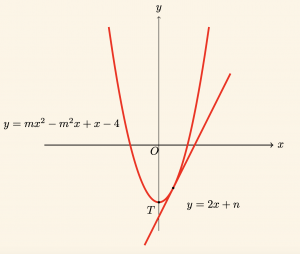
In the figure below, the line \( y = 2x + n \) is tangent to the parabola \( y = mx^2 – m^2x + x – 4m \), whose vertex lies on the y-axis.
Based on this information, what is the value of \( n \)?
\[
\text{A)} -5 \quad
\text{B) } -6 \quad
\text{C) } -7 \quad
\text{D) } -8 \quad
\text{E) } -9
\]
Solution:
Let us rewrite the equation of the parabola by grouping the terms:
\[
y = mx^2 – m^2x + x – 4m \Rightarrow y = mx^2 + (1 – m^2)x – 4m
\]
Since the vertex of the parabola lies on the y-axis, the coefficient of the linear term must be zero (\( b = 0 \)):
\[
1 – m^2 = 0 \Rightarrow m = -1 \text{ or } m = 1
\]
The graph shows that the parabola opens upwards, which means the leading coefficient must be positive (\( m > 0 \)). Therefore, \( m = 1 \), and the equation simplifies to:
\[ y = x^2 – 4 \]
Now, we set the equations of the parabola and the line equal to each other to analyze their intersection:
\[
\left.
\begin{aligned}
y &= x^2 – 4 \\
y &= 2x + n
\end{aligned}
\right\}
\Rightarrow x^2 – 4 = 2x + n \]
\[\Rightarrow x^2 – 2x – 4 – n = 0
\]
Since the line is tangent to the parabola, this quadratic equation must have exactly one real solution, meaning its discriminant must be zero (\( \Delta = 0 \)):
\[ \Delta = (-2)^2 – 4 \cdot 1 \cdot (-4 – n) = 0 \]
\[ \Rightarrow 4 + 16 + 4n = 0 \]
\[ \Rightarrow 4n = -20 \Rightarrow n = -5 \]
\(\textbf{Correct Answer: A} \)
QUESTION 17
What is the y-coordinate (ordinate) of the point on the parabola \( y = -x^2 – x + 2 \) that is closest to the line \( y = -2x + 3 \)?
\[
\text{A)} \frac{3}{4} \quad
\text{B) } 1 \quad
\text{C) } \frac{5}{4} \quad
\text{D) } \frac{3}{2} \quad
\text{E) } \frac{7}{4}
\]
Solution:
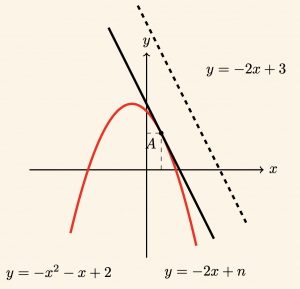
Let point A on the parabola be the closest point to the line \( y = -2x + 3 \). The tangent line to the parabola at point A must be parallel to the given line, so they share the same slope (\( m = -2 \)). Thus, the equation of this tangent line can be written as \( y = -2x + n \).
Solving the parabola and this tangent line simultaneously:
\[
\left.
\begin{aligned}
y &= -x^2 – x + 2 \\
y &= -2x + n
\end{aligned}
\right\}
\Rightarrow -x^2 – x + 2 = -2x + n \]
\[ \Rightarrow x^2 – x + n – 2 = 0 \]
Because the line is tangent to the parabola, the quadratic equation must yield a double root (\( \Delta = 0 \)). The x-coordinate of this point of tangency is given by:
\[
x_1 = x_2 = \frac{-b}{2a} = \frac{-(-1)}{2(1)} = \frac{1}{2}
\]
This gives the x-coordinate of point A. To find its corresponding y-coordinate, substitute \( x = \frac{1}{2} \) back into the equation of the parabola:
\[
y = -\left(\frac{1}{2}\right)^2 – \frac{1}{2} + 2 = -\frac{1}{4} – \frac{2}{4} + \frac{8}{4} = \frac{5}{4}
\]
\(\textbf{Correct Answer: C} \)
QUESTION 18
If the parabolas \( y = 2x^2 + 6x + m \) and \( y = x^2 + 2x – m \) are tangent to each other, what is the sum of \( m \) and the x-coordinate of their point of tangency?
\[
\text{A)} -3 \quad
\text{B) } -2 \quad
\text{C) }-1\quad
\text{D) } 0 \quad
\text{E) } 1
\]
Solution:
Let us solve the equations of the two parabolas simultaneously:
\[
\left.
\begin{aligned}
y &= 2x^2 + 6x + m \\
y &= x^2 + 2x – m
\end{aligned}
\right\}
\Rightarrow 2x^2 + 6x + m = x^2 + 2x – m\]
\[\Rightarrow x^2 + 4x + 2m = 0 \]
Since the two parabolas are tangent to each other, this intersection equation must have exactly one real solution, which requires its discriminant to equal zero (\( \Delta = 0 \)):
\[
\Delta = 4^2 – 4 \cdot 1 \cdot 2m = 0 \Rightarrow 16 – 8m = 0 \Rightarrow m = 2
\]
Substituting \( m = 2 \) back into the intersection equation to find the x-coordinate of the point of tangency:
\[
x^2 + 4x + 2(2) = 0 \Rightarrow x^2 + 4x + 4 = 0 \]
\[\Rightarrow (x + 2)^2 = 0 \Rightarrow x = -2
\]
Thus, the x-coordinate of the point of tangency is \( -2 \).
The sum of the x-coordinate and \( m \) is:
\[ -2 + 2 = 0 \]
\(\textbf{Correct Answer: D} \)
QUESTION 19
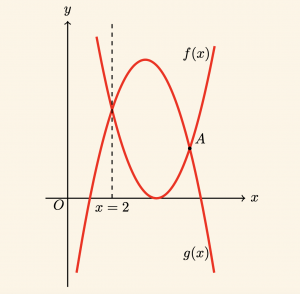
The figure above shows the parabolas \( f(x) = mx^2 – 8x + 8m + 8 \) and \( g(x) = -x^2 + (3m + 4)x – 5m – 1 \). What is the x-coordinate of point A?
\[
\text{A)} \frac{11}{2} \quad
\text{B) } 6 \quad
\text{C) } \frac{13}{2} \quad
\text{D) } 7 \quad
\text{E) } 8
\]
Solution:
The graphs show that the two parabolas intersect on the vertical line \( x = 2 \), meaning that \( f(2) = g(2) \). Let us evaluate both functions at \( x = 2 \):
\[
\left.
\begin{aligned}
f(2) &= m(2)^2 – 8(2) + 8m + 8 = 12m – 8 \\
g(2) &= -(2)^2 + (3m + 4)(2) – 5m – 1 = m + 3
\end{aligned}
\right \}
\]
Equating the two expressions:
\[ 12m – 8 = m + 3 \Rightarrow 11m = 11 \Rightarrow m = 1 \]
Substitute \( m = 1 \) back into the original functions to obtain their specific equations:
\[\left.
\begin{aligned}
f(x) &= x^2 – 8x + 16 \\
g(x) &= -x^2 + 7x – 6
\end{aligned}
\right \}
\]
To find all intersection points, set \( f(x) = g(x) \):
\[ x^2 – 8x + 16 = -x^2 + 7x – 6 \Rightarrow 2x^2 – 15x + 22 = 0 \]
Factoring or using the quadratic formula yields:
\[ (2x – 11)(x – 2) = 0 \Rightarrow x = 2 \quad \text{ or } \quad x = \frac{11}{2} \]
Since \( x = 2 \) corresponds to the first intersection point shown on the y-axis region, the x-coordinate of point A must be \( \frac{11}{2} \).
\(\textbf{Correct Answer: A} \)
QUESTION 20
Consider the family of parabolas defined for varying values of \( m \):
\[
f(x) = (m + 1)x^2 + (m + 2)x – 2m + 1 \]
and
\[ g(x) = mx^2 + 3mx – m^2
\]
Which of the following statements correctly describes the geometric relationship between any pair of functions \( f(x) \) and \( g(x) \)?
\[
\begin{aligned}
&\text{A)} \text{They intersect at two distinct points.} \quad \\
&\text{B) } \text{They are tangent to each other.} \quad \\
&\text{C) } \text{They intersect at exactly one point.} \\
&\text{D) } \text{They have no common points.} \\
&\text{E) } \text{They are completely identical (coincident).} \\
&\end{aligned}
\]
Solution:
Let us find the intersection equation by setting \( f(x) = g(x) \):
\[
(m + 1)x^2 + (m + 2)x – 2m + 1 = mx^2 + 3mx – m^2
\]
Grouping the terms to form a standard quadratic equation:
\[ x^2 + (m + 2 – 3m)x + m^2 – 2m + 1 = 0 \]
\[ x^2 + (2 – 2m)x + (m^2 – 2m + 1) = 0 \]
To determine the number of intersection points, evaluate the discriminant (\( \Delta \)) of this equation:
\[ \Delta = b^2 – 4ac \]
\[ \Delta = (2 – 2m)^2 – 4 \cdot 1 \cdot (m^2 – 2m + 1) \]
\[ \Delta = (4 – 8m + 4m^2) – (4m^2 – 8m + 4) = 0 \]
Since the discriminant is identically zero for any valid value of \( m \), the equation always has a single real double root. Therefore, the parabolas are always tangent to each other.
\(\textbf{Correct Answer: B} \)
QUESTION 21
As the parameter \( m \) varies, the family of parabolas defined by
\[
y = x^2 + (2m + 4)x + 2m + 5
\]
always passes through a fixed, constant point. What is the x-coordinate of this point?
\[
\text{A)} 2 \quad
\text{B) } 1 \quad
\text{C) } 0 \quad
\text{D) } -1 \quad
\text{E) } -2
\]
Solution:
An elegant way to find this fixed point is to choose two different values for the parameter \( m \) and find the intersection point of the resulting distinct parabolas.
\[
y = x^2 + (2m + 4)x + 2m + 5
\]
Let us choose \( m = 1 \) and \( m = 2 \):
\[
\begin{aligned}
\text{For } m = 1 &\Rightarrow y = x^2 + 6x + 7 \\
\text{For } m = 2 &\Rightarrow y = x^2 + 8x + 9
\end{aligned}
\]
Now, solve these two equations simultaneously by setting them equal to each other:
\[
x^2 + 6x + 7 = x^2 + 8x + 9
\]
\[
6x + 7 = 8x + 9 \Rightarrow 2x = -2 \Rightarrow x = -1
\]
Alternatively, rearranging the original equation by grouping the terms containing \( m \) yields \( y = x^2 + 4x + 5 + m(2x + 2) \). For this equation to hold true independently of \( m \), the coefficient of \( m \) must be zero: \( 2x + 2 = 0 \Rightarrow x = -1 \).
\(\textbf{Correct Answer: D} \)
← Previous Page | Next Page →