
Comparing the Roots of a Quadratic Equation to a Real Number
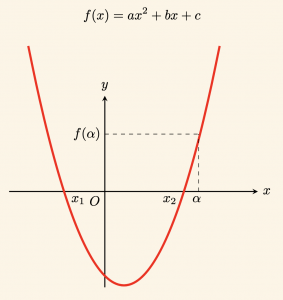
By utilizing the graph (parabola) of the quadratic function \(f(x) = ax^2 + bx + c\), we can compare the roots \(x_1\) and \(x_2\) of the quadratic equation \(ax^2 + bx + c = 0\) with a given real number \(\alpha\).
\(1. \quad \alpha \) lies between the roots
For \(a > 0\), if \(\alpha\) satisfies \(x_1 < \alpha < x_2\), then \(f(\alpha) < 0\). This yields the inequality:
\[ a \cdot f(\alpha) < 0\]
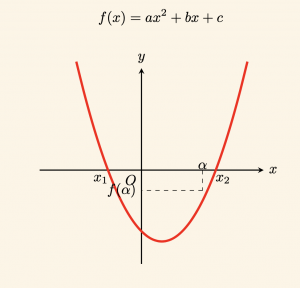
Warning:
For any quadratic equation \(f(x) = ax^2 + bx + c = 0\), if \(a \cdot f(\alpha) < 0\), then it is strictly guaranteed that \(\Delta > 0\).
Example:
Let \(x_1\) and \(x_2\) be the roots of the equation \(f(x) = (m – 1)x^2 + (1 – 3m)x + m + 2 = 0\).
If \(x_1 < 2 < x_2\), determine the valid interval for \(m\).
For \(x_1 < 2 < x_2\), since \(\alpha = 2\) and the leading coefficient is \(a = m – 1\), the condition \(a \cdot f(2) < 0\) must be satisfied:
\[ (m – 1) \cdot f(2) < 0 \]
\[
\Rightarrow (m – 1) \cdot \left[ (m – 1) \cdot 2^2 + (1 – 3m) \cdot 2 + m + 2 \right] < 0
\]
\[
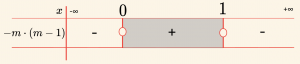
\Rightarrow (m – 1) \cdot (-m) < 0
\]
\[
\text{The solution set is } S = \{ m \mid m < 0 \text{ or } m > 1,\ m \in \mathbb{R} \}.
\]
QUESTION 30
Let \(x_1\) and \(x_2\) be the roots of the equation \(f(x) = (m -\; 1)x^2 – (m^2 + 1)x + 2m^2 -\; 6m + 6 = 0\). If \(x_1 < 1 < x_2\), which of the following statements regarding \(m\) is correct?
\[ \text{A) } 4 < m < 5 \quad
\text{B) } -1 < m < 5 \quad
\text{C) }1 < m < 6 \quad
\text{D) } m > 4 \quad
\text{E) } 1 < m < 4 \]
Solution:
Here, the leading coefficient is \(a = m – 1\) and our benchmark value is \(\alpha = 1\).
\[x_1 < 1 < x_2 \Rightarrow (m – 1) \cdot f(1) < 0\]
\[
\Rightarrow (m – 1) \cdot \left[(m – 1) \cdot 1^2 – (m^2 + 1) \cdot 1 + 2m^2 – 6m + 6\right] < 0
\]
\[
\Rightarrow (m – 1) \cdot \left[m – 1 – m^2 – 1 + 2m^2 – 6m + 6 \right] < 0
\]
\[
\Rightarrow (m – 1) \cdot (m^2 – 5m + 4) < 0
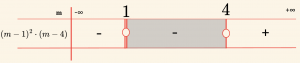
\Rightarrow (m – 1)^2 \cdot (m – 4) < 0
\]
\[
\text{The solution set is } S = \{ m \mid m < 1 \text{ or } 1 < m < 4,\ m \in \mathbb{R} \}.
\]
\(\textbf{Correct Answer: E} \)
\(2. \quad \alpha \) lies outside the roots
For \(a > 0\), if \(\alpha\) satisfies \(\alpha < x_1 < x_2\), then \(f(\alpha) > 0\).
This requires \(a \cdot f(\alpha) > 0\). Therefore, we can establish the following system of inequalities:
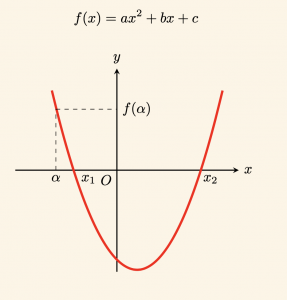
\[
\alpha < x_1 < x_2 \\ \Leftrightarrow
\left\{
\begin{aligned}
\quad &\Delta > 0\\
\quad &a \cdot f(\alpha) > 0 \\
\quad &r = -\frac{b}{2a} > \alpha
\end{aligned}
\right. \\
\]
Similarly, for \(a > 0\), if \(x_1 < x_2 < \alpha\), then \(f(\alpha) > 0\), which again yields \(a \cdot f(\alpha) > 0\). Therefore:
\[
x_1 < x_2 < \alpha \\ \Leftrightarrow
\left\{
\begin{aligned}
\quad &\Delta > 0\\
\quad &a \cdot f(\alpha) > 0 \\
\quad &r = -\frac{b}{2a} < \alpha
\end{aligned}
\right. \\
\]
Example:
Let \(x_1\) and \(x_2\) be the roots of the equation \(f(x) = mx^2 + (2m – 3)x + m – \;3 = 0\). If \(x_1 < x_2 < 1\), find the valid interval for \(m\).
For \(x_1 < x_2 < 1\) to hold, we require:
\[
\Delta = (2m – 3)^2 – 4m \cdot (m – 3) = 9 > 0
\]
Given \(a = m\) and \(\alpha = 1\), we evaluate:
\[
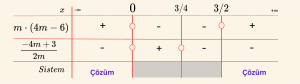
m \cdot f(1) > 0 \Rightarrow m \cdot [m + (2m – 3) + (m – 3)] > 0 \Rightarrow m(4m – 6) > 0
\]
and the axis of symmetry condition:
\[
r = \frac{-b}{2a} = \frac{-(2m – 3)}{2m} < 1 \Rightarrow \frac{-4m + 3}{2m} < 0
\]
\[
\text{The solution set is } S = \{ m \mid m < 0 \text{ or } m > \frac{3}{2},\ m \in \mathbb{R} \}.
\]
Example:
Let \(x_1\) and \(x_2\) be the roots of the equation \(f(x) = -x^2 + mx -\; 4 = 0\). If \(2 < x_1 < x_2\), find the valid interval for \(m\).
For \(2 < x_1 < x_2\) to hold, we require:
\[
\Delta = m^2 – \;4 \cdot (-1) \cdot (-4) = m^2 – \;16 > 0
\]
Given \(a = -1\) and \(\alpha = 2\), we evaluate:
\[
-1 \cdot f(2) > 0 \Rightarrow -1 \cdot (-2^2 + 2m – \;4) > 0 \Rightarrow -2m + 8 > 0
\]
and the axis of symmetry condition:
\[
r = \frac{-b}{2a} = \frac{-m}{-2} = \frac{m}{2} > 2 \Rightarrow m > 4.
\]
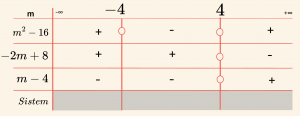
\[ S = \emptyset \]
QUESTION 31
Let \(x_1\) and \(x_2\) be the roots of the equation \(x^2 + mx -\; m – 1 = 0\). If \(x_1 < -1 < x_2 < 2\), which of the following statements regarding \(m\) is correct?
\[ \text{A) } m < -4 \quad
\text{B) } -5 < m < -4 \quad
\text{C) } -4 < m < -3 \quad
\text{D) } -3 < m < 0 \quad
\text{E) } m > 0 \]
Solution:
\[f(x) = x^2 + mx – \;m -\; 1\]
Here, \(a = 1\), \(\alpha_1 = -1\), and \(\alpha_2 = 2\).
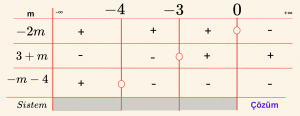
From \(x_1 < -1 < x_2\), we have: \(f(-1) < 0 \Rightarrow 1 \cdot f(-1) < 0 \Rightarrow -2m < 0\)
From \(x_1 < x_2 < 2\), we have: \(f(2) > 0 \Rightarrow 1 \cdot f(2) > 0 \Rightarrow 3 + m > 0\)
Evaluating the position of the vertex relative to the upper bound:
\[
r = \frac{-m}{2 \cdot 1} < 2 \Rightarrow -m – 4 < 0
\]
\[
\text{The solution set is } S = \{ m \mid m > 0,\ m \in \mathbb{R} \}.
\]
\(\textbf{Correct Answer: E} \)
QUESTION 32
Let \(x_1\) and \(x_2\) be the roots of the equation \(-76x^2 + 19x + 263 = 0\). Which of the following statements is true?
\[\begin{aligned} \text{A) } x_1 <& 2 < x_2 \quad
\text{B) } x_1 < x_2 < 2 \quad
\text{C) } 2 < x_1 < x_2 \quad \\ \\ \text{D) } &x_1 = x_2 = 2 \quad
\text{E) } x_1 = x_2 < 2 \end{aligned}\]
Solution:
Let us compare the number 2 with the roots of the equation \(f(x) = -76x^2 + 19x + 263 = 0\).
Given \(a = -76\) and \(\alpha = 2\):
\[
-76 \cdot f(2) = -76 \cdot \left[ -76 \cdot 2^2 + 19 \cdot 2 + 263 \right] = -76 \cdot (-3) > 0
\]
Since the product is positive, the number 2 lies outside the roots.
Checking the position of the vertex:
\[
r = \frac{-b}{2a} = \frac{-19}{2 \cdot (-76)} = \frac{1}{8} < 2 \Rightarrow x_1 < x_2 < 2
\]
\(\textbf{Correct Answer: B} \)
QUESTION 33
Given that \(m < 0 < n\), let \(x_1\) and \(x_2\) be the roots of the equation \(-x^2 + mx + n^2 = 0\). Which of the following ordering is correct?
\[
\begin{aligned}
\text{A) }m < n < x_1 < x_2 \\
\text{B) } x_1 < m < n < x_2 \\
\text{C) } x_1 < x_2 < m < n \\
\text{D) } x_1 < m < x_2 < n \\
\text{E) } m < x_1 < n < x_2
\end{aligned}
\]
Solution:
We compare the constants \(m\) and \(n\) to the roots of the function \(f(x) = -x^2 + mx + n^2 = 0\).
Here, \(a = -1\), \(\alpha_1 = m\), and \(\alpha_2 = n\).
Evaluating at \(x = m\):
\[
-1 \cdot f(m) = -(-m^2 + m \cdot m + n^2) = -n^2 < 0 \Rightarrow m \text{ lies between the roots.}
\]
Evaluating at \(x = n\):
\[
-1 \cdot f(n) = -(-n^2 + m \cdot n + n^2) = -m \cdot n > 0 \Rightarrow n \text{ lies outside the roots.}
\]
Since \(m\) is inside the roots and \(n\) is outside to the right of the larger root, we establish that:
\[ \text{Therefore, } \;\; x_1 < m < x_2 < n. \]
\(\textbf{Correct Answer: D} \)
← Previous Page | Next Page →