
Trigonometric Ratios of Angles Greater Than 90° \( ( \pi/2 \text{ Radians}) \)
Trigonometric Reductions:
Let $\theta$ be an angle greater than $90^\circ$. To find any trigonometric ratio of $\theta$, we express this angle as the sum or difference of a reference acute angle $\alpha$ and one of the quadrantal boundaries ($0^\circ$, $90^\circ$, $180^\circ$, $270^\circ$, or $360^\circ$). Treating $\alpha$ as an acute angle, the reduction format can be written as:
\[(0° − \alpha , \quad 90° + \alpha, \quad 180° \pm \alpha , \quad 270° \pm \alpha , \quad 360° − \alpha ) \]
First, determine the arithmetic sign ($+$ or $-$) of the requested trigonometric function based on the quadrant where the angle $\theta$ resides. Then, apply the following two core rules to simplify the expression in terms of the acute angle $\alpha$:
1) If the angle $\theta$ is expressed in terms of horizontal axes—namely $(0^\circ − \alpha)$, $(180^\circ \pm \alpha)$, or $(360^\circ − \alpha)$—the trigonometric function name remains unchanged.
2) If the angle $\theta$ is expressed in terms of vertical axes—namely $(90^\circ \pm \alpha)$ or $(270^\circ \pm \alpha)$—the trigonometric function converts to its corresponding co-function ($\sin \leftrightarrow \cos$, $\tan \leftrightarrow \cot$, $\sec \leftrightarrow \csc$).
Example:
Find the exact value of $\cos 240^\circ$.
If we write the angle relative to the vertical axis as $240^\circ = 270^\circ – 30^\circ$:
An angle of $240^\circ$ lies in Quadrant III, where the cosine function is strictly negative ($\cos(270^\circ – 30^\circ) < 0$).
Because we used the $270^\circ$ axis boundary, the function changes to its co-function ($\cos \rightarrow \sin$):
\[
\cos 240^\circ = \cos(270^\circ – 30^\circ) = -\sin 30^\circ = -\frac{1}{2}
\]
Example:
Find the simplified equivalent of $\cos(2\pi – \alpha)$.
Assuming $\alpha$ is a positive acute angle, the given angle falls directly into Quadrant IV:
\[
\frac{3\pi}{2} < 2\pi – \alpha < 2\pi
\]
In Quadrant IV, the cosine function is positive ($\cos(2\pi- \alpha) > 0$). Since the boundary is an integer multiple of $\pi$ on the horizontal axis ($2\pi$), the function name remains unchanged:
\[
\cos(2\pi – \alpha) = \cos \alpha
\]
Further Examples:
* $\sin 135^\circ = \sin(90^\circ + 45^\circ) = \cos 45^\circ = \displaystyle\frac{\sqrt{2}}{2}$
* $\tan \displaystyle \frac{7\pi}{4} = \tan\left(\displaystyle\frac{3\pi}{2} + \displaystyle\frac{\pi}{4}\right) = -\cot \displaystyle\frac{\pi}{4} = -1$
* $\cot \displaystyle \frac{11\pi}{6} = \cot\left(2\pi – \displaystyle\frac{\pi}{6}\right) = -\cot \displaystyle\frac{\pi}{6} = -\sqrt{3}$
* $\sec(\pi – \alpha) = -\sec \alpha$
* $\csc\left(\frac{\pi}{2} + \alpha\right) = \sec \alpha$
* $\tan(19\pi + \alpha) = \tan(18\pi + \pi + \alpha) = \tan(\pi + \alpha) = \tan \alpha$
* $\cos(1996\pi – \alpha) = \cos(0 – \alpha) = \cos \alpha$
\[
\begin{array}{| l | r | }
\hline
\sin\left(\frac{\pi}{2} – \theta\right) = \cos \theta \quad \quad \quad & \sin\left(\frac{\pi}{2} + \theta\right) = \cos \theta \\
\hline
\cos\left(\frac{\pi}{2} – \theta\right) = \sin \theta \quad & \cos\left(\frac{\pi}{2} + \theta\right) = -\sin \theta \\
\hline
\tan\left(\frac{\pi}{2} – \theta\right) = \cot \theta \quad & \tan\left(\frac{\pi}{2} + \theta\right) = -\cot \theta \\
\hline
\cot\left(\frac{\pi}{2} – \theta\right) = \tan \theta \quad & \cot\left(\frac{\pi}{2} + \theta\right) = -\tan \theta \\
\hline
\end{array}
\]
\[
\begin{array}{| l | r | }
\hline
\sin(\pi – \theta) = \sin \theta \quad \quad \quad & \sin(\pi + \theta) = -\sin \theta \\
\hline
\cos(\pi – \theta) = -\cos \theta\quad \quad \quad & \cos(\pi + \theta) = -\cos \theta \\
\hline
\tan(\pi – \theta) = -\tan \theta \quad \quad \quad & \tan(\pi + \theta) = \tan \theta \\
\hline
\cot(\pi – \theta) = -\cot \theta \quad \quad \quad & \cot(\pi + \theta) = \cot \theta \\
\hline
\end{array}
\]
\[
\begin{array}{| l | r | }
\hline
\sin\left(\frac{3\pi}{2} – \theta\right) = -\cos \theta \quad \quad & \sin\left(\frac{3\pi}{2} + \theta\right) = -\cos \theta \\
\hline
\cos\left(\frac{3\pi}{2} – \theta\right) = -\sin \theta \quad \quad & \cos\left(\frac{3\pi}{2} + \theta\right) = \sin \theta \\
\hline
\tan\left(\frac{3\pi}{2} – \theta\right) = \cot \theta \quad \quad & \tan\left(\frac{3\pi}{2} + \theta\right) = -\cot \theta \\
\hline
\cot\left(\frac{3\pi}{2} – \theta\right) = \tan \theta \quad \quad & \cot\left(\frac{3\pi}{2} + \theta\right) = -\tan \theta \\
\hline
\end{array}
\]
\[
\begin{array}{| l | r | }
\hline
\sin(2\pi – \theta) = -\sin \theta \quad \quad \quad & \sin(-\theta) = -\sin \theta \\
\hline
\cos(2\pi – \theta) = \cos \theta \quad \quad \quad & \cos(-\theta) = \cos \theta \\
\hline
\tan(2\pi – \theta) = -\tan \theta\quad \quad \quad & \tan(-\theta) = -\tan \theta \\
\hline
\cot(2\pi – \theta) = -\cot \theta \quad \quad \quad & \cot(-\theta) = -\cot \theta \\
\hline
\end{array}
\]
QUESTION 30
If $\sin 7^\circ = a$, then the expression:
\[
\frac{\sin 277^\circ \cdot \tan 173^\circ}{\cos 353^\circ \cdot \cos 97^\circ}
\]
is equal to which of the following?
\[
\text{A) } 1 \quad
\text{B) } \frac{1}{a} \quad
\text{C) } -\frac{1}{a} \quad
\text{D) } \frac{1}{\sqrt{1 – a^2}} \quad
\text{E) } \frac{-1}{\sqrt{1 – a^2}}
\]
Solution:
Rewrite each angle in terms of its closest quadrantal boundary relative to $7^\circ$:
\[
\frac{\sin 277^\circ \cdot \tan 173^\circ}{\cos 353^\circ \cdot \cos 97^\circ} =
\frac{\sin(270^\circ + 7^\circ) \cdot \tan(180^\circ – 7^\circ)}{\cos(360^\circ – 7^\circ) \cdot \cos(90^\circ + 7^\circ)}
\]
Apply quadrant signs and axis rules to reduce the expressions:
* $\sin(270^\circ + 7^\circ) = -\cos 7^\circ$ (Quadrant IV, changes function)
* $\tan(180^\circ – 7^\circ) = -\tan 7^\circ$ (Quadrant II, preserves function)
* $\cos(360^\circ – 7^\circ) = \cos 7^\circ$ (Quadrant IV, preserves function)
* $\cos(90^\circ + 7^\circ) = -\sin 7^\circ$ (Quadrant II, changes function)
\[
= \frac{(-\cos 7^\circ) \cdot (-\tan 7^\circ)}{\cos 7^\circ \cdot (-\sin 7^\circ)} = \frac{\cos 7^\circ \cdot \frac{\sin 7^\circ}{\cos 7^\circ}}{-\cos 7^\circ \cdot \sin 7^\circ} = \frac{\sin 7^\circ}{-\cos 7^\circ \cdot \sin 7^\circ} = \frac{-1}{\cos 7^\circ}
\]
Use the fundamental Pythagorean identity $\cos 7^\circ = \sqrt{1 – \sin^2 7^\circ}$ to substitute $a$:
\[
= \frac{-1}{\sqrt{1 – \sin^2 7^\circ}} = \frac{-1}{\sqrt{1 – a^2}}
\]
\(\textbf{Correct Answer: E} \)
QUESTION 31
What is the result of the following operation?
\[
\frac{\cos 3799^\circ}{\cos 3851^\circ}\; -\; \tan 71^\circ
\]
\[
\text{A) } 2 \tan 19^\circ \quad
\text{B) } – \tan 71^\circ \quad
\text{C) } -2 \cot 19^\circ \quad
\text{D) } \cot 19^\circ \quad
\text{E) } 0
\]
Solution:
Find the coterminal angles by removing full $360^\circ$ rotations ($10 \times 360^\circ = 3600^\circ$):
\[
\frac{\cos(3600^\circ + 199^\circ)}{\cos(3600^\circ + 251^\circ)}\; -\; \tan 71^\circ = \frac{\cos 199^\circ}{\cos 251^\circ } \; -\; \tan 71^\circ
\]
Express these values in terms of the acute reference angle $19^\circ$:
* $\cos 199^\circ = \cos(180^\circ + 19^\circ) = -\cos 19^\circ$ (Quadrant III)
* $\cos 251^\circ = \cos(270^\circ – 19^\circ) = -\sin 19^\circ$ (Quadrant III, changes to co-function)
* $\tan 71^\circ = \tan(90^\circ – 19^\circ) = \cot 19^\circ$ (Complementary angle property)
Substitute these reductions back into the expression:
\[
= \frac{-\cos 19^\circ}{- \sin 19^\circ} \;-\; \cot 19^\circ = \cot 19^\circ – \cot 19^\circ = 0
\]
\(\textbf{Correct Answer: E} \)
Key Concept: Parity of Functions
Cosine is an even function (absorbs negative signs), while sine, tangent, and cotangent are odd functions (expel negative signs):
\[
\begin{aligned}
\cos(-\theta) &= \cos \theta \\
\sin(-\theta) &= -\sin \theta \\
\tan(-\theta) &= -\tan \theta \\
\cot(-\theta) &= -\cot \theta \\
\end{aligned}
\]
QUESTION 32
Which of the following simplifies to the expression below?
\[
\frac{\sin(91\pi + \theta) + \sin(90\pi – \theta)}{\sin\left(-\frac{\pi}{2} – \theta\right) – \cos(-\theta)}
\]
\[
\text{A) } 1\quad
\text{B) } -\tan \theta\quad
\text{C) } -\cot \theta \quad
\text{D) } \tan \theta \quad
\text{E) } \cot \theta
\]
Solution:
Simplify the arguments using period rules ($2\pi$ cycles for sine/cosine, meaning odd multiples of $\pi$ are coterminal to $\pi$, and even multiples are coterminal to $0$):
* $\sin(91\pi + \theta) = \sin(\pi + \theta) = -\sin \theta$
* $\sin(90\pi – \theta) = \sin(0 – \theta) = -\sin \theta$
* $\sin\left(-\frac{\pi}{2} – \theta\right) = -\sin\left(\frac{\pi}{2} + \theta\right) = -\cos \theta$
* $\cos(-\theta) = \cos \theta$
Substitute these individual terms back into the fraction:
\[
\frac{-\sin \theta – \sin \theta}{-\cos \theta – \cos \theta} = \frac{-2\sin \theta}{-2\cos \theta} = \frac{\sin \theta}{\cos \theta} = \tan \theta
\]
\(\textbf{Correct Answer: D} \)
QUESTION 33
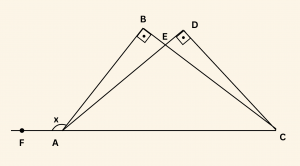
In the figure on the left:
* $m(\hat B) = 90^\circ$
* $m(\hat D) = 90^\circ$
* $m(\hat{ FAD}) = x$
Given $|BC| = 12 \text{ units}$, $|DC| = 8 \text{ units}$, and $|AE| = |EC|$, what is the value of $\tan x$?
\[
\text{A) } -\frac{1}{3}\quad
\text{B) } -\frac{2}{3}\quad
\text{C) } -\frac{3}{4}\quad
\text{D) } -2 \quad
\text{E) } -3
\]
Solution:
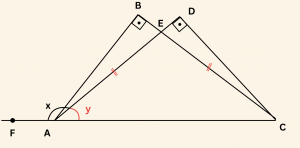
Since the alternate interior angles match and we are given that hypotenuses are equal ($|AE| = |EC|$), the right-angled triangles $\triangle ABE$ and $\triangle CDE$ are congruent ($\triangle ABE \cong \triangle CDE$ by Angle-Side-Angle). Corresponding legs must have matching lengths:
\[
|AB| = |CD| = 8 \text{ units} \quad \text{and} \quad |BE| = |ED|
\]
Because the figure forms parallel lines across equal intervals, the vertical projection yields equal total side lengths: $|AD| = |BC| = 12 \text{ units}$.
Let’s define the internal angle as $m(\hat {CAD}) = y$. The supplementary linear pair layout gives $x = 180^\circ – y$:
\[
\tan x = \tan(180^\circ – y) = -\tan y
\]
Using the dimensions from right triangle $\triangle ADC$ to calculate $\tan y$:
\[
\tan y = \frac{\text{Opposite}}{\text{Adjacent}} = \frac{|DC|}{|AD|} = \frac{8}{12} = \frac{2}{3}
\]
\[
\implies \tan x = -\tan y = -\frac{2}{3}
\]
\(\textbf{Correct Answer: B} \)
QUESTION 34
If $A$, $B$, and $C$ represent the interior angles of a triangle, which of the following expressions is identically equal to:
\[
\frac{\tan(A + B) + \tan A}{\tan(B + C) + \tan C}
\]
\[
\text{A) } -1\quad
\text{B) } 1\quad
\text{C) } \frac{\tan A}{\tan B}\quad
\text{D) } -\frac{\tan A}{\tan B} \quad
\text{E) } \frac{\cot A}{\tan C}
\]
Solution:
The sum of interior angles in any triangle is $A + B + C = 180^\circ$. This allows us to perform substitution:
* $A + B = 180^\circ – C \implies \tan(A + B) = \tan(180^\circ – C) = -\tan C$
* $B + C = 180^\circ – A \implies \tan(B + C) = \tan(180^\circ – A) = -\tan A$
Substitute these equivalents directly into the fraction:
\[
\frac{\tan(A + B) + \tan A}{\tan(B + C) + \tan C} = \frac{-\tan C + \tan A}{-\tan A + \tan C} = \frac{\tan A – \tan C}{-(\tan A – \tan C)} = -1
\]
\(\textbf{Correct Answer: A} \)
QUESTION 35
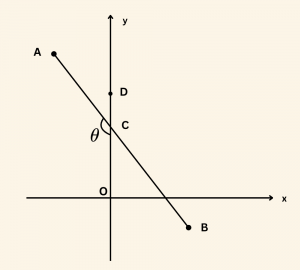
In the coordinate plane shown on the left, two points are given: $A(-2, 7)$ and $B(3, -5)$. Given that $m(\hat{ ACO}) = \theta$, find the exact value of $\sin \theta$.
\[
\text{A) } \frac{1}{4}\quad
\text{B) } \frac{1}{3}\quad
\text{C) } \frac{5}{13}\quad
\text{D) } \frac{8}{13} \quad
\text{E) } \frac{12}{13}
\]
Solution:
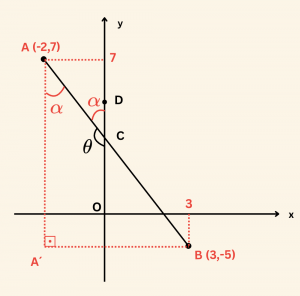
Let’s draw horizontal and vertical reference lines to form a right-angled triangle $\triangle AA’B$ spanning the distance between points $A$ and $B$:
* $\text{Vertical distance } |AA’| = 7 – (-5) = 12 \text{ units}$
* $\text{Horizontal distance } |A’B| = 3 – (-2) = 5 \text{ units}$
By the Pythagorean theorem, the total hypotenuse distance $|AB|$ is:
\[
|AB| = \sqrt{12^2 + 5^2} = \sqrt{144 + 25} = \sqrt{169} = 13 \text{ units}
\]
Let’s denote the inner acute intersection angle as $m(\hat {ACD}) = \alpha$. Thus, the exterior supplementary angle matches our target: $\theta = 180^\circ – \alpha$. By alternate interior angles across parallel coordinate grids, we find $m(\hat A’AC) = \alpha$. Therefore:
\[
\sin \theta = \sin(180^\circ – \alpha) = \sin \alpha = \frac{\text{Opposite}}{\text{Hypotenuse}} = \frac{|A’B|}{|AB|} = \frac{5}{13}
\]
\(\textbf{Correct Answer: C} \)
Pro-Tip for Finding Ratios via Reference Triangles:
When finding a trigonometric ratio for an obtuse angle or an angle outside Quadrant I, you can temporarily treat the angle as acute within a reference right triangle to find the absolute value of the ratio. Then, apply the appropriate positive or negative sign manually based on the original angle’s quadrant.
QUESTION 36
Given $\pi < x < \frac{3\pi}{2}$, if:
\[
3 \tan^2 x + 8 \tan x – 3 = 0
\]
what is the value of $\sin x$?
\[
\text{A) } -\frac{1}{\sqrt{10}} \quad
\text{B) } \frac{1}{\sqrt{10}} \quad
\text{C) } -\frac{1}{\sqrt{3}} \quad
\text{D) } \frac{1}{\sqrt{3}} \quad
\text{E) } \frac{1}{3}
\]
Solution:
Let’s treat this quadratic equation by substituting $t = \tan x$:
\[
3t^2 + 8t – 3 = 0 \implies (3t – 1)(t + 3) = 0 \implies t = \frac{1}{3} \quad \text{or} \quad t = -3
\]
We are given that $\pi < x < \frac{3\pi}{2}$, which specifies Quadrant III. In Quadrant III, tangent values are strictly positive ($\tan x > 0$). Therefore, we discard $-3$:
\[
\tan x = \frac{1}{3}
\]
Now, let’s sketch an acute reference right triangle to calculate the magnitude of the sine component:
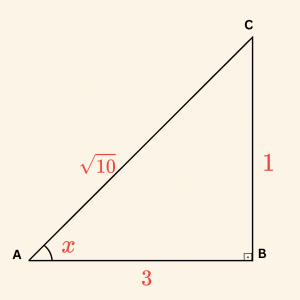
\[
|\sin x| = \frac{\text{Opposite}}{\text{Hypotenuse}} = \frac{1}{\sqrt{1^2 + 3^2}} = \frac{1}{\sqrt{10}}
\]
Since $x$ is in Quadrant III, sine must be negative ($\sin x < 0$). Applying this sign yields:
\[
\sin x = -\frac{1}{\sqrt{10}}
\]
\(\textbf{Correct Answer: A} \)
QUESTION 37
Given $\frac{\pi}{2} < \theta < \pi$ and $\tan \theta = -\frac{3}{4}$, if:
\[
A = \cos(\pi + \theta) \cdot \tan\left(\frac{3\pi}{2} + \theta\right)
\]
what is the exact value of $A$?
\[
\text{A) } \frac{4}{5} \quad
\text{B) } \frac{13}{15} \quad
\text{C) } \frac{14}{15} \quad
\text{D) } 1 \quad
\text{E) } \frac{16}{15}
\]
Solution:
First, reduce the expression for $A$ using the reference angle rules:
* $\cos(\pi + \theta) = -\cos \theta$
* $\tan\left(\frac{3\pi}{2} + \theta\right) = -\cot \theta$
\[
A = (-\cos \theta) \cdot (-\cot \theta) = \cos \theta \cdot \cot \theta = \cos \theta \cdot \frac{1}{\tan \theta}
\]
Now, let’s construct a standard right triangle to extract the numerical magnitude of $\cos \theta$ based on $|\tan \theta| = \frac{3}{4}$:
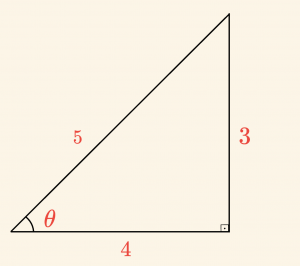
This reveals a standard $3-4-5$ right triangle pattern, giving the absolute value $|\cos \theta| = \frac{4}{5}$.
Since the problem statement places the angle in Quadrant II ($\frac{\pi}{2} < \theta < \pi$), cosine must be negative:
\[
\cos \theta = -\frac{4}{5}
\]
Substitute these values back into our simplified expression for $A$:
\[
A = \left(-\frac{4}{5}\right) \cdot \frac{1}{\left(\displaysteyle-\frac{3}{4}\right)} = \left(-\frac{4}{5}\right) \cdot \left(-\frac{4}{3}\right) = \frac{16}{15}
\]
\(\textbf{Correct Answer: E} \)
← Previous Page | Next Page →