
The Law of Sines
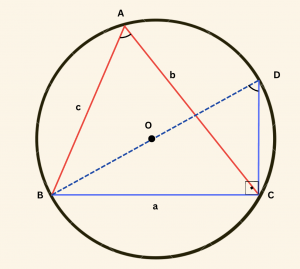 In the given figure, the diameter of the circumcircle of triangle \(ABC\) is \(|BD| = 2R\). Note that \( m(\hat{ BAC}) = m(\hat{ BDC}) \) because they are inscribed angles subtending the same arc.
In right triangle BCD:
\[
\sin D = \frac{|BC|}{|BD|} \Rightarrow \sin A = \frac{a}{2R}
\]
\[
\Rightarrow \frac{a}{\sin A} = 2R
\]
Thus, we obtain the general formula:
\[
\frac{a}{\sin A} = \frac{b}{\sin B} = \frac{c}{\sin C} = 2R
\]
This relationship is known as the Law of Sines.
Conclusion:
In any triangle, the lengths of the sides are proportional to the sines of their opposite angles. This ratio is equal to the diameter of the triangle’s circumcircle.
Example:
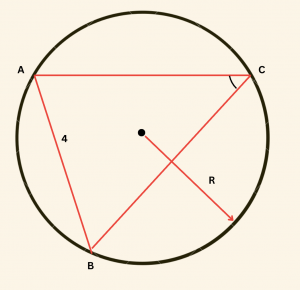
In the given figure, the radius of the circle centered at \( O \) is \( R = 4 \, \text{cm} \). If \( |AB| = 4 \, \text{cm} \), let us find the measure of the acute angle \( C \) in degrees.
Applying the Law of Sines to triangle ABC:
\[ \frac{|AB|}{\sin C} = 2R \Rightarrow \frac{4}{\sin C} = 8 \]
\[ \Rightarrow \sin C = \frac{1}{2} \Rightarrow \text{m}(\hat C) = 30^\circ \]
Example:
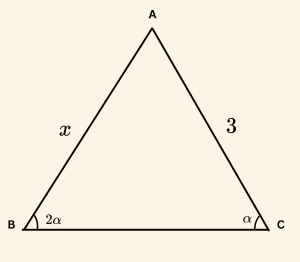 Based on the given figure, if \( \cos \alpha = \frac{3}{4} \), let us determine the side length \( |AB| = x \).
Applying the Law of Sines to triangle ABC:
\[\begin{aligned} &\frac{x}{\sin \alpha} = \frac{3}{\sin 2\alpha} \\ \\ & \Rightarrow \frac{x}{\sin \alpha} = \frac{3}{2 \sin \alpha \cdot \cos \alpha} \\ \\
&\Rightarrow x = \frac{3}{2 \cos \alpha} = \frac{3}{2 \cdot \frac{3}{4}} = 2 \end{aligned}\]
QUESTION 43
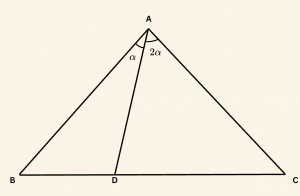
In triangle ABC shown above,
\( \text{m}(\hat {BAD}) = \alpha \),
\( \text{m}(\hat {DAC}) = 2\alpha \), and
\( |DC| = 3|BD| \).
\[ \text{Find the ratio } \frac{|AB|}{|AC|}. \]
\[\text{A) } \frac{1}{3} \cos \alpha \quad
\text{B) } \frac{1}{2} \cos \alpha \quad
\text{C) } \frac{2}{3} \cos \alpha \quad
\text{D) } \cos \alpha \quad
\text{E) } 2\cos \alpha
\]
Solution:
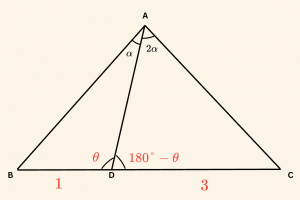
Let \( |BD| = 1 \) unit.
Then, \( |DC| = 3 \) units.
If we let \( \text{m}(\hat {BDA}) = \theta \),
it follows that \( \text{m}(\hat {ADC}) = 180^\circ – \theta \).
Let us apply the Law of Sines to triangles ABD and ADC separately, and then divide the resulting equations.
\[
\frac{|AB|}{\sin \theta} = \frac{1}{\sin \alpha}
\]
\[
\frac{|AC|}{\sin (180^\circ – \theta)} = \frac{3}{\sin 2\alpha}
\]
Since \(\sin(180^\circ – \theta) = \sin \theta\), dividing the equations yields:
\[
\frac{|AB|}{|AC|} = \frac{\sin 2\alpha}{3 \sin \alpha} = \frac{2 \sin \alpha \cdot \cos \alpha}{3 \sin \alpha} = \frac{2}{3} \cos \alpha
\]
\(\textbf{Answer: C} \)
QUESTION 44
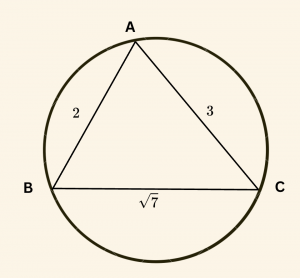
In the given figure,
\( |AB| = 2 \, \text{cm}, \)
\( |AC| = 3 \, \text{cm}, \) and
\( |BC| = \sqrt{7} \, \text{cm} \).
Find the radius of the circumcircle of triangle ABC.
\[
\text{A)} \frac{\sqrt{21}}{2} \quad
\text{B)} \frac{\sqrt{21}}{3} \quad
\text{C)} \frac{\sqrt{10}}{2} \quad
\text{D)} \frac{\sqrt{10}}{3} \quad
\text{E)} 1
\]
Solution:
First, apply the Law of Cosines to triangle ABC to find \(\cos A\):
\[ (\sqrt{7})^2 = 2^2 + 3^2 \;- \; 2 \cdot 2 \cdot 3 \cdot \cos A \Rightarrow \cos A = \frac{1}{2} \]
\[ \Rightarrow A = 60^\circ \]
Now, apply the Law of Sines to triangle ABC. If \(R\) represents the radius of the circumcircle:
\[
\frac{\sqrt{7}}{\sin A} = 2R \Rightarrow \frac{\sqrt{7}}{\sin 60^\circ} = 2R
\]
\[
\frac{\sqrt{7}}{\frac{\sqrt{3}}{2}} = 2R \Rightarrow R = \frac{\sqrt{21}}{3} \, \text{cm}
\]
\(\textbf{Answer: B} \)
QUESTION 45
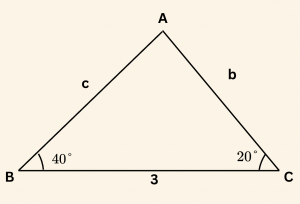
In the given figure,
\( \text{m}(\hat B) = 40^\circ, \quad \text{m}(\hat C) = 20^\circ \), and \[|AB| = c, \quad |AC| = b, \quad |BC| = 3 \text; \text{ units.} \]
Which of the following is equal to?
\[b + c \]
\[
\text{A) } 2\sqrt{3} (\sin 40^\circ + \sin 20^\circ) \quad
\text{B) } 4 \sin 10^\circ \quad
\text{C) } 5 \cos 10^\circ \quad
\text{D) } 6 \cos 10^\circ \quad
\text{E) } 6 \sin 10^\circ
\]
Solution:
Since the sum of interior angles is \(180^\circ\), we find \( m(\hat A) = 120^\circ \).
Applying the Law of Sines to triangle ABC:
\[
\frac{3}{\sin 120^\circ} = \frac{b}{\sin 40^\circ} = \frac{c}{\sin 20^\circ}
\]
Using the properties of proportions:
\[\begin{aligned}\Rightarrow \frac{3}{\frac{\sqrt{3}}{2}} = \frac{b + c}{\sin 40^\circ + \sin 20^\circ} \\ \\
\Rightarrow b + c = 2\sqrt{3} (\sin 40^\circ + \sin 20^\circ) \end{aligned}\]
\(\textbf{Answer: A} \)
← Previous Page | Next Page →