
Sum-to-Product and Product-to-Sum Identities
1. Sum-to-Product Identities:
Let
\[ \left. \begin{array}{l} a + b = x \\ a \ – \ b = y \end{array} \right\} \Rightarrow a = \frac{x+y}{2} \ \text{ and} \ b = \frac{x-y}{2}\]
Then, by manipulating the sum and difference identities:
\[ \begin{array} \cos(a + b) & = \cos a \cos b \ – \ \sin a \sin b \\ \pm \ \cos(a – b) & = \cos a \cos b + \sin a \sin b \\ \hline \cos(a + b) & + \cos(a – b) = 2 \cos a \cos b \end{array} \]
We derive:
\[ 1) \ \cos x + \cos y = 2 \cos \frac{x+y}{2} \cos \frac{x-y}{2} \]
Similarly:
\[ \cos(a + b) – \cos(a – b) = -2 \sin a \sin b \]
\[ 2) \ \cos x – \cos y = -2 \sin \frac{x+y}{2} \sin \frac{x-y}{2} \]
For sine:
\[ \begin{array} \sin(a + b) & = \sin a \cos b + \sin b \cos a \\ \pm \ \sin(a – b) & = \sin a \cos b – \sin b \cos a \\ \hline \sin(a + b) & + \sin(a – b) = 2 \sin a \cos b \end{array} \]
\[ 3) \ \sin x + \sin y = 2 \sin \frac{x+y}{2} \cos \frac{x-y}{2} \]
And:
\[ \sin(a + b) – \sin(a – b) = 2 \sin b \cos a \]
\[ 4) \ \sin x – \sin y = 2 \sin \frac{x-y}{2} \cos \frac{x+y}{2} \]
For tangent, by finding a common denominator:
\[\tan x + \tan y = \frac{\sin x}{\cos x} + \frac{\sin y}{\cos y } \]
\[ = \frac{\sin x \cos y + \sin y \cos x}{\cos x \ \cos y} \]
\[ 5) \ \tan x + \tan y = \frac{\sin(x+y)}{\cos x \ \cos y} \]
Substituting \(-y\) for \(y\) in the previous identity yields:
\[ 6) \ \tan x \ – \tan y = \frac{\sin(x-y)}{\cos x \ \cos y} \]
Similarly, for cotangent:
\[\cot x + \cot y = \frac{\cos x}{\sin x} + \frac{\cos y}{\sin y}\]
\[ = \frac{\cos x \sin y + \sin x \cos y} {\sin x \ \sin y} \]
\[ 7) \ \cot x + \cot y = \frac{\sin (x + y)} {\sin x \ \sin y} \]
Substituting \(-y\) for \(y\) in the cotangent identity yields:
\[ 8) \ \cot x \ – \ \cot y = \frac{-\sin (x – y)}{\sin x \ \sin y} \]
Example:
Evaluate the expression \(\cos 72^\circ – \cos 36^\circ\), and use the result to determine the exact value of \(\sin 18^\circ\).
\[ = \cos 72^\circ – \cos 36^\circ\]
\[ = -2 \sin \frac{72^\circ + 36^\circ}{2} \cdot \sin \frac{72^\circ – 36^\circ}{2} \]
\[ = -2 \sin 54^\circ \cdot \sin 18^\circ \]
Multiply the numerator and the denominator by \(\cos 18^\circ\) to apply double-angle identities:
\[ = \frac{-2 \sin 54^\circ \cdot \sin 18^\circ \cdot \cos 18^\circ}{\cos 18^\circ} \]
\[ = -\frac{\cos 36^\circ \cdot \sin 36^\circ}{\cos 18^\circ} \]
\[ = -\frac{\frac{1}{2} \sin 72^\circ}{\sin 72^\circ} = -\frac{1}{2} \]
Now, let’s solve for \(\sin 18^\circ\):
\[ \cos 72^\circ – \cos 36^\circ = -\frac{1}{2} \]
Using cofunction identities, substitute \(\cos 72^\circ = \sin 18^\circ\):
\[ \Rightarrow \sin 18^\circ – \cos 36^\circ = -\frac{1}{2} \]
Apply the double-angle identity \(\cos 2\theta = 1 – 2\sin^2\theta\):
\[ \Rightarrow \sin 18^\circ \ – \ (1 \ -\ 2 \sin^2 18^\circ) = -\frac{1}{2} \]
\[ \Rightarrow 4 \sin^2 18^\circ + 2 \sin 18^\circ – 1 = 0 \]
Let \( \sin 18^\circ = t \):
\[ \Rightarrow 4t^2 + 2t -1 = 0 \]
Applying the quadratic formula and keeping the positive root since \(18^\circ\) is in Quadrant I:
\[ \Rightarrow t =\sin 18^\circ = \frac{-1 + \sqrt{ 5} }{4} \]
Example:
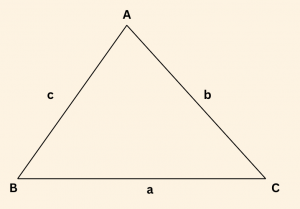
In \(\triangle ABC\), let us find an alternative expression for \[\frac{b+c}{b-c}\]
Applying the Law of Sines to \(\triangle ABC\):
\[ \frac{b}{\sin B} = \frac{c}{\sin C} = 2R\]
\[\begin{array}{l} b = 2R \sin B \\ c = 2R \sin C \end{array} \]
Substituting these values into the ratio:
\[ \frac{b + c}{b – c} = \frac{2R \sin B + 2R \sin C}{2R \sin B \ – \ 2R \sin C} \]
\[ = \frac{\sin B + \sin C}{\sin B \ -\ \sin C} \]
Applying the sum-to-product identities to both the numerator and the denominator:
\[ = \frac{2 \sin \frac{B + C}{2} \cdot \cos \frac{B – C}{2}}{2 \sin \frac{B – C}{2} \cdot \cos \frac{B + C}{2}} \]
\[ = \tan \frac{B + C}{2} \cdot \cot \frac{B – C}{2} \]
\[ = \frac{\tan \frac{B + C}{2}}{\tan \frac{B – C}{2}} \]
This result is famously known as the Law of Tangents.
Question 35
Evaluate the following trigonometric statement: \(\cos 80^\circ + \cos 20^\circ + \sqrt{3} \cos 130^\circ\)
\[ A) -\cos 10^\circ \quad B) -\sin 10^\circ \quad C) \cos 10^\circ \quad D) \sin 10^\circ \quad E) 0 \]
Solution:
\[ \cos 80^\circ + \cos 20^\circ + \sqrt{3} \cos 130^\circ \]
Applying the sum-to-product identity to the first two terms:
\[ = 2 \cos \frac{80^\circ + 20^\circ}{2} \cdot \cos \frac{80^\circ – 20^\circ}{2} \ – \ \sqrt{3} \cos 50^\circ \]
\[ = 2 \cos 50^\circ \cdot \cos 30^\circ \ – \ \sqrt{3} \cos 50^\circ \]
Since \(\cos 30^\circ = \frac{\sqrt{3}}{2}\):
\[ = 2 \cdot \frac{\sqrt{3}}{2} \cos 50^\circ \ – \ \sqrt{3} \cos 50^\circ = 0 \]
\( \text{Correct Answer: E} \)
Question 36
Given \(10x = \pi\), find the value of the rational expression:
\[ \frac{cos 7x + \cos 5x}{\cos 5x + \cos 3x} \]
\[ A) \ 1 \quad B) \ -1 \quad C) \ 2 \quad D) \ -2 \quad E) \ \frac{1}{2} \]
Solution:
Apply the sum-to-product identities:
\[ \frac{\cos 7x + \cos 5x}{\cos 5x + \cos 3x} = \frac{2 \cos \frac{7x+5x}{2} \cdot \cos \frac{7x-5x}{2}}{2 \cos \frac{5x+3x}{2} \cdot \cos \frac{5x-3x}{2}} \]
\[ = \frac{\cos 6x \cdot \cos x}{\cos 4x \cdot \cos x} = \frac{\cos 6x}{\cos 4x} \]
Since \(10x = \pi \implies 6x + 4x = \pi \implies 6x = \pi – 4x\):
\[ = \frac{\cos (\pi – 4x)}{\cos 4x} = \frac{-\cos 4x}{\cos 4x} = -1 \]
\( \textbf{Correct Answer: B} \)
Question 37
Evaluate the following statement:
\[ \frac{\cos 75^\circ + \cos 15^\circ}{\cos 75^\circ – \cos 15^\circ} \]
\[ A) \ -\sqrt{3} \quad B) \ \sqrt{3} \quad C) \ -\frac{1}{2} \quad D) \frac{1}{2} \quad E) \ -\sqrt{3} \]
Solution:
Applying sum-to-product formulas:
\[ \frac{\cos 75^\circ + \cos 15^\circ}{\cos 75^\circ – \cos 15^\circ} \]
\[ = \frac{2 \cos \frac{75^\circ + 15^\circ}{2} \cdot \cos \frac{75^\circ – 15^\circ}{2}}{-2 \sin \frac{75^\circ + 15^\circ}{2} \cdot \sin \frac{75^\circ – 15^\circ}{2}} \]
\[= -\frac{\cos 45^\circ \cdot \cos 30^\circ }{\sin 45^\circ \cdot \sin 30^\circ } = -\cot 45^\circ \cdot \cot 30^\circ \]
\[ = -1 \cdot \sqrt{3} = -\sqrt{3} \]
*(Note: The options provided in the source text contain an error or misprint in the answer key tag; the correct value evaluates to \(-\sqrt{3}\).)*
\( \textbf{Correct Answer: A} \)
Question 38
Given \(20x = \pi\), find the value of:
\[ \frac{\cos 4x \ – \ \cos 8x}{\cos 4x \cdot \cos 8x} \]
\[ A) \ \frac{1}{2} \quad B) \ -1 \quad C) \ 1 \quad D) \ -2 \quad E) \ 2 \]
Solution:
Apply sum-to-product identities to the numerator:
\[ \frac{\cos 4x – \cos 8x}{\cos 4x \cdot \cos 8x} = \frac{-2 \sin \frac{4x + 8x}{2} \cdot \sin \frac{4x – 8x}{2}}{\cos 4x \cdot \cos 8x} \]
\[ = \frac{-2 \sin 6x \cdot \sin (-2x)}{\cos 4x \cdot \cos 8x} = \frac{2 \sin 6x \cdot \sin 2x}{\cos 4x \cdot \cos 8x} \]
Since \(20x = \pi \implies 10x = \frac{\pi}{2}\), we use cofunction transitions \(\cos \theta = \sin(\frac{\pi}{2} – \theta)\):
\(\cos 4x = \cos(\frac{\pi}{2} – 6x) = \sin 6x\) and \(\cos 8x = \cos(\frac{\pi}{2} – 2x) = \sin 2x\).
Substituting these back:
\[ = \frac{2 \sin 6x \cdot \sin 2x}{\sin 6x \cdot \sin 2x} = 2 \]
\( \textbf{Correct Answer: E} \)
Question 39
Which of the following is equivalent to the expression below?
\[ \frac{\sin (a + b \,- \, c) + \sin (a \, – \, b + c)}{\cos (a + b\, – \,c) + \cos (a \,- \,b + c)} \]
\[ A) \ 1 \quad B) \ \tan (b – c) \quad C) \ \cot (b – c) \quad D) \ \tan a \quad E) \ \cot a \]
Solution:
Let \[ \left. \begin{array} a + b \,-\, c = x \\ a \,-\, b + c = y \end{array} \right \} \Rightarrow \frac{x+y}{2} = a \] and \[ \Rightarrow \frac{x-y}{2} = b \;- c \]
Substituting \(x\) and \(y\) into our expression:
\[ \frac{\sin x + \sin y}{\cos x + \cos y} = \frac{2 \sin \frac{x+y}{2} \cdot \cos \frac{x\;-y}{2}}{2 \cos \frac{x+y}{2} \cdot \cos \frac{x\;-y}{2}} \]
\[ = \frac{\sin a}{\cos a} = \tan a \]
\( \textbf{Correct Answer: D} \)
Question 40
Evaluate the following trigonometric operation:
\[ \sin 50^\circ \; – \; \frac{\cos^2 10^\circ}{\sin 50^\circ} \]
\[ A) \ 3 \quad B) \ 2 \quad C) \ \frac{1}{2} \quad D) \ -2 \quad E) \ -\frac{1}{2} \]
Solution:
Find a common denominator:
\[ \sin 50^\circ – \frac{\cos^2 10^\circ}{\sin 50^\circ} = \frac{\sin^2 50^\circ – \cos^2 10^\circ}{\sin 50^\circ} \]
Rewrite \(\sin^2 50^\circ\) as \(\cos^2 40^\circ\) using cofunctions, then factor using a difference of squares:
\[ = \frac{\cos^2 40^\circ – \cos^2 10^\circ}{\sin 50^\circ} = \frac{(\cos 40^\circ – \cos 10^\circ)(\cos 40^\circ + \cos 10^\circ)}{\sin 50^\circ} \]
Apply sum-to-product identities to both factors:
\[ = \frac{(-2 \sin 25^\circ \cdot \sin 15^\circ) \cdot (2 \cos 25^\circ \cdot \cos 15^\circ)}{\sin 50^\circ} \]
Regroup to form double-angle components \(2\sin 25^\circ\cos 25^\circ = \sin 50^\circ\):
\[ = \frac{-2 \sin 15^\circ \cdot \cos 15^\circ \cdot (\sin 50^\circ)}{\sin 50^\circ} \]
\[ = -2 \sin 15^\circ \cdot \cos 15^\circ = -\sin 30^\circ = -\frac{1}{2} \]
\( \textbf{Correct Answer: E} \)
Question 41
Evaluate the following expression:
\[ \frac{1}{\sin 54^\circ} \; – \; \frac{1}{\cos 72^\circ} \]
\[ A) \ 0 \quad B) \ -1 \quad C) \ 1 \quad D) \ -2 \quad E) \ 2 \]
Solution:
Find a common denominator:
\[ \frac{1}{\sin 54^\circ} \; – \frac{1}{\cos 72^\circ} = \frac{\cos 72^\circ – \sin 54^\circ}{\sin 54^\circ \cdot \cos 72^\circ} \]
Using cofunctions, substitute \(\cos 72^\circ = \sin 18^\circ\) and \(\sin 54^\circ = \cos 36^\circ\):
\[ = \frac{\sin 18^\circ – \sin 54^\circ}{\cos 36^\circ \cdot \sin 18^\circ} \]
Apply sum-to-product identity to the numerator:
\[ = \frac{2 \cos \left( \frac{18^\circ + 54^\circ}{2} \right) \cdot \sin \left( \frac{18^\circ – 54^\circ}{2} \right)}{\cos 36^\circ \cdot \sin 18^\circ} \]
\[ = \frac{2 \cos 36^\circ \cdot \sin (-18^\circ)}{\cos 36^\circ \cdot \sin 18^\circ} \]
Since \(\sin(-18^\circ) = -\sin 18^\circ\):
\[ = \frac{-2 \cos 36^\circ \cdot \sin 18^\circ}{\cos 36^\circ \cdot \sin 18^\circ} = -2 \]
\( \textbf{Correct Answer: D} \)
Question 42
Simplify the following expression:
\[ \frac{\sin 6^\circ + \sin 12^\circ + \sin 18^\circ}{1 + \cos 6^\circ + \cos 12^\circ} \]
\[ A) \ 2 \sin 6^\circ \quad B) \ -2 \sin 6^\circ \quad C) \ -1 \quad D) \ 1 \quad E) \ 2 \]
Solution:
Rearrange the numerator and expand the double-angle in the denominator (\(\cos 12^\circ = 2\cos^2 6^\circ – 1\)):
\[ = \frac{(\sin 18^\circ + \sin 6^\circ) + \sin 12^\circ}{1 + \cos 6^\circ + (2 \cos^2 6^\circ – 1)} \]
Apply sum-to-product to the grouped term in the numerator:
\[ = \frac{2 \sin 12^\circ \cdot \cos 6^\circ + \sin 12^\circ}{\cos 6^\circ + 2 \cos^2 6^\circ} \]
Factor out common terms:
\[ = \frac{\sin 12^\circ (2 \cos 6^\circ + 1)}{\cos 6^\circ (1 + 2 \cos 6^\circ)} = \frac{\sin 12^\circ}{\cos 6^\circ} \]
Apply the double-angle formula \(\sin 12^\circ = 2\sin 6^\circ\cos 6^\circ\):
\[ = \frac{2 \sin 6^\circ \cdot \cos 6^\circ}{\cos 6^\circ} = 2 \sin 6^\circ \]
\( \textbf{Correct Answer: A} \)
Question 43
Let \(A = \cos 9x + \cos 7x + \cos 3x + \cos x\). Evaluate the expression below:
\[ \frac{A}{\cos x \cdot \cos 3x \cdot \cos 5x} \]
\[ A) \ 1 \quad B) \ 2 \quad C) \ 3 \quad D) \ 4 \quad E) \ 5 \]
Solution:
Group the terms in \(A\) and apply sum-to-product identities:
\[ A = (\cos 9x + \cos 7x) + (\cos 3x + \cos x) \]
\[ = 2 \cos 8x \cdot \cos x + 2 \cos 2x \cdot \cos x \]
\[ = 2 \cos x \cdot (\cos 8x + \cos 2x) \]
Apply the identity once more inside the parenthesis:
\[ = 2 \cos x \cdot (2 \cos 5x \cdot \cos 3x) = 4 \cos x \cdot \cos 3x \cdot \cos 5x \]
Substituting this back into our rational statement:
\[ \frac{4 \cos x \cdot \cos 3x \cdot \cos 5x}{\cos x \cdot \cos 3x \cdot \cos 5x} = 4 \]
\( \textbf{Correct Answer: D} \)
Question 44
Simplify the following trigonometric fractional expression:
\[ \frac{\cos 12x + \cos 8x + \cos 4x}{\sin 12x + \sin 8x + \sin 4x} \]
\[ A) 1 \quad B) \tan 10x \quad C) \cot 10x \quad D) \tan 8x \quad E) \cot 8x \]
Solution:
Rearrange the terms by grouping the outer angles:
\[ = \frac{(\cos 12x + \cos 4x) + \cos 8x}{(\sin 12x + \sin 4x) + \sin 8x} \]
Apply sum-to-product identities to the grouped pairs:
\[ = \frac{2 \cos 8x \cdot \cos 4x + \cos 8x}{2 \sin 8x \cdot \cos 4x + \sin 8x} \]
Factor out the common terms from both numerator and denominator:
\[ = \frac{\cos 8x (2 \cos 4x + 1)}{\sin 8x (2 \cos 4x + 1)} = \frac{\cos 8x}{\sin 8x} = \cot 8x \]
\(\textbf{Correct Answer: E} \)
Useful Theorem:
In expressions of the form
\[ \frac{\cos A + \cos B + \cos C}{\sin A + \sin B + \sin C} \]
If the angles form an arithmetic progression such that
\[ B = \frac{A + C}{2} \]
then the expression strictly simplifies to \(\displaystyle \frac{\cos B}{\sin B} = \cot B \).
Question 45
Simplify the following trigonometric fractional expression:
\[ \frac{\sin 50^\circ + \cos 55^\circ + \cos 70^\circ}{\cos 50^\circ + \sin 55^\circ + \sin 70^\circ} \]
\[ A) \cot 50^\circ \quad B) \cot 55^\circ \quad C) \tan 50^\circ \quad D) \tan 55^\circ \quad E) 1 \]
Solution:
Convert the first term using cofunctions (\(\sin 50^\circ = \cos 40^\circ\) and \(\cos 50^\circ = \sin 40^\circ\)):
\[ = \frac{\cos 40^\circ + \cos 55^\circ + \cos 70^\circ}{\sin 40^\circ + \sin 55^\circ + \sin 70^\circ} \]
Since the angles form an arithmetic progression with a mean of \( 55^\circ = \displaystyle\frac{40^\circ + 70^\circ}{2} \), we can apply the theorem directly:
\[ = \frac{\cos 55^\circ}{\sin 55^\circ} = \cot 55^\circ \]
\(\textbf{Correct Answer: B} \)
Question 46
Given \( 14x = \pi \), determine the value of:
\[ \frac{\tan 7x + \tan 3x}{\tan 7x \; – \; \tan 3x} \]
\[ A) \ 1 \quad B) \ -1 \quad C) -2 \quad D) \ 2 \quad E) \frac{1}{2} \]
Solution:
Apply the identity for sum and difference of tangents (identities 5 and 6):
\[ \frac{\tan 7x + \tan 3x}{\tan 7x \; – \; \tan 3x} = \frac{\displaystyle\frac{\sin (7x + 3x)}{\cos 7x \cdot \cos 3x}}{\displaystyle\frac{\sin (7x \; – \; 3x)}{\cos 7x \cdot \cos 3x}} \]
Canceling out the common denominators:
\[ = \frac{\sin 10x}{\sin 4x} \]
Since \(14x = \pi \implies 10x = \pi – 4x\), and \(\sin(\pi – \theta) = \sin\theta\):
\[ = \frac{\sin (\pi \; – \; 4x)}{\sin 4x} = \frac{\sin 4x}{\sin 4x} = 1 \]
\(\textbf{Correct Answer: A} \)
Question 47
Given \(16x = \pi\), find the value of the expression: \(\tan 6x \; – \; \tan 2x\)
\[ A) \ \frac{1}{2} \quad B) -\frac{1}{2} \quad C) \ 2 \quad D) -2 \quad E) \ 4 \]
Solution:
Apply the difference identity for tangents:
\[ \tan 6x \; – \; \tan 2x = \frac{\sin (6x – 2x)}{\cos 6x \cdot \cos 2x} = \frac{\sin 4x}{\cos 6x \cdot \cos 2x} \]
Expand the numerator using the double-angle formula \(\sin 4x = 2\sin 2x\cos 2x\):
\[ = \frac{2 \sin 2x \cdot \cos 2x}{\cos 6x \cdot \cos 2x} = \frac{2 \sin 2x}{\cos 6x} \]
Since \(16x = \pi \implies 8x = \displaystyle\frac{\pi}{2}\), it follows that \(2x = \frac{\pi}{2} – 6x\). Applying cofunction relations:
\[ = \displaystyle\frac{2 \sin \left( \frac{\pi}{2} \; – \; 6x \right)}{\cos 6x} = \frac{2 \cos 6x}{\cos 6x} = 2 \]
\(\textbf{Correct Answer: C} \)
← Previous Page | Next Page →