
Inverse Trigonometric Functions
For a function to have an inverse, it must be one-to-one (injective) and onto (surjective). Since trigonometric functions are periodic, they are not one-to-one over their entire natural domains (\(\mathbb{R}\)). However, by restricting their domains to specific intervals where they are one-to-one and onto, we can define inverse trigonometric functions.
1) The Arcsine Function (Inverse Sine):
By restricting the domain of the sine function to \( \displaystyle [-\frac{\pi}{2}, \frac{\pi}{2}] \), it becomes one-to-one and onto. Thus, given:
\( \displaystyle f: [-\frac{\pi}{2}, \frac{\pi}{2}] \rightarrow [-1, 1] \) where \( f(x) = \sin x \), its inverse function is denoted by
\( f^{-1}(x) = \sin^{-1} x \) or \( f^{-1}(x) = \text{arcsin } x \), mapping as \( \displaystyle \text{arcsin} : [-1, 1] \rightarrow [-\frac{\pi}{2}, \frac{\pi}{2}] \).
Therefore:
\( y = f(x) = \sin x \Leftrightarrow x = f^{-1}(y) = \sin^{-1} y \Leftrightarrow x = \text{arcsin } y \)
Interchanging the independent and dependent variables gives the standard form \( y = \text{arcsin } x \).
Examples:
- \( \displaystyle \text{arcsin } \frac{\sqrt{3}}{2} = \frac{\pi}{3} \in [-\frac{\pi}{2}, \frac{\pi}{2}] \) (The angle whose sine value is \( \displaystyle \frac{\sqrt{3}}{2} \) is \( \displaystyle \frac{\pi}{3} \).)
- \( \displaystyle \text{arcsin } (-\frac{1}{2}) = -\frac{\pi}{6} \in [-\frac{\pi}{2}, \frac{\pi}{2}] \)
- Given \( \displaystyle \alpha \in [\frac{\pi}{2}, \frac{3\pi}{2}] \), solving \( \displaystyle \sin\alpha = \frac{\sqrt{2}}{2} \) yields the non-principal value \( \displaystyle \alpha = \frac{3\pi}{4} \).
- Given \( \displaystyle \alpha \in [\frac{3\pi}{2}, \frac{5\pi}{2}] \), solving \( \displaystyle \sin\alpha = -\frac{\sqrt{2}}{2} \) yields the non-principal value \( \displaystyle \alpha = \frac{7\pi}{4} \).
Graph of the Arcsine Function
Let us construct a table of values to sketch the graph of \( f^{-1}(x) = \text{arcsin } x \).
\[
\begin{array}{c|lcr}
x & -1 & \displaystyle -\frac{\sqrt{2}}{2} & 0 & \displaystyle \frac{\sqrt{2}}{2} & 1 \\
\hline
\text{arcsin } x & \displaystyle -\frac{\pi}{2} & \nearrow \displaystyle -\frac{\pi}{4} & \nearrow 0 & \nearrow \displaystyle \frac{\pi}{4} & \nearrow \displaystyle \frac{\pi}{2}
\end{array}
\]
2) The Arccosine Function (Inverse Cosine):
A standard interval where the cosine function is one-to-one and onto is \( [0, \pi] \).
If \( f : [0, \pi] \rightarrow [-1, 1] \) is defined by \( f(x) = \cos x \), then its inverse function
\( f^{-1} : [-1, 1] \rightarrow [0, \pi] \) given by \( f^{-1}(x) = \cos^{-1} x \) is called the inverse cosine function and is denoted by \( f^{-1}(x) = \text{arccos } x \).
Thus:
\( y = f(x) = \cos x \Leftrightarrow x = f^{-1}(y) = \cos^{-1} y \Leftrightarrow x = \text{arccos } y \)
Swapping \( x \) and \( y \) gives the standard equation \( y = \text{arccos } x \).
Examples:
* \( \text{arccos } ( \displaystyle \frac{-1}{2} ) = \displaystyle \frac{2\pi}{3} \in [0, \pi] \)
\[ (\text{The angle whose cosine is } -\frac{1}{2} \text{ is } \frac{2\pi}{3}.) \]
* Given \( \alpha \in [\pi, 2\pi] \), solving \( \cos\alpha = \displaystyle \frac{\sqrt{3}}{2} \) yields the non-principal value \( \alpha = \displaystyle \frac{11\pi}{6} \).
3) Graph of the Arccosine Function
Let us construct a table of values to sketch the graph of \( f^{-1}(x) = \text{arccos } x \).
\[
\begin{array}{c|ccccccc}
x & -1 & & \displaystyle \frac{-\sqrt{2}}{2} & & 0 & & \displaystyle \frac{\sqrt{2}}{2} & & 1 \\ \hline
\text{arccos } x & \pi & \searrow & \displaystyle \frac{3\pi}{4} & \searrow & \displaystyle \frac{\pi}{2} & \searrow & \displaystyle \frac{\pi}{4} & \searrow & 0
\end{array}
\]
3) The Arctangent Function (Inverse Tangent)
The standard restricted interval where the tangent function is one-to-one and onto is \( ( \displaystyle -\frac{\pi}{2} , \frac{\pi}{2} ) \).
If \( f : ( \displaystyle -\frac{\pi}{2} , \frac{\pi}{2} ) \rightarrow (-\infty , +\infty) \) where \( f(x) = \tan x \), then its inverse function
\( f^{-1} : (-\infty , +\infty) \rightarrow ( \displaystyle -\frac{\pi}{2} , \frac{\pi}{2} ) \) given by \( f^{-1}(x) = \tan^{-1} x \)
is called the inverse tangent function and is denoted by \( f^{-1} (x) = \text{arctan } x \).
Thus:
\( y = f(x) = \tan x \Leftrightarrow x = f^{-1} (y) = \tan^{-1} y \Leftrightarrow x = \text{arctan } y \)
Swapping \( x \) and \( y \) gives the standard form \( y = \text{arctan } x \).
Examples:
* \( \text{arctan } (-1) = -\displaystyle \frac{\pi}{4} \in ( -\displaystyle \frac{\pi}{2} , \frac{\pi}{2} ) \)
\[ (\text{The angle whose tangent is } -1 \text{ is } -\frac{\pi}{4}.) \]
* Given \( \alpha \in [ \displaystyle \frac{\pi}{2} , \frac{3\pi}{2} ] \), solving \( \tan\alpha = \sqrt{3} \) yields the non-principal value \( \alpha = \displaystyle \frac{4\pi}{3} \).
Graph of the Arctangent Function
Let us construct a table of values to sketch the graph of \( f^{-1}(x) = \text{arctan } x \).
\[
\begin{array}{c|ccccccc}
x & -\infty & & -1 & & 0 & & 1 & & +\infty \\ \hline
\text{arctan } x & -\displaystyle \frac{\pi}{2} & \nearrow & -\displaystyle \frac{\pi}{4} & \nearrow & 0 & \nearrow & \displaystyle \frac{\pi}{4} & \nearrow & \displaystyle \frac{\pi}{2}
\end{array}
\]
4) The Arccotangent Function (Inverse Cotangent):
The standard restricted interval where the cotangent function is one-to-one and onto is $(0, \pi)$.
\[ f : (0, \pi) \to (-\infty, +\infty), \quad f(x) = \cot x \]
\[ f^{-1} : (-\infty, +\infty) \to (0, \pi), \quad f^{-1}(x) = \cot^{-1} x \]
This inverse function is denoted by \( f^{-1}(x) = \text{arccot } x \).
Thus:
\[ y = f(x) = \cot x \iff x = f^{-1}(y) = \cot^{-1} y \iff x = \text{arccot } y \]
Swapping \(x\) and \(y\) gives the standard equation:
\[ y = \text{arccot } x \]
Examples:
- \( \text{arccot}(-\sqrt{3}) = \frac{5\pi}{6} \in (0, \pi) \)
\[ (\text{The angle whose cotangent is } -\sqrt{3} \text{ is } \frac{5\pi}{6}.) \]
- Given \( \alpha \in (-\pi, 0) \), solving \( \cot\alpha = \frac{\sqrt{3}}{3} \) yields the non-principal value:
\[ \alpha = -\frac{\pi}{3} \]
Graph of the Arccotangent Function
Table of values for \(f^{-1}(x) = \text{arccot } x\):
\[
\begin{array}{c|ccccccc}
x & -\infty & & -1 & & 0 & & 1 & & +\infty \\
\hline
\text{arccot } x & \pi & \searrow & \displaystyle\frac{3\pi}{4} & \searrow & \displaystyle\frac{\pi}{2} & \searrow & \displaystyle\frac{\pi}{4} & \searrow & 0
\end{array}
\]
Note on Composite Identities:
Within their respective restricted domains and ranges, the following inverse properties hold:
\[
\begin{aligned}
\sin(\arcsin x) &= x \\
\cos(\arccos x) &= x \\
\tan(\arctan x) &= x \\
\cot(\text{arccot } x) &= x
\end{aligned}
\]
\[
\begin{aligned}
\text{arcsin}(\sin \theta) &= \theta \\
\text{arccos}(\cos \theta) &= \theta \\
\text{arctan}(\tan \theta) &= \theta \\
\text{arccot}(\cot \theta) &= \theta
\end{aligned}
\]
Examples:
* \( \text{arctan} \left( \tan \frac{\pi}{4} \right) = \frac{\pi}{4} \)
* \( \cos \left( \arccos \left( -\frac{1}{2} \right) \right) = -\frac{1}{2} \)
Example:
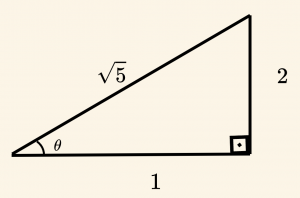
Evaluate the expression \( \sin(\text{arctan } 2) \).
Let \( \text{arctan } 2 = \theta \Leftrightarrow \tan \theta = 2 \).
Constructing a reference right triangle:
\( \sin(\text{arctan } 2) = \sin \theta = \displaystyle \frac{2}{\sqrt{5}} \)
QUESTION 70
What is the exact value of ?
\[ \tan(\text{arccos}(-\displaystyle \frac{3}{5}))\]
\[ A) \ \displaystyle \frac{4}{3} \quad B) \ -\displaystyle \frac{4}{3} \quad C) \ \displaystyle \frac{3}{4} \quad D) \ -\displaystyle \frac{3}{4} \quad E) \ -2 \]
Solution:
In the expression \( \tan(\arccos(-\displaystyle \frac{3}{5})) \), let:
\( \arccos(-\displaystyle \frac{3}{5}) = \theta \Leftrightarrow \cos \theta = -\displaystyle \frac{3}{5} \)
Since \( |\cos \theta| = \displaystyle \frac{3}{5} \), we reference the right triangle shown below:
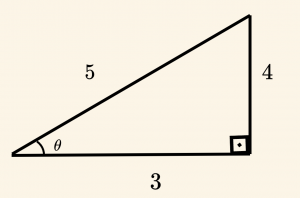
Thus, the absolute value of the tangent ratio is \( |\tan \theta| = \displaystyle \frac{4}{3} \).
Since the range of the arccosine function dictates \( \theta \in [0, \pi] \) and \( \cos \theta < 0 \), the angle \( \theta \) lies in Quadrant II. In Quadrant II, the tangent function is negative (\( \tan \theta < 0 \)).
Therefore:
\( \tan \theta = -\displaystyle \frac{4}{3} \)
\(\textbf{Answer: B} \)
QUESTION 71
Find the value of
\[ \sin \left( \displaystyle \frac{1}{2} \text{ arctan } \displaystyle \frac{3}{4} \right) \]
\[ A) \ \displaystyle \frac{1}{3} \quad B) \ \displaystyle \frac{1}{\sqrt{ 10} } \quad C) \ \displaystyle \frac{1}{\sqrt{ 11} } \quad D) \ \displaystyle \frac{3}{\sqrt{ 10} } \quad E) \ \displaystyle \frac{3}{\sqrt{ 11} } \]
Solution:
Let \( \frac{\displaystyle 1}{\displaystyle 2} \arctan \frac{\displaystyle 3}{\displaystyle 4} = \alpha \), which implies:
\( \arctan \frac{\displaystyle 3}{\displaystyle 4} = 2\alpha \Rightarrow \tan 2\alpha = \frac{\displaystyle 3}{\displaystyle 4} \)
Using the geometric double-angle reference triangle method (extending the base of a $3-4-5$ right triangle by $5$ units to form an isosceles triangle with angle $\alpha$):
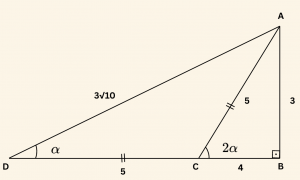
\( \sin \left( \frac{\displaystyle 1}{\displaystyle 2} \arctan \frac{\displaystyle 3}{\displaystyle 4} \right) = \sin\alpha \)
\( = \frac{\displaystyle 3}{3\sqrt{10}} = \frac{\displaystyle 1}{\displaystyle \sqrt{10}} \)
\(\textbf{Answer: B} \)
QUESTION 72
Which of the following expressions is equivalent to ?
\[\cos (2 \arccos x) \]
\[
A) 1 \ – \ 2x^2
\quad
B) 1 \ – \ x^2
\quad
C) 1 + x^2
\quad
D) x^2 \ – \ 1
\quad
E) 2x^2 \ – \ 1
\]
Solution:
Let \( \arccos x = \theta \Leftrightarrow \cos \theta = x \).
Applying the cosine double-angle identity:
\[ \cos (2 \arccos x) = \cos 2\theta \]
\[ = 2\cos^2 \theta \ – \ 1 \]
\[ = 2x^2 \ – \ 1 \]
\(\textbf{Answer: E} \)
QUESTION 73
What is the exact value of the sum ?
\[\arctan 3 + \text{arccot }\frac{\displaystyle 1}{\displaystyle 2} \]
\[
A) \ \frac{\displaystyle 5\pi}{\displaystyle 12}
\quad
B) \ \frac{\displaystyle 7\pi}{\displaystyle 12}
\quad
C) \ \frac{\displaystyle 2\pi}{\displaystyle 3}
\quad
D) \ \frac{\displaystyle 3\pi}{\displaystyle 4}
\quad
E) \ \frac{\displaystyle 5\pi}{\displaystyle 6}
\]
Solution:
Let \( \text{arctan } 3 = \theta \Leftrightarrow \tan \theta = 3 \).
Let \( \text{arccot } \displaystyle \frac{1}{2} = \alpha \Leftrightarrow \cot \alpha = \displaystyle \frac{1}{2} \Rightarrow \tan \alpha = 2 \).
Using the tangent addition formula:
\( \tan (\theta + \alpha) = \displaystyle \frac{\tan \theta + \tan \alpha}{1 \ – \ \tan \theta \tan \alpha} \)
\( = \displaystyle \frac{3 + 2}{1 \ – \ 3 \cdot 2} = -1 \)
Since both angles are positive and acute principal values, their sum lies in the interval \( (0, \pi) \). The angle in this range whose tangent is \(-1\) is:
\( \theta + \alpha = \displaystyle \frac{3\pi}{4} \)
\(\textbf{Answer: D} \)
QUESTION 74
Which of the following is equivalent to ?
\[ \sec ( \text{arctan } \displaystyle \frac{1}{x} ) \]
\[ A) \ x
\quad B) \ \sqrt{1 \ – \ x^2}
\quad C) \ \sqrt{1 + x^2}
\quad D) \ \displaystyle \frac{\sqrt{1 \ – \ x^2}}{x}
\quad E) \ \displaystyle \frac{\sqrt{1 + x^2}}{x} \]
Solution:
Let \( \text{arctan } \displaystyle \frac{1}{x} = \theta \Rightarrow \tan \theta = \displaystyle \frac{1}{x} \).
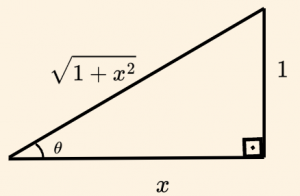
From the reference right triangle:
\( \sec ( \text{arctan } \displaystyle \frac{1}{x} ) = \sec \theta = \displaystyle \frac{1}{\cos \theta} \)
\( = \displaystyle \frac{1}{\displaystyle \frac{x}{\sqrt{1 + x^2}}} = \displaystyle \frac{\sqrt{1 + x^2}}{x} \)
\(\textbf{Answer: E} \)