
The \( n \)th Roots of Complex Numbers
Let \( z \in \mathbb{C} \) and \( n \in \mathbb{Z}^+ \).
We denote the \( n \)th roots of the complex number \( z \) by \( w_k \). In this case, \( w = \sqrt[n]{z} \Leftrightarrow w^n = z \).
The solutions to this equation are called the \( n \)th roots of the complex number \( z \).
To find these roots, we express the complex number \( z \) in polar form and apply De Moivre’s Theorem.
\( w^n = z = |z|(\cos \theta + i \sin \theta) \)
\( \Rightarrow w_k^n = z = |z|[\cos(\theta + 2k\pi) + i \sin(\theta + 2k\pi)] \)
\( \Rightarrow w_k = z^{\frac{1}{n}} = |z|^{\frac{1}{n}}[\cos(\displaystyle\frac{\theta + 2k\pi}{n}) + i \sin(\displaystyle\frac{\theta + 2k\pi}{n})] \)
Thus,
\( w_k = \sqrt[n]{z} = \sqrt[n]{|z|} \cdot [\cos(\displaystyle\frac{\theta + 2k\pi}{n}) + i \sin(\displaystyle\frac{\theta + 2k\pi}{n})] \)
where \( k = 0, 1, 2, 3, \dots, n \ – \ 1 \).
This demonstrates that a complex number has exactly \( n \) distinct \( n \)th roots. The absolute values (magnitudes) of these roots are all equal to \( \sqrt[n]{|z|} \). The arguments of the roots are given by:
\( \arg(\sqrt[n]{z}) = \displaystyle\frac{\theta + 2k\pi}{n} \)
For \( k = 0 \): \( \displaystyle\frac{\theta}{n} \)
For \( k = 1 \): \( \displaystyle\frac{\theta + 2\pi}{n} \)
For \( k = 2 \): \( \displaystyle\frac{\theta + 4\pi}{n} \)
…………………………………..
…………………………………..
For \( k = n \ – \ 1 \): \( \displaystyle\frac{\theta + 2(n \ – \ 1)\pi}{n} \)
Consequently, the geometric representations of the \( n \)th roots of a complex number \( z \) in the complex plane are equally spaced on a circle centered at the origin with a radius of \( \sqrt[n]{|z|} \).
Example:
Find the sixth roots of the complex number \( z = 32 + 32\sqrt{3}\,i \).
\( w^6 = z = 64(\cos 60^\circ + i \sin 60^\circ) \)
\( \Rightarrow w_k^6 = z = 64 \text{ cis }(60^\circ + k \cdot 360^\circ) \)
\( \Rightarrow w_k = \sqrt[6]{z} = \sqrt[6]{64} \text{ cis }(\displaystyle\frac{60^\circ + k \cdot 360^\circ}{6}) \)
Therefore,
For \( k = 0 \): \( w_0 = 2(\cos 10^\circ + i \sin 10^\circ) \)
For \( k = 1 \): \( w_1 = 2(\cos 70^\circ + i \sin 70^\circ) \)
For \( k = 2 \): \( w_2 = 2(\cos 130^\circ + i \sin 130^\circ) \)
For \( k = 3 \): \( w_3 = 2(\cos 190^\circ + i \sin 190^\circ) \)
For \( k = 4 \): \( w_4 = 2(\cos 250^\circ + i \sin 250^\circ) \)
For \( k = 5 \): \( w_5 = 2(\cos 310^\circ + i \sin 310^\circ) \)
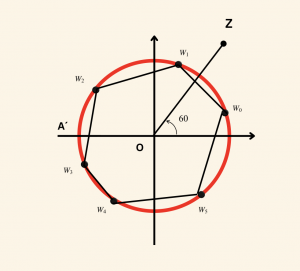
The geometric representations of these roots are equally spaced on a circle centered at the origin with a radius of 2 units. These points form the vertices of a regular hexagon whose centroid is located at the origin.
Example:
Find the fourth roots of the number \( z = \ – \ 16 \).
\( w^4 = z = 16(\cos 180^\circ + i \sin 180^\circ) \)
\( \Rightarrow w_k = \sqrt[4]{z} = \sqrt[4]{16} \text{ cis }(\displaystyle\frac{180^\circ + k \cdot 360^\circ}{4}) \)
For \( k = 0 \): \( w_0 = 2(\cos 45^\circ + i \sin 45^\circ) \).
Since the roots are equally spaced along a circle centered at the origin with a radius of 2 units, the central angles subtended by these equal arcs are equal and measure \( \displaystyle\frac{360^\circ}{4} = 90^\circ \).
Thus,
\[ \text{Arg}(w_1) = \text{Arg}(w_0) + 90^\circ = 135^\circ \]
\[ \text{Arg}(w_2) = \text{Arg}(w_1) + 90^\circ = 225^\circ \]
\[ \text{Arg}(w_3) = \text{Arg}(w_2) + 90^\circ = 315^\circ \]
Hence, the remaining roots are:
\[ w_1 = 2(\cos 135^\circ + i \sin 135^\circ) \]
\[ w_2 = 2(\cos 225^\circ + i \sin 225^\circ) \]
\[ w_3 = 2(\cos 315^\circ + i \sin 315^\circ) \]
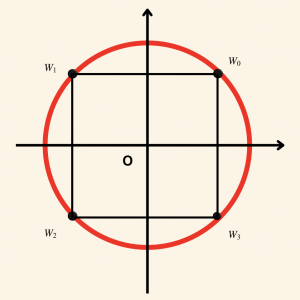
The geometric representations of the roots form the vertices of a square centered at the origin.
Example:
Find the cube roots of the complex number \( z = \ – \ \displaystyle\frac{27\sqrt{2}}{2} + \displaystyle\frac{27\sqrt{2}}{2}\,i \).
\( w^3 = z = 27(\cos 135^\circ + i \sin 135^\circ) = 27 \text{ cis } 135^\circ \)
\( \Rightarrow w_k = \sqrt[3]{z} = \sqrt[3]{27} \text{ cis }(\displaystyle\frac{135^\circ + k \cdot 360^\circ}{3}) \)
\( \Rightarrow \) For \( k = 0 \): \( w_0 = 3(\cos 45^\circ + i \sin 45^\circ) = 3 \text{ cis } 45^\circ \).
\( \text{Arg}(w_1) = \text{Arg}(w_0) + \displaystyle\frac{360^\circ}{3} = 165^\circ \)
\( \text{Arg}(w_2) = \text{Arg}(w_1) + \displaystyle\frac{360^\circ}{3} = 285^\circ \).
Therefore, the remaining roots are:
\( w_1 = 3(\cos 165^\circ + i \sin 165^\circ) = 3 \text{ cis } 165^\circ \)
\( w_2 = 3(\cos 285^\circ + i \sin 285^\circ) = 3 \text{ cis } 285^\circ \)
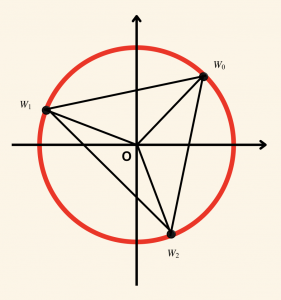
The geometric representations of the roots form the vertices of an equilateral triangle centered at the origin.
Example:
Find the cube roots of the complex number \( z = 8i \).
\( w^3 = z = 8(\cos 90^\circ + i \sin 90^\circ) \)
\( \Rightarrow w_k = \sqrt[3]{z} = \sqrt[3]{8} \text{ cis }(\displaystyle\frac{90^\circ + k \cdot 360^\circ}{3}) \)
\( \Rightarrow \) For \( k = 0 \): \( w_0 = 2(\cos 30^\circ + i \sin 30^\circ) \).
\( \text{Arg}(w_1) = \text{Arg}(w_0) + 120^\circ = 150^\circ \)
\( \text{Arg}(w_2) = \text{Arg}(w_1) + 120^\circ = 270^\circ \).
Hence, the remaining roots are:
\( w_1 = 2(\cos 150^\circ + i \sin 150^\circ) \)
\( w_2 = 2(\cos 270^\circ + i \sin 270^\circ) \)
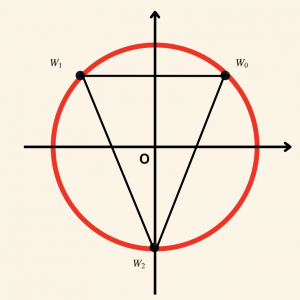
The geometric representations of the roots form the vertices of an equilateral triangle centered at the origin.
Example:
Find the square roots of the complex number \( z = 1 + \sqrt{3}\,i \).
\( w^2 = z = 2(\cos\displaystyle\frac{\pi}{3} + i \sin\displaystyle\frac{\pi}{3}) \)
\( \Rightarrow w_k = \sqrt{z} = \sqrt{2}[\cos(\displaystyle\frac{\displaystyle\frac{\pi}{3} + 2k\pi}{2}) + i \sin(\displaystyle\frac{\displaystyle\frac{\pi}{3} + 2k\pi}{2})] \)
For \( k = 0 \): \( w_0 = \sqrt{2}(\cos\displaystyle\frac{\pi}{6} + i \sin\displaystyle\frac{\pi}{6}) \)
\( = \sqrt{2}(\displaystyle\frac{\sqrt{3}}{2} + \displaystyle\frac{1}{2}\,i) = \displaystyle\frac{\sqrt{2}}{2}(\sqrt{3} + i) \)
For \( k = 1 \): \( w_1 = \sqrt{2}[\cos(\displaystyle\frac{\pi}{6} + \pi) + i \sin(\displaystyle\frac{\pi}{6} + \pi)] \)
\( = \sqrt{2}(\ – \ \displaystyle\frac{\sqrt{3}}{2} \ – \ \displaystyle\frac{1}{2}\,i) = \ – \ \displaystyle\frac{\sqrt{2}}{2}(\sqrt{3} + i) \)
Notice that the square roots are opposites of each other (\( w_1 = \ – \ w_0 \)).
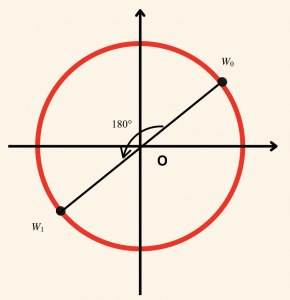
Conclusion:
The square roots of a complex number \( z = |z|(\cos\theta + i \sin\theta) \) are:
\( w_0 = \sqrt{|z|}(\cos\displaystyle\frac{\theta}{2} + i \sin\displaystyle\frac{\theta}{2}) \)
\( w_1 = \ – \ w_0 = \sqrt{|z|}[\cos(\displaystyle\frac{\theta}{2} + \pi) + i \sin(\displaystyle\frac{\theta}{2} + \pi)] \)
Example:
Find the square roots of the complex number \( z = \ – \ 9 i \).
\( |z| = 9 \) and \( \text{Arg}(z) = \displaystyle\frac{3\pi}{2} \).
\( w_0 = \sqrt{|z|} \text{ cis }(\displaystyle\frac{\theta}{2}) \Rightarrow w_0 = 3 \text{ cis } \displaystyle\frac{3\pi}{4} \)
\( w_1 = \sqrt{|z|} \text{ cis }(\displaystyle\frac{\theta}{2} + \pi) \Rightarrow w_1 = 3 \text{ cis } \displaystyle\frac{7\pi}{4} \)
Example:
Find the square roots of the complex number \( z = \ – \ 1 \ – \ \sqrt{3}\,i \).
\( |z| = 2 \) and \( \text{Arg}(z) = 240^\circ \).
\( w_0 = \sqrt{|z|} \text{ cis }(\displaystyle\frac{\theta}{2}) \Rightarrow w_0 = \sqrt{2} \text{ cis } 120^\circ \)
\( w_1 = \sqrt{|z|} \text{ cis }(\displaystyle\frac{\theta}{2} + 180^\circ) \Rightarrow w_1 = \sqrt{2} \text{ cis } 300^\circ \)
Example:
Find the square roots of the complex number \( z = \ – \ 5 + 12i \).
To express this complex number in polar form, we would need to determine values using a trigonometric table. Therefore, we will find its square roots algebraically without converting it to polar form.
Let \( w = \sqrt{z} = x + yi \).
\( w^2 = z \Rightarrow (x + yi)^2 = \ – \ 5 + 12i \)
\( \Rightarrow x^2 \ – \ y^2 + 2xyi = \ – \ 5 + 12i \)
\( \Rightarrow x^2 \ – \ y^2 = \ – \ 5 \) and \( 2xy = 12 \)
Solving this system of equations yields:
\( x_1 = 2 \) and \( y_1 = 3 \) as well as \( x_2 = \ – \ 2 \) and \( y_2 = \ – \ 3 \).
Thus, the roots are:
\( w_1 = 2 + 3i \) and \( w_2 = \ – \ 2 \ – \ 3i \).
QUESTION 38
If \( |z| = 1 \), which of the following is a solution to the equation \( z^{20} \ – \ z^{10} \ – \ 2 = 0 \)?
\[ A) \cos 36^\circ + i \sin 36^\circ \] \[ B) \cos 20^\circ + i \sin 20^\circ \] \[ C) \cos 18^\circ + i \sin 18^\circ \] \[ D) \cos 10^\circ + i \sin 10^\circ \] \[ E) \cos 9^\circ + i \sin 9^\circ \]
Solution:
\( z^{20} \ – \ z^{10} \ – \ 2 = 0 \Rightarrow (z^{10} + 1)(z^{10} \ – \ 2) = 0 \)
\( \Rightarrow z^{10} = \ – \ 1 \) or \( z^{10} = 2 \)
Since \( |z| = 1 \), we have:
\( \Rightarrow z^{10} = \ – \ 1 = \cos 180^\circ + i \sin 180^\circ \)
\( \Rightarrow z = \text{ cis }(\displaystyle\frac{180^\circ + k \cdot 360^\circ}{10}) \)
For \( k = 0 \), one of the roots is:
\( w = \cos 18^\circ + i \sin 18^\circ \)
\( \textbf{Correct Answer: C} \)