
Graphs of Quadratic Functions
Let \( a, b, c, x \in \mathbb{R} \) with \( a \neq 0 \). A function defined in the form
\[
f : \mathbb{R} \to \mathbb{R}, \quad f(x) = ax^2 + bx + c
\]
is called a quadratic function in one variable. The graph of such a function is a curve called a parabola.
If we substitute \( b = 0 \) and \( c = 0 \) into the function \( f(x) = ax^2 + bx + c \), we obtain the parent-type quadratic function \( f(x) = ax^2 \). Let us analyze and sketch the graph of this function.
For any real value of \( x \), the corresponding output value of \( y \) in the function \( y = f(x) = ax^2 \) can be evaluated. To construct a rough sketch, we can map out a table of values showing the coordinates of key points.
1) When \( y = f(x) = ax^2 \) and \( a > 0 \):
\[
\begin{array}{c|ccccccc}
x & -\infty & -2 & -1 & 0 & 1 & 2 & +\infty \\ \hline
y =f(x)= ax^2 & +\infty \; \searrow & 4a\searrow & a \searrow& 0 \nearrow& a \nearrow& 4a \nearrow& +\infty
\end{array}
\]
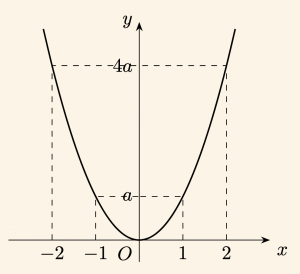
\[
\text{The graph of the parabola } y = ax^2 \text{ for } a > 0 \text{ is a curve that opens upward.}
\]
Since \( a > 0 \) and \( y = f(x) = ax^2 \geq 0 \) for all \( x \in \mathbb{R} \), the parabola opens upward in the positive direction of the y-axis. In this case, the absolute minimum point of the parabola, \( O(0, 0) \), is called the vertex of the parabola.
2) When \( y = f(x) = ax^2 \) and \( a < 0 \):
\[
\begin{array}{c|ccccccc}
x & -\infty & -2 & -1 & 0 & 1 & 2 & +\infty \\ \hline
y =f(x)= ax^2 & -\infty \; \nearrow & 4a\nearrow & a \nearrow& 0 \searrow& a \searrow& 4a \searrow& -\infty
\end{array}
\]
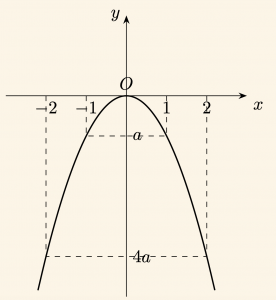
Example:
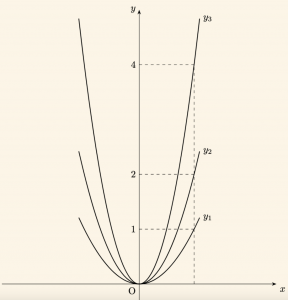
Graph the parabolas \( y_1 = x^2, \;\; y_2 = 2x^2 \), and \( y_3 = 4x^2 \) on the same coordinate plane.
Example:
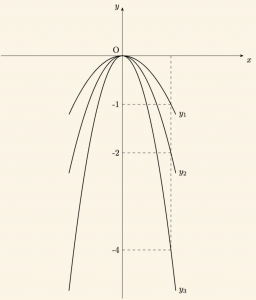
Graph the parabolas \( y_1 = -x^2, \;\; y_2 = -2x^2 \), and \( y_3 = -4x^2 \) on the same coordinate plane.
Key Takeaway:
For any parabola given by \( f(x) = ax^2 + bx + c \):
\(\bullet \quad\) As \( |a| \) increases, the parabola narrows and its branches move closer to the y-axis (vertical stretch / narrower).
\(\bullet \quad\) As \( |a| \) decreases, the parabola widens and its branches move away from the y-axis (vertical compression / wider).
QUESTION 1
The parabola \( y = 2mx^2 \) is shown in the figure below.
– \( [OA] \perp [AB] \),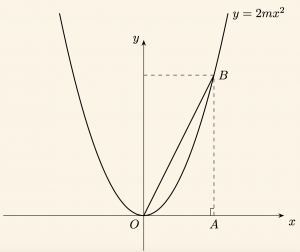
– \( |AB| = 2|OA| \), and
– \( |OB| = \sqrt{10} \) units.
Find the value of m.
\[
\text{A) } \sqrt{ 2} \quad
\text{B) }\frac{\sqrt{ 2}}{2} \quad
\text{C) } 2 \quad
\text{D) } 4 \quad
\text{E) } 8
\]
Solution:
Let \( |OA| = a \).
Then \( |AB| = 2a \).
Applying the Pythagorean theorem in the right triangle \( OAB \):
\[
a^2 + (2a)^2 = (\sqrt{10})^2
\]
\[
a^2 + 4a^2 = 10
\]
\[
\Rightarrow 5a^2 = 10
\]
\[
\Rightarrow a = \sqrt{2}
\]
Since point \( B \) is located at coordinates \( B(a, 2a) \), substituting the value of \( a \) gives \( B(\sqrt{2}, 2\sqrt{2}) \). Since this point lies on the parabola, it must satisfy the equation:
\[
y = 2mx^2 \Rightarrow 2\sqrt{2} = 2m (\sqrt{2})^2
\]
\[
\Rightarrow 2\sqrt{2} = 4m \Rightarrow m = \frac{\sqrt{2}}{2}
\]
\(\textbf{Correct Answer: B} \)
QUESTION 2
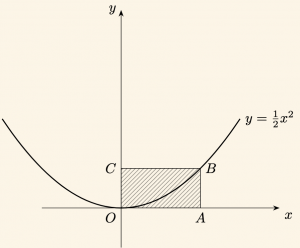 The graph of the parabola
\[
y = \frac{1}{2} x^2
\]
is shown in the figure below.
What is the area of square OABC in square units?
\[
\text{A) } \frac{1}{4} \quad
\text{B) }\frac{1}{2} \quad
\text{C) } 1 \quad
\text{D) } 2 \quad
\text{E) } 4
\]
Solution:
Let the side length of square OABC be \( k \) units. Thus, the coordinates of vertex B are given by \( B(k,k) \).
Since point \( B(k,k) \) lies on the parabola, its coordinates must satisfy the given equation.
Substituting \( x = k \) and \( y = k \):
\[
y = \frac{1}{2} x^2 \quad \Rightarrow \quad k = \frac{1}{2} k^2
\]
Since \( k \neq 0 \) for a square, we can divide both sides by \( k \):
\[
1 = \frac{1}{2} k \Rightarrow k = 2
\]
The area of the square is:
\[
\text{Area}(OABC) = k^2 = 2^2 = 4 \quad \text{square units.}
\]
\(\textbf{Correct Answer: E} \)
Graphing the General Quadratic Function: \( y = f(x) = ax^2 + bx+c \)
To graph a quadratic function (parabola) defined by \( f : \mathbb{R} \to \mathbb{R} \), \( y = f(x) = ax^2 + bx + c \), follow these essential steps:
1) Determine the direction that the parabola opens:
\( \bullet \quad \) If \( a > 0 \), the parabola opens upward (positive direction of the y-axis).
\( \bullet \quad \) If \( a < 0 \), the parabola opens downward (negative direction of the y-axis).
Example:
For the function \[ y = f(x) = x^2 – 4x + 3 \] since the leading coefficient is \( a = 1 > 0 \), the parabola opens upward.
2) Find the coordinates of the vertex:
By completing the square for the quadratic expression \( ax^2 + bx + c \):
\[
f(x) = ax^2 + bx + c
\]
\[
= a\left(x + \frac{b}{2a}\right)^2 + \frac{4ac – b^2}{4a}
\]
If we define the vertex coordinates as \( T(r, k) \), where:
\[
r = -\frac{b}{2a} \quad \text{and} \quad k = \frac{4ac – b^2}{4a}
\]
The equation can be written in vertex form:
\[
f(x) = a(x – r)^2 + k
\]
Thus, the formula for the vertex coordinates \( T(r, k) \) is given by:
\[
r = -\frac{b}{2a} \quad \text{and} \quad k = \frac{4ac – b^2}{4a}
\]
Example:
Let us find the vertex coordinates of the parabola \[ y = x^2 – 4x + 3 \]
\[
r = -\frac{b}{2a} =-\frac{-4}{2 \cdot 1} = \frac{4}{2} = 2
\]
\[
k =\frac{4ac – b^2 }{4a} = \frac{4(1)(3) – (-4)^2}{4(1)}
\]
\[
= \frac{12 – 16}{4} = \frac{-4}{4} = -1
\]
Thus, the vertex is \( T(2, -1) \).
Note:
Since the vertex \( T(r, k) \) lies on the parabola, its y-coordinate can also be found more efficiently by evaluating the function at \( x = r \):
\[
k = f(r)
\]
3) Find the x-intercepts (if they exist):
The x-intercepts are the points on the graph where the value of the function is zero (\( y = 0 \)).
\[
y = ax^2 + bx + c = 0
\]
Let \( x_1 \) and \( x_2 \) be the real roots of this quadratic equation.
a) If \( \Delta > 0 \), the equation has two distinct real roots, meaning the parabola intersects the x-axis at two distinct points: \( (x_1, 0) \) and \( (x_2, 0) \).
b) If \( \Delta = 0 \), the equation has a repeated real root, meaning the parabola is tangent to the x-axis at its vertex.
c) If \( \Delta < 0 \), the equation has no real roots, meaning the parabola does not intersect the x-axis.
Example:
For the parabola \[ y = x^2 – 4x + 3 \]
\[
\Delta = b^2 – 4ac = (-4)^2 – 4(1)(3) = 16 – 12 = 4 > 0
\]
Since \( \Delta > 0 \), the parabola crosses the x-axis at two distinct points. Setting the equation to zero:
\[
y = x^2 – 4x + 3 = 0 \Rightarrow (x-1)(x-3) = 0 \Rightarrow x = 1 \quad \text{or} \quad x = 3
\]
Thus, the x-intercepts are:
\[
(1,0) \quad \text{and} \quad (3,0)
\]
4) Find the y-intercept:
The y-intercept is found by setting \( x = 0 \). Substituting \( x = 0 \) yields \( y = c \).
Therefore, the parabola always crosses the y-axis at the point \( (0,c) \).
Example:
For the parabola \[ y = x^2 – 4x + 3 \]
\[
\text{For } x = 0 \Rightarrow y = 3
\]
Thus, the y-intercept is:
\[
(0,3)
\]
Using the key points found in the steps above, the graph of
\[ y = x^2 – 4x + 3\]
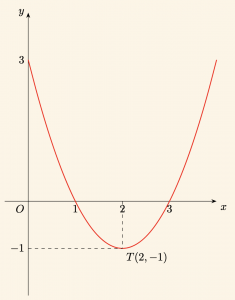
is sketched as shown above.
Example:
Let us sketch the graph of the parabola \[ f(x) = -x^2 + 2x + 3 \]
Since \( a = -1 < 0 \), the parabola opens downward. Let us determine the coordinates of the vertex:
\[
r = -\frac{b}{2a} = \frac{-2}{2(-1)} = 1
\]
\[
k = f(1) = – (1)^2 + 2(1) + 3 = 4
\]
\[
\Rightarrow T(1, 4)
\]
Finding the intercepts:
To find the x-intercepts, set \( y = 0 \):
\[
– x^2 + 2x + 3 = 0 \Rightarrow x^2 – 2x – 3 = 0
\]
\[
\Rightarrow (x – 3)(x + 1) = 0 \Rightarrow x_1 = -1 \quad \text{or} \quad x_2 = 3
\]
Thus, the x-intercepts are:
\[
(-1, 0) \quad \text{and} \quad (3, 0)
\]
To find the y-intercept, set \( x = 0 \):
\[
x = 0 \Rightarrow y = 3 \quad \Rightarrow (0, 3)
\]
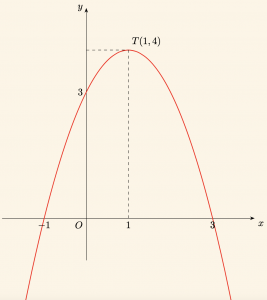
Example:
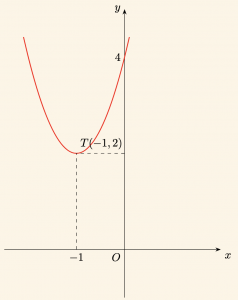
Let us sketch the graph of the parabola \[ f(x) = 2(x + 1)^2 + 2 \]
Direction of the Parabola:
Comparing this with the vertex form \[ y = a(x – r)^2 + k \] we see that:
\[
a = 2 > 0
\]
Therefore, the parabola opens upward.
Coordinates of the Vertex:
By inspection of the equation, \( r = -1 \) and \( k = 2 \):
\[
\Rightarrow T(-1,2)
\]
Finding the Intercepts:
To find the x-intercepts, we set \( y = 0 \):
\[
2(x + 1)^2 + 2 = 0 \Rightarrow 2(x+1)^2 = -2 \Rightarrow (x+1)^2 = -1
\]
Since the square of a real number cannot be negative, \( \Delta < 0 \) and there are no real roots. Thus, the parabola does not cross the x-axis.
Finding the y-intercept:
\[
x = 0 \Rightarrow y = 2(0 + 1)^2 + 2 = 4 \quad \Rightarrow (0, 4)
\]
Example:
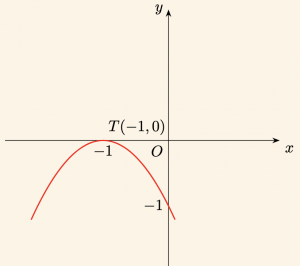
Let us sketch the graph of the parabola \[ f(x) = -x^2 – 2x – 1 \]
If we rewrite the function equation:
\[
y = -x^2 – 2x – 1
\]
Factoring out the negative sign gives a perfect square trinomial:
\[
y = – (x + 1)^2
\]
Comparing this with the vertex form \[ y = a(x – r)^2 + k \] we find:
\[
a = -1 < 0
\]
Hence, the parabola opens downward.
Coordinates of the Vertex:
Here, \( r = -1 \) and \( k = 0 \):
\[
\Rightarrow T(-1,0)
\]
Finding the Intercepts:
To find the x-intercepts, set \( y = 0 \):
\[
– x^2 – 2x – 1 = 0 \Rightarrow -(x+1)^2 = 0
\]
\[
\Rightarrow x_1 = x_2 = -1
\]
Since there is a repeated real root, the parabola is tangent to the x-axis at its vertex:
\[
(-1, 0)
\]
Finding the y-intercept:
\[
x = 0 \Rightarrow y = -1 \quad \Rightarrow (0, -1)
\]
Example:
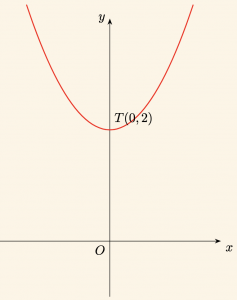
Let us sketch the graph of the parabola \[ y = x^2 + 2 \]
Direction of the Parabola:
Comparing with vertex form \( y = a(x – r)^2 + k \):
\[
a = 1 > 0
\]
Thus, the parabola opens upward.
Coordinates of the Vertex:
Here, \( r = 0 \) and \( k = 2 \):
\[
\Rightarrow T(0,2)
\]
Finding the Intercepts:
To locate any x-intercepts, we set \( y = 0 \):
\[
x^2 + 2 = 0 \Rightarrow x^2 = -2
\]
Since this equation has no real solutions (\( \Delta < 0 \)), the parabola does not intersect the x-axis.
Finding the y-intercept:
\[
x = 0 \Rightarrow y = 2 \quad \Rightarrow (0, 2)
\]
Properties and Conclusions:
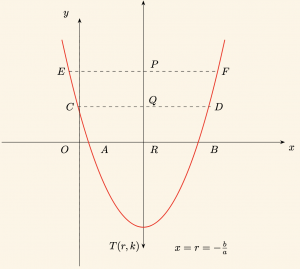
1) Axis of Symmetry: For any parabola \( y = ax^2 + bx + c \), the vertical line passing through its vertex is the axis of symmetry, given by the equation:
\[
x = -\frac{b}{2a}
\]
Because it is a line of symmetry, any horizontal line segment connecting two points on the parabola is bisected by it:
\[
|AR| = |RB|, \quad |CQ| = |QD|, \quad |EP| = |PF|, \dots
\]
2) Let \( x_1 \) and \( x_2 \) be the x-intercepts of the parabola \( y = ax^2 + bx + c \).
By the sum of roots formula, we know that \( x_1 + x_2 = -\frac{b}{a} \). Since the axis of symmetry \( r = -\frac{b}{2a} \) lies exactly midway between the roots:
\[
r = \frac{x_1 + x_2}{2}
\]
3) Maxima and Minima:
If \( a > 0 \), the vertex represents the lowest point on the graph. Thus, the minimum value of the function \( f(x) = ax^2 + bx + c \) is:
\[
k = \frac{4ac – b^2}{4a}
\]
If \( a < 0 \), the vertex represents the highest point on the graph. Thus, the maximum value of the function \( f(x) = ax^2 + bx + c \) is:
\[
k = \frac{4ac – b^2}{4a}
\]
4) Vertex Form Classification: Given the equation in vertex form:
\[
y = ax^2 + bx + c = a(x – r)^2 + k
\]
a) If \( r \neq 0 \) and \( k = 0 \), the vertex \( T(r,0) \) lies on the x-axis, meaning the parabola is tangent to the x-axis.
b) If \( r = 0 \) and \( k \neq 0 \), the vertex \( T(0,k) \) lies on the y-axis. Consequently, the y-axis is the axis of symmetry for the parabola.
In this case:
\[
r = -\frac{b}{2a} = 0 \Rightarrow b = 0
\]
c) If \( r = 0 \) and \( k = 0 \), the vertex \( T(0,0) \) is located exactly at the origin.
QUESTION 3
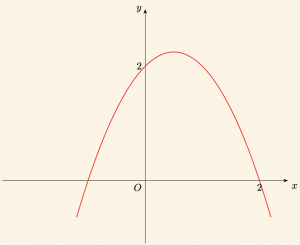 The equation of the parabola shown in the figure is:
\[
f(x) = -x^2 + bx + c
\]
What is the maximum value that \( f(x) \) can achieve?
\[
\text{A) } 3 \quad
\text{B) } \frac{9}{4} \quad
\text{C) } \frac{9}{5} \quad
\text{D) } \frac{3}{2} \quad
\text{E) } \frac{9}{7}
\]
Solution:
The parabola \( y = -x^2 + bx + c \) passes through the points \( (0,2) \) and \( (2,0) \).
Using the y-intercept \( (0,2) \), substitute \( x = 0 \):
\[
y = c = 2
\]
Using the x-intercept \( (2,0) \), substitute \( x = 2 \) and \( c = 2 \):
\[
y = -(2)^2 + b(2) + 2 = 0
\]
\[
\Rightarrow -4 + 2b + 2 = 0 \Rightarrow 2b – 2 = 0 \Rightarrow b = 1
\]
Thus, the exact equation of the parabola is:
\[
y = -x^2 + x + 2
\]
The maximum value corresponds to the y-coordinate of its vertex (\( k \)):
\[
k = \frac{4ac – b^2}{4a} = \frac{4(-1)(2) – (1)^2}{4(-1)}
\]
\[
= \frac{-8 – 1}{-4} = \frac{-9}{-4} = \frac{9}{4}
\]
\(\textbf{Correct Answer: B} \)
QUESTION 4
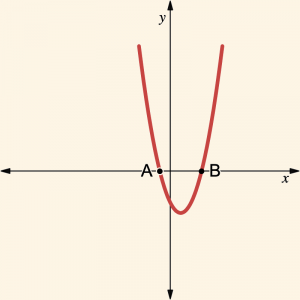
The equation of the parabola shown above is \( y = x^2 – 2x + c \). Given that \( |OB| = 3|OA| \), find the value of c.
\[
\text{A) } -5 \quad
\text{B) } -4 \quad
\text{C) } -3 \quad
\text{D) } -2 \quad
\text{E) } -1
\]
Solution:
Let the x-coordinates of the intercepts A and B be \( x_1 \) and \( x_2 \), respectively.
Since A lies on the negative x-axis and B lies on the positive x-axis, if we define the distance \( |OA| = m \), then \( |OB| = 3m \). This gives the roots as:
\[
x_1 = -m \quad \text{and} \quad x_2 = 3m
\]
The axis of symmetry \( r \) is the midpoint of these two roots:
\[
r = \frac{x_1 + x_2}{2} = \frac{-m + 3m}{2} = m
\]
Using the formula from the equation \( y = x^2 – 2x + c \):
\[
r = -\frac{b}{2a} = \frac{-(-2)}{2(1)} = 1 \Rightarrow m = 1
\]
Substituting \( m = 1 \) back into the roots yields:
\[
x_1 = -1 \quad \text{and} \quad x_2 = 3
\]
By Vieta’s formulas, the product of the roots is equal to \( \frac{c}{a} \):
\[
x_1 \cdot x_2 = \frac{c}{1} \Rightarrow (-1) \cdot 3 = c \Rightarrow c = -3
\]
\(\textbf{Correct Answer: C} \)
QUESTION 5
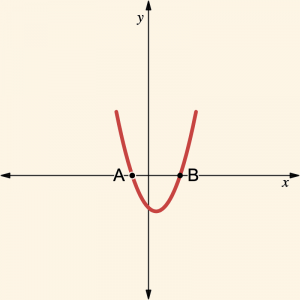
The equation of the parabola shown above is \( y = mx^2 + (m – 2)x – 2 \). If \( |AB| = 3 \) units, find the value of m.
\[
\text{A) } \frac{1}{3} \quad
\text{B) } \frac{1}{2} \quad
\text{C) } 1 \quad
\text{D) } 2 \quad
\text{E) } -3
\]
Solution 1:
Let us find the roots by setting the equation to zero:
\[
mx^2 + (m – 2)x – 2 = 0
\]
This trinomial can be factored as:
\[
(x + 1)(mx – 2) = 0
\]
\[
\Rightarrow x = -1 \quad \text{or} \quad x = \frac{2}{m}
\]
Thus, the coordinates of the intercepts are \( A(-1, 0) \) and \( B\left(\frac{2}{m}, 0\right) \). Since the graph indicates \( B \) is on the positive side of the x-axis, the distance between them is:
\[
|AB| = |AO| + |OB| = 3 \Rightarrow 1 + \frac{2}{m} = 3
\]
\[
\Rightarrow \frac{2}{m} = 2 \Rightarrow m = 1
\]
\(\textbf{Correct Answer: C} \)
Solution 2:
Let \( x_1 \) and \( x_2 \) be the x-intercepts at points A and B.
The distance formula between two roots on the x-axis is given by:
\[
|AB| = |x_2 – x_1| = \frac{\sqrt{\Delta}}{|a|} \Rightarrow 3 = \frac{\sqrt{\Delta}}{|m|}
\]
Evaluating the discriminant \( \Delta = b^2 – 4ac \):
\[
\Delta = (m-2)^2 – 4(m)(-2) = m^2 – 4m + 4 + 8m = m^2 + 4m + 4 = (m+2)^2
\]
Substituting \( \Delta \) back into the distance formula:
\[
3 = \frac{\sqrt{(m+2)^2}}{|m|} \Rightarrow 3 = \frac{|m + 2|}{|m|}
\]
Since the parabola opens upward, \( a = m > 0 \), so we can remove the absolute value signs:
\[
3m = m + 2 \Rightarrow 2m = 2 \Rightarrow m = 1
\]
\(\textbf{Correct Answer: C} \)
QUESTION 6
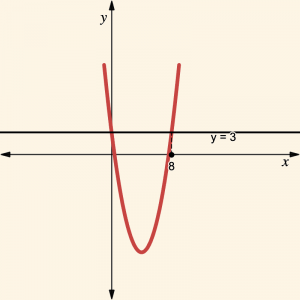
If the equation of the parabola shown above is
\[
y = f(x) = x^2 + bx + c
\]
what is the value of \( f(1) \)?
\[
\text{A) } 1 \quad
\text{B) } 0 \quad
\text{C) } -2 \quad
\text{D) } -4 \quad
\text{E) } -5
\]
Solution:
Let us examine the vertex properties from the given graph:

\[
r = -\frac{b}{2a}
\]
The graph explicitly shows that the axis of symmetry is at \( x = 4 \) (\( r = 4 \)). Given \( a = 1 \):
\[
4 = -\frac{b}{2 \cdot 1} \Rightarrow 4 = -\frac{b}{2}
\]
\[
\Rightarrow b = -8
\]
Furthermore, the graph shows that the y-intercept is at \( (0,3) \), which means:
\[
c = 3
\]
Substituting the values of \( b \) and \( c \) into our function expression gives:
\[
f(x) = x^2 – 8x + 3
\]
Now, we evaluate the function at \( x = 1 \):
\[
f(1) = (1)^2 – 8(1) + 3 = 1 – 8 + 3 = -4
\]
\(\textbf{Correct Answer: D} \)
QUESTION 7

Consider the two functions:
\[
y = \frac{m}{2}x^2+(m+2)x+2m-1
\]
\[
y = -x^2+2x+m+1
\]
Based on the provided graph, what is the length of segment AB in units?
\[
\text{A) } 2 \quad
\text{B) } 3 \quad
\text{C) } 4 \quad
\text{D) } 5 \quad
\text{E) } 6
\]
Solution:
The two given equations are:
\[
y_1 = \frac{m}{2} x^2 + (m+2)x + 2m – 1
\]
and
\[
y_2 = -x^2 + 2x + m + 1
\]
Since both parabolas share the exact same y-intercept on the graph, their constant terms must be equal:
\[
2m – 1 = m + 1 \Rightarrow m = 2
\]
Substituting \( m = 2 \) back into each equation lets us find their respective x-intercepts.
First parabola equation:
\[
y = \frac{2}{2}x^2 + (2+2)x + 2(2) – 1 \Rightarrow y = x^2 + 4x + 3
\]
Setting \( y = 0 \) to find its roots:
\[
x^2 + 4x + 3 = 0 \Rightarrow (x + 3)(x + 1) = 0 \Rightarrow x = -3 \quad \text{or} \quad x = -1
\]
As seen on the graph, point A is the leftmost root:
\[
A(-3, 0)
\]
Second parabola equation:
\[
y = -x^2 + 2x + 2 + 1 \Rightarrow y = -x^2 + 2x + 3
\]
Setting \( y = 0 \) to find its roots:
\[
-x^2 + 2x + 3 = 0 \Rightarrow x^2 – 2x – 3 = 0 \Rightarrow (x – 3)(x + 1) = 0
\]
\[
\Rightarrow x = -1 \quad \text{or} \quad x = 3
\]
Point B corresponds to the rightmost root:
\[
B(3,0)
\]
The length of segment AB is the horizontal distance between A and B:
\[
|AB| = 3 – (-3) = 6 \quad \text{units.}
\]
\(\textbf{Correct Answer: E} \)
QUESTION 8
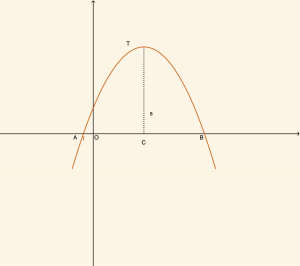
The figure shows a parabola with vertex \( T \) whose equation is given by:
\[
y = -x^2 + 2mx + 5m + 2
\]
Given that \(|OC| = 3|OB|\) and the product of the x-coordinates of points A, B, and C is \(-24\), what is the y-intercept of this parabola?
\[
\text{A) } 8 \quad
\text{B) } 9 \quad
\text{C) } 10 \quad
\text{D) } 11 \quad
\text{E) } 12
\]
Solution:
Let the x-coordinate of point B be \( r \). Since \( |OC| = 3|OB| \), the x-coordinate of point C is \( 3r \). Let the x-coordinate of point A be \( a \). Therefore, the coordinates on the axis are:
\[
A(a,0), \quad B(r,0), \quad C(3r,0)
\]
Since point B represents the vertex’s x-coordinate, the line \( x = r \) is the axis of symmetry between the roots A and C:
\[
r = \frac{a + 3r}{2} \Rightarrow 2r = a + 3r \Rightarrow a = -r
\]
We are given that the product of the x-coordinates of A, B, and C is \(-24\):
\[
a \cdot r \cdot 3r = -24 \Rightarrow (-r) \cdot r \cdot 3r = -24 \Rightarrow -3r^3 = -24 \Rightarrow r^3 = 8 \Rightarrow r = 2
\]
Using the vertex formula from the given function equation:
\[
r = -\frac{b}{2a} = -\frac{2m}{2(-1)} = m
\]
Since \( r = 2 \), it follows that \( m = 2 \). The y-intercept of the parabola is given by the constant term \( c \):
\[
\text{y-intercept} = 5m + 2 = 5(2) + 2 = 12
\]
\(\textbf{Correct Answer: E} \)
QUESTION 9
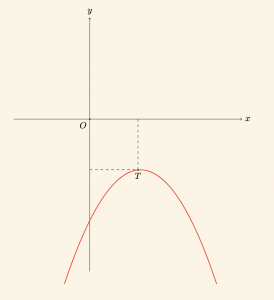
A parabola with vertex T and equation \[ y = ax^2 + bx + c \] is shown in the figure.
Which of the following inequalities is false?
\[
\text{A) } b^2 < 4ac \quad
\text{B) } a < 0 \quad
\text{C) } b > 0 \quad
\text{D) } c < 0 \quad
\text{E) } ab + c > 0
\]
Solution:
A) The parabola does not intersect the x-axis, meaning it has no real roots. Therefore, the discriminant must be negative:
\[
\Delta = b^2 – 4ac < 0 \Rightarrow b^2 < 4ac \quad \text{(True)}
\]
B) The branches of the parabola point downward, which implies that the leading coefficient is negative:
\[
a < 0 \quad \text{(True)}
\]
C) The vertex T lies in the second quadrant, meaning its x-coordinate (\( r \)) is positive. Using the vertex formula:
\[
r = -\frac{b}{2a} > 0
\]
Since we already know that \( a < 0 \), the denominator is negative. For the fraction to be positive, the numerator \( -b \) must be negative, which means:
\[
b > 0 \quad \text{(True)}
\]
D) The parabola crosses the y-axis below the origin, which means the y-intercept is negative:
\[
(0, c) \Rightarrow c < 0 \quad \text{(True)}
\]
E) Let us determine the sign of the expression \( ab + c \). Since \( a < 0 \) and \( b > 0 \), their product \( ab \) is negative. Since \( c < 0 \), adding it to another negative number must result in a negative value:
\[
ab + c < 0
\]
Therefore, statement E claims it is greater than zero, which is false.
\(\textbf{Correct Answer: E} \)
QUESTION 10
The parabola defined by \( y = x^2 + 3mx + 2m^2 + 1 \) is tangent to the x-axis on the positive side of the axis. What is the y-intercept of this parabola?
\[
\text{A) } 7 \quad
\text{B) } 8 \quad
\text{C) } 9 \quad
\text{D) } 10 \quad
\text{E) } 11
\]
Solution:
Since the parabola is tangent to the x-axis, it has a single double root, which means its discriminant must equal zero:
\[
\Delta = 0
\]
Additionally, because it is tangent on the positive side, the x-coordinate of its vertex (\( r \)) must be strictly positive:
\[
r > 0
\]
Let us compute the discriminant:
\[
\Delta = (3m)^2 – 4 \cdot 1 \cdot (2m^2 + 1) = 0
\]
\[
9m^2 – 8m^2 – 4 = 0 \Rightarrow m^2 – 4 = 0 \Rightarrow m = \pm 2
\]
Now, let us examine the vertex coordinate condition:
\[
r = -\frac{b}{2a} = -\frac{3m}{2 \cdot 1} = -\frac{3m}{2}
\]
For \( r > 0 \) to hold true, the parameter \( m \) must be negative (\( m < 0 \)). Thus, we select:
\[
m = -2
\]
The y-intercept corresponds to the constant term \( c \):
\[
c = 2m^2 + 1 = 2(-2)^2 + 1 = 2(4) + 1 = 9
\]
\(\textbf{Correct Answer: C} \)
QUESTION 11
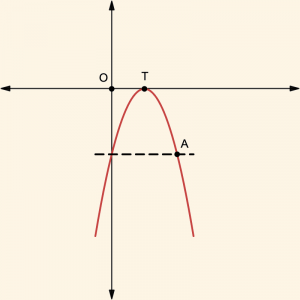
The figure above depicts a parabola whose vertex T lies directly on the x-axis, with the equation:
\[y = -x^2 – mx + 2m + 4\]
Find the x-coordinate of point A.
\[
\text{A) } 1 \quad\text{B) } 2 \quad
\text{C) } 3 \quad
\text{D) } 4 \quad
\text{E) } 5\]
Solution:

Since the parabola is tangent to the x-axis at its vertex, its discriminant must be zero:
\[
\Delta = (-m)^2 – 4 \cdot (-1) \cdot (2m + 4) = 0
\]
\[
m^2 + 4(2m + 4) = 0 \Rightarrow m^2 + 8m + 16 = 0
\]
\[
\Rightarrow (m + 4)^2 = 0 \Rightarrow m = -4
\]
Substituting \( m = -4 \) back into the function equation:
\[
y = -x^2 – (-4)x + 2(-4) + 4
\]
\[
y = -x^2 + 4x – 8 + 4 \Rightarrow y = -x^2 + 4x – 4
\]
Factoring out the negative sign reveals a perfect square:
\[
y = -(x^2 – 4x + 4) \Rightarrow y = -(x – 2)^2
\]
Thus, the vertex of the parabola is located at:
\[
T(2, 0)
\]
The vertical line \( x = 2 \) acts as the axis of symmetry. Since the origin \( (0,0) \) is exactly 2 units to the left of the axis of symmetry, point A (the other symmetric point on the x-axis at that height level) must lie exactly 2 units to the right of the axis of symmetry:
\[
x_A = 2 + 2 = 4
\]
\(\textbf{Correct Answer: D} \)
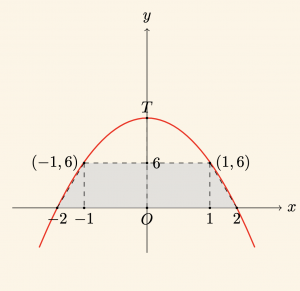
QUESTION 12
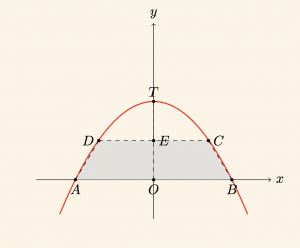
The figure above illustrates a parabola whose vertex T lies on the y-axis, defined by:
\[
y = mx^2 – (m^2 – 4)x + 8
\]
Given that the y-coordinate of point E is 6, what is the area of trapezoid ABCD in square units?
\[
\text{A) } 18 \quad
\text{B) } 16 \quad
\text{C) } 14 \quad
\text{D) } 12 \quad
\text{E) } 10
\]
Solution:
Because the vertex of the parabola lies on the y-axis, the x-coordinate of the vertex must be zero (\( r = 0 \)), which implies that the linear coefficient \( b \) is zero:
\[
b = -(m^2 – 4) = 0 \Rightarrow m^2 = 4 \Rightarrow m = 2 \quad \text{or} \quad m = -2
\]
Since the parabola opens downward, the leading coefficient must be negative (\( m < 0 \)). Therefore, we choose \( m = -2 \). Substituting this value into the equation yields:
\[
y = -2x^2 + 8
\]
Points C and D lie on the horizontal line \( y = 6 \). To find their x-coordinates, set \( y = 6 \):
\[
6 = -2x^2 + 8 \Rightarrow 2x^2 = 2 \Rightarrow x^2 = 1 \Rightarrow x = 1 \quad \text{and} \quad x = -1
\]
Thus, the coordinates of the upper base vertices are \( D(-1, 6) \) and \( C(1, 6) \), making the length of the top base:
\[
|DC| = 1 – (-1) = 2 \quad \text{units.}
\]
To find the lengths of the lower base, we look for the x-intercepts by setting \( y = 0 \):
\[
-2x^2 + 8 = 0 \Rightarrow 2x^2 = 8 \Rightarrow x^2 = 4 \Rightarrow x = 2 \quad \text{and} \quad x = -2
\]
Thus, the base vertices are \( A(-2, 0) \) and \( B(2, 0) \), making the length of the bottom base:
\[
|AB| = 2 – (-2) = 4 \quad \text{units.}
\]
The height of the trapezoid is given by the y-coordinate of point E, which is \( h = 6 \). We can now compute the area of trapezoid ABCD:
\[
\text{Area}(ABCD) = \frac{(\text{base}_1 + \text{base}_2) \cdot h}{2} = \frac{(4 + 2) \cdot 6}{2} = \frac{6 \cdot 6}{2} = 18 \quad \text{square units.}
\]
\(\textbf{Correct Answer: A} \)
← Previous Page | Next Page →