
Inequalities with Absolute Value and Radicals
\( 1. \quad \text{Given that } g(x) > 0 \)
\[ \text{If } \quad \left| f(x) \right| < g(x), \quad \text{ then } \quad -g(x) < f(x) < g(x). \]
QUESTION 18
Which of the following options is one of the intervals that satisfy the inequality?
\[ \left| x^2 – x – 1 \right| < 5 \]
\[ \text{A) } x < -2 \quad
\text{B) } -3 < x < -1 \quad
\text{C) } -2 < x < 3 \quad
\text{D) } x > 3 \quad
\text{E) } 3 < x < 4 \]
Solution:
\[\left| x^2 – x – 1 \right| < 5 \Rightarrow -5 < x^2 – x – 1 < 5 \]
We rewrite this compound inequality as two separate inequalities that must both be satisfied:
\[-5 < x^2 – x – 1 \quad \text{and} \quad x^2 – x – 1 < 5 \]
Evaluating the first inequality:
\[ x^2 – x + 4 > 0 \]
Since the leading coefficient is $a = 1 > 0$ and the discriminant is $\Delta = (-1)^2 – 4(1)(4) = -15 < 0$, the expression is always positive. Thus, its solution set is:
\[ \mathcal{S}_1 = \mathbb{R} \]
Evaluating the second inequality:
\[ x^2 – x – 1 < 5 \Rightarrow x^2 – x – 6 < 0 \]
Factoring gives $(x – 3)(x + 2) < 0$, which yields the critical points $x = -2$ and $x = 3$.
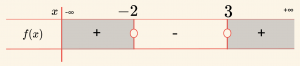
The solution set for the second inequality is:
\[ \mathcal{S}_2 = \{ x \mid -2 < x < 3, \, x \in \mathbb{R} \} \]
The final solution set is the intersection of $\mathcal{S}_1$ and $\mathcal{S}_2$:
\[ \mathcal{S} = \mathcal{S}_1 \cap \mathcal{S}_2 = \{ x \mid -2 < x < 3, \, x \in \mathbb{R} \} \]
\(\textbf{Answer: C} \)
QUESTION 19
Which of the following options is one of the intervals that satisfy the inequality?
\[ \left| x^2 – 3x – 1 \right| < x + 4 \]
\[\text{A) } -3 < x < -1 \quad
\text{B) } -1 < x < 5 \quad
\text{C) } 5 < x < 7 \quad
\text{D) } x < -3 \quad
\text{E) } x > 7 \]
Solution:
For the absolute value inequality to have a valid solution set, the bounding expression must be positive:
\[ x + 4 > 0 \Rightarrow x > -4 \]
Applying the property of absolute value inequalities:
\[ \left| x^2 – 3x – 1 \right| < x + 4 \Rightarrow -(x + 4) < x^2 – 3x – 1 < x + 4 \]
We split this into a system of two inequalities:
\[ -x – 4 < x^2 – 3x – 1 \quad \text{and} \quad x^2 – 3x – 1 < x + 4 \]
Evaluating the first inequality:
\[ x^2 – 2x + 3 > 0 \]
Since $a = 1 > 0$ and $\Delta = (-2)^2 – 4(1)(3) = -8 < 0$, this expression is always positive for all real numbers:
\[ \mathcal{S}_1 = \mathbb{R} \]
Evaluating the second inequality:
\[ x^2 – 3x – 1 < x + 4 \Rightarrow x^2 – 4x – 5 < 0 \]
Factoring gives $(x – 5)(x + 1) < 0$, which yields the roots $x = -1$ and $x = 5$.
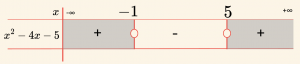
The solution set for this part is:
\[ \mathcal{S}_2 = \{ x \mid -1 < x < 5, \; x \in \mathbb{R} \} \]
Taking the intersection of all conditions ($\mathcal{S}_1$, $\mathcal{S}_2$, and $x > -4$), we get:
\[ \mathcal{S} = \mathcal{S}_1 \cap \mathcal{S}_2 = \{ x \mid -1 < x < 5, \; x \in \mathbb{R} \} \]
\(\textbf{Answer: B} \)
\( 2. \quad \text{If } | f(x) | > g(x), \text{ then } f(x) > g(x) \text{ or } f(x) < -g(x) \)
QUESTION 20
Which of the following options is one of the intervals that satisfy the inequality?
\[\left| x^2 + x – 5 \right| > 2x + 1 \]
\[ \text{A) } x < 3 \quad
\text{B) } -3 < x < 2 \quad
\text{C) } -1 < x < 3 \quad
\text{D) } x > 3 \quad
\text{E) } x < 2 \]
Solution:
\[ \left| x^2 + x – 5 \right| > 2x + 1 \Rightarrow
\begin{cases}
x^2 + x – 5 > 2x + 1 \\
\text{or} \\
x^2 + x – 5 < -(2x + 1)
\end{cases} \]
This results in two separate quadratic conditions:
\[ x^2 – x – 6 > 0 \quad \text{or} \quad x^2 + 3x – 4 < 0 \]
Evaluating the first condition, $x^2 – x – 6 > 0 \Rightarrow (x – 3)(x + 2) > 0$:
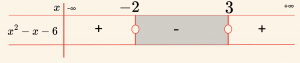
\[ \mathcal{S}_1 = \{ x \mid x < -2 \text{ or } x > 3, \; x \in \mathbb{R} \} \]
Evaluating the second condition, $x^2 + 3x – 4 < 0 \Rightarrow (x + 4)(x – 1) < 0$:
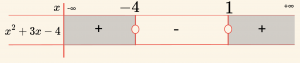
\[ \mathcal{S}_2 = \{ x \mid -4 < x < 1, \; x \in \mathbb{R} \} \]
Since the conditions are connected by “or”, we find the union of both solution sets ($\mathcal{S}_1 \cup \mathcal{S}_2$):
\[ \mathcal{S} = \{ x \mid x < 1 \text{ or } x > 3, \; x \in \mathbb{R} \} \]
Looking at the given options, the interval $x > 3$ is completely contained within this solution set.
\(\textbf{Answer: D} \)
QUESTION 21
Which of the following options is one of the intervals that satisfy the inequality?
\[x^2 + x + 4 < \left| -2x^2 + x – 1 \right| < x^2 + x + 9 \]
\[\text{A) } -2 < x < -1 \quad
\text{B) } x < -2 \quad
\text{C) } -1 < x < 3 \quad
\text{D) } x > 3 \quad
\text{E) } 4 < x < 5 \]
Solution:
Let us look at the trinomial inside the absolute value, \( -2x^2 + x – 1 \). Here, $a = -2 < 0$ and $\Delta = 1^2 – 4(-2)(-1) = -7 < 0$.
Since the discriminant is negative and the leading coefficient is negative, the value of the trinomial is strictly negative for all real numbers:
\[ \forall x \in \mathbb{R}, \quad -2x^2 + x – 1 < 0 \]
Therefore, we can clear the absolute value by reversing the signs:
\[ \left| -2x^2 + x – 1 \right| = 2x^2 – x + 1 \]
Now we substitute this back into the compound inequality:
\[ x^2 + x + 4 < 2x^2 – x + 1 < x^2 + x + 9 \]
This splits into a system of two inequalities:
\[ x^2 + x + 4 < 2x^2 – x + 1 \quad \text{and} \quad 2x^2 – x + 1 < x^2 + x + 9 \]
\[ \Rightarrow -x^2 + 2x + 3 < 0 \quad \text{and} \quad x^2 – 2x – 8 < 0 \]
We find the roots for both expressions to construct a combined sign chart:
– For $-x^2 + 2x + 3 = 0 \Rightarrow -(x – 3)(x + 1) = 0 \Rightarrow x = -1, \, x = 3$
– For $x^2 – 2x – 8 = 0 \Rightarrow (x – 4)(x + 2) = 0 \Rightarrow x = -2, \, x = 4$
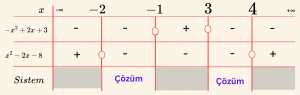
Finding the intersection where both conditions are satisfied:
\[ \mathcal{S} = \{ x \mid -2 < x < -1 \quad \text{or} \quad 3 < x < 4, \; x \in \mathbb{R} \} \]
\(\textbf{Answer: A} \)
\( 3. \quad \text{If } | f(x) | < | g(x) |, \text{ then } [f(x)]^2 < [g(x)]^2. \)
QUESTION 22
Which of the following intervals satisfies the inequality?
\[|x^2 – 3| < |x – 3| \]
\[\text{A) } -4 < x < 1 \quad
\text{B) } 0 < x < 1 \quad
\text{C) } x < -3 \quad
\text{D) } x > 2 \quad
\text{E) } 1 < x < 2 \]
Solution:
Since both sides are non-negative, squaring both sides preserves the inequality:
\[|x^2 – 3| < |x – 3| \Rightarrow |x^2 – 3|^2 < |x – 3|^2\]
\[\Rightarrow x^4 – 6x^2 + 9 < x^2 – 6x + 9 \]
\[\Rightarrow x^4 – 7x^2 + 6x < 0 \]
Now we find the roots of the polynomial equation $x^4 – 7x^2 + 6x = 0$:
\[ x(x^3 – 7x + 6) = 0 \Rightarrow x(x – 1)(x – 2)(x + 3) = 0 \]
The critical roots are:
\[ x_1 = -3, \quad x_2 = 0, \quad x_3 = 1, \quad x_4 = 2 \]
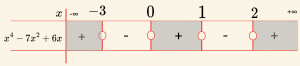
The regions where the polynomial is strictly negative are:
\[ \mathcal{S} = \{ x \mid -3 < x < 0 \quad \text{or} \quad 1 < x < 2, \; x \in \mathbb{R} \} \]
\(\textbf{Answer: E} \)
QUESTION 23
Which of the following intervals satisfies the inequality ?
\[ (|x – 2| – |x + 1| – x + 2 < 0 \]
\[\text{A) } -1 < x < 1 \quad
\text{B) } x > 1 \quad
\text{C) } x < -2 \quad
\text{D) } -2 < x < 0 \quad
\text{E) } 0 < x < 3 \]
Solution:
Let us analyze the critical points where the expressions inside the absolute value change signs. The roots are $x = 2$ and $x = -1$
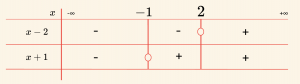
Based on these intervals, we solve the inequality by considering three distinct cases:
Case 1: When \(x \leq -1\)
Both absolute value terms are non-positive, so their signs flip when cleared:
\[\begin{aligned} &- (x – 2) – [ – (x + 1) ] – x + 2 < 0 \\
&\Rightarrow -x + 2 + x + 1 – x + 2 < 0 \\
&\Rightarrow -x + 5 < 0 \\
&\Rightarrow x > 5
\end{aligned}\]
Since the condition $x > 5$ has no intersection with our case constraint $x \leq -1$, this case yields no solution:
\[ \mathcal{S}_1 = \emptyset \]
Case 2: When \(-1 \leq x \leq 2\)
The term $x-2$ is non-positive, while $x+1$ is non-negative:
\[\begin{aligned}
&- (x – 2) – (x + 1) – x + 2 < 0 \\
&\Rightarrow -x + 2 – x – 1 – x + 2 < 0 \\
&\Rightarrow -3x + 3 < 0 \\
&\Rightarrow x > 1
\end{aligned}\]
Intersecting $x > 1$ with our case interval \(-1 \leq x \leq 2\) gives:
\[ \mathcal{S}_2 = \{x \mid 1 < x \leq 2,\, x \in \mathbb{R}\} \]
Case 3: When \(x \geq 2\)
Both absolute value terms are non-negative, so they are cleared without any sign changes:
\[\begin{aligned}&x – 2 – (x + 1) – x + 2 < 0 \\
&\Rightarrow x – 2 – x – 1 – x + 2 < 0 \\
&\Rightarrow -x – 1 < 0 \\
&\Rightarrow x > -1
\end{aligned}\]
Intersecting $x > -1$ with our case interval $x \geq 2$ gives back the entire interval:
\[ \mathcal{S}_3 = \{x \mid x \geq 2,\, x \in \mathbb{R}\} \]
Combining the solutions from all three cases ($\mathcal{S}_1 \cup \mathcal{S}_2 \cup \mathcal{S}_3$):
\[ \mathcal{S} = \{x \mid x > 1,\, x \in \mathbb{R}\} \]
\(\textbf{Answer: B} \)
QUESTION 24
How many integer values of $x$ satisfy the inequality ?
\[ f(x) = \frac{\sqrt{x + 3} \cdot (x^2 – 16)}{| -x^2 + x + 2 |} < 0 \]
\[\text{A) } 5 \quad
\text{B) } 4 \quad
\text{C) } 3 \quad
\text{D) } 2 \quad
\text{E) } 1 \]
Solution:
Let us first determine the constraints for the domain of $f(x)$:
1. The radicand of the square root must be non-negative: $x + 3 \geq 0 \Rightarrow x \geq -3$. Since it is a strict inequality $f(x) < 0$, the root cannot be zero, meaning $x > -3$. For all values in this region, $\sqrt{x+3} > 0$, so it does not affect the sign configuration of the chart.
2. The denominator cannot be zero: $|-x^2 + x + 2| \neq 0 \Rightarrow -(x – 2)(x + 1) \neq 0$, which means $x \neq 2$ and $x \neq -1$. Since an absolute value expression is always positive everywhere else, it also does not alter the sign transitions in our intervals.
Therefore, the sign of $f(x)$ depends entirely on the sign of the polynomial term $x^2 – 16$.
We solve $x^2 – 16 < 0 \Rightarrow (x – 4)(x + 4) < 0$:
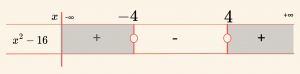
This gives the base interval $-4 < x < 4$. Now we apply our domain constraints:
\[ x > -3, \quad x \neq -1, \quad x \neq 2 \]
Applying these constraints to the interval $(-4, 4)$ yields the valid integer solutions:
\[ x \in \{-2, 0, 1, 3\} \]
There are exactly four integer values.
\(\textbf{Answer: B} \)
QUESTION 25
Which of the following intervals satisfies the inequality \[\sqrt[3]{x^3 \;- \;2x^2 + 1} \leq x\; – \;1 \]?
\[\text{A) } x < -2 \quad
\text{B) } -2 < x < -1 \quad
\text{C) } -1 < x \leq 1 \quad
\text{D) } 1 \leq x \leq 2 \quad
\text{E) } x > 2 \]
Solution:
Since cube roots preserve inequalities across all real numbers without domain constraints, we can cube both sides directly:
\[ \left( \sqrt[3]{x^3 \;-\; 2x^2 + 1} \right)^3 \leq (x\; – \;1)^3 \]
We expand the right side using the perfect cube identity:
\[ x^3\; – \; 2x^2 + 1 \leq x^3 \;- \;3x^2 + 3x\; – 1 \]
Subtracting $x^3$ from both sides and moving all terms to the left gives:
\[ x^2 \;- \; 3x + 2 \leq 0 \]
Factoring the quadratic expression gives $(x – 1)(x – 2) \leq 0$, which yields the roots $x = 1$ and $x = 2$.
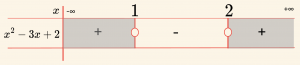
The solution set is:
\[ \mathcal{S} = \{ x \mid 1 \leq x \leq 2,\ x \in \mathbb{R} \} \]
\(\textbf{Answer: D}\)
QUESTION 26
Which of the following intervals satisfies the inequality \[x – 1 < \sqrt{-x^2 + 3x + 4}\]?
\[\text{A) } -1 \leq x < 3 \quad
\text{B) } 0 < x < 4 \quad
\text{C) } 2 < x < 4 \quad
\text{D) } x \geq 3\quad
\text{E) } x < 1 \]
Solution:
For the square root expression to be defined in the set of real numbers, the radicand must be non-negative:
\[ – x^2 + 3x + 4 \geq 0 \Rightarrow x^2 – 3x – 4 \leq 0 \]
Factoring gives $(x – 4)(x + 1) \leq 0$, meaning the domain constraint is:
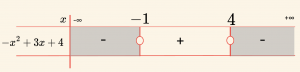
\[ -1 \leq x \leq 4 \]
Now we analyze the inequality within this domain by splitting it into two distinct cases based on the sign of the left-hand side expression:
Case 1: When the left side is strictly negative
\[ x – 1 < 0 \Rightarrow x < 1 \]
Whenever $x < 1$, the left side is negative while the right side (the square root) is always non-negative. A negative number is always less than a non-negative number, so the inequality automatically holds true for this entire region. Intersecting $x < 1$ with our domain $[-1, 4]$ gives:
\[ \mathcal{S}_1 = \{ x \mid -1 \leq x < 1,\ x \in \mathbb{R} \} \]
Case 2: When the left side is non-negative
\[ x – 1 \geq 0 \Rightarrow x \geq 1 \]
Since both sides are non-negative, squaring both sides preserves the inequality:
\[ (x – 1)^2 < \left( \sqrt{-x^2 + 3x + 4} \right)^2 \]
\[ \Rightarrow x^2 – 2x + 1 < -x^2 + 3x + 4 \]
\[ \Rightarrow 2x^2 – 5x – 3 < 0 \]
Factoring this quadratic gives $(2x + 1)(x – 3) < 0$, which yields the roots $x = -\frac{1}{2}$ and $x = 3$
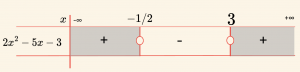
The interval for this quadratic condition is $-\frac{1}{2} < x < 3$. Now we find its intersection with our case constraint $x \geq 1$ and the overall domain $[-1, 4]$:
\[ \mathcal{S}_2 = \{ x \mid 1 \leq x < 3,\ x \in \mathbb{R} \} \]
The total solution set is the union of the solutions from both cases ($\mathcal{S}_1 \cup \mathcal{S}_2$):
\[ \mathcal{S} = \{ x \mid -1 \leq x < 3,\ x \in \mathbb{R} \} \]
\(\textbf{Answer: A} \)
QUESTION 27
Which of the following intervals satisfies the inequality \[x + 2 > \sqrt{x^2 \; – 16}\]?
\[\text{A) } x < -5 \quad
\text{B) } -5 < x < -4\quad
\text{C) } -4 < x < -2 \quad
\text{D) } -2 < x < 4\quad
\text{E) } x \geq 4 \]
Solution:
To solve this radical inequality, we must build a system of conditions that must be simultaneously satisfied:
1. The expression inside the square root must be non-negative for it to be a real number:
\[ x^2 – 16 \geq 0 \Rightarrow x \leq -4 \quad \text{or} \quad x \geq 4 \]
2. Since a square root yields a non-negative value, for the expression $x + 2$ to be strictly greater than it, $x + 2$ must be strictly positive:
\[ x + 2 > 0 \Rightarrow x > -2 \]
3. When both sides are verified to be non-negative, squaring both sides preserves the inequality structure:
\[ (x + 2)^2 > \left(\sqrt{x^2 – 16}\right)^2 \Rightarrow x^2 + 4x + 4 > x^2 – 16 \]
\[ \Rightarrow 4x + 20 > 0 \Rightarrow x > -5 \]
Now we find the intersection of all these conditions:
\[
\left.
\begin{aligned}
&x > -5 \\
&x \leq -4 \quad \text{or} \quad x \geq 4 \\
&x > -2
\end{aligned}
\right\}
\]
Let us test the overlapping regions on a sign chart layout:
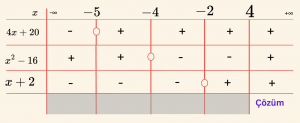
Intersecting the condition $x > -2$ with the domain blocks $(x \le -4 \text{ or } x \ge 4)$ leaves only the positive block as a valid region.
\[ \mathcal{S} = \{ x \mid x \geq 4,\ x \in \mathbb{R} \} \]
\(\textbf{Answer: E} \)
QUESTION 28
How many integer values of $x$ satisfy the inequality?
\[ \sqrt[x – 1]{2^{x^2 + 5x} } \geq 4^x \]
\[\text{A) } 4 \quad
\text{B) } 5\quad
\text{C) } 6\quad
\text{D) } 7\quad
\text{E) } 8 \]
Solution:
We rewrite the radical expression using fractional exponents and match the bases to $2$:
\[ 2^{\frac{x^2 + 5x}{x – 1}} \geq (2^2)^x \Rightarrow 2^{\frac{x^2 + 5x}{x – 1}} \geq 2^{2x} \]
Since the base $2 > 1$, the inequality configuration is preserved when comparing the exponents:
\[ \frac{x^2 + 5x}{x – 1} \geq 2x \]
Moving all terms to one side to find a common denominator:
\[ \frac{x^2 + 5x}{x – 1} – 2x \geq 0 \Rightarrow \frac{x^2 + 5x – 2x(x – 1)}{x – 1} \geq 0 \]
\[ \Rightarrow f(x) = \frac{-x^2 + 7x}{x – 1} \geq 0 \]
We find the roots of the numerator and denominator:
– $-x^2 + 7x = 0 \Rightarrow -x(x – 7) = 0 \Rightarrow x = 0, \, x = 7$
– $x – 1 = 0 \Rightarrow x = 1$
Now we layout these roots on a sign chart:
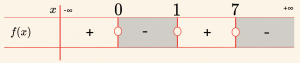
From the chart, the expression is non-negative on the intervals: $x \leq 0$ or $1 < x \leq 7$
Additionally, for the index of a radical expression to be valid in standard algebraic applications, it must be an integer greater than or equal to $2$:
\[ x – 1 \geq 1 \Rightarrow x \geq 2 \quad \text{where } x \in \mathbb{Z} \]
Intersecting the regions from the sign chart with the constraint $x \geq 2$ gives:
\[ \mathcal{S} = \{ x \mid 2 \leq x \leq 7,\ x \in \mathbb{Z} \} \]
The valid integer values are $2, 3, 4, 5, 6$, and $7$. There are exactly six integer values.
\(\textbf{Answer: C} \)
← Previous Page | Next Page →