
Trigonometric Functions
1) The Cosine and Sine Functions:
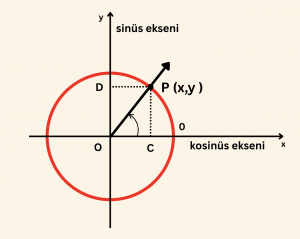
The x-coordinate (abscissa) of the point P, where the terminal side (OP) of an angle \( \alpha \) intersects the unit circle, is called the cosine of \( \alpha \) and is denoted by “\( \cos \alpha \)”.
The y-coordinate (ordinate) of the point P is called the sine of \( \alpha \) and is denoted by \( \sin \alpha \).
Therefore,
\[
\begin{aligned}
\cos \alpha &= |OC| = x \\
\sin \alpha &= |OD| = y
\end{aligned}
\]
On the unit circle, the x-axis is referred to as the cosine axis, and the y-axis is referred to as the sine axis.
Example:
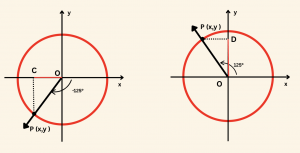
Let us sketch the unit circle to illustrate the values of \( \cos(-125^\circ) \) and \( \sin125^\circ \).
← Previous Page | Next Page →
\[
\cos(-125^\circ) = -|OC| < 0 \]
\[\sin(125^\circ) = |OD| > 0
\]
Now, let us find the cosine and sine values for acute angles.
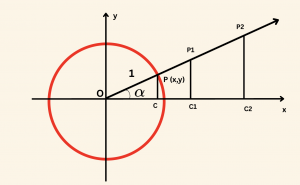
Note that,
\[
\triangle OPC \sim \triangle OP_1C_1 \sim \triangle OP_2C_2 \sim \ldots
\]
It follows that,
\[
\cos \alpha = x = \frac{|OC|}{1} = \frac{|OC|}{|OP|} = \frac{|OC_1|}{|OP_1|} = \frac{|OC_2|}{|OP_2|} = \ldots
\]
Consequently, in a right-angled triangle,
\[
\cos \alpha = \frac{\text{length of the adjacent side}}{\text{length of the hypotenuse}}
\]
Similarly,
\[
\sin \alpha = y = \frac{|CP|}{1} = \frac{|CP|}{|OP|} = \frac{|C_1P_1|}{|OP_1|} = \frac{|C_2P_2|}{|OP_2|} = \ldots
\]
Consequently, in a right-angled triangle,
\[
\sin \alpha = \frac{\text{length of the opposite side}}{\text{length of the hypotenuse}}
\]
2) The Tangent and Cotangent Functions:
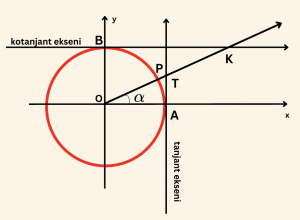
Let the terminal side ([OP]) of an angle \( \alpha \) intersect the tangent line drawn to the unit circle at point A at point T, and the tangent line drawn at point B at point K.
The y-coordinate of point T is called the tangent of \( \alpha \) and is denoted by \( \tan \alpha \).
The x-coordinate of point K is called the cotangent of \( \alpha \) and is denoted by \( \cot \alpha \).
Therefore,
\[
\begin{aligned}
\tan \alpha &= \frac{\sin \alpha}{\cos \alpha} = |AT| \\ \\ \cot \alpha &= \frac{\cos \alpha}{\sin \alpha} = |BK|
\end{aligned}
\]
The tangent line drawn to the unit circle at A(1, 0) is called the tangent axis, and the tangent line drawn at B(0, 1) is called the cotangent axis.
Example:
Let us sketch the unit circle to illustrate the values of \( \tan40°, \;\; \tan230°, \;\; \) and \( \cot330° \).
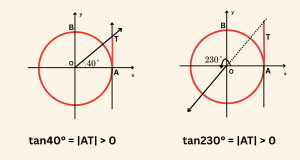
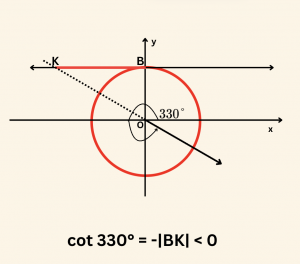
Now, let us evaluate the tangent and cotangent values for acute angles.
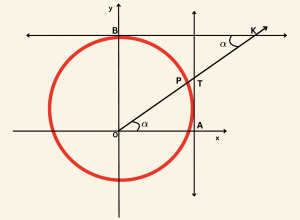
Here,
\[
\tan \alpha = |AT| = \frac{|AT|}{1} = \frac{|AT|}{|OA|}
\]
Thus, in a right-angled triangle,
\[
\tan \alpha = \frac{\text{length of the opposite side}}{\text{length of the adjacent side}}
\]
Similarly,
\[
\cot \alpha = |BK| = \frac{|BK|}{1} = \frac{|BK|}{|OB|}
\]
Thus, in a right-angled triangle,
\[
\cot \alpha = \frac{\text{length of the adjacent side}}{\text{length of the opposite side}}
\]
3) The Secant and Cosecant Functions:
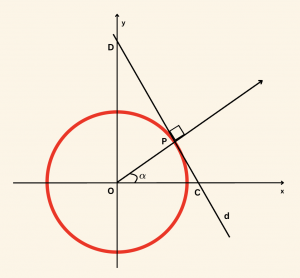
Let line \( d \) be tangent to the unit circle at point P, where the terminal side ([OP]) of an angle \( \alpha \) intersects the circle.
The x-coordinate of point C is called the secant of \( \alpha \) and is denoted by \( \sec \alpha \).
The y-coordinate of point D is called the cosecant of \( \alpha \) and is denoted by \( \csc \alpha \).
Therefore,
\[
\begin{aligned}
\sec \alpha &= \frac{1}{\cos \alpha} = |OC| \\
\csc \alpha &= \frac{1}{\sin \alpha} = |OD|
\end{aligned}
\]