
The Law of Tangents
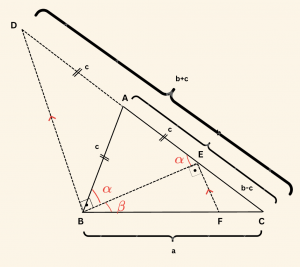
Let us assume \( a > b > c \) in triangle ABC.
Construct points \(D\) and \(E\) such that \( |AD| = |AB| = |AE| = c \). Consequently, triangle EBD becomes a right triangle with \( m(\hat{ EBD}) = 90^\circ \).
Let us draw \( [BD] \parallel [EF] \), which gives \( m(\hat{ BEF} ) = 90^\circ \).
Let \( m(\hat { ABE}) = m(\hat { AEB}) = \alpha \) and \( m(\hat{ EBC}) = \beta \).
In triangle BEC, we can write \( \alpha = \beta + C \) and therefore \( \alpha\; -\; \beta = C \).
Since \( \alpha + \beta = B \), we can solve for \(\alpha\) and \(\beta\) to find:
\[ \alpha = \frac{B + C}{2} \quad \text{and} \quad \beta = \frac{B – C}{2} \]
In right triangle DBE:
\[ \tan \left( \frac{B + C}{2} \right) = \frac{|BD|}{|BE|} \]
In right triangle BEF:
\[ \tan \left( \frac{B – C}{2} \right) = \frac{|EF|}{|BE|} \]
Dividing these two equations side by side gives:
\[
\frac{\tan \left( \frac{B + C}{2} \right)}{\tan \left( \frac{B\; -\; C}{2} \right)} = \frac{|BD|}{|EF|}
\]
Since \( \triangle DBC \sim \triangle EFC \) (similar triangles), their corresponding sides are proportional:
\[
\frac{|BD|}{|EF|} = \frac{|CD|}{|CE|}
\]
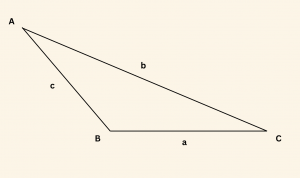
Therefore, we obtain the standard Law of Tangents formula:
\[
\frac{\tan \left( \frac{B + C}{2} \right)}{\tan \left( \frac{B – C}{2} \right)} = \frac{b + c}{b – c}
\]
Example:
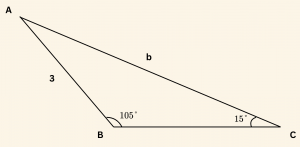
Based on the given figure, let us find the side length \( |AC| = b \).
First, calculate the half-sum and half-difference of the angles:
\[
\frac{B + C}{2} = \frac{105^\circ + 15^\circ}{2} = 60^\circ
\]
\[
\frac{B – C}{2} = \frac{105^\circ – 15^\circ}{2} = 45^\circ
\]
Applying the Law of Tangents to triangle ABC:
\[\begin{aligned}& \frac{\tan \left( \frac{B + C}{2} \right)}{\tan \left( \frac{B – C}{2} \right)} = \frac{b + c}{b – c}
\Rightarrow \frac{\tan 60^\circ}{\tan 45^\circ} = \frac{b + 3}{b – 3} \end{aligned}\]
Substituting the trigonometric values and solving for \(b\):
\[\begin{aligned}\Rightarrow \frac{\sqrt{3}}{1} = \frac{b + 3}{b – 3} \\ \\
\Rightarrow \sqrt{3} \cdot (b – 3) = b + 3 \\ \\
\Rightarrow \sqrt{3} b – 3 \sqrt{3} = b + 3 \\ \\
\Rightarrow \sqrt{3} b – b = 3 + 3 \sqrt{3} \\ \\
\Rightarrow b(\sqrt{3} – 1) = 3(1 + \sqrt{3}) \end{aligned}\]
\[
\Rightarrow b = 6 + 3 \sqrt{3} \text{ units.}
\]
← Previous Page | Next Page →