
Operations with Decimal Numbers
1. Addition and Subtraction:
When adding or subtracting decimal numbers, care must be taken to ensure that the arithmetic place values and the decimal points of the numbers are aligned vertically. The operation is initially carried out according to the standard rules of whole numbers, as if the decimal points were not present at all. Afterward, the resulting sum or difference is separated by a decimal point aligned vertically with the points above.
In cases where the operations are written side-by-side, digits with the same place value are processed among themselves from right to left, and the decimal point is placed immediately to the left of the tenths place.
Warning: If the number of digits after the decimal point does not match during this process, the place values are balanced by appending as many zeros as necessary to the right end of the number with fewer decimal places.
Examples:
1) Let’s add the numbers \( 217.72\), \( 16.4\), and \( 3.215\).
\[\begin{align*}
&\phantom{+} &217.720 \\
&\phantom{+} &16.400 \\
+ &\phantom{+} &3.215 \\
\hline &\phantom{+} &237.335
\end{align*}
\]
or
\[\begin{array}{l l }
217.720 + 16.400 + 3.215 = 237.335
\end{array}\]
2) Let’s find the result of the operation \( 3.12 – 2.108\).
\[\begin{align*}
&\phantom{-} &3.120\\
-&\phantom{-} &2.108 \\
\hline &\phantom{-} &1.012
\end{align*}
\]
or
\[\begin{array}{l l }
3.120 – 2.108 = 1.012 \quad \text{is found.}
\end{array}\]
3) Let’s find the result of the operation \( 1.7 – 1.92\).
\[\begin{array}{l l }
1.7 – 1.92 = 1.70 – 1.92 = -0.22 \quad \text{holds.}
\end{array}\]
2. Multiplication:
When multiplying two decimal expressions, the decimal points are completely ignored, and the multiplication algorithm for natural numbers is applied exactly as usual. Once the multiplication is complete, the total number of decimal places in the factors is determined. This total number of places is counted from the rightmost side toward the left of the final product and separated by a decimal point. If there are insufficient digits, the missing positions are filled with zeros.
Example 1:
\[
\begin{align*}
3.84&\leftarrow \text{ 2 decimal places} \\
\times \quad 1.7&\leftarrow \text{ 1 decimal place} \\
\hline
\phantom{00}2688& \\
+ \phantom{0}384\phantom{0}& \\
\hline
6.528&\leftarrow \text{ 3 (= 2 + 1) decimal places}
\end{align*}
\]
Example 2:
\[
\begin{align*}
0.003&&\leftarrow \text{ 3 decimal places} \\
\times \quad 4&& \leftarrow \text{ 0 decimal places} \\
\hline
0.012&&\leftarrow \text{ 3 decimal places}
\end{align*}
\]
Warning: When multiplying a decimal number practically by positive powers of 10, the decimal point is shifted to the right by as many places as there are zeros at the end of the multiplier. If no digits remain to move past after the decimal point, trailing zeros are appended to the right of the number.
Examples:
- \[\begin{array}{l l } 1.15 \cdot 10 = \displaystyle\frac{115}{100} \cdot 10 =\displaystyle \frac{115}{10} =11.5 \\ 1.15 \cdot 10= 11.5 \end{array}\]
- \[\begin{array}{l l } 100 \cdot 0.125 = 100 \cdot \displaystyle \frac{125}{1000} = \displaystyle\frac{125}{10} =12.5 \\ 100 \cdot 0.125 = 12.5 \end{array}\]
*(Note: Corrected a typo in the original textbook’s secondary expression line where redundant decimal steps were written in an unsimplified format).*
3. Division:
When dividing a decimal fraction by a counting number smaller than it, normal long division steps are followed as if there were initially no decimal point. However, as soon as the next digit brought down from the dividend reaches the first digit after the decimal point (i.e., the tenths place), a decimal point is placed next to the number in the quotient section, and the division process continues from where it left off.
Examples:
Let’s perform the operations \( 49.64 \div 4 \) and \( 42.16 \div 4 \).
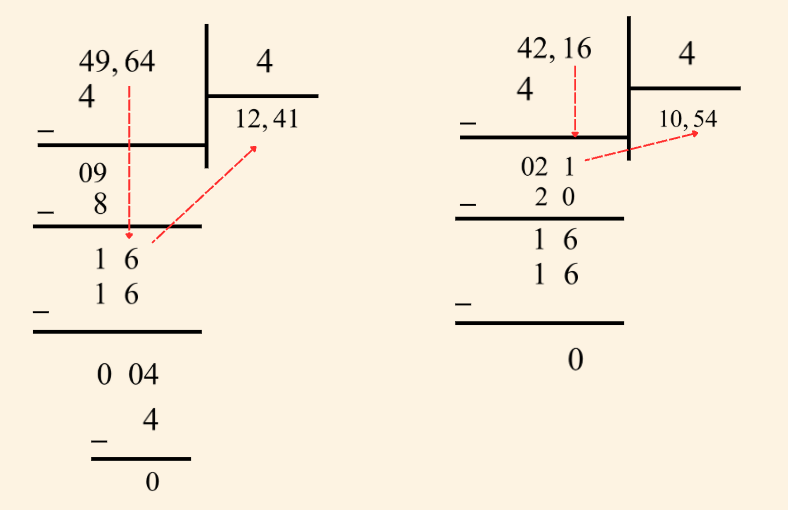
Example:
Let’s perform the operations \( 2.16 \div 4 \) and \( 3.24 \div 24 \).
\[
\begin{array}{c,c}
\begin{array}{c}
\quad &2.16 \;\;\\
-\quad &2 \phantom{.} 0 \;\;\;\; \\
\hline
\;\;\quad &0\phantom{.} 16\\
-\quad \;\;\quad &0\phantom{.} 16\\
\hline
\;\;\quad &00\phantom{,}\\
\end{array}
\begin{array}{|c}
\quad 4 \\
\hline
\quad 0.54
\\
\\
\\
\\
\end{array}
\end{array}
\]
\[
\begin{array}{c,c}
\begin{array}{c}
\quad &3.240 \;\;\\
-\quad &2 \phantom{.} 4 \;\;\;\; \\
\hline
\;\;\quad &0\phantom{.} 84\\
-\quad \;\;\quad \phantom{0} \phantom{,} &72\\
\hline
\;\;\quad &120\phantom{,}\\
-\;\;\quad &120\phantom{,}\\
\hline
\;\;\quad &00\phantom{,}\\
\end{array}
\begin{array}{|c}
\quad 24 \\
\hline
\quad 0.135
\\
\\
\\
\\
\\
\\
\end{array}
\end{array}
\]
During the division process, if the divisor is in decimal form, both the divisor and the dividend are expanded by an appropriate power of 10 to clear them entirely of decimal points before starting the operation. After this simplification step, the classical division method is executed.
Warning: To practically divide a decimal number by 10 and its powers, the decimal point of the expression is shifted to the left by as many positions as there are zeros in the divisor. In cases where no digits remain on the left, the gaps are filled by writing zeros.
Examples:
- $$ 43.8 \div 10 = 4.38$$
- $$ 21.7 \div 100 = 0.217$$
- $$ 2.72 \div 1000 = 0.00272$$