
Angle Measurement Units
Measuring Angles
Measuring an angle means determining the openness between the arms of the angle. Suppose a moving point \(P\) on a circle starts at point \(A\), makes one full rotation in the positive direction, and returns to point \(A\).
The central angle that subtends the full circular arc \(\widehat{ABA}\) is called a full angle.
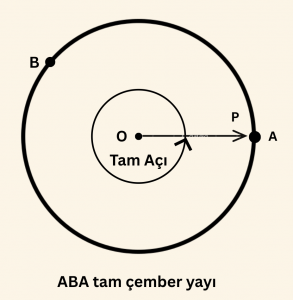
1) Degree
Let us divide the full circular arc into 360 equal parts. The measure of a central angle that subtends one of these parts is defined as 1 degree.
Therefore, the measure of a full angle is:
\[
360^\circ
\]
Furthermore:
\[
1^\circ = 60^{‘} \quad \text{(minutes)} \quad\quad
1^{‘} = 60^{” }\quad \text{(seconds)}
\]
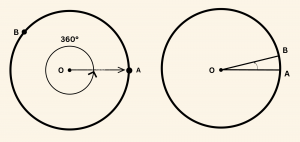
\[
\frac{|\overset{\frown}{ABA}|}{360^\circ} =\overset{\frown}{AB}
= m(\widehat{AOB}) = 1^\circ
\]
2) Gradian (Grad)
Let us divide the full circular arc into 400 equal arc parts. The measure of a central angle that subtends one of these parts is defined as 1 gradian. Thus, the measure of a full angle is 400 gradians.

\[
\frac{|\overset{\frown}{ABA}|}{400} =\overset{\frown}{AB}
= m(\widehat{AOB}) = 1 \;\; \text{grad}
\]
3) Radian
The measure of a central angle that subtends an arc equal in length to the radius of the circle is defined as 1 radian. According to this definition, since the circumference of a full circle is \(2\pi r\), a full angle is calculated as follows:
\[
\frac{2\pi r}{r} = 2\pi \text{ radians.} \]
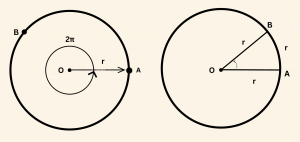
\[ | \overset{\frown}{AB} | = r, \quad |OA |= r , \quad m(\overset{\frown}{AOB} )= 1 \;\; \text{radian} \ ]
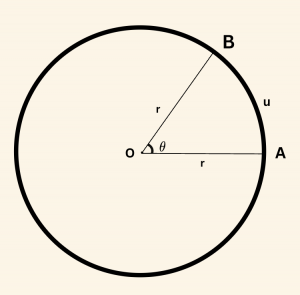
In a circle, the length of an arc segment is given by:
\[
s = |\theta| \cdot r
\]
Example

In the figure above, the radius of the circle centered at \( O \) is \( r = 24 \, \text{cm} \) and the arc length is \( |\overset{\frown}{AB}| = 25.12 \, \text{cm} \). Let us find the approximate value of the angle \( m(\widehat{AOB}) = \theta \). (\( \pi \approx 3.14 \))
\[
s = |\theta| \cdot r \Rightarrow 25.12 = x \cdot 24
\quad \Rightarrow \quad
x = \frac{25.12}{24} \text{ radians.}
\]
To express this value in terms of \(\pi\):
\[
\begin{aligned}
&3.14 \quad \quad &\pi \\
\\
&\frac{25.12}{24} \quad \quad & |\theta| \\
\hline
\\
&\text{Since it is a direct proportion,}
\end{aligned}
\]
\[ \frac{25.12}{24} \cdot \frac{\pi}{3.14} = |\theta| \]
\[
\Rightarrow |\theta| = \frac{\pi}{3} \text{ radians.}
\]
Example:
Let us find the measure in radians of a central angle that subtends an arc whose length is \( 0.785 \) times the length of the radius.
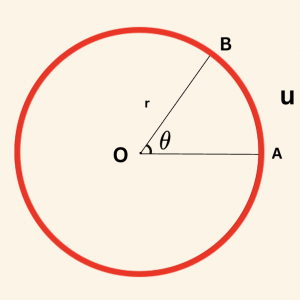
If \( s = 0.785\, r \), then:
\[ s = |\theta| \cdot r \]
\[ \Rightarrow 0.785 \cdot r = x \cdot r \]
\[ \Rightarrow x = 0.785 \text{ radians.} \]
Therefore,
\[
\begin{aligned}
&3.14 \quad &\pi \\
\\
&0.785 \quad & |\theta| \\
\hline
\\
&\text{Since it is a direct proportion,}
\end{aligned}
\]
\[ |\theta| = \frac{0.785 \pi }{3.14} = \frac{\pi}{4} \]
Converting Angle Measurement Units:
Since the measure of a full angle satisfies the identities:
\[360^\circ = 400 \;\; \text{grad} = 2\pi \;\; \text{radians} \]
we can convert angle measurement units using the following proportion:
\[
\frac{D}{180} = \frac{R}{\pi} = \frac{G}{200}
\]
From this, we get:
\[ 1^\circ = \frac{\pi}{180} \text{ radians} \approx 0.0174 \text{ radians} \]
\[ 1 \text{ radian} = \frac{180^\circ}{\pi} \approx 57^\circ. \]
Example:
Let us find the radian and gradian measures of a 50° angle.
\[
\frac{D}{180} = \frac{R}{\pi} = \frac{G}{200} \Rightarrow \frac{50}{180} = \frac{R}{\pi} = \frac{G}{200}
\]
\[
\Rightarrow R = \frac{50\pi}{180} = \frac{5\pi}{18} \text{ radians}
\]
\[
\Rightarrow G = \frac{50 \cdot 200}{180} \Rightarrow G = \frac{500}{9} \text{ grads.}
\]
Example:
Let us find the degree and gradian measures of an angle of \( \frac{11\pi}{2} \) radians.
\[
\frac{D}{180} = \frac{R}{\pi} = \frac{G}{200} \Rightarrow \frac{D}{180} = \frac{\frac{11 \pi }{2} }{\pi} = \frac{G}{200}
\]
\[
\Rightarrow D = \frac{180 \cdot 11\pi}{2\pi} = 990^\circ
\]
\[
\Rightarrow G = \frac{11\pi \cdot 200}{2\pi} \Rightarrow G = 1100 \text{ grads.}
\]
Note:
To convert an angle from radians to degrees, it is sufficient to substitute 180° in place of \( \pi \).
Example:
\( \bullet\ \frac{7\pi}{5} \) radians = \( \left( \frac{7 \cdot 180}{5} \right)^\circ = 252^\circ \)
\( \bullet\ 11\pi \) radians = \( (11 \cdot 180)^\circ = 1980^\circ \).
← Previous Page | Next Page →