
Quadratic Inequalities in One Variable
Given \(a, b, c \in \mathbb{R} \) and \( a \ne 0 \), inequalities of the form
\[ax^2 + bx + c > 0 \]
\[ ax^2 + bx + c \ge 0 \]
\[ ax^2 + bx + c < 0 \]
or
\[ ax^2 + bx + c \le 0 \]
are called quadratic inequalities in one variable. Solving a quadratic inequality in one variable means finding the interval that satisfies the inequality by analyzing the sign of the trinomial
\[
f(x) = ax^2 + bx + c\]
Let us analyze the sign of \( f(x) = ax^2 + bx + c \) by analyzing its graph.
1) When \( \quad \Delta > 0 \)
\[\text{For } \quad x < x_1 \quad \text{ or } \quad x > x_2, \quad f(x) > 0 \]
\[ \text{For } \quad x_1 < x < x_2, \quad f(x) < 0. \]
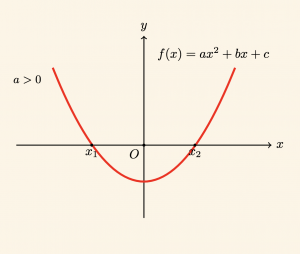
\[\text{For } \quad x < x_1 \quad \text{ or } \quad x > x_2, \quad f(x) < 0 \]
\[ \text{For } \quad x_1 < x < x_2, \quad f(x) > 0. \]
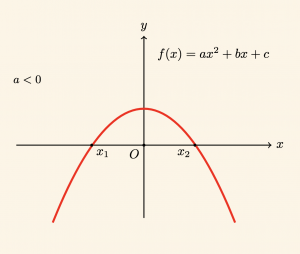
Accordingly,
\[
\text{For } \;\; x < x_1 \;\; \text{ or } \;\; x > x_2, \quad \text{ the sign of the expression } f(x) = ax^2 + bx + c \text{ is the same as the sign of } a,
\]
\[
\text{For } \;\; x_1 < x < x_2, \;\; \text{ the sign of the expression } f(x) = ax^2 + bx + c \;\; \text{ is opposite to the sign of } a.
\]
Let us display this behavior in a sign chart.
\[
\begin{array}{|c | l | c r | r | r | }
\hline
x & -\infty & x_1 && & x_2 & +\infty \\
\hline
f(x)=ax^2+bx+c \;\; (\Delta > 0 ) & \text{Same sign as } a & \circ\ &&\text{Opposite sign to } a & \circ& \text{Same sign as } a \\
\hline
\end{array}
\]
Example:
Analyze the sign of the trinomial \(f(x) = -x^2 + 7x – 6 \).
\[
-x^2 + 7x – 6 = 0
\;\; \Longrightarrow \;\;
x_1 = 1 \quad \text{ or } \quad x_2 = 6
\quad\text{and}\quad
a = -1 < 0
\]
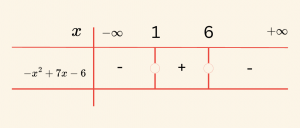
\[ \text{ Therefore, for } \quad x < 1 \quad \text{or} \quad x > 6, \quad f(x) < 0 \]
\[ \text{For } \quad 1 < x < 6, \quad f(x) > 0 \]
Example:
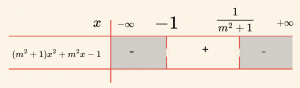
Given \( m \in \mathbb{R} \), find the solution set of the inequality \( (m^2 + 1)x^2 + m^2 x – 1 < 0 \).
\[ (m^2 + 1)x^2 + m^2 x – 1 =0 \]
\[
\Rightarrow \bigl[(m^2 + 1)x – 1\bigr](x + 1) = 0
\quad\Longrightarrow\quad
x_1 = \frac{1}{m^2 + 1}, \quad x_2 = -1.
\]
\[
a = m^2 + 1 > 0 \quad (\text{the parabola opens upward}).
\]
\[
\text{The parabola } (m^2+1)x^2 + m^2 x – 1 \text{ intersects the axes at } x = -1 \text{ and } x = \frac{1}{m^2+1}.
\]
\[
\text{Solution set: }
\left\{x \;\middle|\; -1 < x < \frac{1}{m^2 + 1}, \,x \in \mathbb{R} \right\}
\]
Example:
Find the solution set of the inequality \((-x^2 + 3x + 4)(3x^2 – 4x + 1) > 0 \).
\[
-x^2 + 3x + 4 = 0 \Rightarrow x_1 = -1 \quad \text{and} \quad x_2 = 4 \quad (a = -1 < 0)
\]
\[
3x^2 – 4x + 1 = 0 \Rightarrow x_1 = \frac{1}{3} \quad \text{and} \quad x_2 = 1 \quad (a = 3 > 0)
\]
\[
\text{Critical points: } -1,\quad \frac{1}{3},\quad 1,\quad 4
\]
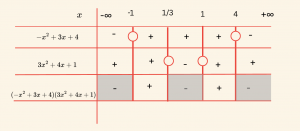
\[
\text{Since the inequality is } > 0, \text{ we select the intervals where the expression is positive.}
\]
\[
\text{Thus, the solution set is: } \quad \mathcal{S} = \left\{ x \in \mathbb{R} \;\middle|\; -1 < x < \frac{1}{3} \;\text{or}\; 1 < x < 4 \right\}
\]
Warning:
Values that make the denominator of a rational expression zero cannot be elements of the solution set and are excluded. Values that make the numerator zero are included in the solution set only when non-strict inequalities (\(\le\) or \(\ge\)) are given.
Example:
Find the solution set of the inequality \[ f(x) = \frac{(4 \;- x^2)x}{x^2 \;- x \;- 2} < 0 \]
\[4 – x^2 = 0 \Rightarrow x = \pm2 \quad (a = -1 < 0) \]
\[x = 0 \quad (a = 1 > 0) \]
\[x^2 – x – 2 = 0 \Rightarrow x_1 = -1, \; \; x_2 = 2 \quad (a = 1 > 0) \]
\[
\text{Critical points: } -2, \; -1, \;0, \; 2
\]
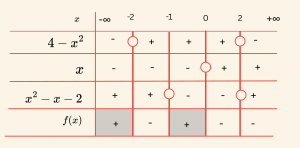
\[
\text{Intervals where } f(x) < 0: \quad -2 < x < -1 \quad \text{and} \quad x > 0 \quad \text{(excluding 2)}
\]
\[
\text{Solution set:} \quad
\mathcal{S} = \left\{ x \;\middle|\; -2 < x < -1 \;\text{or}\; x > 0, x \in \mathbb{R} \right\} \;- \; \{2\}
\]
Example:
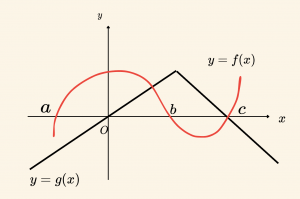
Based on the graph above, find the solution set of the inequality \[\frac{f(x)}{g(x)} \geq 0 \]
\[f(x) = 0 \Rightarrow x = a, \quad x = b, \quad x = c \]
\[g(x) = 0 \Rightarrow x = 0, \quad x = c \]
\[
\text{Required: } \frac{f(x)}{g(x)} \geq 0 \Rightarrow \text{Intervals where the expression is positive or zero:}
\]
\[
x \in (-\infty, a] \cup (0, b]
\]
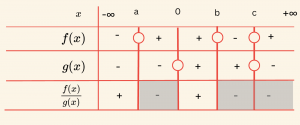
\[\text{The solution set is found as: } \quad \mathcal{S} = \left\{ x \in \mathbb{R} \;\middle|\; -\infty < x \leq a \; \text{or} \; 0 < x \leq b \right\} \]
2) When \( \quad \Delta = 0 \)
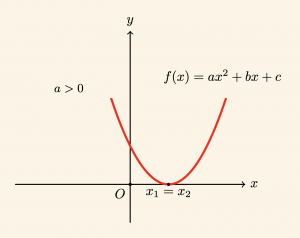
\[ \text{For } \quad x \neq -\frac{b}{2a}, \quad f(x) > 0. \]
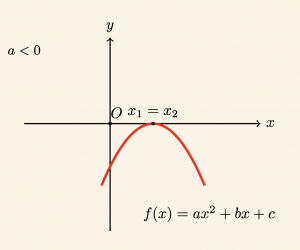
\[ \text{For } \quad x \neq -\frac{b}{2a}, \quad f(x) < 0. \]
\[
\text{Accordingly,} \quad \text{for } \quad x = -\frac{b}{2a}, \quad f(x) = 0,
\]
\[
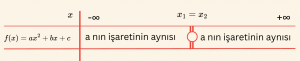
\text{and for } \quad x \ne -\frac{b}{2a}, \text{ the sign of } f(x) = ax^2 + bx + c \text{ matches the sign of } a.
\]
Let us display this behavior in a sign chart:
Example:
Analyze the sign of the trinomial \( -4x^2 + 24x \;- 36 \).
\[
-4x^2 + 24x \; – 36 = 0 \Rightarrow x_1 = x_2 = 3 \quad \text{and} \quad a = -4 < 0
\]
Thus, the sign chart is:

\[ \text{For } \quad x \neq 3, \quad -4x^2 + 24x \; – 36 < 0. \]
Example:
Given \( m \in \mathbb{R} \), analyze the sign of the expression \( x^2 – 2mx – 2x + m^2 + 2m + 1 \).
\[
x^2 – 2(m+1)x + (m+1)^2 = \left(x – (m+1)\right)^2 = 0 \]
\[\Rightarrow x_1 = x_2 = m+1 \]
\[
\text{Since } a = 1 > 0, \text{ the sign chart is:}
\]
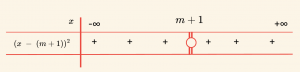
As a result, for \( x \ne m+1 \), we have \( (x \;-\; (m+1))^2 > 0 \).
3) When \( \quad \Delta < 0 \)
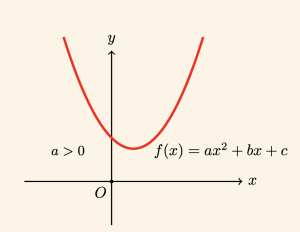
\[ \text{For all } x \in \mathbb{R}, \quad f(x) > 0. \]
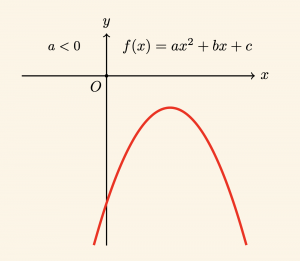
\[ \text{For all } x \in \mathbb{R}, \quad f(x) < 0. \]
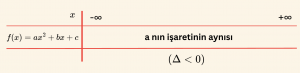
Therefore, the sign of \( f(x) = ax^2+bx+ c \) always matches the sign of \( a \). Let us display this behavior in a sign chart.
Example:
Analyze the sign of the trinomial \( f(x) = -x^2 + 3x- 3 \).
Since \( -x^2 + 3x- 3 = 0 \Rightarrow \Delta = -3 < 0 \) and \( a = -1 < 0 \):
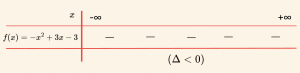
For all \( \; x \in \mathbb{R}, \quad f(x) = -x^2 + 3x\; – \; 3 < 0 \).
Conclusion:
If \( \Delta < 0 \) and \( a > 0 \), then for all \( x \in \mathbb{R} \) (always) \( f(x) = ax^2 + bx + c > 0. \)
If \( \Delta < 0 \) and \( a < 0 \), then for all \( x \in \mathbb{R} \) (always) \( f(x) = ax^2 + bx + c < 0. \)
Example:
If the trinomial \( f(x) = x^2 \,- \; 2x + m \) always takes values greater than \( -7 \) for all \( x \in \mathbb{R} \), find the interval that \( m \) belongs to.
\[ \text{For all } x \in \mathbb{R} \Rightarrow x^2 – 2x + m > -7 \]
\[
\Rightarrow x^2 – 2x + m + 7 > 0
\]
\[
a = 1 > 0 \quad \text{and} \quad \Delta = (-2)^2 \;- \; 4 \cdot (m + 7) < 0
\]
\[
4 < 4 \cdot (m + 7) \Rightarrow 1 < m + 7 \Rightarrow m > -6
\]
Example:
Find the range of values for \( m \) such that the inequality \( mx^2 + (2m + 1)x + m\; -\; 3 < 0 \) holds true for all real numbers.
\[
a = m < 0 \quad \text{and} \quad \Delta = (2m + 1)^2 – 4m \cdot (m\; – \; 3) < 0
\]
\[
\Rightarrow 4m^2 + 4m + 1 \;- \; 4m^2 + 12m = 16m + 1 < 0 \]
\[\Rightarrow m < -\frac{1}{16}
\]
Since \( m < 0 \) is automatically satisfied for \( m < -\frac{1}{16} \):
\[ \Rightarrow \mathcal{S} = \left\{ m \in \mathbb{R} \;\middle|\; m < -\frac{1}{16} \right\}
\]
QUESTION 1
What are the possible values of \( m \) such that the inequality \( (m^2 + 1)x^2 + mx + 1 > 0 \) holds true for all real numbers?
\[\begin{aligned}
&\text{A) } \{ m \mid m < 1, m \in \mathbb{R} \} \quad \\
&\text{B) } \{ m \mid 1 < m < 4 , m \in \mathbb{R} \} \quad \\
&\text{C) } \{ m \mid m > 4, m \in \mathbb{R} \} \quad \\
&\text{D) } \mathbb{R} \quad \\
&\text{E) } \emptyset \end{aligned}\]
Solution:
We must have \( a = m^2 + 1 > 0 \) and \( \Delta = m^2 – 4 \cdot (m^2 + 1) \cdot 1 < 0 \).
\[ \Rightarrow -3m^2\; -\; 4 < 0 \]
Since \( m^2 + 1 > 0 \) and \( -3m^2 – 4 < 0 \) are true for all \( m \in \mathbb{R} \), the solution set is \( \mathcal{S} = \mathbb{R} \).
\(\textbf{Answer: D} \)
QUESTION 2
Which of the following is the solution set of \( m \) for which the inequality \( mx^2 + (2m – 2)x + m – 1 < 0 \) is always true for all real numbers?
\[\begin{aligned}
&\text{A) } \{ m \mid m > 2,\, m \in \mathbb{R} \} \quad \\
&\text{B) }\{ m \mid m < -2,\, m \in \mathbb{R} \} \quad \\
&\text{C) } \{ m \mid -2 < m < 2,\, m \in \mathbb{R} \} \quad \\
&\text{D) } \mathbb{R} \quad \\
&\text{E) } \emptyset \end{aligned}\]
Solution:
\[
a = m < 0 \quad \text{and} \quad \Delta = (2m – 2)^2 – 4m(m – 1) < 0
\]
\[
\Rightarrow -4m + 4 < 0 \Rightarrow m > 1
\]
However, the conditions \( m < 0 \) and \( m > 1 \) cannot be satisfied simultaneously.
\[ \Rightarrow \mathcal{S} = \emptyset \]
\(\textbf{Answer: E} \)
QUESTION 3
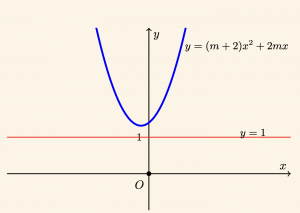
Based on the figure below, which of the following statements is true for \( m \)?
\[ \text{A) } m< 1 \quad \text{B) } 1 < m < 3 \quad \text{C) } 0 < m < 2 \quad \text{D) } m > 0 \quad \text{E) } m > 2 \]
Solution:
According to the given graph, the inequality \( y = (m + 2)x^2 + 2mx + m > 1 \) must hold true for all real numbers.
\[ (m + 2)x^2 + 2mx + m > 1 \]
\[\Rightarrow (m + 2)x^2 + 2mx + m – 1 > 0 \]
For this to hold, we require:
\[ a = m + 2 > 0 \Rightarrow m > -2 \]
and
\[ \Delta = 4m^2 – 4 \cdot (m + 2) \cdot (m – 1) < 0 \]
\[ \Rightarrow -4m + 8 < 0 \]
\[ \Rightarrow m > 2 \]
Since \( m > 2 \) satisfies the condition \( m > -2 \), we conclude that \( m > 2 \).
\(\textbf{Answer: E} \)
Practical Method for Sign Analysis:
Let $A(x)$, $B(x)$, and $C(x)$ be polynomials. Let us list the steps required to analyze the sign of expressions in the form of
\[ A(x) \cdot B(x) \cdot C(x) \] or \[ \frac{A(x) \cdot B(x)}{C(x)} \]
1) The real roots of the equations $A(x) = 0$, $B(x) = 0$, and $C(x) = 0$ are found and placed in a sign chart in ascending order.
If any of these roots appear an even number of times, it is called a double root (or a root of even multiplicity).
2) The signs of the coefficients of the leading terms (the terms with the highest degree) of the polynomials $A(x)$, $B(x)$, and $C(x)$ are multiplied together. The resulting sign is placed in the rightmost interval of the chart (to the right of the largest root).
3) Moving from right to left across the chart, the sign changes every time a simple root (odd multiplicity) is crossed. However, the sign does not change when crossing a double root (even multiplicity).
Warning:
In inequalities of the form
\[ \frac{A(x) \cdot B(x)}{C(x)} \geq 0 \] or \[ \frac{A(x) \cdot B(x)}{C(x)} \leq 0 \]
the roots of the equation $C(x) = 0$ make the denominator zero and therefore cannot be included in the solution set. Conversely, the roots of $A(x) = 0$ and $B(x) = 0$ are included because of the non-strict inequality ($\ge$ or $\le$).
For strict inequalities of the form
\[ \frac{A(x) \cdot B(x)}{C(x)} > 0 \quad \text{or} \quad \frac{A(x) \cdot B(x)}{C(x)} < 0 \]
none of the roots from the equations $A(x) = 0$, $B(x) = 0$, or $C(x) = 0$ can be part of the solution set.
Example:
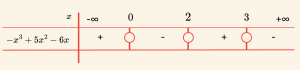
Find the solution set of the inequality $- x^3 + 5x^2 – 6x \leq 0 $.
$- x^3 + 5x^2 – 6x = 0 \Rightarrow x = 0 $ or $x = 2 $ or $x = 3 $.
Since the leading coefficient of the polynomial (the coefficient of $-x^3$) is negative $(-)$, the sign to the right of the largest root ($3$) is $(-)$.
The solution set is found as:
\[ \mathcal{S} = \{ x \mid 0 \leq x \leq 2 \quad \text{ or } \quad 3 \leq x < +\infty, \, x \in \mathbb{R} \} \]
Example:
Find the solution set of the inequality $x^4 \; – \; x^3 \; – \; x + 1 > 0 $.
\[ x^4 \; – \; x^3 \; – \; x + 1 = 0 \Rightarrow (x^3 – 1)(x – 1) = 0 \Rightarrow (x^2 + x + 1)(x – 1)^2 = 0 \]
\[ x^2 + x + 1 = 0 \Rightarrow \Delta < 0, \text{ so this quadratic part has no real roots.} \]
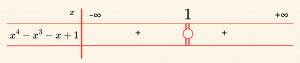
\[ (x – 1)^2 = 0 \Rightarrow x_1 = x_2 = 1. \text{ Since it is a double root, the sign does not change at } x = 1. \]
Since the leading coefficient of the polynomial ($x^4$) is positive $(+)$, the sign to the right of $1$ is $(+)$.
The solution set is found as:
\[ \mathcal{S} = \mathbb{R} – \{ 1 \} \]
Example:
Find the solution set of the inequality \[ f(x) = \frac{x^2 – 4}{-x^2 + 2x – 2} \geq 0 \]
\[\begin{aligned} &x^2 – 4 = 0 \Rightarrow x_1 = -2 \quad \text{ or } \quad x_2 = 2 \\
\\
-& x^2 + 2x – 2 = 0 \Rightarrow \Delta < 0, \text{ so it has no real roots.} \end{aligned} \]
The product of the leading coefficients of the numerator ($x^2$) and denominator ($-x^2$) is $(+) \cdot (-) = (-)$.
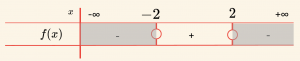
\[ \mathcal{S} = \{ x \mid -2 \leq x \leq 2 \} \]
Example:
Find the solution set of the inequality \[ \frac{x}{2} \;-\; \frac{1}{2} < \frac{1}{x} \]
\[\frac{x}{2}\; -\; \frac{1}{2}\; – \; \frac{1}{x} < 0\]
\[ \frac{x \;-\; 1}{2} \; – \; \frac{1}{x} < 0 \Rightarrow \frac{x^2 \;- \;x \;- \; 2}{2x} < 0 \]
\[ x^2 \;-\; x \;-\; 2 = 0 \Rightarrow x_1 = -1, \, x_2 = 2 \]
\[ 2x = 0 \Rightarrow x = 0 \]
The product of the signs of the leading coefficients of the numerator ($x^2$) and denominator ($x$) is $(+) \cdot (+) = (+)$.
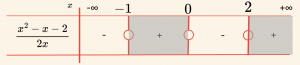
\[ \mathcal{S} = \{ x \mid -\infty < x < -1 \text{ or } 0 < x < 2, \, x \in \mathbb{R} \} \]
Example:
Find the solution set of the inequality \[ f(x) = \frac{(9 – x^2) \cdot x^4}{x^2 – 2x – 3} \geq 0 \]
\[
\begin{aligned}
&9 – x^2 = 0 \Rightarrow x_1 = -3, \, x_2 = 3 \\
\\
&x^4 = 0 \Rightarrow x_1 = x_2 = x_3 = x_4 = 0 \quad \text{ (double root)} \\
\\
&x^2 \;-\; 2x \;-\; 3 = 0 \Rightarrow x_1 = -1,\quad x_2 = 3 \\
\\
\end{aligned}
\]
Notice that $3$ is obtained twice (once from the numerator and once from the denominator), which means it becomes a double root overall. The product of the leading coefficients of the terms $-x^2$, $x^4$, and $x^2$ is $(-) \cdot (+) \cdot (+) = (-)$.
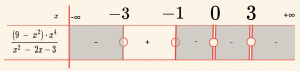
\[ \mathcal{S} = \{ x \mid -3 \leq x \leq -1 , \, x \in \mathbb{R} \} \cup \{0 \} \]
QUESTION 4
How many integer values of $x$ satisfy the inequality \[ f(x) = \frac{-x^2 + 6x – 9}{(-x^2 + x – 2)(x^2 – 4)} \leq 0 \]
\[ \text{A) } 2 \quad \text{B) } 3 \quad \text{C) } 4 \quad \text{D) } 5 \quad \text{E) } 6 \]
Solution:
\[- x^2 + 6x – 9 = 0 \Rightarrow -(x – 3)^2 = 0 \Rightarrow x_1 = x_2 = 3 \]
The equation $- x^2 + x – 2 = 0$ has $\Delta < 0$, meaning it has no real roots.
\[ x^2 – 4 = 0 \Rightarrow x_1 = -2 \text{ or } x_2 = 2 \]
The product of the leading coefficients of the polynomials $-x^2$, $-x^2$, and $x^2$ is $(-) \cdot (-) \cdot (+) = (+)$.
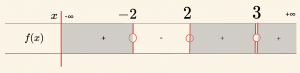
Since the solution set is $\mathcal{S} = \{ x \mid -2 < x < 2, \, x \in \mathbb{R} \} \cup \{ 3 \}$, the integer values that $x$ can take are $-1, 0, 1$, and $3$. Thus, there are four values.
\(\textbf{Answer: C} \)
QUESTION 5
Which of the following statements is true for the values of $x$ that satisfy the inequality \[ f(x) = \frac{(1 – x^3)^2 \cdot 2^x}{x^5 + 32} > 0 \]
\[\text{A) } x < -2 \quad
\text{B) } x < 1 \quad
\text{C) } x > 0 \quad
\text{D) } -2 < x < 1 \quad
\text{E) } x > -2 \]
Solution:
\[ (1 – x^3)^2 = 0 \Rightarrow x_1 = x_2 = 1 \]
Since $2^x > 0$ for all $x \in \mathbb{R}$, this term is always positive and does not affect the sign of $f(x)$.
\[ x^5 + 32 = 0 \Rightarrow x = -2 \]
The product of the leading coefficients of the polynomials $x^6$ (from expanding the square) and $x^5$ is $(+) \cdot (+) = (+)$.
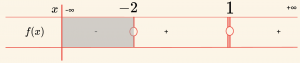
\[\mathcal{S} = \{ x \mid -2 < x < 1 \text{ or } 1 < x < \infty, \, x \in \mathbb{R} \} = \{ x \in \mathbb{R} \mid x > -2 \} – \{1\} \]
Looking at the options, the condition that captures the valid domain (except the single point $x=1$ which is excluded) is best represented in choice E.
\(\textbf{Answer: E} \)
QUESTION 6
Which of the following intervals satisfies the inequality \[ f(x) = \frac{-\frac{1}{x} +1 \;-\; x }{\sqrt{ x^2+4}-1 } < 0 \]
\[\text{A) } x < -1 \quad
\text{B) } -1 < x < 0 \quad
\text{C) } x > 0 \quad
\text{D) } -2 < x < -1 \quad
\text{E) } -3 < x < -2 \]
Solution:
\[ f(x) = \frac{-\frac{1}{x} +1 \;-\; x }{\sqrt{ x^2+4}-1 } < 0 \Rightarrow \frac{-x^2 + x – 1}{x(\sqrt{x^2 + 4} \;- \;1)} < 0 \]
The quadratic expression $- x^2 + x – 1 = 0$ has $\Delta < 0$, so it has no real roots.
Since $\sqrt{x^2 + 4} – 1 > 0$ for all $x \in \mathbb{R}$, this term is always positive and does not change the sign of $f(x)$.
The leading coefficient signs for the changing terms are negative for $-x^2$ and positive for $x$, giving a product of $(-) \cdot (+) = (-)$.
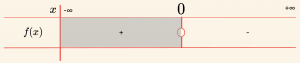
\[ \mathcal{S} = \{ x \mid 0 < x < \infty, \, x \in \mathbb{R} \} \]
\(\textbf{Answer: C} \)
QUESTION 7
Which of the following is one of the intervals that satisfy the inequality \[ f(x) = \frac{(x^4 – 1)(1 – x^3)}{x^2 – 4x + 3} \leq 0 \]
\[ \text{A) } x \leq -1 \quad
\text{B) } -2 < x < 1 \quad
\text{C) } -1 \leq x < 3 \quad
\text{D) } 1 < x < 3 \quad
\text{E) } -1 \leq x < 1 \]
Solution:
\[ x^4 – 1 = 0 \Rightarrow x_1 = -1 \text{ or } x_2 = 1 \]
\[ 1 – x^3 = 0 \Rightarrow x = 1 \]
\[ x^2 – 4x + 3 = 0 \Rightarrow x_1 = 1 \text{ or } x_2 = 3 \]
Here, the root $1$ is found three times total (twice in the numerator, once in the denominator), making it a root of odd multiplicity (3). Therefore, it acts as a simple root and the sign changes when crossing it. The product of the signs of the leading coefficients of $x^4$, $-x^3$, and $x^2$ is $(+) \cdot (-) \cdot (+) = (-)$.
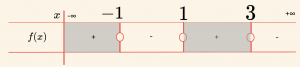
\[ \mathcal{S} = \{ x \mid -1 \leq x < 1 \text{ or } x > 3, \, x \in \mathbb{R} \} \]
Looking at the given choices, the interval $[-1, 1)$ matches part of our solution. (Note: $x=1$ must be excluded because it makes the denominator zero).
\(\textbf{Answer: E} \)
QUESTION 8
Which of the following intervals satisfies the inequality \[ x + \frac{12}{x} > 6 + \frac{8}{x^2} \]
\[\text{A) } 1 < x < 3 \quad
\text{B) } -1 < x < 1 \quad
\text{C) } x < 0 \quad
\text{D) } 0 < x < 2 \quad
\text{E) } x > 2 \]
Solution:
\[ x + \frac{12}{x} > 6 + \frac{8}{x^2} \Rightarrow x + \frac{12}{x}\; – \; 6\; -\; \frac{8}{x^2} > 0 \]
\[\Rightarrow f(x) = \frac{x^3\; -\; 6x^2 + 12x\; -\; 8}{x^2} > 0 \]
\[ x^3 \;- \;6x^2 + 12x\; – \;8 = (x – 2)^3 = 0 \Rightarrow x_1 = x_2 = x_3 = 2 \]
\[ x^2 = 0 \Rightarrow x_1 = x_2 = 0 \]
The product of the leading coefficients of the numerator ($x^3$) and denominator ($x^2$) is $(+) \cdot (+) = (+)$.
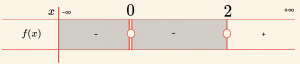
\[ \mathcal{S} = \{ x \mid x > 2 , \; x \in \mathbb{R} \} \]
\(\textbf{Answer: E} \)
QUESTION 9
Given $a < 0 < b$, which of the following intervals satisfies the inequality
\[ f(x) = \frac{x^2 – (a + b)x + ab}{(ax^2 – b)x^4} > 0 \]
\[\text{A) } a < x < 0 \quad
\text{B) } a < x < b \quad
\text{C) } x < a \quad
\text{D) } x > b \quad
\text{E) } x > 0 \]
Solution:
\[ x^2 – (a + b)x + ab = 0 \Rightarrow x_1 = a \text{ or } x_2 = b \]
Since $a < 0$ and $b > 0$, the equation $ax^2 – b = 0 \Rightarrow x^2 = \frac{b}{a} < 0$, so it has no real roots.
\[ x^4 = 0 \Rightarrow x_1 = x_2 = x_3 = x_4 = 0 \]
The product of the leading coefficients of the polynomials $x^2$, $ax^2$, and $x^4$ is $(+) \cdot (-) \cdot (+) = (-)$.
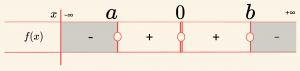
\[ \mathcal{S} = \{ x \mid a < x < b, \, x \in \mathbb{R} \}\; – \; \{ 0 \} \]
This is equivalent to the two intervals combined: $a < x < 0$ or $0 < x < b$. Looking at the choices, option A corresponds to one of these valid regions.
\(\textbf{Answer: A} \)
QUESTION 10
Given $m^2 + \frac{1}{m} < 0$, which of the following intervals satisfies the inequality
\[ f(x) = \frac{mx^2 + (1 – m^2)x – m}{x^2 – m^2} \geq 0 \]
\[ \text{A) } m < x < 0 \quad
\text{B) } x < m \quad
\text{C) } x > m \quad
\text{D) } -m < x \leq -\frac{1}{m} \quad
\text{E) } x \geq -\frac{1}{m} \]
Solution:
\[ m^2 + \frac{1}{m} < 0 \Rightarrow \frac{m^3 + 1}{m} < 0 \]
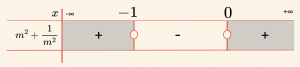
From this analysis, we find that $-1 < m < 0$. Therefore:
\[ mx^2 + (1 – m^2)x – m = 0 \Rightarrow (mx + 1)(x – m) = 0 \Rightarrow x_1 = m, \, x_2 = -\frac{1}{m} \]
\[ x^2 – m^2 = 0 \Rightarrow x_1 = m, \, x_2 = -m \]
The product of the leading coefficients of the expressions $mx^2$ and $x^2$ is $(-) \cdot (+) = (-)$.
Since $-1 < m < 0$, their order from smallest to largest is $m < -m < -\frac{1}{m}$.
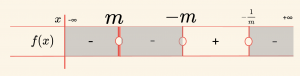
\[ \mathcal{S} = \left\{ x \;\middle|\; -m < x \leq -\frac{1}{m}, \, x \in \mathbb{R} \right\} \]
\(\textbf{Answer: D} \)
QUESTION 11
How many integer values of $x$ satisfy the inequality \[ f(x) = \frac{x + 5}{x^3 + 8} \;- \; \frac{x}{x^2\; – \;2x + 4} + \frac{1}{x + 2} \geq 0\]
\[ \text{A) } 3 \quad
\text{B) } 4 \quad
\text{C) } 5 \quad
\text{D) } 6 \quad
\text{E) } 7 \]
Solution:
\[ f(x) = \frac{x + 5}{x^3 + 8}\; -\; \frac{x}{x^2 \;- \;2x + 4} + \frac{1}{x + 2} \geq 0 \]
Finding a common denominator gives:
\[ \Rightarrow f(x) = \frac{-3x + 9}{(x + 2)(x^2 – 2x + 4)} \geq 0 \]
\[-3x + 9 = 0 \Rightarrow x = 3 \]
\[x + 2 = 0 \Rightarrow x = -2 \]
The equation $x^2 – 2x + 4 = 0$ has $\Delta < 0$, so it yields no real roots.
The product of the signs of the leading coefficients of $-3x$, $x$, and $x^2$ is $(-) \cdot (+) \cdot (+) = (-)$.
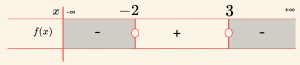
\[ \mathcal{S} = \{ x \mid -2 < x \leq 3, \, x \in \mathbb{R} \} \]
The integer values that satisfy this inequality are $-1, 0, 1, 2$, and $3$. Thus, there are five values.
\(\textbf{Answer: C} \)
QUESTION 12
Which of the following intervals satisfies the inequality \[ f(x) = \frac{x^{1995} + 1}{(1 – x)^{1995}} > 0 \]
\[\text{A) } x < -1 \quad
\text{B) } -1 < x < 1 \quad
\text{C) } x > 1 \quad
\text{D) } x > 0 \quad
\text{E) } x < 0 \]
Solution:
\[ x^{1995} + 1 = 0 \Rightarrow x = -1 \]
\[ (1 – x)^{1995} = 0 \Rightarrow x = 1 \]
The product of the signs of the leading coefficients of $x^{1995}$ and $-x^{1995}$ is $(+) \cdot (-) = (-)$.
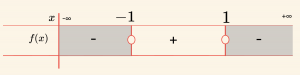
\[ \mathcal{S} = \{ x \mid -1 < x < 1, \, x \in \mathbb{R} \} \]
\(\textbf{Answer: B} \)
QUESTION 13
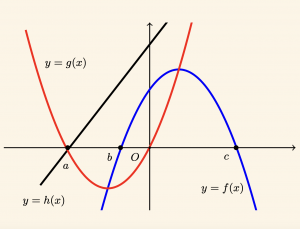
The figure above shows the parabolas $y = f(x)$ and $y = g(x)$ along with the line $y = h(x)$. Which of the following is one of the intervals that satisfy the inequality
\[ R(x) = \frac{g(x) \cdot h(x)}{f(x)} \geq 0 \]
\[ \text{A) } x > c \quad
\text{B) } b < x < 0 \quad
\text{C) } 0 \leq x < c \quad
\text{D) } x < 0 \quad
\text{E) } x > 0 \]
Solution:
\[ g(x) = 0 \Rightarrow x_1 = a \text{ or } x_2 = 0 \]
\[ h(x) = 0 \Rightarrow x = a \]
\[ f(x) = 0 \Rightarrow x_1 = b \text{ or } x_2 = c \]
The leading coefficient of the polynomial $g(x)$ is positive $(+)$ because the branches of the parabola open upwards.
The leading coefficient of the linear polynomial $h(x)$ is positive $(+)$ because the slope of the line is positive.
The leading coefficient of the polynomial $f(x)$ is negative $(-)$ because the branches of the parabola open downwards.
Multiplying these signs gives $(+) \cdot (+) \cdot (-) = (-)$. Note that $x=a$ appears once in $g(x)$ and once in $h(x)$, making it a root of even multiplicity (2) for the entire expression.
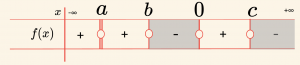
\[\mathcal{S} = \{ x \mid x < b \text{ or } 0 \leq x < c, \, \; x \in \mathbb{R} \} \]
Looking at the choices, option C ($0 \leq x < c$) matches the second part of our solution set.
\(\textbf{Answer: C} \)
← Previous Page | Next Page →