
Verknüpfung
Es sei $A$ eine nichtleere Menge und $A \subset B$.
Jede Abbildung
\[
f : A \times A \to B
\]
wird als eine zweistellige Verknüpfung (oder kurz Verknüpfung) auf $A$ bezeichnet.
Wir werden Verknüpfungen im Allgemeinen mit Symbolen wie $+$, $-$, $\cdot$, $\times$, $\star$, $\Delta$, $\circ$, $\dots$ darstellen.
Wenn eine Verknüpfung
\[
\star : A \times A \to B
\]
gegeben ist, wird jedes geordnete Paar $(x, y) \in A \times A$ auf ein eindeutiges Element $z \in B$ abgebildet. Dies schreiben wir als:
\[
(x, y)\;\to\;x \,\star\,y \;=\;z
\]
Beispiel:

Untersuchen wir die Relation von $A \times A$ nach $B$ mit der Vorschrift
\[
f(x,y) = x + 2y
\]
wobei $A = \{1, 2\}$ und $B = \{1, 2, 3, 4\}$.
Wir berechnen die Funktionswerte für die Paare:
\[
f(1,1) = 1 + 2\cdot1 = 3,\quad
f(1,2) = 1 + 2\cdot2 = 5,\quad
f(2,1) = 2 + 2\cdot1 = 4,\quad
f(2,2) = 2 + 2\cdot2 = 6.
\]
Die Relation $f$ ist keine Funktion von $A \times A$ nach $B$ (da die Ergebnisse 5 und 6 nicht in der Zielmenge $B$ liegen). Folglich ist $f$ keine Verknüpfung auf $A$.
Beispiel:
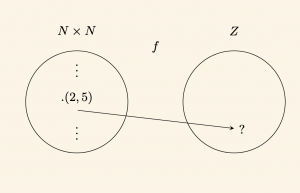
Untersuchen wir die Relation von $\mathbb{N} \times \mathbb{N}$ nach $\mathbb{Z}$ mit der Vorschrift:
\[
f(x,y) = \frac{x + y}{3}.
\]
Betrachten wir zum Beispiel das Paar:
\[
f(2,5) = \frac{2 + 5}{3} = \frac{7}{3},
\]
wobei dieser Wert nicht in $\mathbb{Z}$ liegt. Demnach ist die Relation $f$ keine Funktion von $\mathbb{N} \times \mathbb{N}$ nach $\mathbb{Z}$. Somit ist $f$ keine Verknüpfung auf der Menge der natürlichen Zahlen.
Beispiel:
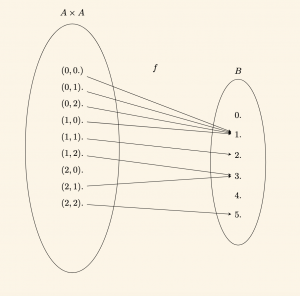
Gegeben seien $A = \{0, 1, 2\}$ und $B = \{0, 1, 2, 3, 4, 5\}$. Untersuchen wir die Relation von $A \times A$ nach $B$:
\[
f(x, y) = x \cdot y + 1
\]
Die Relation $f$ ist eine wohldefinierte Funktion von $A \times A$ nach $B$. Folglich ist $f$ eine Verknüpfung auf der Menge $A$.
Wenn wir diese Verknüpfung mit dem Symbol $\star$ bezeichnen, gilt:
\[
x \star y = x \cdot y + 1.
\]
Die zugehörige Verknüpfungstabelle sieht wie folgt aus:
\[
\begin{arraypre}
\begin{array}{c|ccc}
\star & 0 & 1 & 2\\
\hline
0 & 1 & 1 & 1\\
1 & 1 & 2 & 3\\
2 & 1 & 3 & 5
\end{array}
\end{arraypre>
\]
Daraus ergibt sich zum Beispiel:
\[
2 \star 2 = 2 \cdot 2 + 1 = 5.
\]
Hinweis:
Eine Verknüpfungstabelle für eine auf der Menge $A$ definierten Verknüpfung $\star$ hat folgende Struktur:
\[
\begin{arraypre}
\begin{array}{c|cccc}
\star & \dots & b & \dots \to \quad \text{Kopfzeile (Zweite Komponente)} \\ \hline
a & & x& \\
\vdots& & & \\
\downarrow \\ \text{Kopfspalte (Erste Komponente)}
\end{array}
\end{arraypre>
\]
Der Wert $x$, der in der Tabelle an der Kreuzung von Element $a$ und Element $b$ steht, wird als „$a \star b = x$“ gelesen.
Beispiel:
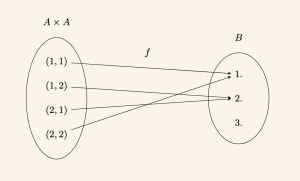 Gegeben seien $A = \{1, 2\}$ und $B = \{1, 2, 3\}$. Wir betrachten die von $A \times A$ nach $B$ definierte Relation:
\[
f(x,y) = 2^{\,|x – y|}\
\]
Die Berechnungen für alle Paare lauten:
\[ \Longrightarrow f(1,1) = 2^{|1-1|} = 2^0 = 1, \]
\[f(1,2) = 2^{|1-2|} = 2^1 = 2, \]
\[ f(2,1) = 2^{|2-1|} = 2^1 = 2, \]
\[ f(2,2) = 2^0 = 1. \]
Die Relation $f$ ist eine Funktion von $A \times A \to B$. Daher handelt es sich um eine Verknüpfung auf $A$.
Bezeichnen wir diese Verknüpfung mit dem Symbol $\Delta$. Die Verknüpfungstabelle lautet:
\[
x \,\Delta\, y = 2^{\,|x – y|}
\quad\times\quad
\begin{array}{c|cc}
\Delta & 1 & 2 \\
\hline
1 & 1 & 2 \\
2 & 2 & 1
\end{array}
\]
Einzelne Rechenschritte:
\[
1 \,\Delta\, 1 = 2^{ |1 – 1| } = 2^0 = 1
\]
\[
1 \,\Delta\, 2 = 2^{|1 – 2|} = 2^1 = 2
\]
\[
2 \,\Delta\, 1 = 2^{|2 – 1|} = 2^1 = 2
\]
\[
2 \,\Delta\, 2 = 2^{|2 – 2|} = 2^0 = 1
\]
AUFGABE 1
Auf $\mathbb{R}$ ist die Verknüpfung $x \star y = x^y + y^x$ definiert. Welchen Wert hat der Ausdruck $(2 \star 3) \star 1$?
\[
\text{A) } 14 \quad
\text{B) } 15 \quad
\text{C) } 16\quad
\text{D) } 17 \quad
\text{E) } 18
\]
Lösung:
\[
x \star y = x^y + y^x
\quad\Longrightarrow\quad
2 \star 3 = 2^3 + 3^2 = 8 + 9 = 17
\]
\[
(2 \star 3) \star 1 = 17 \star 1 = 17^1 + 1^{17} = 17 + 1 = 18
\]
\(\textbf{Antwort: E} \)
AUFGABE 2
Auf $\mathbb{R}$ ist folgende Verknüpfung gegeben:
\[
x \,\Delta\, y =
\begin{cases}
x \cdot y, & \text{wenn } x > y,\\
x + y, & \text{wenn } x \le y.
\end{cases}
\]
Welchen Wert hat der Ausdruck $(2 \,\Delta\, 2)\,\Delta\, 5$?
\[
\text{A) } 6 \quad
\text{B) } 7 \quad
\text{C) } 8\quad
\text{D) } 9 \quad
\text{E) } 10
\]
Lösung:
Da für $2 \le 2$ die Bedingung $x \le y$ gilt, verwenden wir $x + y$:
\[
2 \,\Delta\, 2 = 2 + 2 = 4
\]
Da für $4 \le 5$ ebenfalls $x \le y$ gilt, folgt:
\[
(2 \,\Delta\, 2)\,\Delta\, 5 = 4 \,\Delta\, 5 = 4 + 5 = 9
\]
\(\textbf{Antwort: D} \)
AUFGABE 3
Auf $\mathbb{R} – \{0\}$ ist die Verknüpfung $\star$ wie folgt definiert:
\[
\frac{2}{a \star b} \;=\; \frac{2}{a} \;+\; \frac{b}{3}
\]
Welchen Wert hat der Ausdruck $1 \star 6$?
\[
\text{A) } \frac{1}{2} \quad
\text{B) } 2 \quad
\text{C) } 3\quad
\text{D) } 4 \quad
\text{E) } 5
\]
Lösung:
\[
\frac{2}{a \star b}
\;=\;
\frac{2}{a} + \frac{b}{3}
\quad\Longrightarrow\quad
\frac{2}{\,1 \star 6\,}
=
\frac{2}{1} + \frac{6}{3}
= 2 + 2
= 4
\]
\[ 2 = 4 \cdot ( 1 \star 6 ) \]
\[
\Rightarrow \quad 1 \star 6 = \frac{2}{4} = \frac{1}{2}
\]
\(\textbf{Antwort: A} \)
AUFGABE 4
Auf $\mathbb{R}^+$ sind die Verknüpfungen $\Delta$ und $\circ$ wie folgt definiert:
\[
9^{x \,\Delta\, y} = x^y
\quad\text{und}\quad
x \,\circ\, y = (x \,\Delta\, y) + xy + 1
\]
Welchen Wert hat der Ausdruck $3 \circ 4$?
\[
\text{A) } 14 \quad
\text{B) } 15 \quad
\text{C) } 16 \quad
\text{D) } 17 \quad
\text{E) } 18
\]
Lösung:
\[
x \,\circ\, y = (x \,\Delta\, y) + x\,y + 1
\]
\[3 \circ 4 = (3 \,\Delta\, 4) + 3\cdot4 + 1 = (3 \,\Delta\, 4) + 13\]
Berechnen wir nun den Wert für $3 \,\Delta\, 4$:
\[9^{x \,\Delta\, y }= x^y \quad\Longrightarrow\quad 9^{3 \,\Delta\, 4} = 3^4 = 81\]
\[9^{3 \,\Delta\, 4} = 9^2 \quad\Longrightarrow\quad 3 \,\Delta\, 4 = 2\]
Wenn wir diesen Wert einsetzen, erhalten wir:
\[
3 \circ 4 = 2 + 13 = 15
\]
\(\textbf{Antwort: B} \)
AUFGABE 5
Auf $\mathbb{R}$ ist die Verknüpfung $\star$ wie folgt definiert:
\[
\sqrt[3]{x} \;\star\; \sqrt[3]{y} \;=\; x^2 + y^2
\]
Welchen Wert hat der Ausdruck $-1 \;\star\; 2$?
\[
\text{A) } 63 \quad
\text{B) } 64 \quad
\text{C) } 65 \quad
\text{D) } 66 \quad
\text{E) } 67
\]
Lösung:
Wir bestimmen zunächst die Werte für $x$ und $y$:
\[ \sqrt[3]{x} = -1 \;\Longrightarrow\; x = (-1)^3 = -1 \]
\[ \sqrt[3]{y} = 2 \;\Longrightarrow\; y = 2^3 = 8 \]
Nun wenden wir die Definition an:
\[
\sqrt[3]{-1} \;\star\; \sqrt[3]{8}
= (-1) \;\star\; 2
= (-1)^2 + 8^2 = 1 + 64 = 65.
\]
\(\textbf{Antwort: C} \)
AUFGABE 6
Auf $\mathbb{R} – \{0\}$ ist die Verknüpfung $\star$ definiert durch:
\[
\frac{2}{x} \;\star\; \frac{3}{y} \;=\; x + y
\]
Welche der folgenden Optionen beschreibt die Verknüpfung $x \;\star\; y$?
\[
\text{A) } \frac{2x+ 3y}{xy} \quad
\text{B) } \frac{3x+ y}{xy} \quad
\text{C) } \frac{2x+ y}{xy} \quad
\text{D) } \frac{x+ y}{xy} \quad
\text{E) } \frac{2y+ 3x}{xy}
\]
Lösung:
Bestimmen wir zuerst den allgemeinen Ausdruck für $a \;\star\; b$:
\[
\frac{2}{x} = a
\;\Rightarrow\;
x = \frac{2}{a},
\quad
\frac{3}{y} = b
\;\Rightarrow\;
y = \frac{3}{b}.
\]
Setzen wir diese Ausdrücke in die Gleichung ein:
\[
a \;\star\; b = \frac{2}{a} + \frac{3}{b} = \frac{2b + 3a}{ab}
\]
Ersetzen wir nun die Variablen $a$ durch $x$ und $b$ durch $y$:
\[
x \;\star\; y = \frac{2y + 3x}{\,x\,y}.
\]
\(\textbf{Antwort: E} \)
AUFGABE 7
Auf $\mathbb{R}^2$ ist die Verknüpfung $o$ wie folgt definiert:
\[
(x, y)\, o\, (z, t) = \bigl(x \cdot z,\; x + y + t + 1\bigr)
\]
Wenn $(m, n) \, o \, (2, 3) = (4, 7)$ gilt, wie lautet der Wert von $m \cdot n$?
\[
\text{A) } 1 \quad
\text{B) } 2 \quad
\text{C) } 3 \quad
\text{D) } 4 \quad
\text{E) } 5
\]
Lösung:
Wir wenden die Definition an:
\[
(m, n)\, o\, (2, 3)
= (\,m \cdot 2,\; m + n + 3 + 1\,)
= (4, 7).
\]
Durch Komponentenvergleich erhalten wir:
\[
m \cdot 2 = 4
\quad\Longrightarrow\quad
m = 2,
\]
und
\[
m + n + 4 = 7
\quad\Longrightarrow\quad
2 + n + 4 = 7
\quad\Longrightarrow\quad
n = 1.
\]
Daraus ergibt sich:
\[
m \cdot n = 2 \cdot 1 = 2.
\]
\(\textbf{Antwort: B} \)
← Vorherige Seite | Nächste Seite →