
Trigonometrische Werte von Winkeln
größer als 90° \( ( \pi/2 \;\; \text{Rad}) \)
Trigonometrische Funktionen und Reduktion:
Es sei \(\theta\) ein Winkel größer als 90°. Um ein beliebiges trigonometrisches Verhältnis von \(\theta\) zu bestimmen, wird dieser Winkel als Summe oder Differenz eines spitzen Winkels \(\alpha\) und eines Quadrantenwinkels (0°, 90°, 180°, 270° oder 360°) dargestellt. Unter der Annahme, dass \(\alpha\) ein spitzer Winkel ist, wird der Ausdruck in einer der folgenden Formen angesetzt:
\[(0° − \alpha , \quad 90° + \alpha, \quad 180° \pm \alpha , \quad 270° \pm \alpha , \quad 360° − \alpha ) \]
Hierdurch lässt sich das Vorzeichen des gesuchten trigonometrischen Wertes anhand des jeweiligen Quadranten bestimmen. Der resultierende trigonometrische Wert in Abhängigkeit von \(\alpha\) wird anschließend nach folgenden Regeln ermittelt:
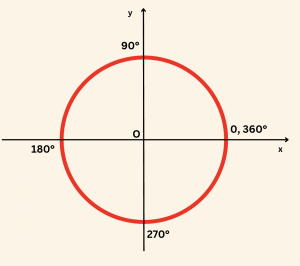
1) Wird der Winkel \(\theta\) in der Form (0° − \(\alpha\)), (180° ± \(\alpha\)) oder (360° − \(\alpha\)) geschrieben, bleibt die trigonometrische Funktion unverändert (kein Namenswechsel).
2) Wird der Winkel \(\theta\) in der Form (90° ± \(\alpha\)) oder (270° ± \(\alpha\)) geschrieben, wechselt die trigonometrische Funktion in ihre Kofunktion (sin ↔ cos, tan ↔ cot, sec ↔ csc).
Beispiel:
Bestimmen Sie den exakten Wert des trigonometrischen Ausdrucks \(\cos 240^\circ\).
Durch die Zerlegung \[240^\circ = 270^\circ – 30^\circ\] ergibt sich:
\(\cos(270^\circ – 30^\circ) < 0\), da der Cosinus im dritten Quadranten ein negatives Vorzeichen besitzt.
Zudem bewirkt der Bezug zur 270°-Achse einen Wechsel in die entsprechende Kofunktion (cos → sin). Folglich gilt:
\[\cos 240^\circ = \cos(270^\circ – 30^\circ) = -\sin 30^\circ\]
Beispiel:
Bestimmen Sie den exakten Wert des trigonometrischen Ausdrucks \(\cos(2\pi – \alpha)\).
Unter der Annahme, dass \(\alpha\) ein spitzer Winkel ist, folgt:
\[\frac{3\pi}{2} < 2\pi – \alpha < 2\pi\]
Der Winkel liegt somit im vierten Quadranten, in dem \(\cos(2\pi- \alpha) > 0\) gilt. Da sich der Ausdruck auf die \(2\pi\)-Achse bezieht, bleibt die Funktion unverändert. Es gilt somit:
\[\cos(2\pi – \alpha) = \cos \alpha\]
Beispiele:
\( \bullet \quad \sin 135^\circ = \sin(90^\circ + 45^\circ) = \cos 45^\circ = \displaystyle\frac{\sqrt{2}}{2}\)
\( \bullet \quad \tan \displaystyle \frac{7\pi}{4} = \tan\left(\displaystyle\frac{3\pi}{2} + \displaystyle\frac{\pi}{4}\right) = -\cot \displaystyle\frac{\pi}{4} = -1\)
\( \bullet \quad \cot \displaystyle \frac{11\pi}{6} = \cot\left(2\pi – \displaystyle\frac{\pi}{6}\right) = -\cot \displaystyle\frac{\pi}{6} = -\sqrt{3}\)
\( \bullet \quad \sec(\pi – \alpha) = -\sec \alpha\)
\( \bullet \quad \csc\left(\frac{\pi}{2} + \alpha\right) = \sec \alpha\)
\( \bullet \quad \tan(19\pi + \alpha) = \tan(18\pi + \pi + \alpha) = \tan(\pi + \alpha) = \tan \alpha\)
\( \bullet \quad \cos(1996\pi – \alpha) = \cos(0 – \alpha) = \cos \alpha\)
\[
\begin{array}{| l | r | }
\hline
\sin\left(\frac{\pi}{2} – \theta\right) = \cos \theta \quad \quad \quad &\sin\left(\frac{\pi}{2} + \theta\right) = \cos \theta \\
\hline
\cos\left(\frac{\pi}{2} – \theta\right) = \sin \theta \quad &\cos\left(\frac{\pi}{2} + \theta\right) = -\sin \theta \\
\hline
\tan\left(\frac{\pi}{2} – \theta\right) = \cot \theta \quad &\tan\left(\frac{\pi}{2} + \theta\right) = -\cot \theta \\
\hline
\cot\left(\frac{\pi}{2} – \theta\right) = \tan \theta \quad &\cot\left(\frac{\pi}{2} + \theta\right) = -\tan \theta \\
\hline
\end{array}
\]
\[
\begin{array}{| l | r | }
\hline
\sin(\pi – \theta) = \sin \theta \quad \quad \quad & \sin(\pi + \theta) = -\sin \theta \\
\hline
\cos(\pi – \theta) = -\cos \theta\quad \quad \quad & \cos(\pi + \theta) = -\cos \theta \\
\hline
\tan(\pi – \theta) = -\tan \theta \quad \quad \quad & \tan(\pi + \theta) = \tan \theta \\
\hline
\cot(\pi – \theta) = -\cot \theta \quad \quad \quad & \cot(\pi + \theta) = \cot \theta \\
\hline
\end{array}
\]
\[
\begin{array}{| l | r | }
\hline
\sin\left(\frac{3\pi}{2} – \theta\right) = -\cos \theta \quad \quad & \sin\left(\frac{3\pi}{2} + \theta\right) = -\cos \theta \\
\hline
\cos\left(\frac{3\pi}{2} – \theta\right) = -\sin \theta \quad \quad & \cos\left(\frac{3\pi}{2} + \theta\right) = \sin \theta \\
\hline
\tan\left(\frac{3\pi}{2} – \theta\right) = \cot \theta \quad \quad & \tan\left(\frac{3\pi}{2} + \theta\right) = -\cot \theta \\
\hline
\cot\left(\frac{3\pi}{2} – \theta\right) = \tan \theta \quad \quad & \cot\left(\frac{3\pi}{2} + \theta\right) = -\tan \theta \\
\hline
\end{array}
\]
\[
\begin{array}{| l | r | }
\hline
\sin(2\pi – \theta) = -\sin \theta \quad \quad \quad & \sin(-\theta) = -\sin \theta \\
\hline
\cos(2\pi – \theta) = \cos \theta \quad \quad \quad & \cos(-\theta) = \cos \theta \\
\hline
\tan(2\pi – \theta) = -\tan \theta\quad \quad \quad & \tan(-\theta) = -\tan \theta \\
\hline
\cot(2\pi – \theta) = -\cot \theta \quad \quad \quad & \cot(-\theta) = -\cot \theta \\
\hline
\end{array}
\]
AUFGABE 30
Gegeben sei \(\sin 7^\circ = a\). Welcher der folgenden Ausdrücke ist äquivalent zu:
\[
\frac{\sin 277^\circ \cdot \tan 173^\circ}{\cos 353^\circ \cdot \cos 97^\circ}
\]
\[
\text{A) } 1 \quad
\text{B) } \frac{1}{a} \quad
\text{C) } -\frac{1}{a} \quad
\text{D) } \frac{1}{\sqrt{1 – a^2}} \quad
\text{E) } \frac{-1}{\sqrt{1 – a^2}}
\]
Lösung:
\[
\frac{\sin 277^\circ \cdot \tan 173^\circ}{\cos 353^\circ \cdot \cos 97^\circ} =
\frac{\sin(270^\circ + 7^\circ) \cdot \tan(180^\circ – 7^\circ)}{\cos(360^\circ – 7^\circ) \cdot \cos(90^\circ + 7^\circ)}
\]
\[
= \frac{-\cos 7^\circ \cdot (-\tan 7^\circ)}{\cos 7^\circ \cdot (-\sin 7^\circ)} =
\frac{-1}{\cos 7^\circ}
\]
\[
= \frac{-1}{\sqrt{1 – \sin^2 7^\circ}} = \frac{-1}{\sqrt{1 – a^2}}
\]
\(\textbf{Antwort: E} \)
AUFGABE 31
Berechnen Sie das Ergebnis des folgenden Ausdrucks:
\[
\frac{\cos 3799^\circ}{\cos 3851^\circ}\; -\; \tan 71^\circ
\]
\[
\text{A) } 2 \tan 19^\circ \quad
\text{B) } – \tan 71^\circ \quad
\text{C) } -2 \cot 19^\circ \quad
\text{D) } \cot 19^\circ \quad
\text{E) } 0
\]
Lösung:
\[
\frac{\cos 3799^\circ}{\cos 3851^\circ}\; – \;\tan 71^\circ
\]
\[
= \frac{\cos(10 \cdot 360^\circ + 199^\circ)}{\cos(10 \cdot 360^\circ + 251^\circ)}\; -\; \tan 71^\circ
= \frac{\cos 199^\circ}{\cos 251^\circ } \; -\; \tan 71^\circ
\]
\[
= \frac{\cos(180^\circ + 19^\circ)}{\cos(270^\circ \;-\; 19^\circ)} – \cot 19^\circ
\]
\[= \frac{-\cos 19^\circ}{- \sin 19^\circ} \;-\; \cot 19^\circ \]
\[ = \frac{-\cos 19^\circ }{- \sin 19^\circ} \;-\; \cot 19^\circ \]
\[= \cot 19^\circ – \cot 19^\circ = 0 \]
\(\textbf{Antwort: E} \)
Hinweis:
\[
\begin{aligned}
\cos(-\theta) &= \cos(0\; -\; \theta) = \cos \theta \\
\sin(-\theta) &= \sin(0\; – \;\theta) = -\sin \theta \\
\tan(-\theta) &= \tan(0\; -\; \theta) = -\tan \theta \\
\cot(-\theta) &= \cot(0 \;- \;\theta) = -\cot \theta \\
\end{aligned}
\]
AUFGABE 32
Welcher der folgenden Ausdrücke ist äquivalent zu:
\[
\frac{\sin(91\pi + \theta) + \sin(90\pi – \theta)}{\sin\left(-\frac{\pi}{2} – \theta\right) – \cos(-\theta)}
\]
\[
\text{A) } 1\quad
\text{B) } -\tan \theta\quad
\text{C) } -\cot \theta \quad
\text{D) } \tan \theta \quad
\text{E) } \cot \theta
\]
Lösung:
\[
\frac{\sin(91\pi + \theta) + \sin(90\pi – \theta)}{\sin\left(-\frac{\pi}{2} – \theta\right) – \cos(-\theta)} =
\frac{\sin(90\pi + \pi + \theta) + \sin(0 – \theta)}{-\sin\left(\frac{\pi}{2} + \theta\right) – \cos \theta}
\]
\[
= \frac{-\sin \theta – \sin \theta}{- \cos \theta – \cos \theta} =
\frac{-2\sin \theta}{-2\cos \theta} = \tan \theta
\]
\(\textbf{Antwort: D} \)
AUFGABE 33
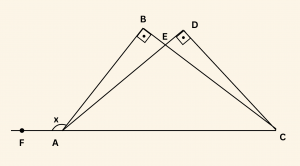
In der nebenstehenden Abbildung gilt:
\(m(\hat B) = 90^\circ\)
\(m(\hat D) = 90^\circ\)
\(m(\hat{ FAD}) = x\)
\[
|BC| = 12 \text{ Längeneinheiten}, \quad |DC| = 8 \text{ Längeneinheiten}, \quad |AE| = |EC|
\]
Bestimmen Sie den Wert von \(\tan x\).
\[
\text{A) } -\frac{1}{3}\quad
\text{B) } -\frac{2}{3}\quad
\text{C) } -\frac{3}{4}\quad
\text{D) } -2 \quad
\text{E) } -3
\]
Lösung:
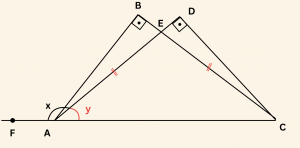
Da \(\triangle ABE \sim \triangle CDE \quad \) und \( |AE| = |EC| \) gilt, sind die Dreiecke \( \triangle ABE \) und \( \triangle CDE \) zueinander kongruent.
Daraus folgt:
\[\begin{aligned} &|BE| = |ED| \\ + & |EC| = |AE| \\ \hline \\ &|BC| = |AD| = 12 \text{ Längeneinheiten.}\end{aligned}\]
\[\begin{aligned} \text{Setzt man } m(\hat {CAD}) = y, \quad \text{so gilt} \quad x = 180^\circ – y \\
\tan x = \tan(180^\circ – y) = -\tan y \end{aligned}\]
\[
= -\frac{|DC|}{|AD|} = -\frac{8}{12} = -\frac{2}{3}
\]
\(\textbf{Antwort: B} \)
AUFGABE 34
Wenn A, B und C die Innenwinkel eines Dreiecks beschreiben, bestimmen Sie den vereinfachten Wert des Ausdrucks:
\[
\frac{\tan(A + B) + \tan A}{\tan(B + C) + \tan C}
\]
\[
\text{A) } -1\quad
\text{B) } 1\quad
\text{C) } \frac{\tan A}{\tan B}\quad
\text{D) } -\frac{\tan A}{\tan B} \quad
\text{E) } \frac{\cot A}{\tan C}
\]
Lösung:
Wegen A + B + C = \(180^\circ\) gilt:
\[
\frac{\tan(A + B) + \tan A}{\tan(B + C) + \tan C}
= \frac{\tan(180^\circ – C) + \tan A}{\tan(180^\circ – A) + \tan C}
\]
\[
= \frac{- \tan C + \tan A}{-\tan A + \tan C}
= -1
\]
\(\textbf{Antwort: A} \)
AUFGABE 35
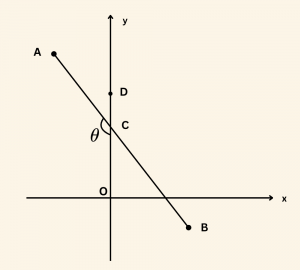
In der obigen Abbildung sind die Punkte \(A(-2, 7)\) and \(B(3, -5)\) im kartesischen Koordinatensystem gegeben. Wenn \(m(\hat{ ACO}) = \theta\) gilt, wie lautet der Wert von \(\sin \theta\)?
\[
\text{A) } \frac{1}{4}\quad
\text{B) } \frac{1}{3}\quad
\text{C) } \frac{5}{13}\quad
\text{D) } \frac{8}{13} \quad
\text{E) } \frac{12}{13}
\]
Lösung:
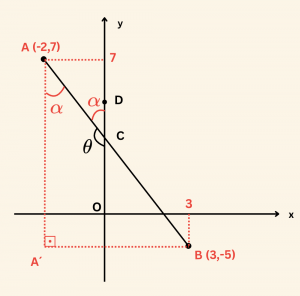
Da \(|AA’| = 12\) Einheiten und \(|A’B| = 5\) Einheiten betragen, folgt aus dem Satz des Pythagoras im rechtwinkligen Dreieck \(AA’B\):
\(|AB| = 13\) Einheiten.
Setzt man \(m(\hat {ACD}) = \alpha\), so ergibt sich \(\theta = 180^\circ – \alpha\) und \(m(\hat A’AC) = \alpha\). Aus dem rechtwinkligen Dreieck \(AA’B\) folgt somit:
\[
\sin \theta = \sin(180^\circ – \alpha) = \sin \alpha = \frac{|A’B|}{|AB|} = \frac{5}{13}
\]
\(\textbf{Antwort: C} \)
Strategie:
Wenn ein bestimmter trigonometrischer Wert eines Winkels \(\theta > 90^\circ\) bekannt ist, können die übrigen trigonometrischen Werte mithilfe eines rechtwinkligen Referenzdreiecks ermittelt werden. Dabei wird \(\theta\) zunächst als spitzer Winkel behandelt, um den Betrag des gesuchten Werts zu berechnen. Das finale Vorzeichen ergibt sich dann aus dem Quadranten, in dem sich der ursprüngliche Winkel \(\theta\) befindet.
AUFGABE 36
Unter der Bedingung \[ \pi < x < \frac{3\pi}{2} \]
und der Gleichung \[ 3 \tan^2 x + 8 \tan x – 3 = 0 \]
bestimmen Sie den Wert von \(\sin x\).
\[
\text{A) } -\frac{1}{\sqrt{10}} \quad
\text{B) } \frac{1}{\sqrt{10}} \quad
\text{C) } -\frac{1}{\sqrt{3}} \quad
\text{D) } \frac{1}{\sqrt{3}} \quad
\text{E) } \frac{1}{3}
\]
Lösung:
Durch Substitution von \(\tan x = t\) in der quadratischen Gleichung \[ 3 \tan^2 x + 8 \tan x – 3 = 0 \]
erhalten wir:
\[
3t^2 + 8t – 3 = 0 \Rightarrow t = -3 \text{ oder } t = \frac{1}{3}
\]
Da für \[ \pi < x < \frac{3\pi}{2} \] der Tangenswert im dritten Quadranten positiv sein muss (\(\tan x > 0\)), folgt:
\[
t = \tan x = \frac{1}{3}
\]
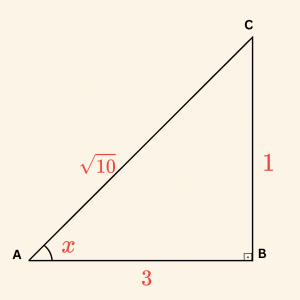
Betrachtet man \(x\) als spitzen Winkel, lässt sich folgendes rechtwinklige Referenzdreieck konstruieren:
\[
|\sin x| = \frac{1}{\sqrt{10}}
\]
Da für \[ \pi < x < \frac{3\pi}{2} \] die Sinusfunktion im dritten Quadranten negativ ist (\(\sin x < 0\)), gilt schließlich:
\[
\sin x = -\frac{1}{\sqrt{10}}
\]
\(\textbf{Antwort: A} \)
AUFGABE 37
Unter den Bedingungen \[ \frac{\pi}{2} < \theta < \pi \quad \text{ und } \quad \tan \theta = -\frac{3}{4} \]
bestimmen Sie den Wert von \(A\) im Ausdruck \[ A = \cos(\pi + \theta) \cdot \tan\left(\frac{3\pi}{2} + \theta\right) \]
\[
\text{A) } \frac{4}{5} \quad
\text{B) } \frac{13}{15} \quad
\text{C) } \frac{14}{15} \quad
\text{D) } 1 \quad
\text{E) } \frac{16}{15}
\]
Lösung:
Unter Verwendung der Reduktionsformeln (wobei \(\theta\) als spitzer Winkel behandelt wird) gilt:
\[\begin{aligned}A & = \cos(\pi + \theta) \cdot \tan\left(\frac{3\pi}{2} + \theta\right)\\ \\
&= -\cos \theta \cdot (-\cot \theta) \\ \\
&= \cos \theta \cdot \frac{1}{\tan \theta} \end{aligned}\]
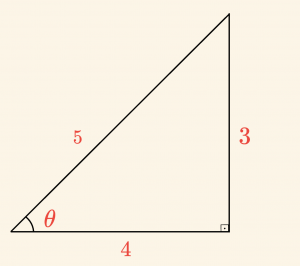
Den Wert für \(\cos \theta\) ermitteln wir über das rechtwinklige Dreieck:
\[
\tan \theta = -\frac{3}{4} \Rightarrow |\tan \theta| = \frac{3}{4}
\]
Aus der Skizze des Dreiecks folgt:
\[
|\cos \theta| = \frac{4}{5}
\]
Da wegen \[ \frac{\pi}{2} < \theta < \pi \] der Winkel im zweiten Quadranten liegt, ist der Cosinus dort negativ:
\[
\Rightarrow \cos \theta = -\frac{4}{5}
\]
Einsetzen der Werte in den Ausdruck für \(A\) ergibt:
\[
A = -\frac{4}{5} \cdot \frac{1}{-\frac{3}{4}} = \frac{16}{15}
\]
\(\textbf{Antwort: E} \)
← Vorherige Seite | Nächste Seite →