
Der Kosinussatz
Für die Seiten \(a\), \(b\) und \(c\) eines beliebigen Dreiecks \(ABC\) gilt:
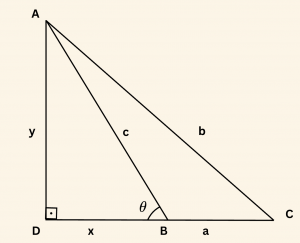
Im rechtwinkligen Dreieck ADB gilt:
\[
\cos \theta = -\cos B = \frac{x}{c}
\]
und nach dem Satz des Pythagoras:
\[
x^2 + y^2 = c^2
\]
Im rechtwinkligen Dreieck ADC gilt nach dem Satz des Pythagoras:
\[
(x + a)^2 + y^2 = b^2
\]
\[
\Rightarrow x^2 + a^2 + 2ax + y^2 = b^2
\]
\[
\Rightarrow x^2 + y^2 + 2ax + a^2 = b^2
\]
\[
\Rightarrow c^2 + 2a(-c \cos B) + a^2 = b^2
\]
\[
\Rightarrow b^2 = a^2 + c^2\; -\; 2ac \cos B
\]
Daraus ergeben sich die allgemeinen Formulierungen des Kosinussatzes:
\[
\begin{aligned}
a^2 &= b^2 + c^2 \;-\; 2bc \cos A \\ \\
b^2 &= a^2 + c^2 \;- \;2ac \cos B \\ \\
c^2 &= a^2 + b^2 \;-\; 2ab \cos C
\end{aligned}
\]
Folgerungen:
1. Sind zwei Seiten und der eingeschlossene Winkel eines Dreiecks bekannt (SWS), lässt sich die dritte Seite mithilfe des Kosinussatzes berechnen.
2. Sind alle drei Seitenlängen eines Dreiecks bekannt (SSS), kann jeder Innenwinkel des Dreiecks mithilfe des Kosinussatzes bestimmt werden.
Beispiel:
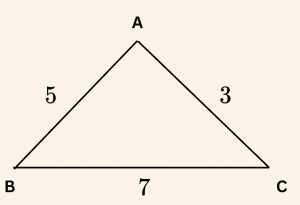 Wir bestimmen den Wert von \(\cos A\) anhand der gegebenen Abbildung.
Durch Anwendung des Kosinussatzes im Dreieck ABC erhalten wir:
\[7^2= 5^2 + 3^2- 2 \cdot 5 \cdot 3 \cos A \]
\[ \Rightarrow \cos A= – \frac{1}{2} \]
Beispiel:
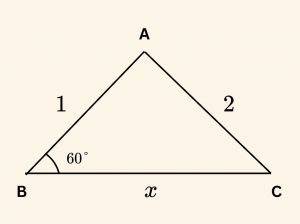 Wir bestimmen die Seitenlänge \(|BC| = x\) anhand der gegebenen Abbildung.
Durch Anwendung des Kosinussatzes im Dreieck ABC erhalten wir:
\[
2^2 = 1^2 + x^2 – 2 \cdot 1 \cdot x \cdot \cos 60^\circ
\]
\[
\Rightarrow 4 = 1 + x^2 – 2x \cdot \frac{1}{2}
\Rightarrow x^2 – x – 3 = 0
\]
\[
\Rightarrow x = \frac{1 + \sqrt{13}}{2}
\]
AUFGABE 38
Für die Seitenlängen \(a, b, c\) eines Dreiecks gilt die Beziehung:
\[
b + c \;- \;a = \frac{bc}{a + b + c}
\]
Wie groß ist der Innenwinkel \(A\) dieses Dreiecks in Grad?
\[
\text{A) } 45^\circ \quad
\text{B) } 60^\circ \quad
\text{C) } 90^\circ \quad
\text{D) } 120^\circ \quad
\text{E) } 150^\circ
\]
Lösung:
\[
b + c\; – \;a = \frac{bc}{a + b + c}
\Rightarrow (b + c \;-\; a)(a + b + c) = bc
\]
\[\begin{aligned} \Rightarrow (b + c)^2 \;- a^2 = bc \\ \\
\Rightarrow b^2 + c^2 + 2bc\; – a^2 = bc \\ \\
\Rightarrow a^2 = b^2 + c^2 + bc \end{aligned}\]
Kosinussatz im Dreieck ABC aufgestellt:
\[\begin{aligned} a^2 = b^2 + c^2 \;- \;2bc \cos A \\ \\
\Rightarrow b^2 + c^2 + bc = b^2 + c^2 \;- \;2bc \cos A \\ \\
\Rightarrow bc = -2bc \cos A \end{aligned}\]
\[\begin{aligned} \Rightarrow \cos A = -\frac{1}{2} \\ \\
\Rightarrow m(\hat A) = 120^\circ \end{aligned}\]
\(\textbf{Antwort: D} \)
AUFGABE 39
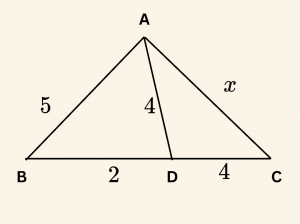
In der nebenstehenden Abbildung gilt:
\(|AB| = 5\) cm,
\(|BD| = 2\) cm,
\(|AD| = |DC| = 4\) cm.
Wie lang ist \(|AC| = x\) in cm?
\[
\text{A) } \sqrt{19} \quad
\text{B) } 2\sqrt{5} \quad
\text{C) } \sqrt{21} \quad
\text{D) } \sqrt{22} \quad
\text{E) } \sqrt{23}
\]
Lösung:
Kosinussatz im Teildreieck ABD:
\[
4^2 = 5^2 + 2^2 – 2 \cdot 5 \cdot 2 \cdot \cos B
\Rightarrow \cos B = \frac{13}{20}
\]
Kosinussatz im Gesamtdreieck ABC:
\[
x^2 = 5^2 + 6^2 – 2 \cdot 5 \cdot 6 \cdot \frac{13}{20}
\Rightarrow x^2 = 22
\Rightarrow x = \sqrt{22}
\]
\(\textbf{Antwort: D} \)
AUFGABE 40
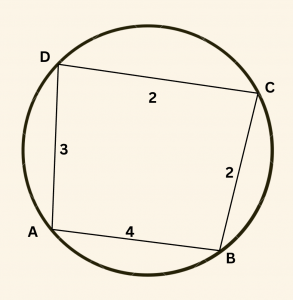
Die nebenstehende Abbildung zeigt ein Sehnenviereck ABCD.
Gegen sind \(|AB| = 4\) cm, \(|BC| = |CD| = 2\) cm, \(|AD| = 3\) cm.
Welchen Wert hat \(\cos A\)?
\[
\text{A) } \frac{15}{32} \quad
\text{B) } \frac{1}{2} \quad
\text{C) }\frac{17}{32} \quad
\text{D) }\frac{9}{16} \quad
\text{E) } \frac{19}{32}
\]
Lösung:
Da gegenüberliegende Winkel in einem Sehnenviereck supplementär sind (sich zu \(180^\circ\) ergänzen):
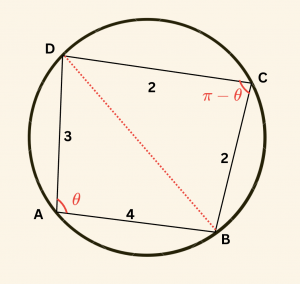
\[m(\hat A) + m(\hat C )= \pi \]
\[\Rightarrow m( \hat C )= \pi \;- \; \theta\]
Kosinussatz in den Teildreiecken ADB und CDB:
\[\begin{aligned} |BD|^2 &= 3^2 + 4^2 – 2 \cdot 3 \cdot 4 \cdot \cos \theta \\ \\ |BD|^2 &= 25 -24\cos \theta \end{aligned}\]
\[
|BD|^2 = 3^2 + 4^2 – 2 \cdot 3 \cdot 4 \cdot \cos \theta
\]
\[
|BD|^2 = 2^2 + 2^2 – 2 \cdot 2 \cdot 2 \cdot \cos(\pi – \theta)\]
\[\Rightarrow \cos(\pi – \theta) = -\cos \theta \\
\]
\[\\ |BD|^2 = 8 + 8 \cos \theta \ \]
Durch Gleichsetzen beider Ausdrücke für \(|BD|^2\) bestimmen wir \(\cos \theta\):
\[\begin{aligned} 25 \;- \; 24 \cos \theta = 8 + 8 \cos \theta \\ \\
\Rightarrow 17 = 32 \cos \theta \\ \\
\Rightarrow \cos \theta = \frac{17}{32} \end{aligned}\]
\(\textbf{Antwort: C} \)
AUFGABE 41
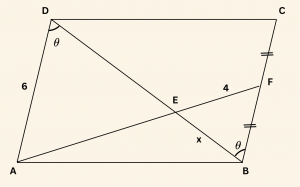 In der Abbildung ist das Viereck ABCD ein Parallelogramm.
Es gilt \(|EF| = 4\) cm, \(|AD| = 6\) cm, \(|CF| = |FB|\), \(m(\hat{ ADE}) = \theta\) und \(\cos \theta = \frac{1}{3}\).
Wie lang ist \(|EB| = x\) in cm?
\[\text{A) } 1 + 2\sqrt{2} \quad
\text{B) } 2 + \sqrt{2} \quad
\text{C) } \sqrt{2} \quad
\text{D) } 2\sqrt{2} \quad
\text{E) } 3 – \sqrt{2}
\]
Lösung:
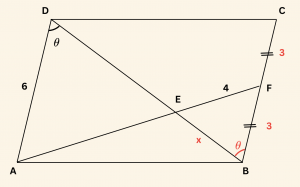 Da gegenüberliegende Seiten im Parallelogramm gleich lang sind:
\[
|AD| = |BC| = 6 \implies |FB| = 3
\]
Aufgrund von Wechselwinkeln an parallelen Geraden gilt:
\[
m(\hat {ADE}) = m(\hat {EBF}) = \theta
\]
Anwendung des Kosinussatzes im Dreieck EBF:
\[\begin{aligned} 4^2 &= x^2 + 3^2\; – \; 2 \cdot x \cdot 3 \cdot \cos \theta \\ \\
\Rightarrow 16 &= x^2 + 9 \;- \; 6x \cdot \frac{1}{3} \\ \\ \Rightarrow 16 &= x^2 + 9 \; – \;2x \\ \\ \Rightarrow 0&=x^2\; -\; 2x\; -\; 7 \\ \\ \Rightarrow x& = 1 + 2\sqrt{2} \end{aligned} \]
\(\textbf{Antwort: A} \)
AUFGABE 42
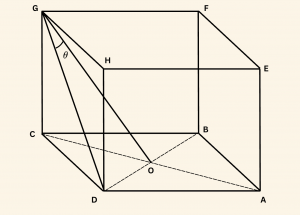
Wenn $ABCDEFGH$ in der Abbildung ein Würfel ist, wie groß ist das Winkelmaß $m(\hat{ DGO}) = \theta$ in Grad?
\[\text{A) } 15^\circ \quad
\text{B) } 30^\circ \quad
\text{C) } 45^\circ \quad
\text{D) } 60^\circ \quad
\text{E) } 75^\circ
\]
Lösung:
Wir nehmen eine Kantenlänge des Würfels von $2$ Längeneinheiten an.
Im Quadrat ABCD gilt für die Diagonalen:
\[
|AC| = |BD| = 2\sqrt{2} \Rightarrow |OD| = |OC| = \sqrt{2}
\]
Satz des Pythagoras im rechtwinkligen Dreieck GCO angewendet:
\[
|GC|^2 + |OC|^2 = |OG|^2 \Rightarrow 2^2 + (\sqrt{2})^2 = |OG|^2 \Rightarrow |OG| = \sqrt{6}
\]
Satz des Pythagoras im rechtwinkligen Dreieck GCD angewendet:
\[
|GC|^2 + |CD|^2 = |GD|^2 \Rightarrow 2^2 + 2^2 = |GD|^2 \Rightarrow |GD| = 2\sqrt{2}
\]
Kosinussatz im Raumdreieck GDO angewendet:
\[
|OD|^2 = |GD|^2 + |OG|^2 – 2|GD| \cdot |OG|\cos\theta
\]
Werte einsetzen:
\[
2 = 8 + 6 – 2 \cdot 2\sqrt{2} \cdot \sqrt{6} \cdot \cos\theta
\Rightarrow 2 = 14 – 4\sqrt{12} \cdot \cos\theta
\]
Da $\sqrt{12} = 2\sqrt{3}$ ist:
\[
2 = 14 – 8\sqrt{3} \cos\theta
\Rightarrow 8\sqrt{3} \cos\theta = 12 \Rightarrow \cos\theta = \frac{3}{2\sqrt{3}} = \frac{\sqrt{3}}{2}
\Rightarrow \theta = 30^\circ
\]
\(\textbf{Antwort: B} \)
← Vorherige Seite | Nächste Seite →